About the author
Published December 6, 2025 · Last reviewed October 6, 2026 · 19 min read
In this article · 6 sections
Before you can stop overthinking, you have to understand what it actually is. It’s not just thinking a lot—it’s a destructive pattern. The first step isn't some complex psychological trick; it's simply learning to recognize your specific thought loops and accepting that this habit is a very human response to uncertainty, not a personal failure.
Once you can spot it happening, you can start using simple, practical strategies to break the cycle, ground yourself in the present, and focus only on what you can actually control.
Stopping overthinking starts with noticing your own thought loops, such as analysis paralysis, replaying the past or predicting worst-case futures, and spotting what triggers them. In the moment, quick circuit breakers can help: count down 5-4-3-2-1 and then physically act, or label thoughts as thoughts rather than facts. The aim is to interrupt the spiral and refocus on what you can control.
Understanding Why You Overthink and How to Spot It
Ever get stuck in a mental loop, replaying conversations from last week or endlessly spinning through "what ifs" about tomorrow? It’s exhausting. If that hits home, know that you're in good company. This isn't a sign of weakness; it’s your brain’s clumsy attempt to protect you by analyzing every possible threat and outcome.
That endless spiral is often fueled by a deep-seated need for control in a world that feels anything but.
Overthinking is a very specific kind of thinking: unproductive, repetitive, and circular. It’s like a hamster wheel for your mind—lots of motion, but you’re not going anywhere. It usually shows up in a few classic ways:
- Analysis Paralysis: You get so bogged down weighing every single pro and con for a decision that you end up making no decision at all. It could be about a major career move or just what to eat for dinner. The fear of choosing the "wrong" option keeps you completely stuck.
- Replaying the Past: You dissect past conversations and actions on a loop, picking apart everything you said or did. This mental instant replay is almost always drenched in self-criticism and regret, even over the smallest interactions.
- Fortune-Telling the Future: Your mind automatically jumps to the worst-case scenario for things that haven't even happened. You start assuming a work presentation will be a disaster or worrying that a friend's vague text message means they're mad at you.
Recognizing Your Patterns
Learning to stop overthinking starts with becoming a detective of your own mind. You have to identify your personal triggers and the thought loops they kick off.
Do you find yourself spiraling after getting ambiguous feedback from your boss? Does 30 minutes of scrolling Instagram leave you comparing yourself to others and second-guessing your entire life? Pinpointing these moments is the first real step toward taking back control.
This is the classic overthinking process—a "what if" thought pops up, which triggers you to replay scenarios, and the whole thing results in total indecision.
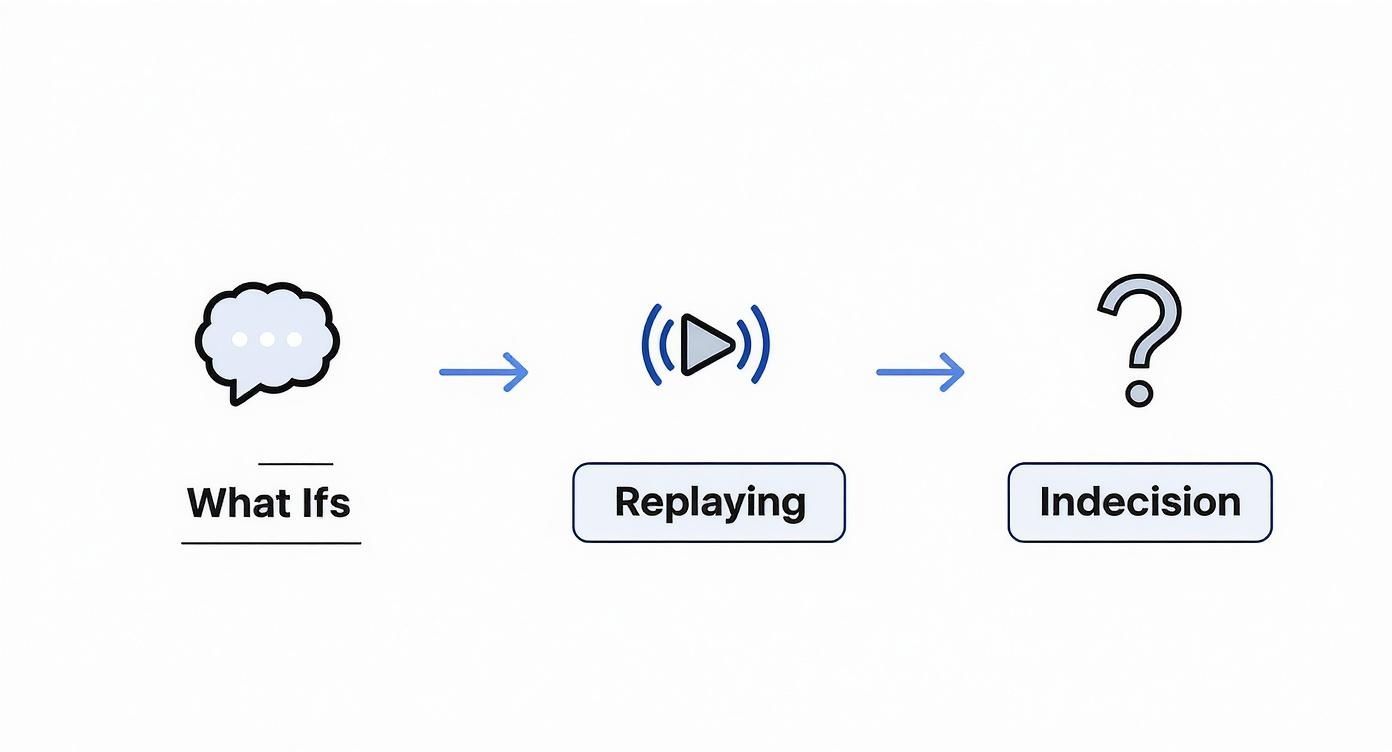
As the visual shows, it doesn’t take much. One single anxious thought can set off a cascade, turning a fleeting worry into a prolonged state of mental gridlock.
To help you get better at spotting these moments in real-time, here’s a quick-reference table. It shows common triggers, the overthinking loops they create, and what you can do instead.
Overthinking Triggers vs Mindful Responses
| Common Trigger | Typical Overthinking Loop | Mindful Response to Try Instead |
|---|---|---|
| An ambiguous email from your boss | "What did they mean by that? Am I in trouble? I should have done that project differently." | Acknowledge the uncertainty. Say to yourself, "I'll ask for clarification tomorrow morning. For now, I'll focus on something else." |
| Seeing friends' highlight reels on social media | "Everyone is so successful/happy/far ahead of me. I'm not doing enough with my life." | Remind yourself it's a curated view. Put the phone down and do one small thing that makes you feel good or productive. |
| Making a small mistake at work | "I can't believe I did that. Everyone probably thinks I'm incompetent. I'm going to get fired." | Shift from self-blame to problem-solving. Ask, "What can I do to fix this? What did I learn?" |
| An upcoming social event | "What if I say something awkward? What if no one talks to me? I should just stay home." | Focus on a simple, controllable goal, like "I'll try to have one meaningful conversation" instead of trying to control the entire night. |
This table isn't about perfectly executing a "mindful response" every time. It’s about building the muscle of noticing the loop and having a simple, alternative path ready to go.
Why Self-Awareness Is Your Foundation
Recognizing these patterns isn’t about beating yourself up. It's about gathering data. Every time you catch your mind spinning, you’ve just uncovered a valuable clue. This awareness is the bedrock for every other strategy that follows.
Overthinking is often a symptom, not the core problem. It’s your mind’s attempt to solve for anxiety, fear, or uncertainty. By understanding why you're doing it, you can address the root cause instead of just fighting the thoughts themselves.
This mental habit is far from rare. In a landmark study of over 150,000 adults, researchers found that about 50% of people will experience a mental health disorder in their lifetime. Symptoms like excessive worry and persistent negative thinking are incredibly common. You can learn more about the study and its findings on mental health prevalence from Harvard Medical School.
This is why building coping skills to manage overthinking isn’t just a nice-to-have; it's a powerful form of preventative mental wellness.
Quick Mindset Shifts to Break the Overthinking Loop
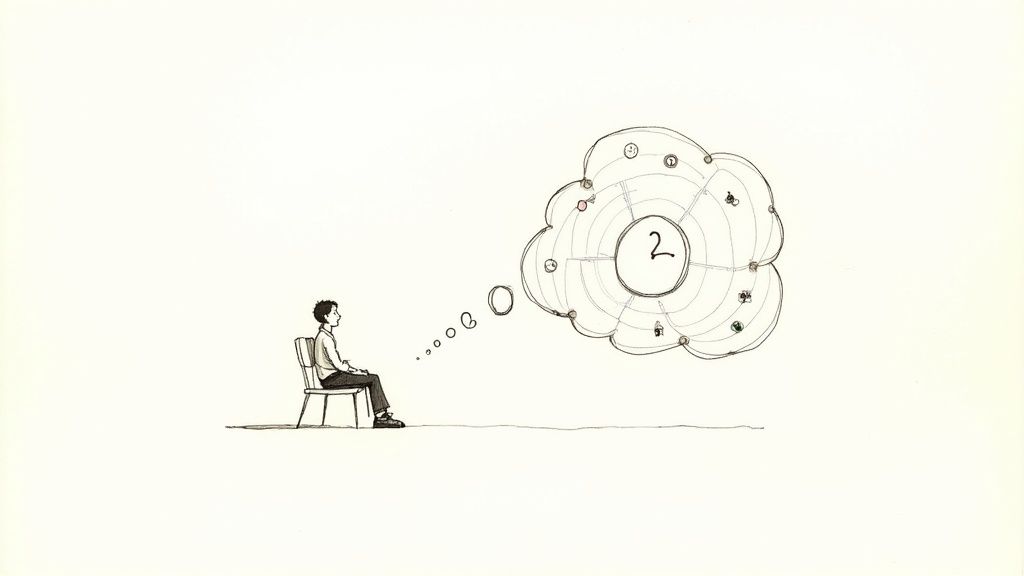
When your mind gets stuck in that relentless spin cycle, long-term strategies can feel completely out of reach. You need an emergency brake—something to jolt you out of the thought loop right now.
These in-the-moment mindset shifts are your circuit breakers. They’re designed to pull you from the abstract world of what-ifs and plant you firmly back in the present.
The best part? You don’t need a quiet room or a yoga mat. You can use these while frozen at your keyboard or staring blankly at the cereal aisle, unable to make a simple choice. The goal isn’t to solve the big problem instantly; it’s to stop the unproductive spiral so you can actually think clearly again.
Jolt Your Brain with the 5-Second Rule
Overthinking absolutely thrives on hesitation. That tiny gap between an impulse and an action? That's where doubt, fear, and a thousand "what-ifs" come rushing in. The 5-Second Rule, made famous by Mel Robbins, is a brilliantly simple way to slam that door shut.
Here’s how it works: the moment you feel yourself starting to overthink or hesitate on an impulse, you count down from five. 5-4-3-2-1-GO. On "GO," you physically move.
- You've spent 20 minutes rewriting a simple one-line email, agonizing over the tone. You catch yourself about to delete it for the fifth time.
- You think, "5-4-3-2-1," and on one, your finger just hits "send."
This isn't about being reckless. It's about breaking the habit of second-guessing that fuels analysis paralysis. The countdown acts like a starting pistol, launching you from thinking to doing before your brain has a chance to talk you out of it.
Detach by Labeling Your Thoughts
When you're deep in an overthinking spiral, your thoughts feel like urgent, undeniable truths. A critical skill is learning to see them for what they really are: just thoughts. Not facts. Thought labeling is the practice of simply observing your thoughts as they pop up and giving them a neutral name.
Instead of getting sucked into the drama of, "I'm going to bomb this presentation and everyone will think I'm an idiot," you take a step back and label it.
"Ah, there's that 'fear of failure' thought again." Or even just, "I'm having the thought that I'm going to mess up."
This simple act of naming creates a sliver of separation between you and the thought. It instantly shifts you from being a participant in the drama to being an observer of it. You're no longer wrestling with the thought; you're just acknowledging it's there. That detachment drains the thought of its power, allowing it to drift by without sweeping you away.
Box Up Your Worries with a "Worry Timer"
One of the most maddening things about overthinking is how it bleeds into every corner of your day. It shatters your focus at work, steals your joy during dinner, and keeps you staring at the ceiling at 2 a.m. The "worry timer" is a surprisingly effective way to take back control.
The concept is simple: you schedule a specific, limited time to do nothing but worry.
- Set a Timer: Pick a 15-minute window in your day. This is your official "worry time."
- Worry on Command: During these 15 minutes, you have full permission to let your mind run wild. Overthink, analyze, and fret about everything on your list.
- Postpone New Worries: When an anxious thought pops up outside of this window, you acknowledge it and tell yourself, "Thanks, I'll think about that during my worry time at 4 PM."
This technique works because you stop fighting the thoughts and start managing them. You give your brain the space it seems to crave, but on your terms. You'll often find that by the time your appointment rolls around, the worries that felt so monumental hours ago have lost their teeth.
This method is incredibly powerful for managing overthinking, a key symptom of anxiety. It's a widespread issue—anxiety disorders affected an estimated 359 million people globally in 2021, and so many go without support. You can see more on these global mental health trends from the WHO.
Decision-Free Rituals That Calm an Anxious Mind
Sometimes, the best way to quiet a racing mind isn't to wrestle with your thoughts, but to give them a complete break. Overthinking thrives on a constant barrage of choices and "what-ifs," a phenomenon known as decision fatigue. The most effective antidote I've found is to carve out small pockets in your day where decisions simply don't exist.
These decision-free rituals become your sanctuary. They allow your brain to downshift from high-alert, analytical mode into a state of gentle focus. Think of them as a circuit breaker for your anxiety—short, structured activities, often lasting just 15 to 30 minutes, that demand almost no mental energy but deliver a powerful calming effect.
Embrace the Simplicity of Monochrome Coloring
One of the quickest ways to stop a spiral of overthinking is to get your hands and senses involved in a simple, repetitive task. This is exactly where monochrome coloring shines. Let's be honest, even standard coloring can sometimes add a layer of pressure: “Which color should I use next? Do these shades even go together?”
Monochrome coloring strips all of that away.
When you use just one color—a single black pen, a gray marker, or whatever you have on hand—you eliminate every single choice except the physical motion of your hand. The goal isn't to create a gallery-worthy masterpiece; it's to get lost in the meditative flow of filling a space without the burden of choice. This intentional limitation is what makes it so incredibly powerful.
The image below touches on the idea of mindfulness, which is really the heart of why these decision-free activities work so well.
This is the shift we're aiming for: from a mind overflowing with scattered, anxious thoughts to one that is present and focused. That's precisely what a single-color creative ritual helps you achieve.
This simple practice helps quiet down the amygdala, the brain's fear center that gets overactive when we're trapped in a cycle of worry. By focusing on a simple, tactile process, you ground yourself squarely in the present moment, making it much harder for those anxious thoughts to find a foothold. If you're looking for a structured way to try this, a dedicated One Color Coloring Book gives you beautiful, pre-designed patterns that are perfect for this exact purpose.
By removing the pressure to be creative or make the 'right' choice, you allow your nervous system to regulate. It’s a form of active meditation that doesn't require you to sit still and clear your mind—it does the clearing for you.
Curate a Calming Sensory Experience
Your environment has a massive impact on your mental state. Creating a quick sensory ritual can pull you out of an anxious thought loop by redirecting your brain's focus to something more pleasant and predictable. This doesn't need to be complicated at all; a few intentional choices can make a world of difference.
Here are a few ideas for a 15-minute sensory reset:
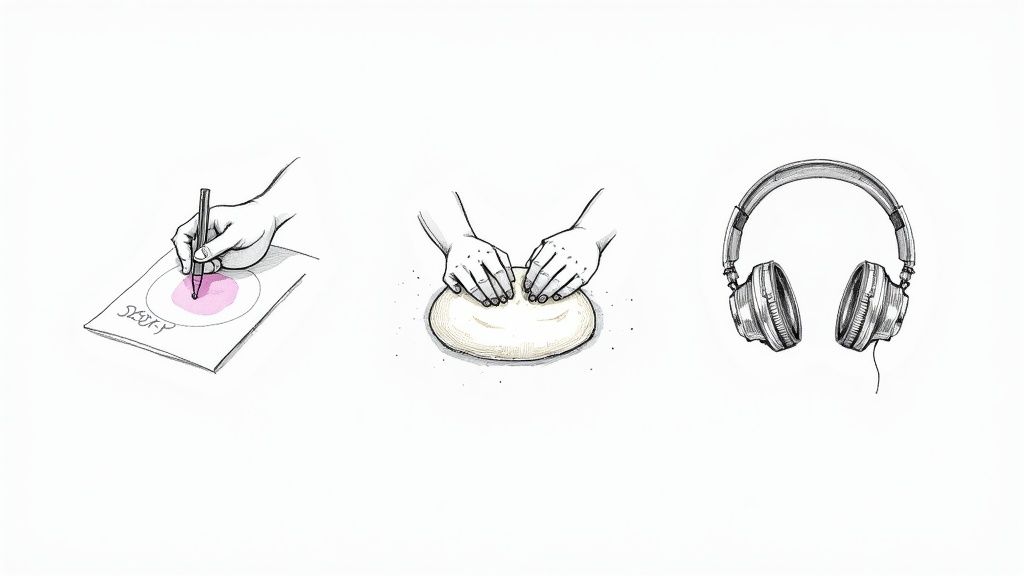
- Listen to a Familiar Playlist: Don't go searching for new music. Put together a specific, go-to playlist of ambient sounds, instrumental tracks, or lo-fi beats that you associate only with relaxation. The predictability is the magic ingredient here—your brain knows what’s coming and doesn’t have to work to process anything new.
- Engage in a Rhythmic Physical Task: The repetitive motion of certain tasks can be incredibly soothing. Try kneading dough, methodically watering your plants, or even folding laundry while focusing completely on the texture of the fabric and the crispness of each fold.
- Use a Scent Anchor: Scent is deeply connected to memory and emotion. Light a specific candle or use an essential oil diffuser with a calming scent like lavender or sandalwood only when you want to wind down. Over time, your brain will build a powerful association between that scent and a state of peace.
Why Decision-Free Rituals Actually Work
These practices aren't about distraction; they're about intentional redirection. When you're overthinking, your mind is stuck in the abstract—worrying about the future or replaying the past. A decision-free ritual yanks your attention back into the concrete, physical world. You feel the pen in your hand, you hear the steady rhythm of a song, you smell a calming aroma.
This sensory grounding is a powerful tool. It breaks the cycle of rumination by giving your brain a simple, tangible task to latch onto. Weaving one of these 15-minute routines into your day gives you a reliable escape valve for mental pressure, helping you build resilience against overthinking one quiet moment at a time.
Building Daily Habits That Prevent Overthinking
While the in-the-moment tricks are great for snapping out of a thought spiral, the real game-changer is building a lifestyle that keeps those spirals from starting in the first place. This is about playing offense, not defense.
By weaving small, intentional habits into your day, you’re not just coping—you’re building a foundation of mental resilience. These aren't massive life overhauls. They’re tiny adjustments that, over time, create a powerful buffer against anxious thought loops. Think of it as strengthening your mental immune system. The stronger it gets, the less likely you are to get knocked down by overthinking.
Start Your Day Without Your Phone
The way you start your morning can make or break your entire day. If your first move is grabbing your phone, you're immediately inviting chaos into your brain—work emails, breaking news, other people’s highlight reels. It’s a reactive way to wake up, and it primes your mind for anxiety before you’ve even had a sip of coffee.
Instead, try carving out a phone-free first 30 minutes. Just thirty. Use that time to do something that grounds you in your own world, not someone else's.
- Stretch for five minutes: Really feel what your body needs.
- Make a cup of tea or coffee: Savor the smell, the warmth.
- Just look out the window: Watch the world without judging or analyzing it.
This simple boundary is a powerful act of self-preservation. You’re protecting your mental space when it's most impressionable and starting the day with a sense of control, not panic.
Externalize Your Worries with a Brain Dump
Overthinking can feel like a room full of TVs all blaring at once. It's loud, messy, and impossible to focus. One of the best ways to hit the mute button is to get all that noise out of your head and onto paper. A "brain dump" is exactly what it sounds like: you unload every single thought, worry, and task onto a page, no filter, no order.
Set aside 10–15 minutes each day—morning or evening, whatever works for you. Grab a notebook and just go. Don't worry about grammar or if it even makes sense. The only goal is to move the clutter from your mind to the page.
Once your thoughts are written down, something shifts. They seem smaller, less intimidating. You can spot the irrational fears and separate them from the actual problems you can solve. That internal storm becomes a simple, manageable list.
This process creates a healthy distance between you and your thoughts. They're no longer you; they're just words on paper you can observe. And honestly, having a few nice tools can make the ritual feel more intentional. Using a good set of pens, like a simple three-piece coloring pen set, can make the physical act of writing feel that much more grounding.
Use Short Bursts of Physical Activity
When your mind is racing, your body is listening. It tenses up and floods your system with stress hormones like cortisol. Moving your body is one of the quickest ways to clear out that chemical sludge and release pent-up physical tension. And no, you don't need to hit the gym for an hour.
Short, sharp bursts of activity are incredibly effective at breaking an overthinking cycle. The next time you feel your thoughts starting to spin out, try one of these:
- Go for a 10-minute brisk walk. Focus on your feet hitting the pavement.
- Do two minutes of jumping jacks or run in place. Get that heart rate up.
- Throw a five-minute dance party in your kitchen to a song you love.
Exercise forces your brain to shift its focus from abstract worries to physical coordination. That brief mental break is often all it takes to reset your perspective, letting you come back to the issue with a much clearer head.
Hitting a Wall? How to Troubleshoot Common Overthinking Roadblocks
Let's be real. Even with the best habits and mindset shifts, some days overthinking just feels unbeatable. These are the roadblocks—those stubborn, looping thought patterns that seem completely immune to your best efforts.
This is your troubleshooting guide for those moments. Think of it as a specific game plan for when you feel most stuck, whether you're staring at the ceiling at 2 AM or frozen by a life-altering decision.
Getting Unstuck from Analysis Paralysis
Big life choices—a career change, a move, a major purchase—are the perfect storm for overthinking. You get so lost weighing every pro, con, and what-if that you end up doing nothing at all. This is analysis paralysis, and it’s fueled by the fear of making the "wrong" choice.
The secret? Let go of the myth that a "perfect" decision even exists. Your goal is to make a good enough choice that lets you move forward.
Here’s a simple framework to break the gridlock:
- List Your Non-Negotiables: Write down 3-5 core values or must-have outcomes. If an option ticks these boxes, it’s a solid contender.
- Give Yourself a Deadline: Don't let the decision drag on forever. Set a reasonable deadline—maybe 48 hours or one week—and stick to it.
- Listen to Your Gut: After you've done the research, step away. Go for a walk. Do something completely unrelated. Your intuition often knows the way once you quiet the mental chatter.
Silencing the Late-Night Brain Buzz
Is there anything more maddening than being physically exhausted but mentally running a marathon? A racing mind at night is a classic overthinker problem. With no daytime distractions, your brain decides it's the perfect time to replay every awkward conversation and stress about tomorrow's to-do list.
The solution is a wind-down routine that doesn't just stop stimulation—it actively calms your brain down.
Don’t just put your phone away; replace it with a ritual that tells your mind it's time to power down. Swapping scrolling for a simple, screen-free activity an hour before bed can make a world of difference.
Try this proven sequence:
- The Brain Dump: About ten minutes before bed, grab a notebook and scribble down every single thought, worry, or task buzzing in your head. Getting it on paper frees your mind from the burden of remembering it all.
- Sensory Grounding: Engage in a simple, no-decision activity like a monochrome coloring book. The repetitive motion and lack of choice are incredibly meditative. You can see why this works for so many people by reading these Mono Moment reviews.
- Focused Breathing: Once you're in bed, practice box breathing. Inhale for four counts, hold for four, exhale for four, and hold for four. It’s a simple rhythm that calms your nervous system and gives your racing mind something else to focus on.
Overthinking in Your Relationships
Relationships can be a huge trigger for overthinking. We've all been there—endlessly analyzing a text message, replaying a conversation, or worrying about unspoken tension. This kind of rumination can create problems out of thin air because you start reacting to your fears instead of reality.
This isn't just you. The UK Mental Health Foundation found that anxiety levels jumped from 19.8% in 2018/19 to 24.2% in 2020/21. Even though the rates have settled a bit, they remain high, showing just how much this kind of mental distress can stick around.
To keep overthinking from harming your connections, your best tools are direct communication and self-soothing.
Before you react to a worry, pause and ask yourself: "What actual evidence do I have for this?" More often than not, it’s based on an assumption. Instead of letting the thought spiral, try getting some clarity with a gentle, non-accusatory script. Something like, "Hey, I might be overthinking this, but I felt a bit of a weird vibe earlier. Is everything okay?"
This approach seeks connection, not conflict.
Your Questions, Answered
Even with the best strategies in hand, you're bound to have questions. It's only natural. Getting a handle on overthinking is a process, and sometimes you hit a snag or need a bit more clarity. Let's tackle some of the most common questions that come up once you start putting these techniques into practice.
Is Overthinking a Sign of Mental Illness?
This is a really important question, and the answer isn't a simple yes or no. Think of overthinking like a fever—it's a clear signal that something's off, but it isn't the illness itself.
On its own, overthinking isn't a formal diagnosis. We all get caught in thought loops from time to time, especially when we're stressed. The problem arises when it becomes a constant, relentless habit that gets in the way of your life, affecting your sleep, your work, or your relationships.
That said, chronic overthinking is a key feature of several mental health conditions, particularly Generalized Anxiety Disorder (GAD) and depression. If you feel like the strategies in this guide are just barely scratching the surface and you're still drowning in thoughts, it’s a strong indicator that it might be time to talk to a professional.
A good therapist can help you dig into the roots of your thought patterns. Cognitive Behavioral Therapy (CBT), for example, is incredibly effective at helping people restructure the very thought loops that fuel overthinking.
How Can I Stop Overthinking a Past Mistake?
Ah, the dreaded mistake replay loop. It's one of the most painful forms of overthinking, chaining you to regret and self-criticism. The trick is to consciously pivot from self-blame to self-compassion and learning. You have to turn the memory from a weapon you use against yourself into a tool for growth.
First, give yourself a break. Making mistakes is a universal human experience, not a character flaw. Berating yourself for hours changes absolutely nothing about what happened; it just makes you feel worse.
Next, give that nagging thought a final resting place.
- Write It All Out: Grab a journal and spill everything about what happened, no filter.
- Find the Lesson: What's the one concrete thing you learned from this?
- Create an Action Plan: What is one specific thing you'll do differently next time?
- Give Yourself Permission to Move On: Say it out loud if you have to: "I've learned from this. I'm letting it go now."
When the memory pops up again (and it will), you can greet it with, "Thanks for the reminder, but we've already handled this." Then, immediately pull your focus to something happening right now.
Can Overthinking Ever Be a Good Thing?
Absolutely, but we need to draw a clear line between destructive overthinking and productive reflection. The two can feel similar, but their outcomes are worlds apart.
Productive reflection is strategic. It’s analytical, it’s focused on finding a solution, and it has an end point. Spending an hour brainstorming solutions to a work problem is productive.
Overthinking, on the other hand, is just spinning your wheels. It's a chaotic vortex of "what-ifs" and self-doubt that leads nowhere. It's replaying a conversation for the tenth time, searching for a hidden meaning that isn't there.
Here’s the real difference:
- Productive Reflection ends with a decision, a plan, or a fresh perspective.
- Overthinking ends with more anxiety and total mental burnout.
The goal isn't to shut down your thinking, but to learn how to spot the exact moment it stops being helpful and starts being harmful.
What Is the Best First Step If I Feel Completely Overwhelmed?
When you're so deep in a spiral that you feel paralyzed, trying to tackle the big problem is impossible. Your first mission isn't to solve anything—it's just to break the spell and get back into your body.
For this, nothing beats a simple sensory exercise. The 5-4-3-2-1 grounding technique is my go-to recommendation because it forces your brain to ditch abstract worries and plug back into physical reality.
Just pause and quietly notice:
- 5 things you can see right now. (Your keyboard, a plant, the light on the wall).
- 4 things you can feel. (The fabric of your jeans, the floor under your feet, the air on your skin).
- 3 things you can hear. (A car outside, the hum of your fridge, your own breath).
- 2 things you can smell. (Leftover coffee, the scent of a book).
- 1 thing you can taste. (Mint from your toothpaste, or even just the neutral taste in your mouth).
Think of this as a hard reset for your nervous system. It creates just enough space and calm to help you breathe and decide what to do next.
At Mono Moment, we believe finding calm shouldn't be another thing to overthink. Our decision-free monochrome coloring books are designed as a quiet sanctuary for your mind, helping you break the cycle one simple, meditative moment at a time. Discover your moment of peace today at mono-moment.com.

The One Color Coloring Book
A single-pen, decision-free coloring book on 160 gsm cream paper — engineered for the wind-down ritual described above.
 Pair it with the 3 Dual Tip Brush Pens — $5 instead of $9.95 in the Book + Pens bundle.