About the author
Published January 29, 2026 · Last reviewed April 26, 2026 · 16 min read
In this article · 6 sections
- Why Journaling Is One of Your Best Allies Against Anxiety
- Creating Your Personal Journaling Sanctuary
- Effective Journaling Methods for Anxious Minds
- Pairing Journaling With Creative Mindfulness
- Overcoming Common Journaling Roadblocks
- Still Have Questions About Journaling for Anxiety? Let’s Clear Things Up.
Journaling for anxiety is really just a simple, powerful way to get your thoughts and feelings out of your head and onto paper. Think of it as a private space to untangle all those worries, turning a chaotic mess of emotions into something you can actually look at and understand. It's one of the most accessible tools out there—all you need is a pen and paper to start feeling a little calmer.
Why Journaling Is One of Your Best Allies Against Anxiety
If anxiety has you feeling overwhelmed and alone, you're not. Far from it. Anxiety disorders are the most common mental health issue on the planet, impacting a staggering 301 million people worldwide back in 2019. During the pandemic, that number shot up by 26% in just one year, which really shows how much outside stress can mess with our internal peace. Journaling is a real, tangible way to start pushing back.
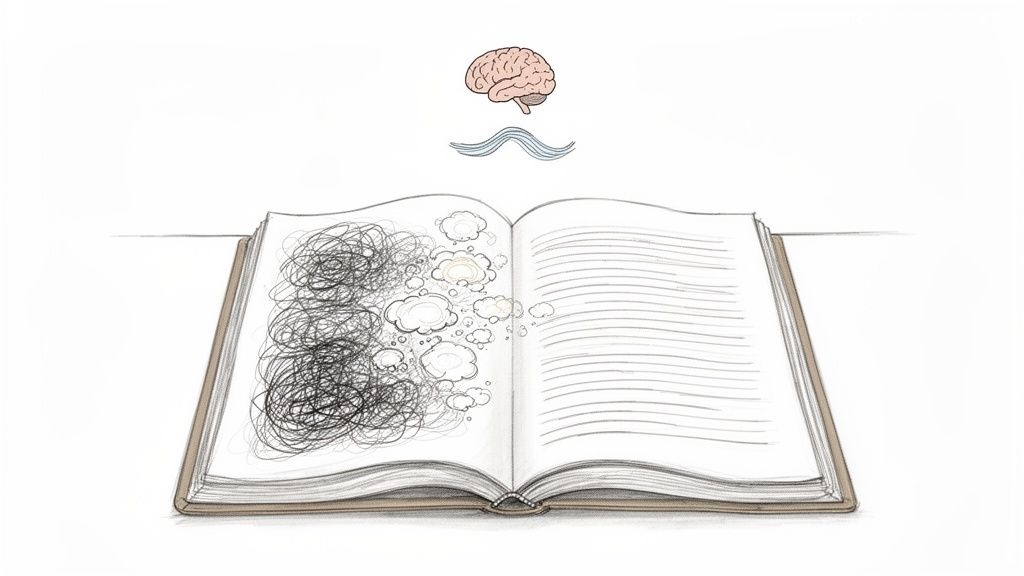
It works by getting those frantic, looping thoughts that feed anxiety out of your mind. Once they're written down, you create a bit of distance. This space allows you to look at your worries without getting so emotionally tangled up in them. It’s not about finding perfect solutions. It's about giving your anxieties a physical form so they don't have to take up so much room in your head.
The Power of a Decision-Free Practice
Let's be honest: the best tools for anxiety are the ones you'll actually use. They need to feel simple and inviting. The whole point is to reduce stress, not add another chore to your already packed to-do list.
By transforming abstract fears into concrete words, journaling helps calm your brain’s fear center (the amygdala) and engages the more logical parts of your brain, allowing for clearer thinking and emotional regulation.
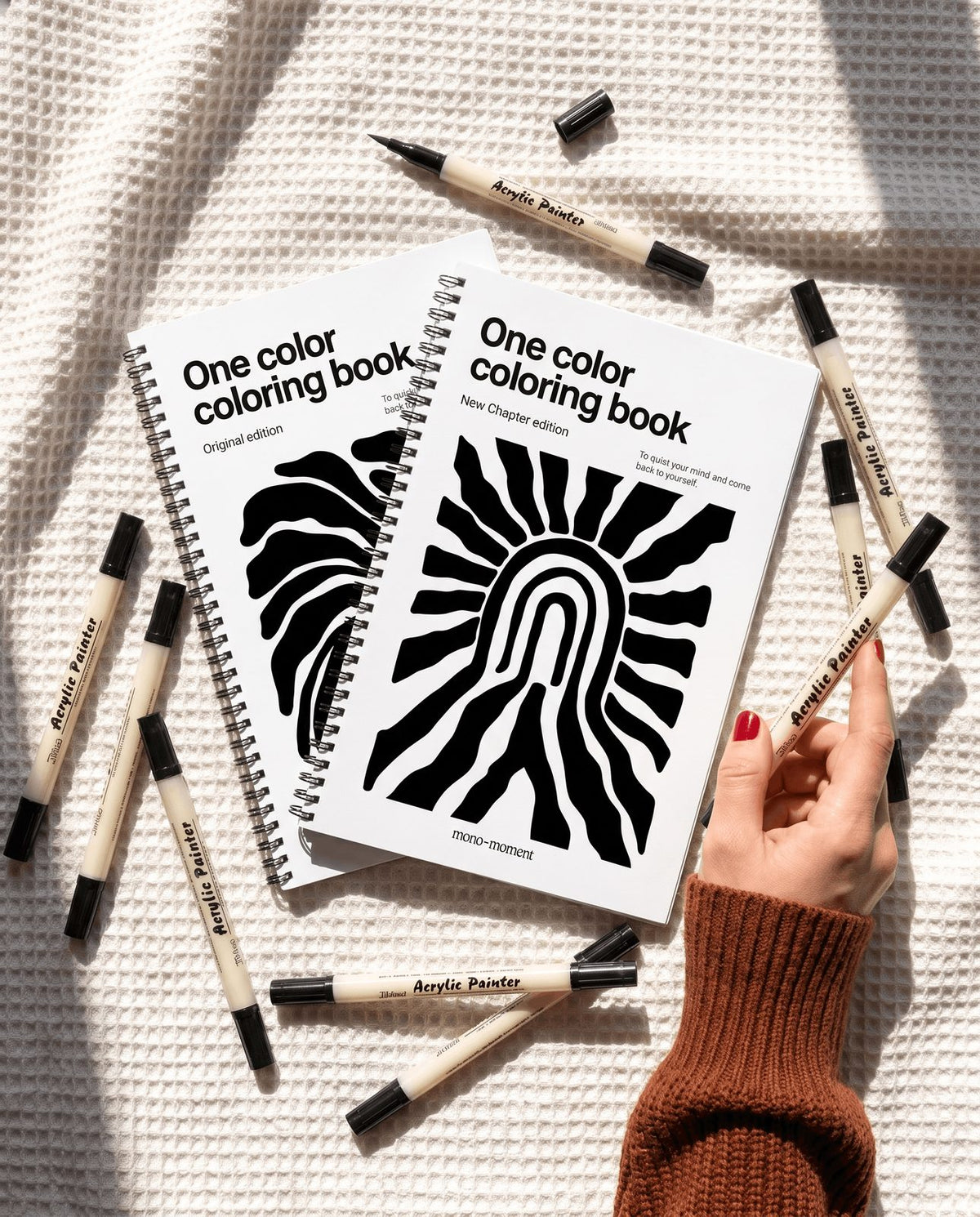
This is why pairing journaling with a completely decision-free creative outlet can be a game-changer. For example, after writing, you could spend some time with the Mono Moment One Color Coloring Book. This bestselling coloring book is specifically designed for anxiety relief, as it completely removes the pressure of picking colors, letting you slip into a meditative flow almost effortlessly. While journaling is a fantastic tool on its own, it's always good to build a full toolkit of effective strategies to cope with anxiety.
At its core, journaling for anxiety is about creating a reliable anchor in your day. It’s a way to confront overthinking head-on. If you find your mind constantly racing, you might find our guide on https://mono-moment.com/blogs/news/how-to-stop-overthinking especially helpful. This simple practice builds resilience, helping you navigate the waves of anxiety with a little more confidence and a lot more self-awareness.
Creating Your Personal Journaling Sanctuary
Before you even think about what to write, let’s talk about where you’ll write. The space you use for journaling can either quiet your mind or kick it into a higher gear. Turning this from just another task on your to-do list into a genuine ritual starts with setting the stage. When you create a dedicated space, you’re sending a clear signal to your brain: this is our time to unwind.
You absolutely don’t need a separate room. Your "sanctuary" could be a specific armchair you love, a cleared-off corner of your desk, or even just a cushion on the floor. The magic is in the consistency. By returning to the same spot each time, you build a powerful mental shortcut that helps you drop into a reflective state of mind much faster.
Choosing Your Anxiety-Relief Tools
The tools you use are a surprisingly big part of the experience. The physical, tactile sensation of putting pen to paper can be incredibly grounding, and the right tools make all the difference. Think about the smooth, satisfying glide of a good pen over a substantial piece of paper. If you're particular about your instruments, this guide to finding great pens to write with has some great pointers.
This sensory feedback is what it's all about. It’s why we specifically designed our Mono Moment journals with premium, 160gsm bleed-proof paper—nothing’s worse than seeing your thoughts bleed through to the other side. When your tools feel good in your hands, you’ll find yourself actually looking forward to your journaling time instead of dreading it.
The goal is to minimize friction and maximize comfort. Every element of your sanctuary, from the lighting to the notebook in your hands, should feel supportive and intentional.
This act of setting things up just so is a powerful form of self-care. It's about carving out a small pocket of peace in a world that often feels chaotic. To dive deeper into this idea, check out our advice on how to create a self-care routine that actually sticks.
Adding Calming Sensory Elements
With your journal and pen sorted, what else can you bring in to make the space even more calming? Engaging your other senses can really deepen the experience. A few simple additions can have a massive impact.
- Soothing Scents: A favorite scented candle, a diffuser with a few drops of lavender oil, or even the aroma from a cup of chamomile tea can instantly change the mood.
- Gentle Sound: Maybe you need total silence to think. Or maybe you find that some soft, lyric-free music or a nature sounds app helps drown out the mental chatter.
- Comfortable Textures: Never underestimate the power of physical comfort. A soft blanket over your lap or a cozy cushion at your back can help your body relax, which in turn helps your mind follow.
In the end, this is your space. It’s designed by you, for you. The "best" setup is simply the one that feels good to you—the one that makes you want to show up for yourself, day after day. That consistency is what will truly build a journaling practice that can help you manage anxiety for the long haul.
Effective Journaling Methods for Anxious Minds
Okay, you've set up your space and you're ready to go. So... what do you actually write? The biggest hurdle for most people is the pressure to be profound or poetic. Let's get rid of that right now.
The goal isn't to write the next great novel. It's to use simple, proven methods to get the anxious chatter out of your head and onto the page. Think of these techniques as your personal anxiety-fighting toolkit. Different situations call for different tools, and having a few reliable ones on hand makes all the difference.
The Brain Dump: Your First Line of Defense Against Overwhelm
When your mind feels like a web browser with way too many tabs open, the Brain Dump is your go-to. It’s exactly what it sounds like. You open your journal and let everything—and I mean everything—spill out onto the page. No filter, no judgment, no organization.
Just get it out.
- "I need to call the dentist."
- "Why did I say that weird thing in the meeting?"
- "The car is making that noise again and I can't afford a big repair."
- "I hope my friend isn't mad at me for not texting back."
- "What if I completely bomb the presentation on Friday?"
The magic here is in the transfer. By moving these thoughts from the chaos of your mind to the structure of a page, you instantly strip them of some of their power. They stop being terrifying, abstract fears and become tangible words you can actually look at. That's the first real step toward managing them.
Worry Time Journaling: Putting Anxiety on a Leash
Here's another brilliant technique: Worry Time Journaling. This method is all about containment. Instead of letting anxiety bleed into every corner of your day, you schedule a specific, non-negotiable appointment with it.
Pick a short, dedicated window—maybe 15 minutes every day at 5 PM—and that’s your official worry time. During those 15 minutes, you write down every single anxiety you have. If a worry pops up at 10 AM, you simply acknowledge it and tell yourself, "Thanks for the reminder. I'll deal with you at 5."
This simple act trains your brain to postpone anxious spirals, giving you back control over your attention and energy for the rest of the day.
Anxious thoughts love to run in circles, fueled by vagueness and repetition. By scheduling a time to face them head-on, you break that rumination cycle and prove to your brain that you're the one in charge.
This flowchart shows just how simple it is to build the right foundation for these practices.
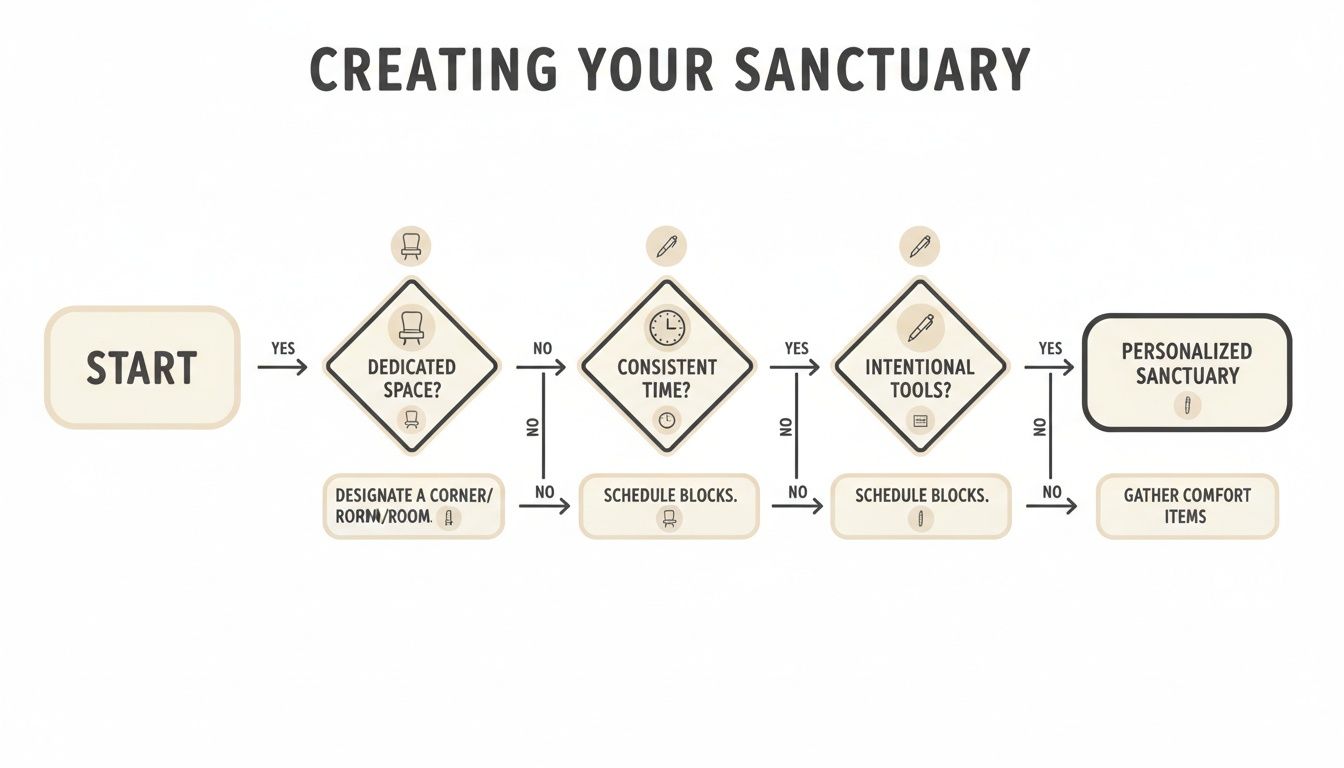
As you can see, creating a calming ritual starts with small, intentional choices about your space, your time, and your tools.
To help you get started, here's a quick look at a few proven journaling methods.
Journaling Methods for Anxiety Relief
| Technique | Best For | Example Prompt |
|---|---|---|
| Brain Dump | Moments of intense overwhelm when your mind is racing. | "What's taking up all my mental energy right now?" |
| Worry Time | Containing recurring anxieties that disrupt your day. | "During my next worry session, I need to address..." |
| Gratitude Journaling | Shifting focus away from negative thought patterns. | "What are three small things that brought me comfort today?" |
| Future Self Journaling | Visualizing a calmer state and building hope. | "What would my future, less-anxious self tell me right now?" |
These are just starting points. Feel free to mix and match them to see what works best for you on any given day.
Going Beyond Words: Combining Writing with Mindful Action
Sometimes, anxiety isn't just in your head—it's a full-body experience. Your shoulders are tense, your stomach is in knots, and words alone just don't cut it. This is where you can amplify your journaling by pairing it with a simple, decision-free creative practice.
Imagine this: After a 10-minute brain dump, you close your journal and immediately turn to an activity that calms your nervous system without requiring any mental heavy lifting.
This is exactly why we created our flagship product, the Mono Moment One Color Coloring Book. Its beautiful illustrations are intentionally designed to be completed in just 15-30 minutes, making it the perfect companion to a journaling session. You get to offload all your worries onto the page and then soothe your system with the meditative act of coloring—without the stress of picking a single color.
With the global incidence of anxiety disorders rising, accessible tools are more important than ever. Expressive writing is a proven ally; one study found 79% of students were able to lower their test anxiety just by writing about their feelings. The Mono Moment One Color Coloring Book builds on that foundation by giving you a structured, completable task. The sense of accomplishment you feel after finishing a page is a powerful antidote to the helplessness that anxiety often creates. You can dig into the research showing how writing can improve mental health to learn more.
Pairing Journaling With Creative Mindfulness
Sometimes, getting your anxieties down on paper is only half the battle. You’ve done the hard work of pulling those racing thoughts out of your head, but your body might still be holding onto the physical echo of that stress—the tight chest, the clenched jaw, the tense shoulders. This is where a little creative mindfulness can make all the difference.
When your mind is still buzzing after a journaling session, you might find that words just aren't enough to quiet the noise. That's the perfect time to shift gears from a thinking exercise (writing) to a sensory one (creating). The idea is to give your hands and senses a simple, repetitive task that requires zero decisions, allowing your nervous system to naturally calm down.
Why Decision-Free Creativity Is So Powerful
Let's face it, anxiety often comes from feeling overwhelmed by choices and a million "what-if" scenarios. So, a truly calming activity should be the complete opposite: simple, predictable, and totally free from the pressure to be perfect.
This is exactly why we created the Mono Moment One Color Coloring Book. It was designed from the ground up to be the perfect companion to your anxiety journal. By taking the stress of choosing colors completely out of the equation, it lets you sidestep that all-too-familiar analysis paralysis and sink right into a meditative flow. There's no right or wrong way to do it—just the simple, soothing motion of pen on paper.
Pairing expressive writing with a calming, non-verbal activity creates a powerful one-two punch against anxiety. First, you articulate and process the worry. Then, you soothe the physical and emotional residue it leaves behind.
This combination hits anxiety from two different angles. Journaling gives you the mental clarity to understand and challenge your anxious thoughts. Then, a mindful activity like monochrome coloring helps dial down your body's physical stress response.
Your Simple Journal-and-Color Routine
Building a routine that actually brings you relief doesn't have to be complicated. In fact, the simpler, the better—you'll be far more likely to stick with it. Here’s a surprisingly powerful routine that brings these two practices together.
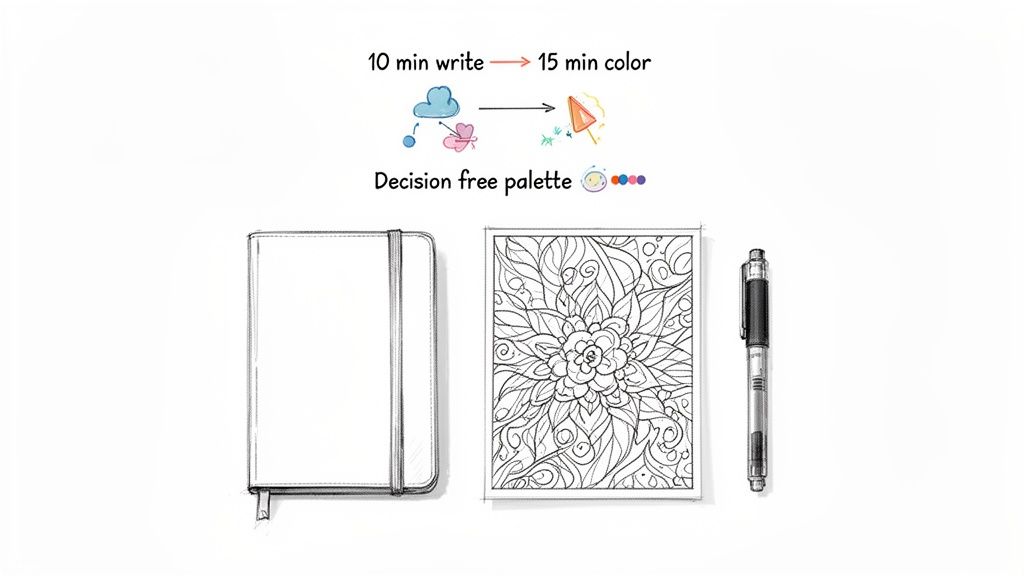
- Journal for 10 Minutes: Set a timer and just write. Do a "brain dump" to get everything out, or use one of our prompts to focus your thoughts. The only rule is not to edit or judge yourself.
- Color for 15 Minutes: As soon as the timer goes off, close your journal. Open your Mono Moment One Color Coloring Book, pick a design that speaks to you, and just color for the next 15 minutes. Pay attention to the feeling of the pen gliding across the premium 160gsm paper, the sound it makes, and the simple act of filling in the lines.
This entire 25-minute ritual is designed to fit into almost any schedule. We intentionally designed the illustrations in our bestselling coloring book to be completable in 15-30 minutes. This gives you a tangible sense of accomplishment, which is a fantastic antidote to the feeling of being stuck that so often comes with anxiety. You can dive deeper into how this works in our guide to art therapy for anxiety.
By creating this simple sequence, you’re doing more than just journaling. You're building a complete ritual that calms both your mind and your body. It’s a gentle, structured way to process what you're feeling and then actively guide yourself back to a state of peace, one pen stroke at a time.
Overcoming Common Journaling Roadblocks
Getting started with a journal is one thing; sticking with it is another. It’s completely normal to hit a few snags along the way. I've seen it time and time again. The trick is to remember that your journal is a tool for you—it's not another test you have to pass or a chore you can fail at.
The most common hurdle? The dreaded blank page. You sit down, ready to pour your heart out, and… nothing. Your mind is a total blank. That pressure to write something brilliant or deeply insightful can ironically spark the exact anxiety you're trying to manage. Let's not let perfectionism win this one.
When Words Won't Come
If you find yourself staring into the white abyss of a fresh page, give yourself permission to shift gears. Forget about writing for a minute. Just start doodling. Draw a squiggle, a shape, a stick figure—anything. The simple physical act of moving the pen across the paper can be surprisingly effective at breaking that mental gridlock.
Another approach I love is to start ridiculously small. I mean, impossibly small. Instead of trying to fill a whole page, commit to writing just one single word that sums up how you feel right now. Sad. Tired. Hopeful. Whatever it is.
Or, try answering a dead-simple, sensory question:
- "What's one thing I can see from where I'm sitting?"
- "What sound can I hear right now?"
- "What does the air in this room smell like?"
This takes all the pressure off and gets the momentum flowing.
The Myth of Perfect Consistency
So many people give up on journaling because they miss a day, which turns into two, and suddenly they feel like they’ve completely failed. This all-or-nothing mindset is a trap. Your journal works for you, not the other way around. Skipping a few entries doesn’t negate all the good work you’ve already done.
Reframe your thinking: Journaling isn't a streak you have to maintain. It’s a resource you can tap into whenever you need it—whether that's daily, weekly, or once in a blue moon.
If you're struggling to make it a regular thing, try linking it to something you already do and enjoy. For example, you could make a ritual of writing for just five minutes before you relax with a page from our amazing Mono Moment One Color Coloring Book. This is called 'habit stacking,' and it works because it attaches the new habit to an existing one that already feels good. It becomes less of a "should" and more of a natural part of your routine.
Ultimately, learning to journal for anxiety is really an exercise in self-compassion. Some days, the words will flow effortlessly. Other days, they won't. And that's okay. The real goal is just to keep the line of communication with yourself open.
Still Have Questions About Journaling for Anxiety? Let’s Clear Things Up.
Starting any new habit, especially one as personal as journaling, naturally comes with a few questions. Feeling unsure is part of the process, but knowing what to expect can give you the confidence to really commit and make this a practice that sticks.
Let's be honest, life today can feel overwhelming. Mental health struggles are more common than ever, with nearly one billion people dealing with them worldwide. The last few years have been particularly tough, driving anxiety rates up by a staggering 25%. But there's a flip side to that coin: simple, accessible tools can make a huge difference. In fact, 76% of people who journaled for just 20 minutes a day reported feeling less anxious. You can see more powerful stats on how journaling helps for yourself.
With that in mind, let's tackle some of the most common hurdles people face.
How Much Time Do I Really Need to Spend Journaling?
This is the biggest myth out there—that you need to dedicate hours to see any benefit. You don't. The real magic is in consistency, not the clock.
Just 15 to 20 minutes a day is a fantastic and realistic goal. That's all it takes to start untangling your thoughts and calming your mind.
A simple routine I love, and one that works for so many, is our "Mono Moment Method," featuring our bestselling products:
- 10 minutes of writing: This is your time to get all those swirling thoughts and worries down on paper in your Mono Moment journal. Just let it flow.
- 15 minutes of monochrome coloring: Afterward, switch gears to a simple, creative act with the Mono Moment One Color Coloring Book that gives your analytical brain a break and soothes your nervous system.
This 25-minute practice is small enough to fit into almost any schedule, yet powerful enough to give you both mental clarity and meditative calm.
What if I Stare at the Page and Nothing Comes Out?
Ah, the dreaded blank page. We’ve all been there. It’s completely normal, so please don’t let it discourage you.
When you genuinely don’t know what to write, just start with a "brain dump." Seriously, write down anything and everything that pops into your head. It doesn’t need to be profound or even make sense. "I'm tired," "I need to buy milk," "That bird outside is loud"—it all counts.
Another trick is to use a gentle prompt. Something like, "What's one thing I actually have control over right now?" can be a great starting point. Or, "Where in my body am I feeling this anxiety?" If you’re still drawing a blank, flip the script. Start with a page from your Mono Moment One Color Coloring Book first. Easing into that creative, decision-free zone can quiet your inner critic, and you might be surprised by how easily the words come afterward.
Putting pen to paper physically slows down your racing thoughts in a way typing just can't. The sensory experience of a good pen gliding across smooth, thick paper is incredibly grounding. It’s not just writing; it's a mindful, tactile ritual.
Is It Okay to Journal on My Phone, or is Pen and Paper Better?
Look, any journaling is better than no journaling. If a digital app is what works for you, that’s great.
That said, there's a reason so many people find their way back to physical writing. The act of writing by hand has unique neurological benefits, engaging your brain on a different level. It’s a tactile experience that can pull you into the present moment. That’s precisely why we made the Mono Moment journal with thick, 160gsm bleed-proof paper—we wanted the physical act of writing to feel like a comforting, luxurious part of your routine.
Ready to combine the clarity of writing with the quiet focus of creative mindfulness? The Mono Moment One Color Coloring Book is the perfect partner for your new journaling practice. It’s designed to give your anxious mind a much-needed rest with beautiful, decision-free patterns on premium paper.

The One Color Coloring Book
A single-pen, decision-free coloring book on 160 gsm cream paper — engineered for the wind-down ritual described above.
 Pair it with the 3 Dual Tip Brush Pens — $5 instead of $9.95 in the Book + Pens bundle.