About the author
Published December 15, 2025 · Last reviewed April 26, 2026 · 19 min read
In this article · 6 sections
When your thoughts are racing and your heart is pounding, you need something that works right now. The secret isn't some complex mental trick; it's about interrupting the chaos with a simple, tangible action. Think of it as hitting a pause button on your brain's frantic spiraling.
Things like structured breathing or a decision-free creative outlet can work wonders. They shift your focus from the storm inside your head to a calm, external task. Our entire line of products at Mono Moment, especially our signature One Color Coloring Book, is designed around this very principle.
Your Guide to Finding Calm in the Chaos
That feeling of being a passenger on a runaway train of thought? It’s exhausting, and it’s a hallmark of anxiety. But here's the thing: you are not powerless. Learning how to calm your mind is a skill, and just like any other, you can get better at it with the right tools and a little practice.
Think of this guide as your personal toolkit, packed with practical strategies you can pull out and use the moment you need them. It's all about giving you options that quiet your mental load, not add to it.
Shifting from Overwhelmed to Empowered
The goal isn't to get rid of anxiety forever—that’s not realistic. It’s about building resilience and having a game plan. It's about knowing exactly what to do when that familiar wave of panic starts to creep in.
We’re going to cover a whole range of techniques, so you can find what works for you in any situation.
Here’s what we’ll get into:
- Immediate Grounding Exercises: Quick, in-the-moment techniques to pull you back to the present when anxiety spikes.
- Sustainable, Peace-Promoting Rituals: Short, restorative practices you can weave into your daily life to keep stress at bay.
- Actionable Steps for Lasting Relief: Moving past theory and into real-world applications for genuine, long-term results.
One of our core principles is focusing on simple, decision-free activities. When you're anxious, the last thing you need is another choice to make. Activities that eliminate decision fatigue are incredibly powerful. This philosophy is the foundation of every product we create at Mono Moment.
The Power of Decision-Free Activities
One of the best ways to short-circuit an anxiety spiral is to do something that requires your focus but doesn't ask you to make any complicated decisions.
This is exactly why tools like our One Color Coloring Book can be so effective. The designs are already black and white, which completely removes the pressure of picking colors—a subtle stressor that can make you feel even more anxious.
Instead of agonizing over which shade of green to use, you just get lost in the simple, rhythmic motion of filling in the patterns. This kind of mindful flow helps calm the amygdala (your brain's fear center) and gives your mind a much-needed break. It's about moving from a place of overwhelm to one of empowerment, one simple, actionable step at a time.
Quick Grounding Techniques for Immediate Relief
When your mind starts to spiral, you need a way to hit the brakes—fast. We’ve all been there: standing in a crowded grocery store, stuck in traffic, or staring at a blank screen, feeling that familiar wave of panic rise.
Those are the moments when you need an immediate, practical tool to pull you back from the edge. This is where grounding techniques become your secret weapon for finding stability in the storm.
These simple exercises are designed to interrupt the anxiety loop. They work by yanking your focus away from the racing thoughts inside your head and anchoring it to the real, physical world around you. Best of all, they're discreet, require no special equipment, and you can do them anywhere.
Master the 5-4-3-2-1 Sensory Method
One of the most effective grounding exercises I've come across is the 5-4-3-2-1 method. It's brilliant because it forces your brain to engage with your five senses, pulling you firmly into the present moment. It's a simple, structured way to tell your anxious mind, "Hey, you are safe right now."
Let's say you're at your desk, feeling completely overwhelmed before a big presentation. Here’s how you can use it:
- 5 Things You Can See: Look around and mentally name five objects. Don't just glance; really see them. Notice the exact shade of blue in your pen, the subtle wood grain on your desk, or the way the light reflects off a picture frame.
- 4 Things You Can Feel: Now, shift your focus to physical sensations. Feel the solid back of your chair supporting you, the texture of your sleeve against your skin, the cool surface of the desk under your hands, and the weight of your feet flat on the floor.
- 3 Things You Can Hear: Listen intently for three distinct sounds. It could be the low hum of the air conditioner, the distant sound of traffic, or the clicking of your own keyboard. Just acknowledge each one without judgment.
- 2 Things You Can Smell: This one can be a little tricky, but give it a try. Maybe it's the faint aroma of your morning coffee still lingering, or the clean scent of hand sanitizer.
- 1 Thing You Can Taste: Finally, focus on a single taste. This could be the ghost of your toothpaste or a quick sip of water. The simple act of noticing grounds you.
This sensory scan is so powerful because your brain simply can't focus on internal worries and the external environment at the same time. If you’re looking for more ideas like this, check out our guide to quick mindfulness activities for adults.
Harness the Power of Deliberate Breathing
Breathing is something we do without thinking, but when you do it with intention, it becomes one of the most powerful tools you have to calm your anxious mind. Slow, deep breathing sends a direct signal to your nervous system that it’s time to relax. This isn't just a feeling; it triggers a direct physiological change.
In fact, research shows that slow diaphragmatic breathing can reliably increase heart rate variability—a key sign of your body’s relaxation response—by 20–40% compared to normal breathing. You can learn more about the physiological effects of slow breathing on anxiety from scientific studies.
One of the most effective and easiest methods to remember is the 4-7-8 breathing technique. It's incredibly good at stopping anxiety in its tracks.
Here's the 4-7-8 Breathing Technique:
- First, exhale completely through your mouth with a gentle whooshing sound.
- Now, close your mouth and inhale quietly through your nose for a count of four.
- Hold your breath for a count of seven.
- Finally, exhale completely through your mouth, making that whooshing sound again, for a count of eight.
Repeat this cycle three to five times. That long exhale is the most important part—it’s what activates the parasympathetic nervous system, shifting your body into a "rest and digest" state. This simple technique can bring you tangible relief in less than a minute, giving you a powerful sense of control right when you need it most.
Build Your Own 30-Minute Anxiety-Soothing Ritual
While quick grounding techniques are lifesavers when anxiety suddenly hits, building a consistent, restorative ritual is your best defense for the long haul. Don't think of this as another chore on your to-do list. See it for what it is: a protected sanctuary you carve out just for yourself. This isn't about grand, time-consuming gestures; it's about creating a small, repeatable pocket of peace you can genuinely look forward to.
The whole point is to design a simple, multi-sensory experience that tells your brain and body it's safe to power down. This 30-minute practice is your permission slip to unplug from the world’s endless demands and reconnect with your own sense of calm. We’ll build this ritual around a powerful, decision-free activity designed to quiet the mental chatter that anxiety thrives on.
The Centerpiece: Decision-Free Coloring
At the heart of any effective anxiety-soothing ritual is an activity that holds your focus without adding more mental clutter. This is exactly where our One Color Coloring Book shines. When your mind is already buzzing with a thousand worries, the last thing it needs is more choices—even seemingly harmless ones like, "Which color should I use next?"
That constant stream of tiny decisions adds up, creating what’s known as decision fatigue, a huge trigger for an already anxious mind. Our black-and-white patterns sidestep this problem completely. You don’t have to waste a single ounce of mental energy on color theory or coordination. You just pick up a pen and fill in the spaces.
The real beauty of this is its simplicity. The repetitive, rhythmic motion of coloring within structured lines helps to calm the amygdala—your brain's alarm system—and guides you into a gentle, meditative state often called "flow."
This state of flow is where the magic really happens. Your focus narrows to the simple task at hand, the outside world starts to fade away, and that internal monologue of worries finally goes quiet. It’s a super accessible form of mindfulness that doesn't require you to sit in perfect silence or wrestle with your thoughts. The gentle, focused action does the heavy lifting for you.
Crafting Your Multi-Sensory Sanctuary
Now, let's take this coloring experience and make it truly immersive by layering in other sensory soothers. When you engage multiple senses at once, you create a powerful calming effect that makes your 30-minute ritual feel deeply restorative. The trick is to pick things you personally find comforting and keep them consistent.
Here’s a simple framework to get you started:
-
Set the Scene (Sight & Smell): Before you even open your book, take two minutes to shift your environment. Dim the lights. Light a scented candle with a calming fragrance like lavender, chamomile, or sandalwood. The soft, flickering light and gentle aroma are the first signals to your brain that it's time to relax.
-
Prepare a Soothing Drink (Taste & Touch): Brew a cup of caffeine-free herbal tea. Peppermint, ginger, or a classic chamomile blend are all great choices. Just feeling the warmth of the mug in your hands is a grounding sensation, and the simple act of sipping slowly encourages you to breathe more deeply.
-
Engage in Mindful Coloring (Focus): Alright, now it's time to open your One Color Coloring Book. Spend the next 20–25 minutes just coloring. Forget about perfection. The goal isn't to create a masterpiece; it's to lose yourself in the process. Pay attention to the smooth glide of the pen on the premium paper and watch the intricate patterns come to life under your hand.
-
Close with Gratitude (Reflection): In the last few minutes, put down your pen. Take a couple of deep breaths, finish your tea, and think of one small thing from your day that you're grateful for. It can be as simple as the comfort of your chair or the quiet moment you just gave yourself.
This entire sequence creates a predictable and comforting routine. After a while, just the act of lighting your specific candle or brewing your favorite tea will start to trigger a relaxation response in your body, long before you even start coloring.
Why This Ritual Actually Works
Creating a consistent ritual like this does wonders for managing the stress hormone cortisol. When your body is constantly on high alert, cortisol levels can stay elevated, feeding feelings of anxiety and leading to burnout. A predictable, calming routine helps regulate your nervous system, sending a clear signal that you are safe and can shift out of "fight or flight" mode.
You can dive deeper into creating lifestyle habits that support this process by reading our guide on how to reduce cortisol levels naturally.
Ultimately, this 30-minute practice is far more than just a break—it's an active investment in your mental well-being. It provides a structured container for your thoughts, allowing you to process the day without feeling so overwhelmed. By making it a non-negotiable part of your schedule, whether to wind down before bed or to reset after a stressful workday, you build a powerful habit that fortifies your mind against the daily grind of anxiety.
Develop Long-Term Habits for a Calmer Life
While quick-fix techniques are fantastic for stopping an anxiety spike in its tracks, building real, lasting resilience is a different game. It’s played through the small, consistent things you do every single day.
Think of these habits less like chores and more like investments in your future self. You're not just coping; you're actively fortifying your mind against stress and building a new, calmer baseline. The goal is to shift from constantly reacting to anxiety to proactively creating a life that just naturally keeps it at bay.
These aren't about massive, life-altering changes. We’re talking about simple, almost seamless adjustments that add up over time, creating a powerful buffer that makes it much harder for anxiety to take hold in the first place.
Integrate Mindful Movement into Your Day
One of the most powerful, science-backed ways to quiet a racing mind is to simply move your body. And no, you don’t need to sign up for a grueling gym membership. Even a simple 15-minute walk can completely change your mental state by releasing feel-good endorphins and burning off stress hormones.
The link between moving your body and clearing your head is undeniable. Study after study confirms that regular exercise is a legitimate, evidence-based treatment for anxiety. In fact, multiple analyses have shown that consistent aerobic activity can lead to a significant drop in anxiety scores in as little as 8–12 weeks. It’s not just a feeling; it’s science.
Here are a few easy ways to make movement a non-negotiable part of your day:
- The Lunch Break Reset: Ditch the desk lunch. Use 15-20 minutes to get outside and walk. The combination of movement, fresh air, and a new environment can completely reset your brain for the afternoon.
- The Post-Work Decompression: Before you melt into the couch for the night, take a quick 10-minute walk around the block. It creates a mental boundary between your workday and personal time, helping you shed the stress you’ve carried home.
- Stair Sprints: If you work or live in a multi-story building, make the stairs your friend. A few trips up and down is a surprisingly effective way to get your heart rate up and clear your head fast.
Implement a Digital Sunset
In a world that’s always on, our brains rarely get a true break. The constant buzz of notifications and the endless glow of blue light keep our nervous systems on high alert, making it nearly impossible to wind down.
This is where a "digital sunset" can be a game-changer.
The idea is simple: you deliberately disconnect from all screens—phones, tablets, laptops, TVs—for at least one hour before bed. This one habit can have a massive impact on your sleep quality, which is absolutely fundamental to managing anxiety.
A vicious cycle exists between poor sleep and anxiety. Anxiety makes it hard to sleep, and not sleeping well makes you far more vulnerable to anxiety the next day. A digital sunset is your circuit breaker.
So what do you do with that screen-free hour? Instead of scrolling, you reclaim it for calming, analog activities. This is the perfect time to bring back that anxiety-soothing ritual we talked about earlier.
Pairing a simple, decision-free activity like monochrome coloring with a warm, non-caffeinated drink and some deep breathing creates a powerful multi-sensory signal that tells your body and mind it’s time to rest. The Mono Moment One Color Coloring Book is the perfect companion for this screen-free wind-down.
Schedule Dedicated "Worry Time"
Okay, this one might sound completely backward, but hear me out. One of the best ways to get a handle on persistent worry is to give it its own scheduled appointment.
Anxious thoughts are bullies. They pop up at the worst times because they’re demanding your attention right now. By scheduling a brief, 15-minute "worry time" each day, you’re telling them, "I hear you, but we'll deal with this on my terms."
Here’s how to put it into practice:
- Book It: Pick a specific 15-minute slot in your day—just make sure it’s not right before you go to bed.
- Let It Rip: During this time, let yourself worry completely. Grab a journal and write down every single anxious thought that crosses your mind. Get it all out.
- Close the Book: When the timer goes off, you're done. Close the journal. You’ve given the worries their time, and now you can move on.
- Table It: If a worry pops up outside of your scheduled time, just make a mental note: "Thanks, brain. I'll add that to the list for my worry time later."
This isn't about ignoring your anxiety; it's about containing it. You’re training your brain to stop the endless loop of overthinking. If that’s a cycle you know all too well, you might find our guide on how to stop overthinking really helpful.
Choosing Your Daily Anxiety-Reducing Habit
So, which habit should you start with? The best one is the one you’ll actually stick with. Each of these practices offers unique benefits, so it’s all about finding what fits your life right now.
This table can help you decide.
| Habit | Time Commitment | Best For | Key Benefit |
|---|---|---|---|
| Mindful Movement | 15–30 min/day | People who feel restless or have a lot of pent-up energy. | Releases endorphins and burns off stress hormones like cortisol. |
| Digital Sunset | 30–60 min/evening | Anyone struggling with sleep or feeling constantly overstimulated. | Improves sleep quality, a cornerstone of mental health. |
| Worry Time | 10–15 min/day | Individuals who get stuck in loops of repetitive, anxious thoughts. | Contains worry to a specific time, freeing up the rest of your day. |
You don't have to do everything at once. Pick one. Try it for a week and see how it feels. By creating these small, sustainable habits—moving your body, protecting your sleep, and managing your thoughts—you’re not just surviving anxiety. You're building a resilient foundation for a calmer, more centered life.
Knowing When to Seek Professional Support
The grounding techniques and daily rituals we've talked about are incredibly powerful. They're your frontline defense. But it's just as important to know when you need to call in reinforcements.
Recognizing that you might need professional support isn't a sign of failure. Far from it. It’s a courageous, proactive step toward getting well and staying well. Think of it this way: you can handle minor scrapes with a first-aid kit, but you'd see a doctor for a deeper wound. The same logic applies to your mental health. Asking for help shows strength and a serious commitment to calming your anxious mind for good.
Signs It Might Be Time for More Support
So, how do you know? The line between everyday stress and something more persistent can feel blurry. It usually comes down to how much anxiety is interfering with your life, day in and day out.
Take a moment and honestly ask yourself if any of these patterns feel familiar:
- Your daily life feels derailed. Is anxiety making it tough to focus at work, manage family responsibilities, or even run simple errands?
- Your relationships are taking a hit. Maybe you're avoiding social events you used to love, or you notice more friction with your partner, friends, or family.
- Physical symptoms are a constant. Are you dealing with frequent tension headaches, stomach issues, or a sense of exhaustion that has no other medical cause?
- Your go-to tools aren't cutting it anymore. You’re trying the breathing exercises and building your rituals, but the anxiety still feels huge and unmanageable most days.
If you’re nodding along to any of these, it could be a clear signal that it’s time to explore a more structured approach with a professional.
What Therapy Is Actually Like
The idea of therapy can be intimidating, but let's demystify it a bit. One of the most effective, evidence-based approaches for anxiety is something called Cognitive Behavioral Therapy (CBT).
Don't let the name scare you. CBT is a practical, goal-oriented therapy that works on a simple idea: our thoughts, feelings, and actions are all linked. A therapist helps you spot the negative thought loops that are fueling your anxiety and then gives you real, tangible strategies to change how you react to them. It’s less about digging endlessly into your past and more about building practical skills you can use right now.
An initial consultation is just a conversation. It's a low-pressure chance for you to see if you click with the therapist and for them to understand what's going on. Think of it as an interview—where you're both deciding if it's a good fit.
You're not alone in this. The World Health Organization estimated that in 2021, about 359 million people worldwide had an anxiety disorder. The problem is, a huge treatment gap exists—roughly 72% of people who need help don't get it. But here’s the hopeful part: treatments like CBT have been shown to lead to remission in 40–60% of people in just 8–12 weeks. You can read more about the global anxiety statistics and treatment effectiveness on who.int.
Finding the Right Person for You
Finding a therapist is a personal journey, and finding the right "fit" is everything. You need to feel comfortable and understood.
Here are a few places to start your search:
- Talk to your doctor. Your primary care physician is a great first stop for a referral.
- Explore online directories. Websites like Psychology Today or the Anxiety & Depression Association of America (ADAA) have excellent, searchable databases of licensed therapists.
- Call your insurance provider. They can give you a list of mental health professionals covered by your plan.
Remember, seeking professional help is a powerful act of self-care. It doesn't replace the strategies we've discussed—from mindful coloring in our One Color Coloring Book to daily grounding exercises—it enhances them. Combining your personal practices with expert guidance creates the strongest possible foundation for building a calmer, more centered life.
Got Questions? Let's Troubleshoot Your Path to Calm
Even with a solid plan, trying out new ways to manage anxiety can feel a bit strange at first. It's totally normal to wonder, "Am I even doing this right?" or feel frustrated when a technique doesn't click immediately. Let's tackle some of the most common hurdles you might face.
Think of this as your friendly troubleshooting guide. The point isn't to be perfect; it's about finding what works for you. Every time you try, even if it feels clumsy, you're learning and moving forward.
What if Breathing Exercises Actually Make Me More Anxious?
Believe it or not, this is incredibly common. For many people, focusing too intently on the breath can backfire, triggering a feeling of panic or the sensation that you can't get enough air. If this is you, please don't force it.
Instead of rigid counting methods like 4-7-8 breathing, try something gentler. Just focus on making your exhale a little bit longer than your inhale, without getting hung up on the numbers. You can also pivot to something more external and tangible. The 5-4-3-2-1 grounding technique is perfect for this, as is spending a few quiet minutes with our One Color Coloring Book, which skillfully pulls your attention away from the panic without any pressure.
How Long Does This Stuff Actually Take to Work?
This is the million-dollar question, and the honest-to-goodness answer is: it really depends. Fast-acting grounding techniques can pull you back from the edge in the moment, sometimes within a matter of minutes. They’re built to be an emergency brake for an anxiety spike.
Building long-term resilience, however, is a different game. That's where habits come in. You might start noticing a real, though subtle, shift in your day-to-day anxiety after a few weeks of consistent practice—like a daily walk or a regular coloring session. The magic is in consistency, not intensity.
I’m Too Jittery to Sit Still. What Can I Do?
When your system is buzzing with adrenaline, the thought of sitting quietly can feel like torture. That restless energy is screaming for an outlet. So, give it one. This is the perfect time to embrace mindful movement.
- Pace with purpose. Instead of just wearing a hole in the carpet, walk slowly. Feel your feet connect with the floor on each step.
- Stretch it out. A few simple, gentle stretches can work wonders. Really tune into the feeling of your muscles letting go of that tension.
- Get your hands busy. This is my favorite tip. Activities with repetitive hand motions, like coloring in detailed patterns, are fantastic. They give all that nervous energy a job to do, channeling it into something focused and calming.
The simple, structured patterns in our One Color Coloring Book are practically designed for this exact scenario. It gives that anxious buzz a place to land, helping you transform restlessness into a sense of creative flow. You get to calm your mind without forcing a stillness your body just isn't ready for.
Any Tips for Actually Remembering to Use These Techniques?
It’s one thing to know the tools, and another thing to remember them in the heat of the moment. The secret is to practice when you don't need them, weaving them into your day so they become second nature.
Start ridiculously small. For example, decide to do one single deep breath every time you sit down at your computer. Or commit to just five minutes of coloring right after you finish dinner. When you "piggyback" a new habit onto one you already do, you're creating a mental shortcut that makes it so much easier to stick with.
Ready to build a calming ritual with a tool specifically designed to quiet the mental noise? The Mono Moment One Color Coloring Book takes decision-making out of the equation, so you can find your calm through simple, focused creativity.

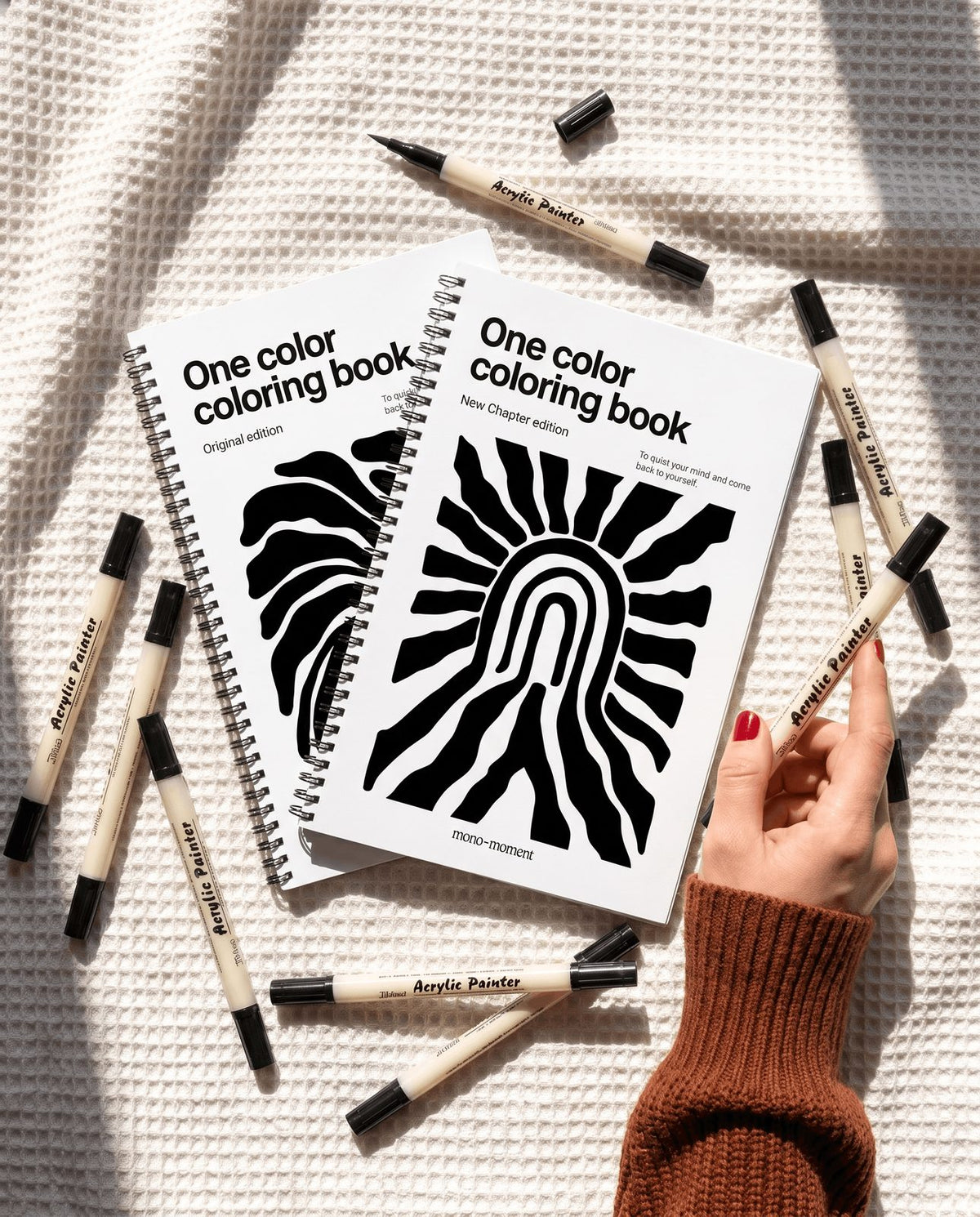
The One Color Coloring Book
A single-pen, decision-free coloring book on 160 gsm cream paper — engineered for the wind-down ritual described above.
 Pair it with the 3 Dual Tip Brush Pens — $5 instead of $9.95 in the Book + Pens bundle.