About the author
Published December 22, 2025 · Last reviewed April 26, 2026 · 17 min read
In this article · 6 sections
Let's get one thing straight: creating a self-care routine begins with the radical idea of giving yourself an actual break. It’s not about adding another ambitious project to your already-packed schedule. It's about finding a simple, decision-free activity you can lose yourself in for just 15 minutes, scheduling it like an important meeting, and dropping the need to do it perfectly.
The goal here is relief, not another checkmark on your to-do list.
Stop Treating Self-Care Like a Chore

If you're an overthinker or constantly juggling a million things, the very idea of a "self-care routine" can feel exhausting. It immediately sounds like another job—something to manage, optimize, and, let's be honest, probably feel guilty about not doing "right." That pressure completely defeats the entire purpose of taking a break in the first place.
Here’s the thing your overworked brain is trying to tell you: it craves simplicity. It’s desperate for it, especially when running on fumes. This is precisely where the magic of 'decision-free' self-care comes into play. It’s all about picking genuinely simple, almost meditative activities that quiet your racing thoughts without asking for more of your precious mental energy.
Instead of wrestling with a practice that feels like work, you find a gentle, accessible path to calm.
Embrace Simplicity Over Complexity
Just take a second to think about the sheer mental load you carry every single day. From coordinating complex projects at work to figuring out what's for dinner, your brain is a non-stop decision-making machine. When it's finally time to unplug, the absolute last thing it needs is another set of choices.
This is why an activity as simple as coloring can be so effective. But even that can get complicated fast, right? Staring at a complex design with a 64-pack of colored pencils can easily trigger that familiar perfectionism and anxiety. What if I pick the 'wrong' colors? What if it looks terrible?
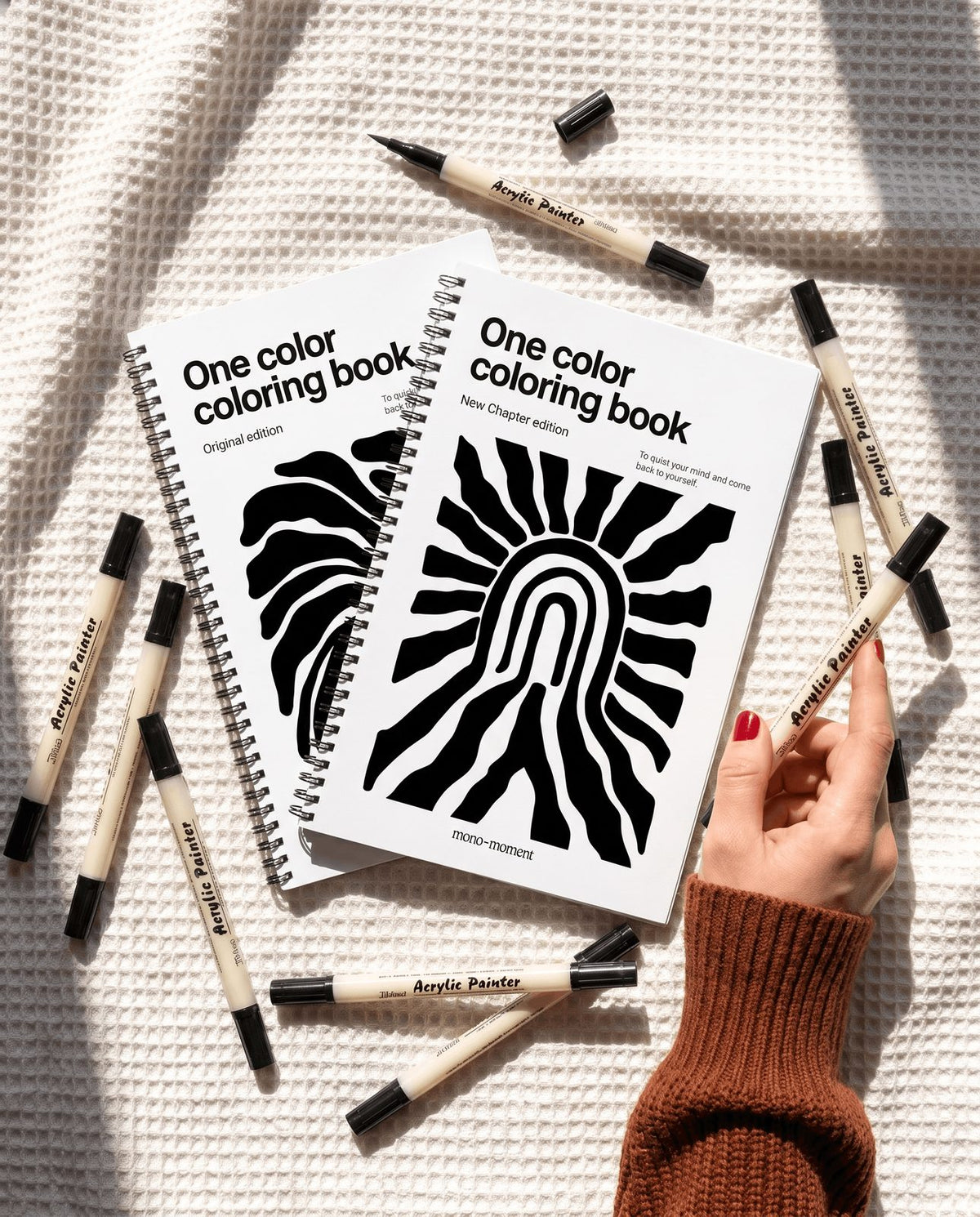
Our monochrome coloring book was designed to short-circuit that entire cycle of self-doubt. With just one color, the pressure of choice vanishes. You’re not trying to be an artist creating a masterpiece; you're simply a person carving out a moment of peace. Your only job is to fill in the space, which is a powerful invitation for your mind to finally settle down and enter a meditative state.
Self-care shouldn’t feel like a performance. It's about finding genuine moments of relief designed for a busy, overthinking mind. It’s permission to pause without the pressure to produce anything at all.
The Power of a Single, Easy Step
When you frame your routine this way, everything changes. It’s no longer about adding one more thing to your day but about intentionally subtracting the mental noise. By choosing a single, uncomplicated activity, you build a reliable refuge you can turn to anytime. Suddenly, figuring out how to make time for self care feels so much more achievable because the activity itself is effortless.
Think about the immediate benefits of this decision-free approach:
- It lowers the barrier to entry. You're way more likely to actually do it when the first step is ridiculously simple.
- It silences your inner critic. With fewer variables, there's less to get "wrong," which helps quiet that voice of perfectionism.
- It encourages a state of flow. Simplicity is the key to becoming absorbed in the moment, offering a true escape from anxious thoughts.
Starting here sets an empathetic, realistic, and genuinely kind tone for your entire self-care journey. You're meeting yourself exactly where you are.
Figure Out What Actually Recharges You
Let's be honest: the internet's generic advice to "take a bubble bath" rarely cuts it. That’s because effective self-care isn't one-size-fits-all; it's deeply personal. What recharges one person can feel like just another chore to someone else.
So, before we even think about scheduling, the first real step is to discover what genuinely fills your tank.
This calls for a bit of honest self-reflection. Start by noticing your personal stress triggers. When do you feel most drained? Is it after a long day of back-to-back meetings? Or maybe it's the constant mental load of managing household logistics that leaves you feeling depleted. Pinpointing what drains you is the best clue to understanding what will restore you.
And this isn't some fleeting trend. The self-care industry was valued at $41.2 billion in 2025 and is on track to hit a massive $81.2 billion by 2030. With nearly 88% of Americans now actively practicing some form of self-care, it's clear that people are realizing a personalized routine is a vital investment in their long-term well-being.
Build Your Personal Self-Care Menu
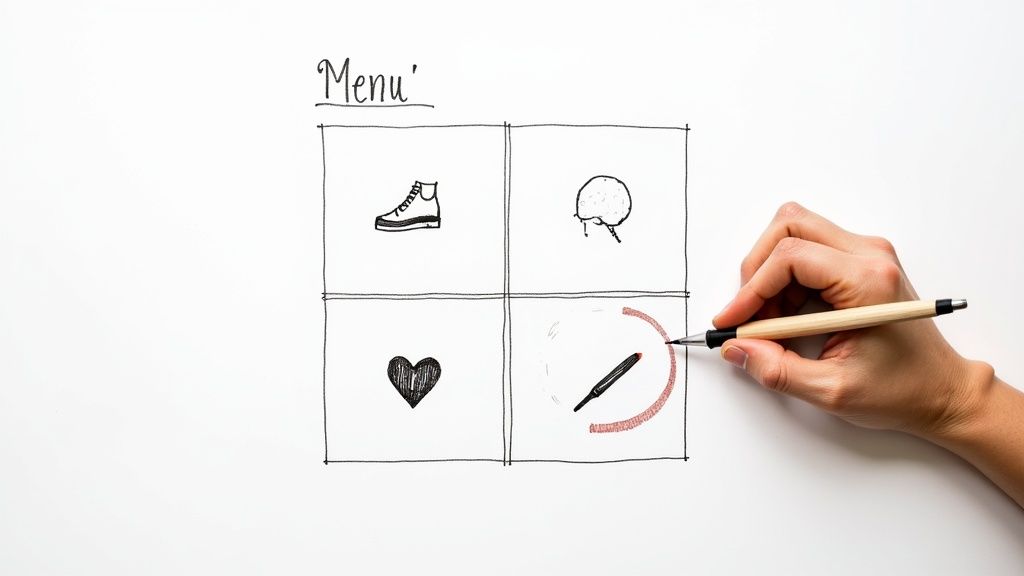
Once you've identified your triggers, you can start building a "menu" of activities that actually work for you. Think of this not as a rigid to-do list, but as a go-to collection of options you can pull from based on how you feel and how much time you have. A balanced menu usually covers a few different aspects of your well-being.
Consider brainstorming a few ideas for each of these key categories:
- Physical: Anything that gets you back into your body. This could be a brisk walk around the block, a few gentle stretches at your desk, or even just dancing to one song. The goal is simply to release tension.
- Mental: This is all about giving your busy mind a break. Maybe it's reading a chapter of a book (not for work!), listening to an engaging podcast, or doing a simple puzzle that doesn't require intense strategy.
- Emotional: These are activities that help you process your feelings in a healthy way. Think about journaling, calling a friend you can be real with, or putting on a playlist that matches your mood.
- Creative: Tapping into your creative side is an incredible way to get out of your own head. This isn't about being an "artist"—it's about the simple act of making something, whether that's doodling, trying a new recipe, or coloring with a product like our monochrome coloring book.
Your self-care menu is a tool for self-kindness, not a list of new obligations. It’s designed to give you permission to choose what you truly need in the moment, free from the pressure to do what you think you should be doing.
Tailor Your Activities to Your Real-Life Schedule
Okay, now let's get practical. For each of those categories, come up with a few things that fit into different time slots. What can you realistically do in just five minutes? What about when you have a solid fifteen or thirty?
Having these options ready to go makes it so much easier to seize those small pockets of time that pop up during the day.
This is where a personal menu becomes so powerful. You can map out your ideas to have them ready at a glance.
Your Personal Self-Care Menu
Use this table to brainstorm and organize self-care activities that fit your needs and schedule, making it easy to choose one when you need it most.
| Self-Care Category | 5-Minute Reset | 15-Minute Activity | 30-Minute Practice |
|---|---|---|---|
| Physical | 10 deep belly breaths | Walk around the block | Gentle yoga flow video |
| Mental | Listen to one favorite song | Read a chapter of a novel | Listen to a short podcast |
| Emotional | Jot down 3 things you feel | Quick phone call with a friend | Journaling session |
| Creative | Doodle on a sticky note | A monochrome coloring page | Try a new simple recipe |
With a menu like this, you have a cheat sheet for taking care of yourself. For instance, a 5-minute mental reset could be as simple as stepping away from your desk to do some deep breathing. For a longer, 30-minute creative session, you could get lost in a page from our monochrome coloring book, which is perfectly decision-free—no colors to pick, just calming patterns to fill.
By creating this menu, you're building a personalized toolkit for resilience. For even more ideas to get you started, check out our guide on quick mindfulness activities for adults. You’ll have go-to practices ready for any situation, making self-care feel less like another project and more like a natural part of your day.
Fit Self-Care Into Your Real Life
So, you’ve got a fantastic list of self-care ideas that actually resonate with you. That's a huge first step. But how do you make them stick when your calendar is already bursting at the seams? This is where the plan meets reality. It's time to move beyond the what and get into the practical how of building habits that don’t just survive, but thrive in your busy life.
The secret isn’t about magically finding huge, empty blocks of time. It’s about strategically weaving tiny moments of care into the day you already live. This little trick helps you sidestep that all-or-nothing thinking that so often leads straight to burnout. You actually have more time for yourself than you think—you just need to know where to look for it.
Use Habit Stacking to Build Momentum
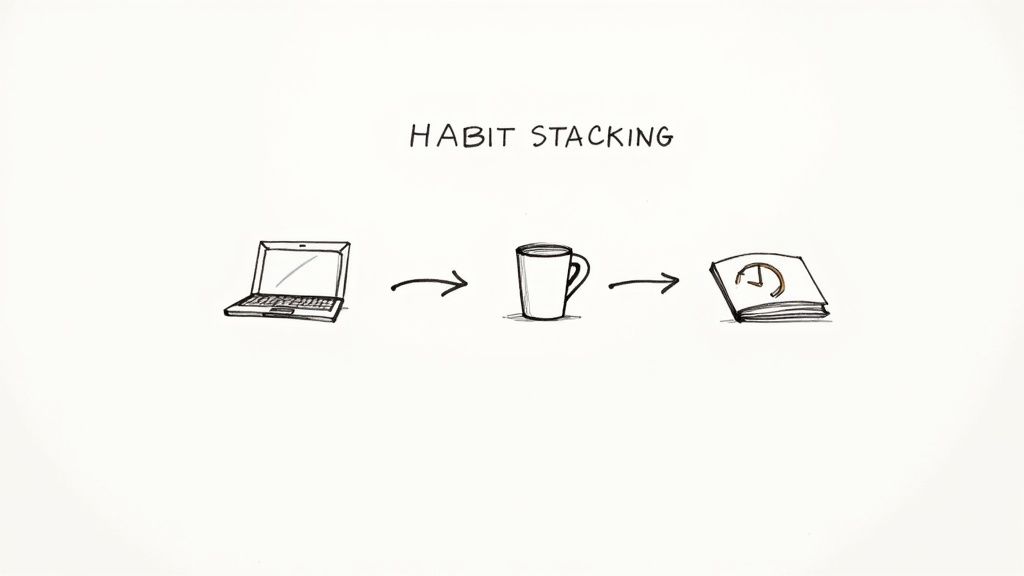
One of the most powerful ways I've seen people (and myself!) successfully add a new habit is through a technique called habit stacking. Instead of trying to forge a new routine from scratch, you simply piggyback your new self-care activity onto a habit you already do automatically. It’s brilliant because it creates a natural trigger, making the new habit feel effortless over time.
Think about it: your day is already full of dozens of established routines you don’t even have to think about. Waking up, brushing your teeth, making that first cup of coffee, shutting down your computer at the end of the day. These are your foundational habits.
By linking your new self-care practice to one of these, you take willpower and reminders right out of the equation. The formula is beautifully simple: “Right after [MY CURRENT HABIT], I will [MY NEW SELF-CARE HABIT].” This creates a seamless, natural flow from one action to the next.
For example, instead of just vaguely hoping to find time to unwind, you could create a specific, unbreakable contract with yourself:
- “Right after my last work email is sent, I will spend 10 minutes with my monochrome coloring book.”
- “Immediately after I pour my morning coffee, I will do five minutes of mindful breathing.”
- “As soon as I change out of my work clothes, I will put on a podcast and go for a 15-minute walk.”
This method completely removes the decision fatigue. The choice is already made; all you have to do is follow your own lead.
Identify Your Anchor Moments
To make habit stacking truly work for you, you need to pinpoint your personal anchor moments. These are the solid, reliable points in your day that can serve as the foundation for your new routine. They’re the things that happen consistently, no matter how chaotic the day gets.
Everyone’s anchor moments will be different, but some classic examples include:
- The moment your morning alarm goes off
- Finishing your lunch break
- The kids finally heading off to school
- Putting your keys down on the counter when you get home
An anchor moment is a stable point in your day that you can count on. By attaching your self-care practice to it, you’re not adding a new task to your schedule; you’re simply enhancing a moment you already own.
Once you’ve identified a few key anchors, you can start building your micro-routines around them. This is exactly how to practice mindfulness daily without feeling like you're overhauling your entire life. It’s all about finding and protecting these small but mighty pockets of time.
Design Your Micro-Routines
With your anchor moments identified, you can start designing intentional micro-routines that match your energy levels and needs throughout the day. The goal isn't to find a full hour for self-care. It’s to claim several 10 to 15-minute windows that are just for you.
Think about what you truly need at different times. A morning routine might be about waking up your mind and setting a positive tone, while an evening practice is all about winding down and letting go of the day's stress.
Sample Micro-Routines
- Morning Energizer (15 minutes): Right after your alarm goes off, spend five minutes stretching, five minutes journaling three things you're grateful for, and five minutes sipping your coffee in complete silence.
- Midday Pause (10 minutes): Immediately after you finish lunch, step away from your screen and complete one page in your monochrome coloring book to reset your brain and regain focus.
- Evening Wind-Down (20 minutes): As soon as the kitchen is clean, dim the lights, put on some calming music, and read a book (for fun, not work!) until you feel ready for bed.
When you start small and link these practices to habits you already have, you build undeniable momentum. You’re no longer just hoping to feel better—you’re actively building a self-care system that’s designed to last in the real world.
How to Handle the Inevitable Self-Care Roadblocks
Let's be real for a moment. You can design the most beautiful, thoughtful self-care plan, but life will absolutely get in the way. It always does.
A last-minute project drops on your desk. Your kid wakes up with a fever. You just feel... off. This is precisely where most well-intentioned routines fall apart. Missing one day turns into two, and before you know it, a wave of guilt washes over you, making it even harder to get back on track.
But here’s the secret: a resilient self-care practice isn't about being perfect. It’s about anticipating these bumps in the road and knowing how to steer around them. It's about building a system that's flexible enough for the beautiful mess that is your actual life.
What to Do When You Feel Guilty Taking Time for Yourself
This one is huge. In a world that puts a gold medal on "busy," carving out even 15 minutes for yourself can feel ridiculously selfish. That nagging inner voice starts up, telling you all the "productive" things you should be doing instead.
It’s time to flip that script. Self-care isn't an indulgence; it's a fundamental part of being effective at anything. When you consistently recharge, you're building a defense against burnout. You think more clearly, solve problems more creatively, and have more patience for the people around you. Taking that time isn't slacking off—it's a strategic investment in your own well-being and performance.
Think of it this way: you wouldn't feel guilty for plugging in your phone when its battery is low. Your energy is no different. Self-care is simply how you recharge.
When Your Motivation Completely Vanishes
Some days, you just won't have it in you. The motivation well is dry, and the thought of starting anything new feels like climbing a mountain. This is where your secret weapon comes in: the zero-effort, no-decisions-needed activity. A solid system never relies on fleeting feelings like motivation.
This is exactly why we created the monochrome coloring book. When you're mentally tapped out, the last thing you need is another choice to make. No agonizing over color palettes or stressing about the finished product. Just grab one pen and fill in the shapes. That’s it.
Lowering the barrier to entry is everything. On those days when you’re running on fumes, your only goal is to show up. Having an activity that requires almost zero mental lift means you can keep the promise to yourself, even when you feel like you have nothing left to give.
When Your Schedule Implodes
Life is chaos, elegantly disguised as a plan. A week that looks calm and collected on Monday can be an absolute dumpster fire by Wednesday. And when things get hectic, what's the first thing we sacrifice? The very habits designed to keep us sane.
The trick to surviving these moments is to be flexible, not rigid. Your routine is a toolkit, not a contract you'll be penalized for breaking.
- Shrink the habit. Can't find 15 minutes? Do five. Even a few deep breaths or coloring one tiny section of a page in our monochrome coloring book counts. It’s about keeping the habit's neural pathway active, not about hitting a time quota.
- Pull out your '5-Minute Resets.' Remember that self-care menu you made? This is what it was built for. Deploy one of those quick-hit activities and move on with your day.
- Give yourself some grace. Seriously. If you miss a day, don't let it become a spiral of self-criticism. Acknowledge that you did your best in a tough spot, and simply plan to get back to it tomorrow.
Building a self-care practice that actually lasts means being kind to your future self. When you plan for these challenges, you create a system that can bend without breaking, ensuring you have the support you need when you need it most.
Weaving Modern Tools into Your Wellness Practice
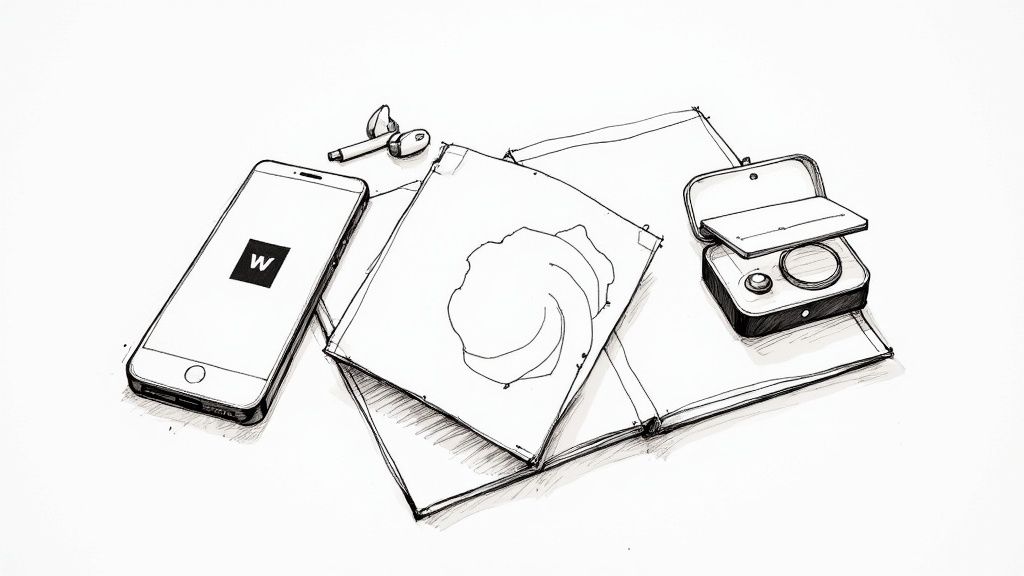
Trying to build a self-care routine from scratch on willpower alone is a recipe for burnout. Luckily, we don't have to. We're surrounded by an incredible number of thoughtfully designed tools—both digital and physical—that can make this whole process feel less like a chore and more like a gift to yourself.
The secret is picking resources that reduce friction, not add another layer of complexity to your already packed schedule.
Before you start downloading every wellness app you see, take a moment. What do you actually need? A gentle nudge to take a deep breath? An app might be perfect. A screen-free way to quiet a racing mind? A physical tool like our monochrome coloring book is probably the better bet. You’re looking for allies in your well-being, not another demanding task on your to-do list.
Finding Support, Not More Digital Noise
The best tools are the ones designed with intention, fitting neatly into the cracks of your day. A great meditation app can guide you through a session on your lunch break, and a quality journal gives your thoughts a dedicated, private home.
This is exactly why we create our Mono Moment products. They are born from the need for a simple, decision-free escape—something tactile that can calm the nervous system without staring at yet another screen.
This move toward curated, intentional wellness isn't just a fleeting trend. People are actively searching for products to build better self-care habits, and it shows. The personal care industry is booming with over 35,040 companies and 3,025 startups innovating in this space. You can discover more about the future of personal care innovation and see just how technology is shaping our wellness routines.
Choosing Tools That Actually Serve Your Goals
When you're looking at a new app or product, always bring it back to your "why." Does this tool align with what you’re trying to achieve?
If your goal is to reduce screen time before bed, reaching for a physical journal makes a lot more sense than opening a notes app on your phone. If you need a quick, meditative break between meetings, a monochrome coloring book you can finish in 15 minutes is far more practical than a complicated craft project that will sit half-finished for weeks.
The best wellness tools don't ask you to change your life to fit them. They seamlessly fit into the life you already have, making consistency feel almost effortless.
So, how do you pick the right kind of support for your practice?
- To stay consistent: Look into habit-tracking apps or even just a simple wall calendar. That visual proof of your progress can be a huge motivator to keep the streak alive.
- To practice mindfulness: Guided meditation apps, calming playlists, or analog tools like our One Color Coloring Book are fantastic for helping you stay grounded in the present moment.
- To spark new ideas: Wellness podcasts or curated newsletters can introduce you to fresh practices, keeping your routine from feeling stale.
By choosing just a few key resources, you're not just buying a product; you're building a personal support system. It's what makes showing up for yourself so much easier, especially on the days you need it most.
Got Questions About Making Self-Care Stick? You're Not Alone.
As you start weaving these new habits into your life, questions are going to come up. That’s a good sign—it means you’re engaged and thinking critically about what works for you. Let's tackle some of the most common hurdles people face so you can navigate them with confidence.
"What Do I Do When I'm Just Not Feeling Motivated?"
This is probably the most common question I get, and the answer is surprisingly simple: have a "no-brain" option ready to go. This is your default activity for days when your energy is at zero and your decision-making capacity is shot.
This is exactly why something like our monochrome coloring book is so effective. There's no big decision about which colors to use or what masterpiece to create. You just… start. On those days when motivation is nowhere to be found, your goal isn't to have a profound self-care experience; it's just to show up for five minutes. Having a ridiculously easy, decision-free option on hand helps you sidestep the motivation trap entirely and keep the momentum going.
"How Long Does This Actually Take to Work?"
You'll feel the immediate benefits of a micro-routine right away. Seriously. A single 15-minute coloring session is enough to slow a racing heart and turn down the volume on anxious thoughts. It’s an instant pattern interrupt.
The bigger, more lasting changes? You'll start noticing a real shift in your overall mood, your ability to focus, and how you handle stress after just a few weeks of staying consistent. It's a cumulative effect—track your energy levels for a week or two and see for yourself.
"Help! I Missed a Day. Have I Failed?"
Let’s get one thing straight: missing a day is not a failure. It's life. The real trap isn't missing a day; it's letting one missed day convince you to throw in the towel completely. Don't fall for that "all-or-nothing" thinking.
The goal here is a consistent pattern over the long haul, not a perfect, unbroken streak. So, you missed a day. Acknowledge it, let go of any guilt, and just pick it back up tomorrow. A truly sustainable practice is flexible enough to handle the messiness of real life.
"Should My Routine Always Stay the Same?"
Absolutely not! In fact, it should change. Think of your self-care routine as a living, breathing part of your life—it needs to adapt as you do. The support you need when you're powering through a massive project at work is completely different from what you'll need during a quiet week.
Check in with yourself every so often. Is your routine still serving you? What feels good? What feels like a chore? Give yourself permission to swap activities out, try new things, and adjust your routine to fit the season of life you're in right now.
Ready to build a simple, decision-free moment of calm into your day? The Mono Moment One Color Coloring Book is designed to help you unwind without the pressure of choice.
Find your moment of peace today at mono-moment.com

The One Color Coloring Book
A single-pen, decision-free coloring book on 160 gsm cream paper — engineered for the wind-down ritual described above.
 Pair it with the 3 Dual Tip Brush Pens — $5 instead of $9.95 in the Book + Pens bundle.