About the author
Published January 14, 2026 · Last reviewed April 26, 2026 · 15 min read
In this article · 6 sections
Art therapy gives you a powerful way to work through complicated feelings when words just aren't enough. It works by pulling your focus away from the spiral of overwhelming thoughts and grounding you in a hands-on, creative activity. This simple shift helps calm your nervous system and dial down stress.
This creative outlet acts as a release valve, letting you express emotions that are often too tangled to talk about. It’s a gentle, quiet path toward finding a bit of inner peace, and tools from stores like Mono Moment are designed to make this process accessible to everyone.
How Art Therapy Quiets a Worried Mind
Think of anxiety as a shaken-up snow globe, with all your worried thoughts swirling around in a chaotic blizzard. Art therapy is like gently setting that snow globe on a table and watching the flakes slowly, gracefully settle. It gives you a non-verbal way to handle feelings that are too messy or intense for a simple conversation, turning abstract stress into something real and tangible that you can see and interact with.
This whole creative process does more than just distract you—it actively soothes your brain. When you get lost in a focused artistic activity, you can quiet down the amygdala, which is basically the brain's alarm system. Instead of getting stuck in a loop of worry, your mind puts its energy into creating, pulling you into a state of mindful focus.
Embrace the Process, Not Perfection
One of the most important parts of using art therapy for anxiety is learning to let go of trying to create a perfect masterpiece. The real magic is in the doing—the journey of creating—not the finished product. For anyone who struggles with perfectionism (and many of us do), this can be an incredibly freeing idea. It's about the simple, physical feeling of a pen gliding across the paper or the quiet satisfaction of filling a shape with color.
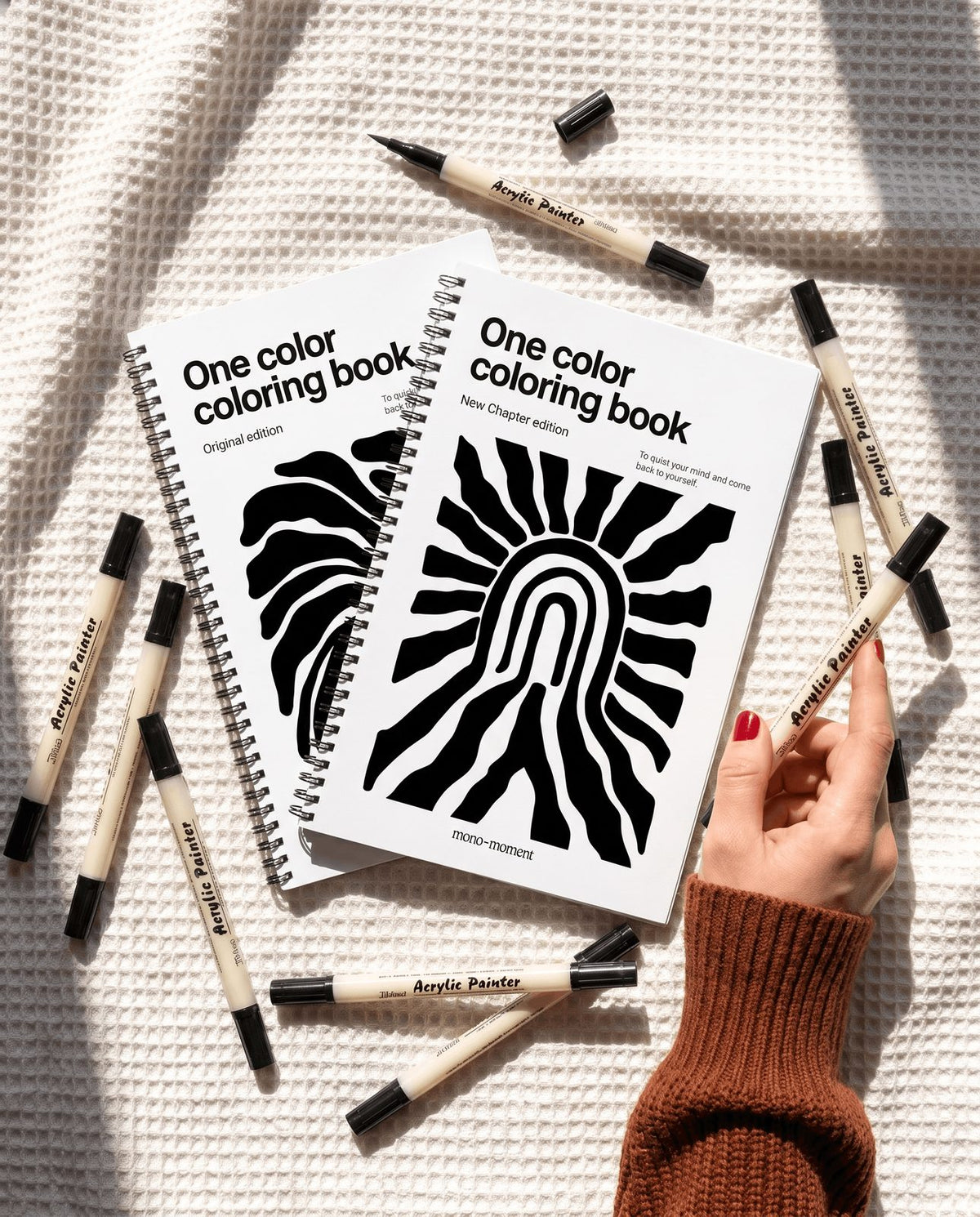
This is exactly where the right tools can make all the difference. Products like the Mono Moment monochrome coloring book are designed around this very principle. By taking away the overwhelming pressure of choosing colors, they cut through decision fatigue and help silence that inner critic who’s always worried about "getting it right."
"The aim of art is not to represent the outward appearance of things, but their inward significance." - Aristotle
An Easy Place to Start
You don’t need a fancy art studio or a cart full of expensive supplies to get started. The most helpful therapeutic art practices are usually the simplest. Structured activities, like coloring inside the lines, give you a safe, manageable framework that feels contained and reassuring, especially when you’re feeling a spike of anxiety. The Mono Moment store curates products specifically for this purpose, ensuring your path to calm is straightforward.
By focusing on one simple, repetitive task, you give your mind a much-needed break from the endless "what ifs" and "shoulds." Our guide on coloring for stress relief dives deeper into this idea. It’s an easy-to-reach approach that helps you build a calming, creative ritual into your day, one pen stroke at a time.
The Science Behind Creative Stress Reduction
Making art feels good, but have you ever wondered why it brings such a sense of calm? The power of art therapy for anxiety isn't just wishful thinking; it’s backed by some fascinating science, showing real, measurable changes happening inside your brain and body. When you pick up a pen and start creating, you’re not just doodling—you're actively shifting your entire neurological state.
Repetitive, structured motions, like the simple act of coloring inside a pattern, are especially powerful. This kind of focused activity is your ticket to a flow state—that deeply immersive, almost meditative zone where the noise of the world just fades into the background. When you're in flow, your brain waves actually change, your heart rate can slow down, and your body eases up on producing cortisol, the main stress hormone.
Calming the Brain's Alarm System
Picture your amygdala as your brain's super-sensitive smoke detector. If you live with anxiety, that alarm is probably going off all the time, signaling threats and worries that aren't really there. Making art, particularly coloring, acts like a gentle reset button for that alarm.
By focusing on the simple, sensory experience—the smooth glide of a pen, the sight of ink filling a clean shape—you redirect your brain's attention. Instead of fueling anxious loops, you're anchoring yourself firmly in the present moment. This is exactly the science that inspired the Mono Moment monochrome coloring book. Every detail, from the beautifully complex (but not overwhelming) patterns to the premium, no-bleed paper, is designed to guide you into that state of focused calm, minus the pressure of picking colors.
The infographic below breaks down just how effective this approach can be, showing art as a powerful outlet that sharpens focus and is incredibly easy to access.
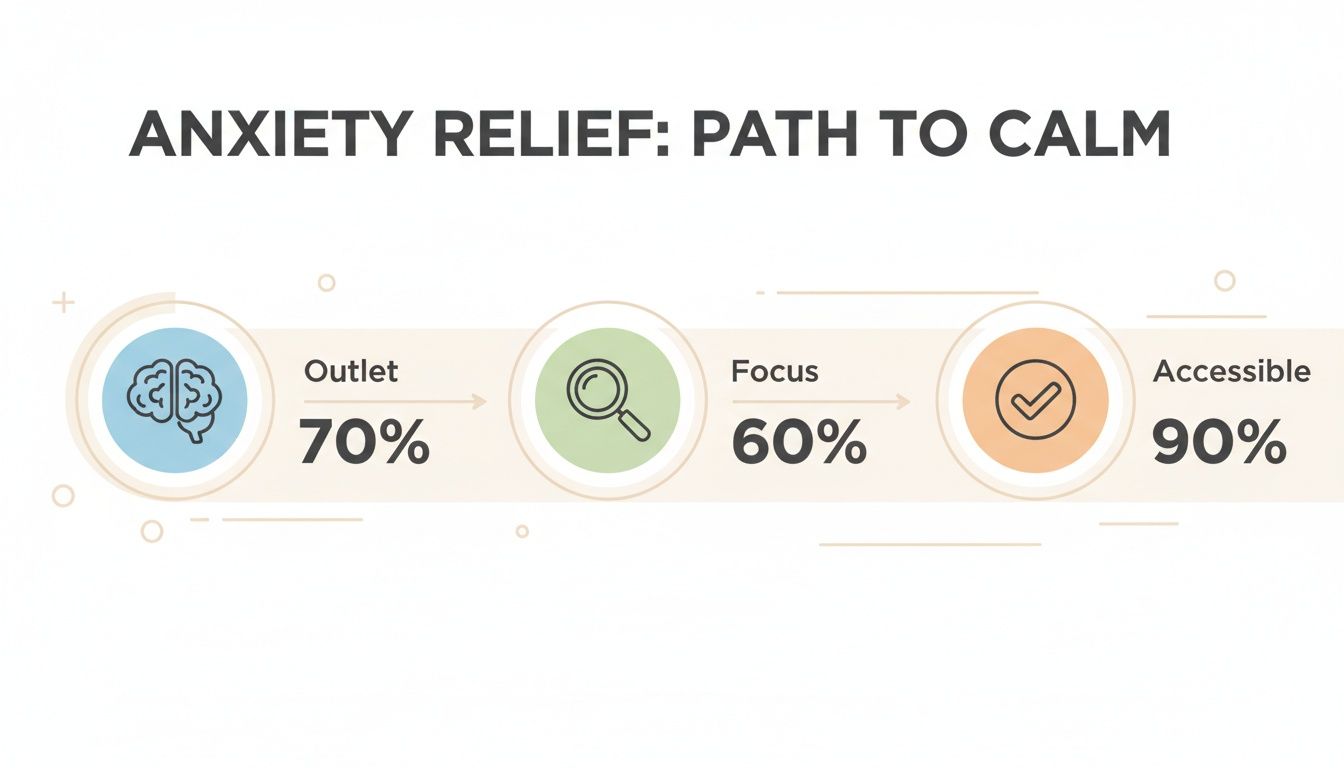
This really drives home how the creative process delivers a unique mix of emotional expression, mental clarity, and accessibility to help you manage anxiety on your own terms.
The Evidence for Creative Relief
And it’s not just theory. The scientific community has turned up strong, consistent evidence that art therapy works. The impact on younger minds is particularly striking. A meta-analysis combining six different studies, which included over 400 children and adolescents, revealed that art therapy significantly reduced their anxiety symptoms. The findings were so clear that they position art therapy as a genuinely powerful tool for managing anxiety.
The flow state you find through art isn't just a fleeting feeling of relaxation. It's a true neurological shift that actively pushes back against your body's stress response, offering real relief from the physical grip of anxiety.
By focusing on the creative process itself, you give your nervous system a much-needed break and a chance to reset. It’s a quiet but profound way to lower those stress hormones and find your center again.
If you're looking for more ways to manage stress, our guide on how to reduce cortisol levels naturally offers even more practical strategies. Ultimately, a simple creative practice with a tool like a Mono Moment coloring book puts a reliable method for finding calm right at your fingertips, ready whenever you need it most.
Simple Art Exercises You Can Try Tonight
Jumping into art therapy doesn't mean you need a dedicated studio or years of training. In fact, some of the most effective exercises for anxiety are refreshingly simple. They're designed to do one thing exceptionally well: quiet your mind and anchor you in the present. If you're an overthinker, these practices are the perfect, gentle way to unwind.
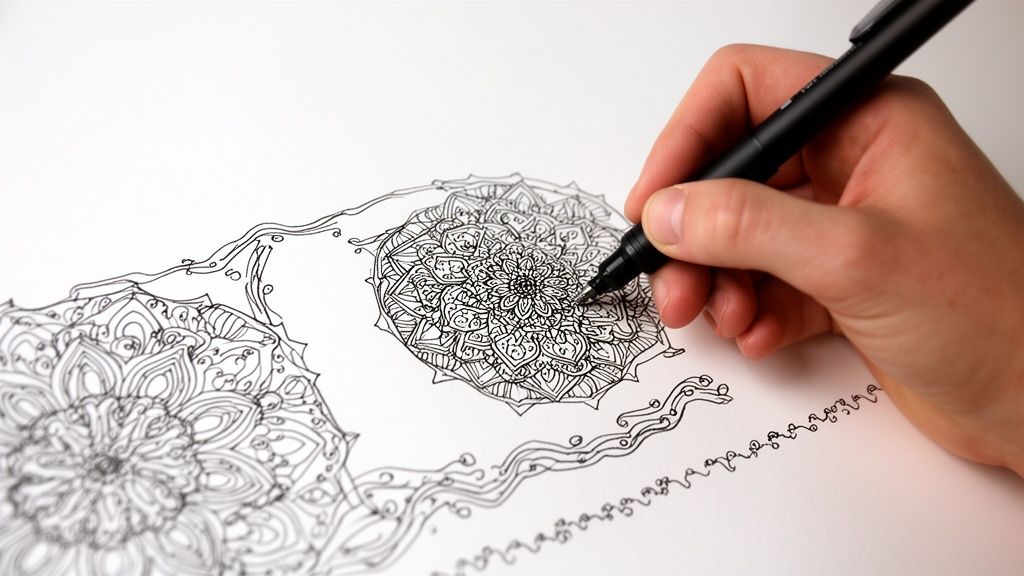
The point isn't to create a gallery-worthy masterpiece. It's about giving your anxious thoughts a place to rest while your hands get busy. By focusing on simple, repetitive motions, you can gently shift your brain out of its frantic worry-loop and into a state of calm, mindful focus.
Your First Step: Monochrome Mindful Coloring
When your mind is already racing, the last thing you need is a rainbow of choices. Picking colors, deciding where they go… it can all feel overwhelming. This is exactly why monochrome coloring is such a brilliant starting point. It strips away decision fatigue, letting you sink right into the creative flow without any mental hurdles.
The Mono Moment monochrome coloring book is perfectly suited for this. Its detailed patterns and premium paper are designed to give you a calming, decision-free experience from the get-go. All you need is the book and a simple pen, a key product also available from the Mono Moment store.
Ready to start your first mindful coloring session? Here’s all it takes:
- Choose a Single Pen: Just grab one black pen that feels good in your hand. Maybe you love how the ink flows or the weight of it. This one small choice sets an intention for simplicity.
- Focus on the Sensation: As you begin coloring, tune into the physical experience. What does the pen sound like against the paper? How does your hand feel as it moves across the page?
- Breathe with Each Stroke: Try syncing your breath to your coloring. Inhale as you draw a line, and exhale as you finish it. This is a powerful way to pull your awareness right back to this very moment.
- Embrace Simplicity: Let go of any pressure to make it "perfect." The beauty of black and white is its built-in elegance. Your only job is to fill the space and enjoy the feeling of doing it.
This isn't just coloring—it’s a moving meditation that can bring a sense of immediate relief.
The act of creation is a powerful anchor. By engaging your senses in a simple, tangible task, you can quiet the storm of racing thoughts and find a peaceful harbor in the here and now.
Other Powerful Exercises for Overthinkers
While monochrome coloring is a fantastic foundation, a few other structured exercises can also work wonders for a busy mind. These are designed to help you break free from the grip of perfectionism and find a soothing, meditative rhythm.
Here are a few simple exercises designed to help you calm an overthinking mind.
| Exercise | Best For | How It Helps |
|---|---|---|
| Monochrome Coloring | Quieting a racing mind and eliminating decision fatigue. | Using a dedicated product like the Mono Moment book removes the need to choose colors, so you can focus entirely on the physical act of filling in patterns, promoting a state of flow. |
| Continuous Line Drawing | Letting go of perfectionism and self-criticism. | Forces you to embrace imperfection as you draw an object without lifting your pen, teaching self-compassion. |
| Rhythmic Doodling | Soothing physical symptoms of anxiety. | Creating repetitive patterns like waves or spirals helps regulate your breathing and heart rate, creating a sense of calm. |
Each of these activities offers a unique pathway to a quieter mind.
Continuous line drawing, for instance, is a fantastic way to practice self-compassion. Just pick an object in your room and draw it without ever lifting your pen from the paper. It's guaranteed to be "messy," and that's the whole point. It trains you to let go of control and accept the beautifully imperfect outcome.
The power of these hands-on activities is backed by solid research. One study found that after university students participated in ceramic art sessions, their anxiety levels dropped dramatically. Before the sessions, 64.2% of participants reported mild to severe anxiety; afterward, not a single one reported severe anxiety. It’s a clear demonstration of the real, tangible calming effect of creative work.
If you’d like to explore more creative practices, take a look at our guide to different art therapy activities for adults. Think of these exercises as different tools for your mental well-being, with the Mono Moment book ready to serve as a trusted companion on your journey.
Building Your 20-Minute Calming Art Ritual
Real, lasting change when it comes to managing anxiety isn’t about grand gestures. It's about small, consistent habits. Building a creative self-care ritual can be the anchor you need in a sea of stress. This is about carving out a dedicated window of time—your own ‘Mono Moment’—to intentionally shut out the noise and reconnect with yourself through a simple, creative act.
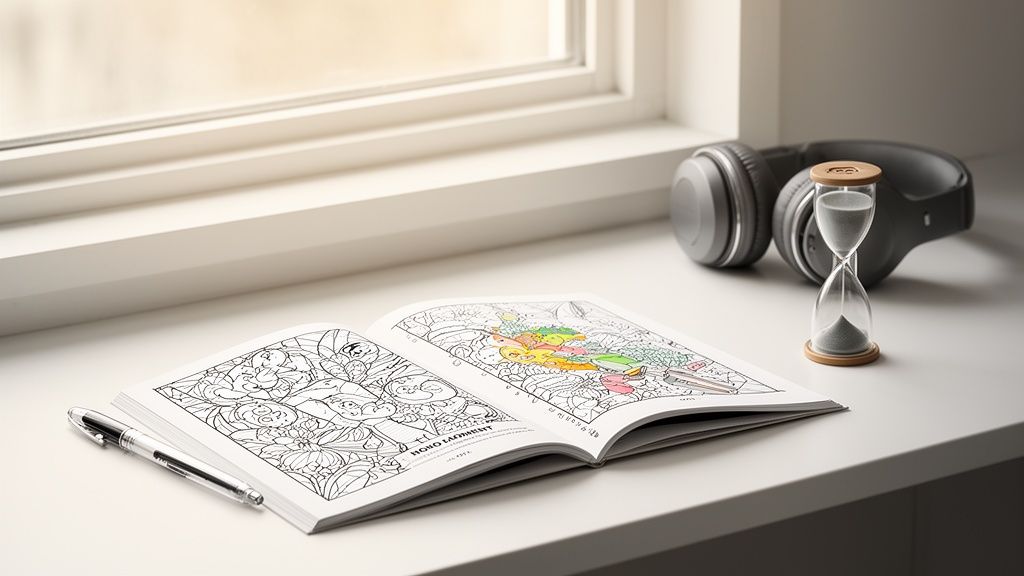
This ritual doesn’t need to be elaborate. In fact, its power is in its simplicity. Just 15 to 20 minutes a few times a week can do more for your nervous system than a single, marathon session once a month. The goal is to create a small, inviting space for calm that you actually want to return to, again and again.
Setting the Stage for Calm
The first step to making your ritual stick is creating the right environment. This sends a clear signal to your brain that it’s time to shift gears from high alert to a state of rest. Think of it as building a tiny sanctuary where your only job is to be present with your art.
Here’s how to set up your space for success:
- Find Your Quiet Corner: This doesn't have to be an entire room. A comfy chair by a window or a small, clear space at your desk is perfect. The key is consistency, so your mind begins to associate that specific spot with relaxation.
- Curate Your Soundtrack: Gentle instrumental music or ambient sounds can be a game-changer, helping to drown out distracting background noise and ease you into a focused state. Try to avoid anything with lyrics, which can easily pull your attention away.
- Silence the Outside World: This one is crucial. Put your phone on silent and, if you can, move it out of arm's reach. Turn off notifications on your computer. This small boundary protects your time and reinforces that this moment is just for you.
Anchoring Your Ritual with the Right Tool
Once your space is ready, you need a focal point—an activity that is both engaging enough to hold your attention and simple enough to be calming. This is where the Mono Moment monochrome coloring book becomes the perfect anchor for your new habit. It was designed from the ground up to support this exact kind of ritual, making the practice of art therapy for anxiety feel almost effortless. All Mono Moment products are built around this philosophy of simplicity and focus.
The most powerful self-care practices are the ones you actually stick with. By removing friction and making the experience inherently satisfying, you're not just coloring—you're building a reliable coping mechanism.
The illustrations inside are intentionally designed to be finished in one short session. This gives you a satisfying sense of accomplishment every time, preventing the low-grade stress of leaving a project unfinished. Instead of feeling like another task on your to-do list, your creative time ends with a feeling of completion and calm.
This simple, decision-free habit of picking up a single pen and your Mono Moment book can become one of your most dependable tools for navigating anxiety. It's a quiet promise you make to yourself—a consistent investment in your own peace of mind.
When Art Feels Like an Anchor in the Storm
When life starts to feel chaotic and your thoughts are racing a mile a minute, art can be an incredible anchor. In those moments of intense stress, when everything feels out of your control, a simple creative practice can bring you back to solid ground. It carves out a quiet, structured space where you can reclaim a sense of order, one deliberate pen stroke at a time.
This is when the idea of art therapy for anxiety shifts from a nice self-care activity to a vital coping strategy.
We saw this happen on a massive scale during recent global crises. With stress and uncertainty at an all-time high, so many people turned to creative outlets as a lifeline. It became a way to process emotions that were simply too big and too messy for words.
This isn't just a feeling; the power of art to restore a sense of control is backed by real-world experience. A May 2020 survey of 623 art therapy professionals found that a staggering 92% of their clients were struggling with anxiety from isolation, and over 80% were worried about their health.
The powerful part? The same report revealed just how effective art therapy was in those exact situations. It helped people manage everything from chronic pain to PTSD by giving them a way to shift their focus and feel in charge of something again. You can read more about these findings on the American Art Therapy Association's blog.
From Crisis Tool to Everyday Resilience
Knowing how well art works when things get tough really highlights its true potential: it’s a skill you can build for everyday life. You don't have to wait for a storm to learn how to navigate it. By developing a creative practice when you're feeling calm, you're turning it into a reliable tool you can lean on when you truly need it.
Practicing mindfulness through art when you are calm is like training your nervous system. You're teaching it the way back to a peaceful state, so when you do feel overwhelmed, it becomes a familiar, trusted path to follow.
This is exactly the thinking behind the Mono Moment coloring book. It’s designed to be more than just a way to relax after a tough day. Every time you sit down with an illustration, you're strengthening a mental muscle. You're building a proactive habit that grounds you, making it that much easier to face life's inevitable storms with a little more strength and a much clearer mind. The entire Mono Moment product line is created to support this kind of mental resilience.
Got Questions About Art Therapy? Let's Clear Things Up.
Starting anything new, especially when it’s for your own well-being, naturally brings up a few questions. If you're curious about using art therapy for anxiety, you're probably wondering about a few things. Let's get those sorted out so you can begin with clarity and confidence.
Think of this as our little chat before you dive in. We’ll tackle the most common questions head-on, turning that curiosity into focused, calming action. Once we’re done, you’ll have everything you need to start your own creative path to a quieter mind.
Do I Actually Need to Be "Good at Art" for This to Work?
Absolutely not. This is probably the biggest misconception out there, and it stops so many people before they even start. Let’s be clear: your artistic skill level has zero impact on the benefits you can get from this.
The whole point isn't to create a masterpiece for a gallery; it’s about the process of expressing yourself without words. The real magic happens in the doing—the focus it requires, the feeling of a pen moving across paper, the simple act of checking in with yourself. It's all about letting go of that pressure to be perfect.
This is exactly why something like the Mono Moment monochrome coloring book works so well. It’s designed to be approachable for everyone, no matter your artistic background, making the whole experience stress-free right from the start.
What’s the Difference Between Real Art Therapy and Just Coloring at Home?
That's a fantastic question, and it gets to a really important distinction. Formal art therapy is a clinical practice guided by a licensed, professional art therapist. It's a legitimate form of psychotherapy that helps people work through specific mental health challenges in a therapeutic environment.
What we're talking about here are therapeutic art activities, which are self-directed practices you can do on your own. This could be mindful coloring, doodling, or sketching to help manage everyday stress and anxiety. Here’s a simple way to think about it:
- Art Therapy: It’s like going to a physical therapist to treat a specific injury.
- Therapeutic Art: This is like doing your daily stretches at home to maintain your overall flexibility and well-being.
Both are incredibly valuable. Using a tool like a Mono Moment book at home is a powerful way to practice self-care and manage stress, tapping into the proven psychological benefits of creative expression to find your calm.
How Often Should I Be Doing This to Feel a Difference?
When you're trying to build a new, calming habit, consistency beats intensity every single time. A dedicated 15-20 minute session a few times a week will do you far more good than one marathon session once a month.
The real aim is to weave a sustainable ritual into your daily life. This way, you’re proactively managing anxiety by making calm a regular practice, instead of just reacting when you’re already feeling overwhelmed.
By keeping it short and manageable, you're much more likely to stick with it. And that consistency is what really retrains your nervous system, teaching it how to return to a state of calm more easily and building up your resilience to stress over the long run.
Your journey to a quieter mind doesn't have to be complicated. It can start right now. With the right approach, you can build a simple, effective ritual that anchors you in the present moment. The Mono Moment monochrome coloring book and other curated products were designed specifically for this—to offer a gentle, decision-free path to creative calm.
Ready to find your focus and let anxiety fade into the background? Explore the collection and claim your quiet moment at https://mono-moment.com.

The One Color Coloring Book
A single-pen, decision-free coloring book on 160 gsm cream paper — engineered for the wind-down ritual described above.
 Pair it with the 3 Dual Tip Brush Pens — $5 instead of $9.95 in the Book + Pens bundle.