About the author
Published December 20, 2025 · Last reviewed April 26, 2026 · 20 min read
In this article · 6 sections
To practice mindfulness daily, you don't need to overhaul your schedule. It’s about weaving small, intentional moments of awareness into the routine you already have. The real goal is consistency over duration, focusing on short, 1- to 5-minute exercises that feel effortless.
Your Path to Daily Mindfulness Starts Now
Feeling overwhelmed by the idea of starting a mindfulness practice? You’re not alone. So many of us picture needing hours of silent meditation, but the truth is far more accessible—and frankly, far more practical.
The secret to building a habit that actually sticks is to start small and weave moments of presence into the life you're already living. This isn't about adding another stressful item to your to-do list; it's about making mindfulness a natural, easy part of your day.
Instead of aiming for some long, perfect session, think in terms of "mindfulness micro-practices." These are short, powerful exercises you can do literally anywhere. Stuck in line at the grocery store? That’s a one-minute opportunity to notice your breath. Feeling that familiar tension at your desk? Take two minutes to feel your feet grounded on the floor and just listen to the sounds around you.
Why Starting Small Is Your Secret Weapon
The pressure to do mindfulness "right" is often the very thing that stops us from doing it at all. When you commit to just a few minutes a day, you lower the barrier so much that it feels genuinely easy to succeed. This little trick helps bypass the resistance and perfectionism that so often derail our best intentions.
So, what does this actually look like in practice?
- Mindful Sips: Instead of chugging your morning coffee on autopilot, take the first two sips with your full attention. Notice its warmth, its aroma, and how it tastes.
- A Single Breath: Before you fire off that next email or jump into a meeting, take one slow, deep breath. Inhale. Exhale. That's it. That’s a complete practice.
- Focus on One Sense: The next time you wash your hands, pay full attention to the feeling of the warm water and the smell of the soap. Simple, right?
This journey is all about taking that first tiny step, then another, and another.
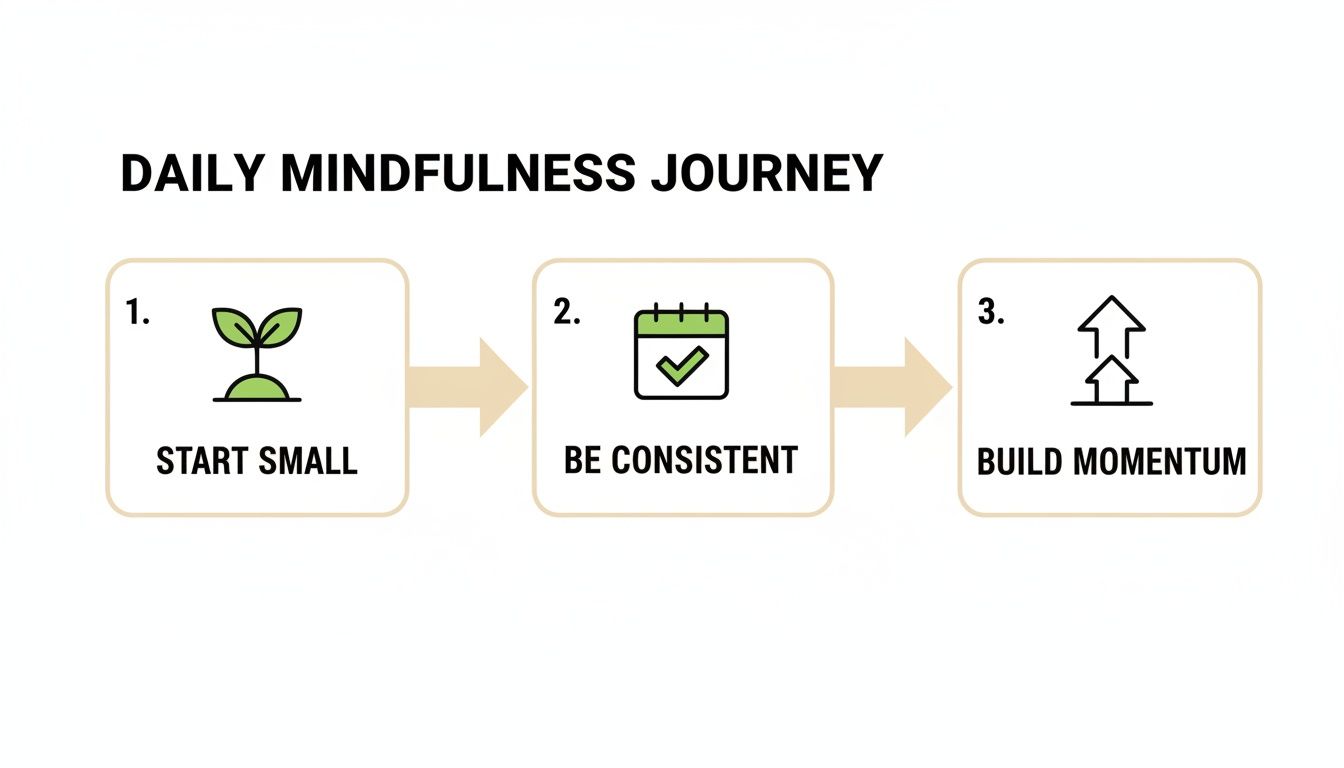
As you can see, starting with small, manageable steps is the key. That’s what creates consistency, which in turn builds the momentum you need to create a truly mindful life.
Your First Week of Mindfulness Micro-Practices
To help you get started, here's a sample schedule that integrates these tiny practices into a typical week. The goal here isn't perfection; it's just about showing up for a few minutes each day.
| Day | Morning (1-2 Mins) | Midday (3-5 Mins) | Evening (1-2 Mins) |
|---|---|---|---|
| Monday | Notice the taste & smell of your first 3 sips of coffee/tea. | Mindful walk: Pay attention to 5 sounds you can hear. | Before sleep, take 3 deep, slow breaths. |
| Tuesday | While brushing your teeth, focus only on the sensation. | Desk Reset: Feel your feet on the floor and sit up straight. | Notice the feeling of the sheets and pillow. |
| Wednesday | Feel the warm water on your skin during your shower. | Eat one snack without distractions (no phone, no screen). | Listen to a favorite song with your full attention. |
| Thursday | Mindful Commute: Notice 3 things you've never seen before. | 3-minute "body scan": Notice sensations in your hands, then feet. | Stretch your arms overhead and take one deep breath. |
| Friday | Take one conscious breath before opening your first email. | Look out a window and simply observe for 3 minutes. | Name 3 things you're grateful for from the day. |
| Saturday | Mindful Listening: Tune into the sounds around you for 1 min. | Step outside and feel the air on your skin for 5 minutes. | Color one section in a Mono Moment coloring book. |
| Sunday | S.T.O.P. practice: Stop, Take a breath, Observe, Proceed. | Mindful Moment: Pick an object and notice its color/texture. | Think of one kind thing you did for yourself today. |
Use this as a starting point. Feel free to mix and match or create your own tiny moments of awareness. The best practice is the one you'll actually do.
A daily mindfulness practice isn’t about adding more to your plate; it’s about changing how you experience what’s already there. It’s a shift from autopilot to awareness, one small moment at a time.
These tiny actions, when repeated daily, genuinely build powerful new neural pathways. Over time, these micro-practices accumulate, creating a foundation of calm and presence that you can draw upon when things get challenging.
So forget the pressure. Just start with one breath, one sip, one moment. You already have everything you need to begin today.
Crafting Your Morning Mindfulness Ritual
How you start your day sets the tone for everything that follows. Think about it: a frantic, reactive morning almost always leads to a frazzled, chaotic day. But when you start with a few moments of calm intention, you build a foundation of focus and stability that you can return to for hours.
This is exactly why a morning mindfulness practice is so powerful. It’s not about adding another stressful "to-do" to your list. It's about reclaiming those first few precious moments for yourself, before the world starts making its demands. It's a profound act of self-care that prepares you to handle whatever the day throws your way with a little more grace.
Why Mornings Are the Golden Hour for Mindfulness
There’s a good reason so many seasoned practitioners swear by a morning session. The early hours are often the quietest part of our day, a rare pocket of stillness before the emails, notifications, and responsibilities start flooding in. That peace and quiet makes it so much easier to turn your attention inward without the usual distractions.
This isn't just a feeling; the data backs it up. The 2025 Meditation Practice Report, which surveyed 212 practitioners, found that a whopping 57.8% prefer to meditate in the morning. It’s the most effective time for building a habit that actually sticks. The Mindful Leader meditation report suggests this timing works with our natural circadian rhythms, helping to set a calm baseline before the chaos of the day even has a chance to begin.
Simple Ways to Start Your Day Mindfully
You don’t need an hour-long silent retreat to feel the benefits. Honestly, even a few intentional minutes can completely shift your mindset. The real goal is to sprinkle moments of awareness into the things you’re already doing.
Here are a few incredibly simple ways to get started:
- The Three-Breath Reset Before Your Phone: We all do it—roll over and immediately grab our phone. Before you do, just pause. Take three slow, deliberate breaths. Feel the air fill your lungs and notice the gentle release as you exhale. This tiny act creates a crucial buffer between your peaceful sleep and the digital onslaught.
- Mindful Stretching: While waiting for the coffee to brew or tea to steep, do a few gentle stretches. But don't just go through the motions. Really pay attention to the sensations in your body. Feel the tension releasing from your shoulders, the stretch in your back.
- Savor That First Sip: When you take that first sip of coffee or tea, give it your full attention. For just a moment, let it be your entire world. Notice the warmth of the mug, the rich aroma, the actual taste on your tongue.
These small actions are the real building blocks of a meaningful practice. If you're looking for more ideas, we’ve put together a great list of quick mindfulness activities for adults that you can weave into any part of your day.
Designing Your 10-Minute Morning Session
Once you get the hang of these micro-practices, you might feel ready to carve out a slightly longer, dedicated block of time. A 10- or 20-minute session lets you go a bit deeper and really solidify the habit.
Your morning mindfulness session isn't something you have to do; it's something you get to do. It is a gift of stillness you give yourself before giving your energy to the rest of the world.
Here’s a simple framework for a 10-minute session. Feel free to play with it and make it your own:
1. Find Your Spot (1 minute):
Choose a comfortable, quiet place where you won’t be disturbed. This doesn't need to be some perfect zen den—a corner of your living room or even just sitting upright on the edge of your bed works beautifully.
2. Settle In and Breathe (3 minutes):
Gently close your eyes and bring your awareness to your breath. Don't force it or try to change it. Just observe its natural rhythm. Your mind will wander—that's what minds do! When it does, just gently guide your attention back to the breath.
3. Do a Gentle Body Scan (5 minutes):
Start with your toes and slowly bring your attention to each part of your body. Simply notice any sensations you feel—warmth, tingling, tightness—without judging them. Move up through your feet, legs, torso, arms, and all the way to the crown of your head. This is a wonderful way to connect with your physical self and ground you in the present.
4. Set an Intention (1 minute):
As you wrap up, think of one quality you’d like to carry with you into the day. Maybe it's patience, or kindness, or focus. Hold that word or feeling in your mind for a few moments before slowly opening your eyes and moving on with your day.
Weaving Mindfulness into Your Busiest Days
Let's be honest, the idea of adding one more thing to your packed schedule can feel completely overwhelming. But here’s the secret: mindfulness isn't another task for your to-do list. It’s a gentle shift in awareness that you can bring to the moments you already have.
This is where the real magic happens. You start transforming those mundane, autopilot activities—like doing the dishes or waiting for the kettle to boil—into rich opportunities to ground yourself and reconnect.
The most effective way I've found to do this is through a simple but powerful technique called habit stacking. Instead of trying to carve out new time for a mindfulness practice, you simply piggyback it onto an existing, non-negotiable habit. Think about it: you brush your teeth, make coffee, walk to your car every single day. Each one is a golden opportunity waiting to be noticed.
This approach cleverly bypasses the most common roadblocks, like feeling too busy or getting sidetracked. It’s about moving from "doing mindfulness" to simply "being mindful" in a way that feels seamless and natural.

Transforming Routine Tasks into Mindful Moments
The beauty of habit stacking lies in its simplicity. You don't need a special cushion, a quiet room, or even an extra minute. All you need is a willingness to pay attention. Start small by picking just one or two routine activities to infuse with a little more presence.
Here are a few practical examples I often suggest to get people started:
- Mindful Dishwashing: Instead of rushing through the chore with your mind elsewhere, tune into your senses. Really feel the warmth of the water on your hands. Notice the slick texture of the soap and the gentle clink of the plates.
- The Commute Reset: That short walk to the bus stop or your car? Turn it into a walking meditation. Feel your feet making solid contact with the ground. Notice the air on your skin and the sounds of the world around you, without judging any of it.
- Waiting Game Wake-Up: The next time you're stuck waiting for your computer to boot up, resist the urge to grab your phone. Use that minute for a quick body scan. Notice your posture, feel the chair supporting you, and just take three deep, conscious breaths.
This approach is gaining serious traction for good reason. It’s a fantastic way to build consistency, especially when formal meditation feels like too much. It directly tackles the common barrier of 'distractions'—which stops 26.2% of people from practicing—by embedding mindfulness right into life's unavoidable moments. You can read more about how this strategy is shaping wellness on YogaJournal.com.
Using Your Senses as Anchors
When your mind is racing a mile a minute, your senses are the most direct path back to the present. They act as powerful anchors, pulling you out of the chaotic stream of thoughts and into the tangible reality of right here, right now.
The goal is to intentionally tune into just one sense at a time during a routine activity.
Three Sensory Anchors to Try Today
- Sound: The next time you make a cup of coffee or tea, just listen. Close your eyes and hear the click of the machine turning on, the water beginning to rumble, and the final pour. Don't label the sounds as good or bad—just notice them.
- Touch: As you wash your hands, bring your full attention to the physical sensations. What’s the exact temperature of the water? How does the soap feel against your skin? What is the texture of the towel as you dry them?
- Sight: Before you take your first bite of lunch, take a 'mindful minute' to simply look at your food. Observe the different colors, shapes, and textures on your plate. This simple act can transform eating from a rushed task into a moment of genuine appreciation.
The point isn’t to do these tasks perfectly; it's to use them as a gentle reminder to return to yourself. Each time you bring your attention back, you are strengthening your mindfulness muscle.
This process can be a powerful act of reclaiming your time and attention. If you’re struggling to find these small pockets in your day, you might find some helpful ideas in our guide on how to make time for self-care, even when you feel totally swamped.
By weaving these small, sensory-based practices into your daily rhythm, you'll find that a calmer, more present life isn't something you have to chase—it’s something that naturally unfolds, one mindful moment at a time.
An Evening Ritual for Deep Rest and Relaxation
How you close out your day is every bit as important as how you start it. If your morning routine sets the tone, your evening ritual is your chance to consciously unplug from the day's chaos, quiet your mind, and prep your body for deep, restorative sleep.
This isn't about just collapsing in front of the TV. It's about creating a gentle, intentional buffer—a transition that tells your entire system it's time to power down and recharge. Think of it as one of the most powerful acts of self-care you can give yourself. It's your space to process the day, let go of that lingering tension, and create the ideal conditions for a peaceful night.

The Power of a Screen-Free Wind-Down
At the heart of any truly effective evening ritual is one non-negotiable rule: step away from the screens. The endless scroll, the constant pings, and the stimulating blue light keep our brains wired and on high alert. It's the opposite of what you need when you're trying to unwind.
A screen-free activity provides that vital buffer, giving your nervous system a real chance to settle. This is where a simple, tangible practice makes all the difference. I've found that an activity engaging your hands and senses in a gentle, repetitive motion is incredibly effective for calming a busy mind. It pulls your focus away from those anxious thought loops and grounds you right here, right now.
Your 20-Minute Coloring Meditation Ritual
We actually designed the Mono Moment monochrome coloring book with this exact purpose in mind. The intricate black-and-white patterns give you a structured, creative outlet that feels inherently meditative. By taking the decision of "what color should I use?" out of the equation, we’ve removed the pressure to be perfect. You can just sink into a state of easy, gentle flow.
Here’s how you can turn a simple coloring session into a powerful mindfulness practice that readies you for incredible rest.
-
Set the Scene (2 minutes): Start by dimming the lights. This is a classic, powerful signal to your body that the day is winding down. Maybe light a calming, scented soy candle from our collection to bring your sense of smell into the experience and create a truly tranquil vibe.
-
Choose Your Page (1 minute): Flip through your Mono Moment monochrome coloring book and just pick a pattern that catches your eye. We intentionally designed the illustrations to be completed in a 15–30 minute session, so they’re the perfect length for a nightly ritual without ever feeling like a chore.
-
Engage in Mindful Coloring (15 minutes): As you start coloring, bring all of your attention to the physical sensations. Notice the smooth glide of the pen across the premium 160gsm paper—it’s thick enough to prevent any bleed-through. Feel the simple, repetitive motion of filling in the lines. When your mind inevitably wanders, just gently guide it back to the point where your pen meets the page.
-
Sip and Reflect (2 minutes): I love pairing this with a warm, non-caffeinated drink like chamomile tea. When you finish your page, take a few sips and maybe jot down a couple of thoughts in a journal. It could be as simple as one thing you’re grateful for or something you want to consciously let go of before you sleep.
This whole sequence becomes a powerful sensory signal to your brain. The dim light, the soft scent, the tactile focus of coloring, and the warmth of the drink all work in concert to deliver one clear message: the day is done.
This structured creative practice is more than just a hobby; it’s a reliable, screen-free method to reduce cortisol and quiet the amygdala, your brain’s fear center. It is a predictable and comforting way to end your day on your own terms.
A mindful ritual like this doesn't just help you fall asleep faster; it actually improves the quality of that sleep, helping you wake up feeling more refreshed and resilient. For more ideas on how to decompress, you might find our guide on how to relax after work helpful.
By consistently practicing this evening wind-down, you're actively training your mind and body to release stress. You're building a sanctuary of calm you can return to every single night, ensuring you get the deep rest you truly deserve.
Navigating the Inevitable Bumps in the Road
Starting a mindfulness practice is exciting, but let’s get real for a moment—it’s not always a smooth, serene journey. Life has a way of showing up, unannounced. Your brain will feel like a loud, crowded room. Some days, the simple act of sitting down to practice can feel like pushing a boulder uphill.
This is all completely normal. More than that, it's not a sign you're failing.
The secret to a practice that actually lasts isn't about achieving perfection. It’s about learning how to handle these bumps with a bit of grace and self-compassion. Knowing what to expect is half the battle, so let’s talk about the most common hurdles and how to clear them.

"My Mind Won't Shut Up!"
This is, without a doubt, the biggest myth in mindfulness. The goal has never been to force your thoughts to stop or to achieve a totally empty mind. Honestly, that's impossible. Our brains are thought-making machines.
The real practice happens in the moment you notice your mind has wandered off and you gently, without judgment, guide it back.
Imagine your thoughts are just clouds floating through the sky. You're the sky itself—vast, open, and unchanging. You don't have to chase every cloud or try to force it away. Just acknowledge it's there and let it drift by on its own.
That moment you realize you've been lost in thought and you gently return to your breath? That’s not a mistake. That is the practice. Every single time you do it, you're building your mindfulness muscle.
When your mind feels especially chaotic, giving it a tangible anchor can be a game-changer. This is precisely why we created the Mono Moment monochrome coloring book. The simple, rhythmic motion of a pen on paper gives your racing mind a gentle, singular thing to focus on, making it so much easier to stay grounded.
"I Can't Sit Still—I Feel Too Restless"
That antsy, fidgety feeling is incredibly common, especially when you’re new to this. It can feel like your body is literally rebelling against the idea of stillness. So, instead of fighting that energy, why not work with it?
Solutions for When You Feel Fidgety
- Try a Walking Meditation: Take your practice outside. Instead of your breath, focus on the physical sensation of your feet connecting with the ground, the feeling of the air on your skin, or the sounds filling the space around you.
- Move Mindfully: A few gentle stretches or a simple yoga flow can be a fantastic way to tune into your body without demanding perfect stillness.
- Use a Tactile Anchor: Ground yourself with a physical object. The satisfying feel of a pen gliding across the premium 160gsm paper in your Mono Moment monochrome coloring book can channel that restless energy into a calming, creative flow.
The trick is to meet yourself where you are, rather than trying to force a state of being that just isn't happening right now.
"I Seriously Don't Have the Time"
This is the big one. In our jam-packed lives, finding even 10 spare minutes can feel like a monumental ask. The key here is to completely redefine what "practice" looks like.
It doesn’t have to be a long, formal meditation session. Think back to the micro-practices we talked about.
- A single minute of deep breathing before you log into your first meeting.
- Paying 100% attention to the warmth and taste of your morning coffee.
- Doing a quick 30-second body scan while you wait for the microwave.
These tiny moments really do add up. They weave a thread of mindfulness throughout your day without requiring you to overhaul your entire schedule. And remember, just 15–20 minutes with your coloring book before bed can be a powerful, seamless way to build mindfulness into a routine you already have.
"I Just Keep Forgetting to Do It"
When a habit is brand new, it's so easy for it to slip your mind. Don't rely on willpower alone to remember—that's a recipe for frustration. Instead, design your environment to do the remembering for you.
- Set Gentle Nudges: A recurring, low-key alarm on your phone or a simple sticky note on your bathroom mirror works wonders.
- Try Habit Stacking: Piggyback your new mindfulness habit onto an existing one. For example: "After I brush my teeth at night, I will color for one page."
- Use a Visual Cue: This is my favorite. Leave your Mono Moment monochrome coloring book and a nice pen out on your nightstand or coffee table. When you see it, it serves as a beautiful, inviting reminder, not another chore on your to-do list.
By expecting these obstacles, you can approach your practice with more flexibility and kindness. Every challenge is just an opportunity to learn what works for you, ensuring your journey toward a more mindful life is one you can actually stick with.
Your Mindfulness Questions Answered
As you start weaving mindfulness into your daily life, questions are going to come up. That’s not just normal—it's a great sign. It means you're really digging in and figuring out what this all means for you.
So, let's talk through some of the most common hurdles and "am I doing this right?" moments. Think of this as a quick chat to clear up any confusion and help you move forward with confidence.
What Is the Difference Between Mindfulness and Meditation?
I get this one all the time, and it's a fantastic question. The easiest way I've found to explain it is by comparing it to physical fitness.
Mindfulness is the overall quality of being present and aware. It’s the "fitness" you carry with you all day long—like truly tasting your food, feeling the warmth of the sun on your skin, or actually hearing what your friend is saying instead of just waiting for your turn to talk. It's a state of being.
Meditation, on the other hand, is the workout. It's the specific time you set aside, maybe for 10-20 minutes, to intentionally train your attention. It's the "reps" you do to build your mindfulness muscle.
Meditation is the dedicated training session. Mindfulness is the strength and awareness you use in the real world, long after the session is over.
Is It Okay if My Mind Wanders During Practice?
Yes. A thousand times, yes. In fact, if your mind didn't wander, you wouldn't be human.
A wandering mind isn't a failure; it's an opportunity. The real magic of the practice happens in that gentle moment you realize you've drifted off and you kindly guide your attention back. Each time you do that, you're completing a mental push-up. You're literally strengthening the parts of your brain responsible for focus and self-awareness.
This is a huge reason we created the Mono Moment monochrome coloring book. The simple, structured patterns provide a perfect, tangible anchor for your attention. When you notice your mind has jumped from coloring to replaying a work meeting, you can easily bring your focus back to the simple sensation of the pen gliding across the paper. It makes that act of "returning" feel restorative, not frustrating.
How Long Until I Start to Feel the Benefits?
Everyone’s timeline is different, but the secret is to stop looking for a lightning bolt moment and start noticing the small, quiet shifts. Many people feel a little calmer right after their very first session, especially with a hands-on activity like coloring that gets them out of their heads.
The deeper, more lasting changes—like feeling less stressed, improving your focus, or not getting so easily hooked by difficult emotions—tend to build gradually with consistency.
What to Look for Early On:
- You might find yourself a little less irritated by the person driving slowly in front of you.
- You might actually taste the first few sips of your morning coffee instead of just chugging it.
- You might catch yourself before firing off a reactive text and take a breath first.
These little moments are the benefits. They are the real-world proof that you're learning how to practice mindfulness daily in a way that’s actually changing how you experience your life. Don't dismiss them—they are the bedrock of a calmer, more present you.
Ready to build your own calming evening ritual? The Mono Moment monochrome coloring book is designed to make mindfulness easy and accessible. With decision-free patterns and premium paper, it’s the perfect tool to quiet your mind.
Discover your moment of calm at mono-moment.com

The One Color Coloring Book
A single-pen, decision-free coloring book on 160 gsm cream paper — engineered for the wind-down ritual described above.
 Pair it with the 3 Dual Tip Brush Pens — $5 instead of $9.95 in the Book + Pens bundle.