About the author
Published January 6, 2026 · Last reviewed April 26, 2026 · 18 min read
In this article · 6 sections
Ever finish a long day and feel completely steamrolled by the simple question of what to make for dinner? That mental fog, that feeling of being utterly done, is very real. It’s called decision fatigue, and it’s what happens when the sheer volume of choices you’ve made all day leaves you mentally exhausted.
The Hidden Drain of Everyday Choices
Think of your willpower and decision-making ability like a muscle. Each morning, you wake up fresh. But with every choice you make—what to wear, which email to tackle first, whether to have that second cup of coffee—you’re doing a mental rep.
Some decisions are like lifting a small dumbbell. Others, like navigating a tricky work problem or a tense conversation, are a heavy deadlift. By the end of the day, that muscle is spent. That’s the core of decision fatigue: the quality of your choices starts to tank simply because you’ve run out of the mental energy to make good ones.
When this happens, your brain doesn't just shut down; it starts looking for the easy way out. Instead of carefully weighing pros and cons, you might act impulsively, or even worse, avoid making a decision altogether. This isn't a character flaw. It's just a sign that your cognitive tank for the day is running on empty.
Why Your Mental Battery Drains So Fast
Modern life is an endless barrage of choices. Research suggests the average adult makes a staggering 35,000 remotely conscious decisions every single day. That relentless demand puts a massive strain on our prefrontal cortex—the part of the brain that handles executive functions like rational thinking and self-control.
When it gets overworked, you start to see the signs:
- Putting off important tasks you know you should be doing.
- Getting irritable or frustrated over things that normally wouldn't bother you.
- Making impulsive purchases you later regret.
- Feeling your focus completely dissolve by late afternoon.
This is precisely why finding ways to rest your brain is no longer a luxury, but a necessity. You need moments of decision-free quiet to let that mental battery recharge.
Activities that eliminate choice, like the simple, structured process of coloring in a Mono Moment monochrome coloring book, are a powerful antidote to this daily drain. By removing the need to even pick a color, it gives your brain a much-needed break and a direct path to mental rest. Understanding this daily drain is the first step toward getting your focus, clarity, and peace of mind back.
What Is Decision Fatigue, Really?
Ever wonder why you can stick to a healthy diet all day, only to find yourself ordering a greasy pizza at 10 PM? Or why you meticulously plan your budget but then make a spontaneous online purchase you instantly regret? The culprit is likely decision fatigue.
At its heart, decision fatigue is the slow erosion of your ability to make sound choices after a long session of decision-making. Think of your self-control or willpower as a muscle. Just like lifting weights, every choice you make—from what to wear to which email to answer first—is a "rep." By the end of the day, that muscle is tired, weak, and prone to failure.
When your mental energy hits rock bottom, your brain takes one of two shortcuts to conserve what's left. The first is recklessness: you act impulsively, grabbing the easiest, most gratifying option without thinking it through. The second is paralysis: you avoid making a choice altogether, stuck in a loop of indecision because the effort feels too monumental.
The Slow Burn of a Thousand Tiny Choices
It’s rarely one massive decision that breaks us. It's the relentless onslaught of thousands of tiny, seemingly insignificant ones that add up. From the moment you wake up, you’re bombarded with choices that slowly drain your cognitive battery.
This simple illustration shows exactly how our mental energy gets depleted as the day's choices accumulate.
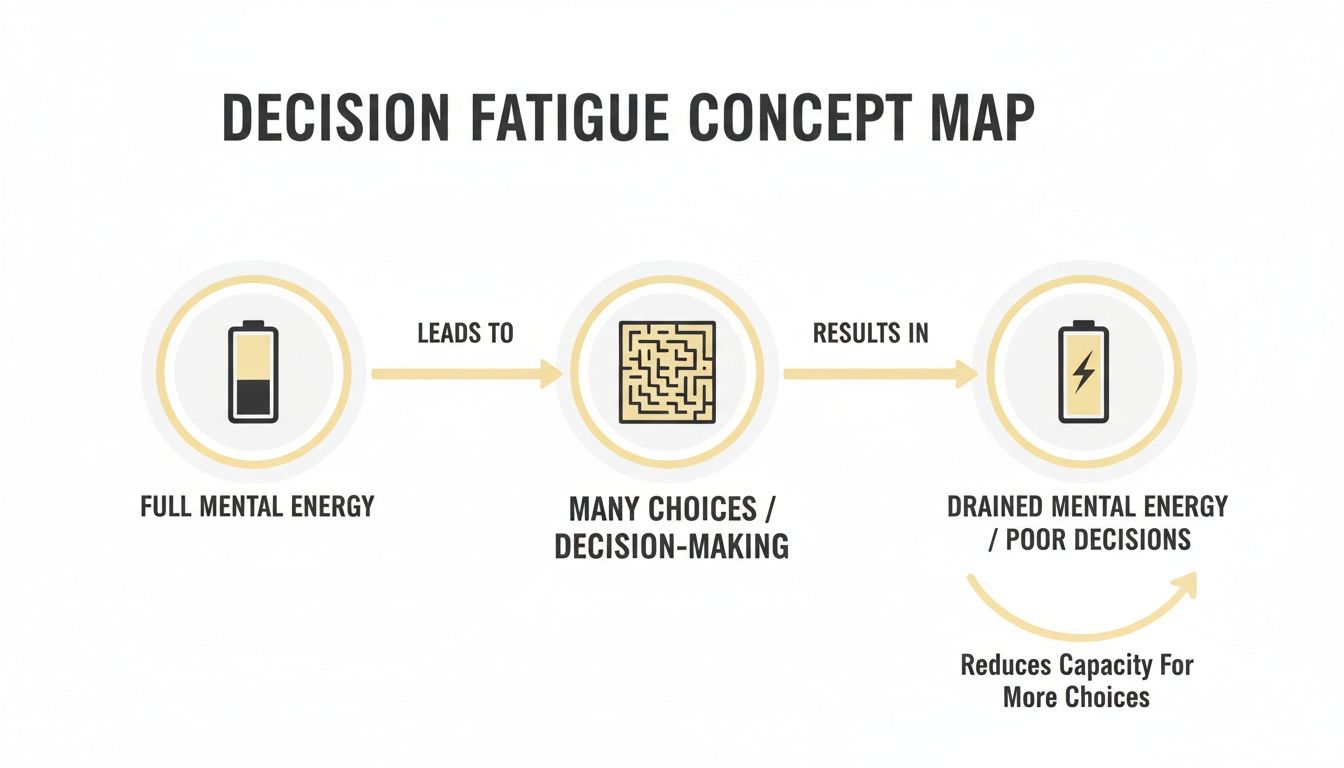
As you can see, the more decisions you're forced to make, the lower your mental reserves drop, making poor judgment almost inevitable.
This isn't just a vague feeling; the numbers are staggering. The average adult makes an estimated 35,000 decisions a day. In the office, workers are interrupted every 3 to 11 minutes, and they spend 30% of their time just hunting for information—each search a series of micro-decisions. For those of us prone to overthinking, this constant demand compounds stress and leads to information overload, costing the U.S. economy a jaw-dropping $900 billion annually in lost productivity.
It’s in this context that truly decision-free activities, like the calming ritual of using a Mono Moment monochrome coloring book, become so powerful. You can learn more about the workplace impact of decision fatigue and its surprising economic costs.
How to Recognize Decision Fatigue in Your Life
Decision fatigue is sneaky. It creeps in gradually, so you might just feel "off," irritable, or unmotivated without knowing why. Being able to spot the warning signs is the first, most crucial step toward getting back in control.
Decision fatigue isn't a personal failure; it's a natural consequence of a brain pushed beyond its limits. The key is not to judge yourself for feeling drained but to identify the signs early and take restorative action.
So, what should you look out for? This table breaks down the most common symptoms, what they feel like day-to-day, and the real-world consequences they can have.
Signs of Decision Fatigue in Your Daily Life
| Symptom | What It Feels Like | Common Outcome |
|---|---|---|
| Procrastination | That overwhelming urge to put off tasks—even simple ones—because just starting feels like too much work. | Deadlines get missed, projects pile up, and you’re left with a constant, nagging feeling of being behind. |
| Impulsivity | Making rash, short-sighted choices without really considering the fallout. | You find yourself caving to unhealthy habits, making impulse buys, or saying "yes" to things you later regret. |
| Irritability | A short fuse. Minor inconveniences that you’d normally brush off now feel intensely frustrating. | You might snap at loved ones or coworkers over small things, putting a strain on your important relationships. |
| Mental Fog | A feeling of being mentally "stuck." You struggle to concentrate, focus on one thing, or even remember simple details. | Your work quality slips, and you find it hard to contribute meaningfully in meetings or even follow a conversation. |
| Avoidance | Actively dodging any situation that requires a decision, from what to have for dinner to major life choices. | You get stuck in indecision, leading to missed opportunities and a frustrating feeling of powerlessness. |
By recognizing these patterns in your own behavior, you can start to understand when your brain is signaling for a break and begin implementing strategies to recharge.
The Science of a Mentally Drained Brain
Ever feel completely "fried" after a long day of work? That's not just a feeling—it’s a very real process happening inside your brain. To really get what decision fatigue is, we need to look at the neurological tug-of-war going on between two key parts of your mind.
This mental drain is often explained by a concept called ego depletion. The easiest way to think about it is to picture your self-control and willpower as a battery. It starts the day fully charged, but every single decision you make—big or small—saps a little bit of that power.
By the time late afternoon rolls around, after you’ve made hundreds of choices, that battery is running on fumes. This is when your brain's internal balance starts to tip, leading straight to that all-too-familiar irritability, impulsiveness, and sheer exhaustion.
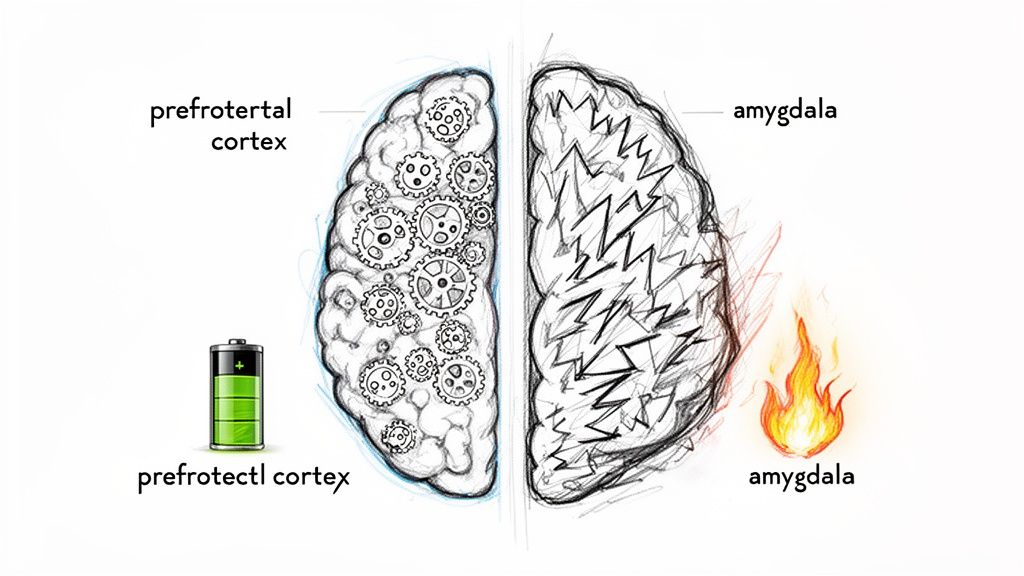
Your Brain's CEO Is Overworked
The part of your brain in charge of logic, planning, and reining in your impulses is the prefrontal cortex. Think of it as the calm, rational CEO of your mind. It’s the part that carefully weighs the pros and cons to make smart, calculated decisions.
Your prefrontal cortex is what convinces you to choose the salad over the fries, resist checking your phone during a meeting, or patiently work through a tricky problem. But like any CEO buried in meetings and requests, it can get completely burned out.
When it's hit with a non-stop barrage of choices, its performance tanks. With each new demand, its ability to manage emotions, fight off impulses, and make thoughtful judgments gets weaker and weaker.
When the Emotional Brain Takes Over
As your prefrontal cortex gets exhausted, a more primal part of your brain sees its chance and jumps into the driver's seat: the amygdala. This is your brain’s built-in alarm system, the command center for your fight-or-flight response.
The amygdala is all about impulse, reaction, and getting what it wants right now. It couldn't care less about long-term goals; its only job is to avoid pain and seek pleasure in the immediate moment. This neurological power shift is precisely why you're more likely to snap at a partner or make a rash online purchase after a draining day. Your rational CEO has clocked out, and the emotional, reactive intern is now running the show.
This shift from the thoughtful prefrontal cortex to the reactive amygdala is the core biological reason behind decision fatigue. It’s not a lack of willpower; it’s a temporary hijacking of your brain's control center by its most primitive instincts.
This constant state of high alert can also flood your system with stress hormones. For more on this, our guide on how to reduce cortisol levels naturally offers some practical ways to calm your body’s stress response.
Taming the Amygdala and Restoring Balance
So, how do you give your prefrontal cortex a much-needed break and quiet down that overactive amygdala? The key is to find activities that demand very little mental energy and actively soothe your nervous system. This is where structured, decision-free practices and products become incredibly powerful.
An activity like coloring in a Mono Moment monochrome coloring book, for instance, is a product designed specifically to tackle this neurological imbalance. By completely removing the need to choose colors, it gives your overworked prefrontal cortex a chance to step back.
- It reduces cognitive load: Your brain isn’t forced to analyze, compare, or decide. It can just relax and follow the simple lines.
- It engages in gentle focus: The simple, repetitive motion is inherently calming, helping to pull your brain out of its stressed, reactive mode.
- It quiets the amygdala: Research has shown that structured, creative activities like coloring can lower anxiety and turn down the volume on the amygdala's frantic signals.
When you intentionally make time for a decision-free ritual using a purpose-built product like this, you're doing more than just relaxing. You are actively helping your brain's CEO recover, giving your prefrontal cortex the quiet space it needs to recharge its battery. That way, it can come back online refreshed and ready to make clear, rational choices once again.
Practical Strategies to Combat Decision Fatigue
Knowing the science behind a mentally fried brain is one thing. Actually reclaiming your focus and clarity is another game entirely. Now that we’ve unpacked why decision fatigue hits so hard, let’s get to the most important part: what you can actually do about it.
The goal isn't to stop making decisions altogether—that’s impossible. It's about getting smarter and more intentional with how you spend your precious mental energy. By building a few simple, repeatable systems into your life, you can offload dozens of daily choices, freeing up your mind for the stuff that truly matters.
Create Routines to Autopilot Your Day
One of the most powerful weapons against decision fatigue is a solid routine. Every time you automate a small, recurring choice, you save a little bit of your brain's processing power for later.
Think of it like meal prepping for your mind. You wouldn't want to figure out every single ingredient for dinner from scratch when you're already exhausted, would you? The same idea applies to the rest of your day.
- Adopt a "work uniform." Icons like Steve Jobs and Mark Zuckerberg famously wore the same thing every day for one simple reason: to eliminate a trivial choice. You don’t have to go that extreme, but creating a few go-to work outfits you can rotate without thinking works wonders.
- Plan your meals for the week. Set aside a bit of time on Sunday to map out your lunches and dinners. This one planning session completely sidesteps the daily "what's for dinner?" debate that so often ends in an impulsive, unhealthy takeout order.
- Lock in your morning routine. Decide the night before what your first 60 minutes will look like. Whether it's a workout, meditation, or reading a book, having a pre-set plan means you don't have to negotiate with your tired morning brain.
These small automations really add up. They create a stable foundation that helps preserve your mental stamina all day long.
Front-Load Your Most Important Decisions
Your brain is at its sharpest in the morning, right after it’s had a chance to rest and reset. This is when your prefrontal cortex—your rational "CEO"—is fully online and ready for business. You have to use this to your advantage.
When you tackle your most cognitively demanding tasks first thing, you're guaranteeing that your best mental energy is spent on your biggest priorities.
Make your most important decisions before lunch. This simple rule of thumb can dramatically improve the quality of your choices. By the afternoon, your mental battery is running low, so you can shift to more routine, less demanding work.
For instance, if you need to nail down a major project proposal or have a tough conversation, get it on the calendar for the morning. Save things like clearing out your inbox or organizing files for the afternoon when your decision-making reserves are naturally lower.
Master the Art of Decision Batching
Just like you might batch-cook meals for the week, you can batch-process similar decisions. Constantly switching between different kinds of tasks—like writing a report, then answering an email, then making a phone call—forces your brain to change gears, which burns a surprising amount of energy.
Decision batching keeps your brain locked into one type of problem at a time, making you far more efficient.
Instead of answering emails as they flood your inbox, set aside two or three specific blocks of time each day to handle them all at once. This prevents constant interruptions and lets you tackle your correspondence with a focused mindset.
You can do the same with household chores. Rather than doing a little tidying here and there, you could dedicate one hour on Saturday to handle all the cleaning, laundry, and organizing in one go. If you find yourself getting stuck in loops of indecision, our guide on how to stop overthinking offers more targeted strategies to break free.
Build in Decision-Free Pauses
Sometimes, the most direct way to fight decision fatigue is to give your brain exactly what it's screaming for: a real break. Intentionally scheduling "decision-free zones" into your day isn't a luxury; it's essential maintenance for your mind.
This is where a tool like the Mono Moment monochrome coloring book becomes invaluable. It was specifically designed as a product to be an antidote to the mental exhaustion of modern life.
- It eliminates choice overload. The biggest decision in coloring—which colors to use—is already made for you. This simple constraint allows your prefrontal cortex to completely disengage and rest.
- It promotes a state of flow. The simple, repetitive motion of coloring is inherently meditative. It has a knack for calming your nervous system and quieting a racing mind.
- It offers a defined break. The designs were created to be completed in just 15–30 minutes, making it the perfect restorative pause to drop into a busy day.
By engaging in a structured, calming activity like this, you aren't just resting. You are actively recharging your brain's capacity to make clear, thoughtful decisions later on.
Recharge Your Mind with Decision-Free Activities
Building routines and batching tasks are great defensive moves—they help you conserve mental energy. But they only solve half the problem. They help you spend less, but they don't help you get more. To truly beat decision fatigue, you need to give your overworked prefrontal cortex a real break using a product that asks for nothing in return.
The best antidote for a mind drowning in choices is an activity that has none. This is where you find real restoration, stepping away from the mental fog and into a space of effortless focus. It’s how your brain gets to reset and recover its strength.
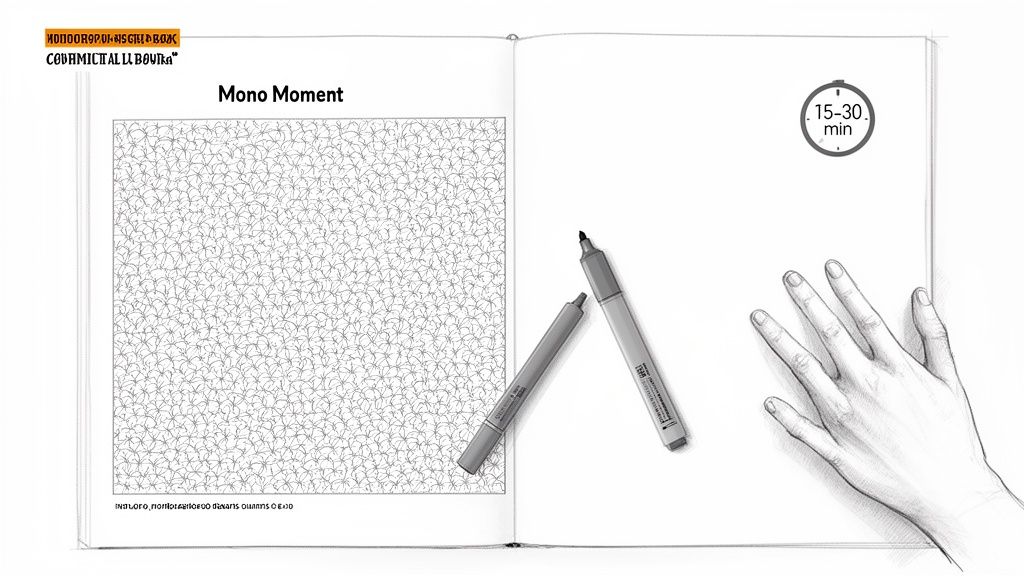
The Power of a Single-Color Focus
This is the entire idea behind the Mono Moment monochrome coloring book. This flagship product was designed from the ground up for busy, overthinking minds because it goes straight to the heart of decision fatigue. It removes the single biggest choice in coloring: what colors to use. It sounds like a small change, but for your brain, it’s a massive relief.
When you don't have to worry about picking the "right" color palette, you sidestep the paralysis of perfectionism entirely. There are no clashing shades or disappointing combinations. Your brain is finally free from the endless cycle of comparing, judging, and choosing, which lets it slip into a deep, meditative flow state almost immediately.
For a mind that's been hammered by thousands of choices all day, the simplicity of just following a line with one color isn't just relaxing—it's deep cognitive rest. You're giving the brain's "CEO," the prefrontal cortex, permission to finally go offline.
This is more than just keeping your hands busy. It’s about engaging your mind in a gentle, structured way that quiets down the reactive amygdala—your brain's alarm system for stress and anxiety. The simple, repetitive motion of coloring is inherently soothing, calming your nervous system one stroke at a time.
A Tool Built for Effortless Relaxation
The Mono Moment experience is designed to remove every obstacle between you and a state of calm. Every detail of this product is intentional, making it the perfect self-care ritual to reclaim your mental space after a long day of putting out fires.
- Premium Paper That Welcomes Any Pen: Each page is made with thick, 160gsm paper that stands up to markers and pens without any bleed-through. You can use your favorite tools without that nagging worry of ruining the next page.
- Completable in One Sitting: The illustrations are designed to be finished in just 15–30 minutes. This turns coloring from a big, daunting project into a quick, satisfying win you can easily fit into your evening or a midday break.
- A Clear Path to Calm: The monochrome format gives you a clear, guided path forward. You don’t have to plan or strategize. You just pick up a pen and begin, which makes it the perfect go-to when you feel too drained for anything else.
By getting rid of these little points of friction, the Mono Moment coloring book becomes more than a product—it’s a reliable system for hitting the reset button on your mind.
Reclaiming Your Peace, One Moment at a Time
Bringing a truly decision-free activity into your routine is one of the most powerful ways to build resilience against cognitive overload. It’s a deliberate act of carving out a sanctuary for your mind in a world that never stops asking for more. If you're looking for other simple yet powerful practices, our guide on 10 Quick Mindfulness Activities for Adults to Find Calm in 2025 is a great place to start.
Ultimately, managing decision fatigue isn’t about trying to live a life without choices. It's about creating balance. It’s about knowing when your mental battery is low and having a trusted, effective product to plug it back in. With a tool like the Mono Moment coloring book, you give yourself the gift of a quiet mind—a peaceful, decision-free pause that lets you return to your life with renewed clarity, focus, and calm.
Your Top Questions About Decision Fatigue
We've covered a lot of ground—what decision fatigue is, the brain science behind it, and how to start managing it. Now, let's tie it all together by tackling some of the most common questions that come up. Think of this as your quick-reference guide for navigating cognitive overload with confidence.
Is Decision Fatigue the Same as Burnout?
That's a great question, and it's easy to see why they get confused. While they're definitely related, they aren't the same thing.
Think of decision fatigue as the "low battery" warning on your phone. It’s a daily signal that your mental energy is drained, and you need to recharge soon. It’s that feeling at the end of the day when picking a movie feels like the hardest task in the world.
Burnout, on the other hand, is what happens when you ignore that warning for weeks or months on end until the phone just shuts down completely. It’s a deeper state of chronic emotional, physical, and mental exhaustion caused by prolonged, unrelenting stress.
Decision fatigue is a daily symptom; burnout is a long-term condition. The key takeaway? By actively managing your daily decision fatigue with restorative practices, you're taking a powerful step toward preventing the slide into full-blown burnout.
So, while a day packed with back-to-back meetings can absolutely cause decision fatigue, it's the chronic weight of that fatigue, piled on top of other stressors, that can lead to burnout.
How Long Does It Take to Bounce Back from Decision Fatigue?
Here’s the good news: recovering from everyday decision fatigue can be surprisingly fast. For most of us, a solid night's sleep is the ultimate reset button. It clears the slate and replenishes our capacity for thoughtful choices.
But you don't have to wait until bedtime to feel better. Short, intentional breaks can work wonders in the middle of a draining day. Even a simple 15–30 minute decision-free activity can give your brain the pause it desperately needs.
This is exactly why the Mono Moment monochrome coloring book was designed with easily completable patterns. One short session with this unique product is enough to provide a genuine cognitive break, giving your prefrontal cortex a chance to rest and recover.
If your fatigue feels more chronic and has been building up for weeks, it might take a few days of intentionally simplifying, resting, and engaging in calming activities before you feel fully back on your game.
Can I Prevent Decision Fatigue Completely?
In the world we live in, trying to eliminate decision fatigue entirely is a bit like trying to stop the rain. It's just not going to happen—and that’s okay! The goal isn’t to stop making decisions altogether, but to get smarter about how you spend your precious mental energy. It's all about conservation.
You can seriously lessen its grip on your life by building a few simple systems:
- Automate the small stuff: Lay out your work clothes the night before. Create a simple rotation of go-to healthy lunches. Put the recurring, low-stakes choices on autopilot.
- Eat the frog: Tackle your most important, brain-draining decisions first thing in the morning when your willpower is at its peak.
- Schedule "no-decision zones": Intentionally block out time in your calendar for activities where you don't have to decide a single thing. Just be.
It's a lot like managing a budget. You can't just stop spending money, but you can be deliberate about where it goes. By protecting your cognitive resources, you make sure you have plenty of bandwidth for the decisions that actually matter.
This is where a dedicated practice can make all the difference. When you set aside time for a Mono Moment coloring session, you’re not just doodling—you're actively investing in your mental well-being with a product designed for this purpose. It's a simple, reliable way to build resilience against the constant hum of a choice-filled world.
Ready to give your brain the decision-free break it deserves? Discover how the simple act of monochrome coloring can restore your mental clarity and calm. Explore the Mono Moment collection of products today at https://mono-moment.com and reclaim your peace of mind.

The One Color Coloring Book
A single-pen, decision-free coloring book on 160 gsm cream paper — engineered for the wind-down ritual described above.
 Pair it with the 3 Dual Tip Brush Pens — $5 instead of $9.95 in the Book + Pens bundle.