About the author
Published February 5, 2026 · Last reviewed April 26, 2026 · 19 min read
In this article · 7 sections
- Why Simple Activities Are Your Mental Health Toolkit
- How Therapeutic Activities Rewire a Stressed Brain
- Your 20-Minute Menu for Mental Calm
- Building a Self-Care Ritual That Sticks
- Creative and Mindful Practices Beyond Coloring
- Knowing When to Seek Professional Support
- Common Questions About Therapeutic Coloring
Let's be honest, the term "therapeutic activities" can sound a bit clinical. But what we're really talking about are simple, intentional practices designed to give your nervous system a much-needed break and dial down the stress.
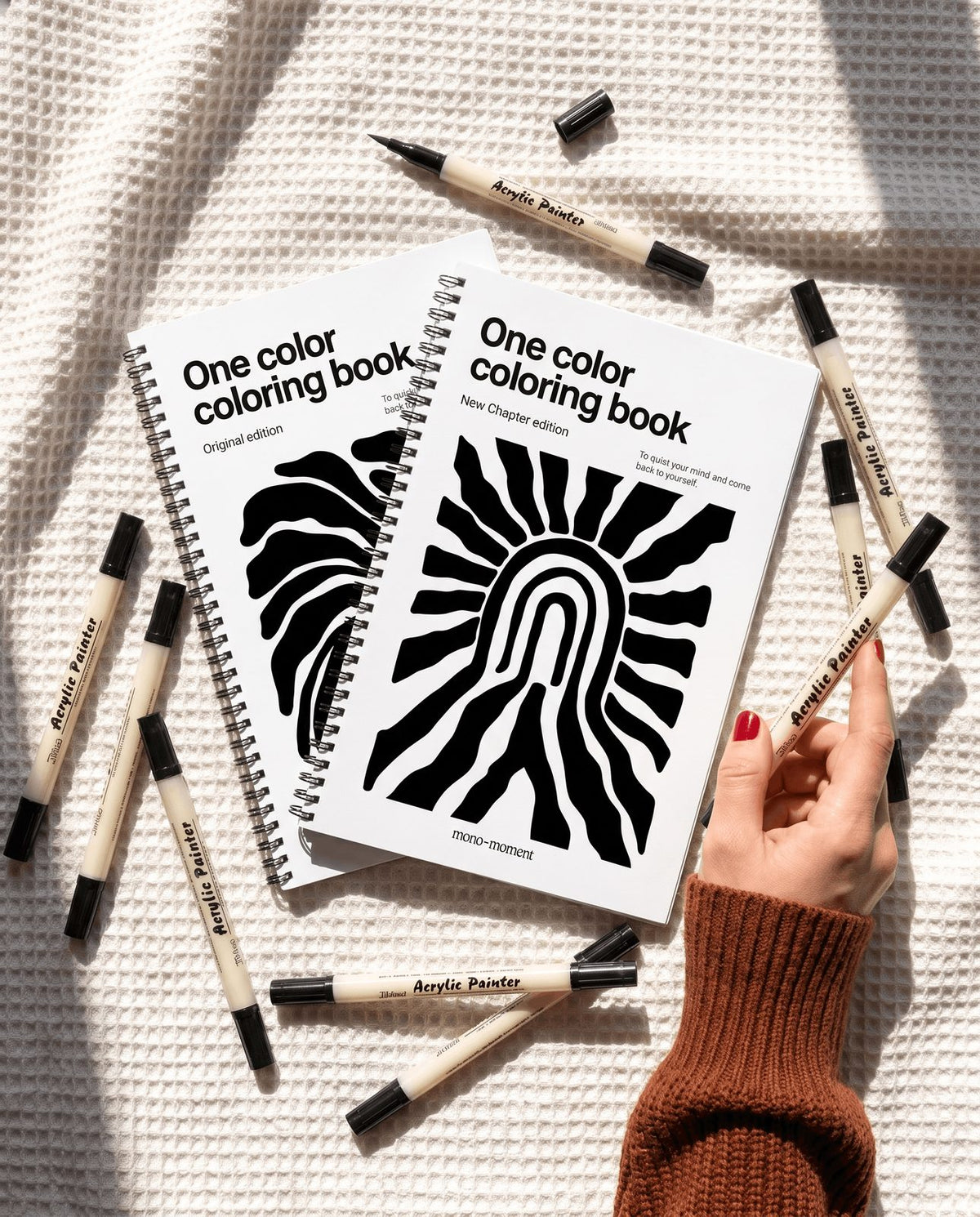
These aren't just random hobbies. They are purposeful actions that create a small, quiet sanctuary from the constant noise of modern life. And the best part? Tools like the Mono Moment monochrome coloring book are specifically designed to make this process as easy and effective as possible.
Why Simple Activities Are Your Mental Health Toolkit
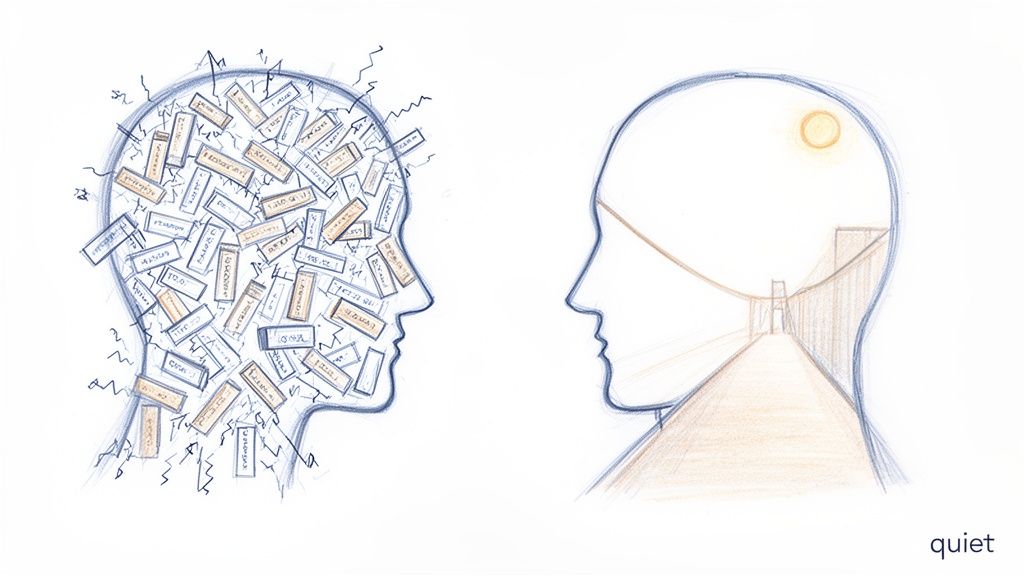
Does your mind ever feel like a web browser with way too many tabs open? The constant ping of notifications, looming deadlines, and a running list of personal worries creates a kind of mental traffic jam, leaving you feeling drained and completely overwhelmed. It’s a feeling most of us know all too well in a world that simply refuses to slow down.
This isn’t just a personal feeling; it’s a global reality. The data shows that more than one in every eight individuals worldwide live with a mental health condition. Anxiety disorders alone affect a staggering 301 million people globally, making them the most prevalent mental illness. If you're curious, you can dig into these findings on global mental health from the World Health Organization.
This is exactly where therapeutic activities step in. Instead of seeing them as another chore on your to-do list, think of them as a quiet side street you can turn down to escape the chaos.
What Makes an Activity Therapeutic
So, what’s the secret sauce that turns a simple action into a powerful tool for your mind? It all comes down to intention and structure.
A truly therapeutic activity is one that guides you from a state of high alert—that fight-or-flight feeling—to one of focused calm. It works by gently pulling your attention away from your stressors and onto a simple, engaging task. This process helps quiet down the brain's alarm system, the amygdala, which tends to be in overdrive when we're feeling anxious.
The goal isn’t to magically stop thinking. It’s to give your mind a structured, peaceful place to rest. An activity becomes therapeutic when it offers a sanctuary from decision fatigue and the constant pressure to perform.
For anyone who tends to overthink or juggle a demanding schedule, this is a total game-changer. The most effective practices, like those offered by Mono Moment, are the ones that strip away complexity and the burden of choice.
The Power of Decision-Free Mindfulness
This brings us to a really powerful concept: decision-free mindfulness. When you’re mentally fried, the very last thing you need is another decision to make. Activities that offer clear boundaries and a simple, repeatable process allow you to find your flow without the mental heavy lifting of planning or creating something from scratch.
This is the whole idea behind products like the Mono Moment monochrome coloring book. By taking the choice of color completely off the table, the focus shifts entirely to the soothing, repetitive motion of filling in the design. It's a structured path to immediate calm, specifically engineered for minds that are crying out for a break.
Ultimately, these activities are your personal mental toolkit—simple, accessible, and always there when you need to find your center. They're proof that you don't need to carve out hours of free time to make a real, meaningful difference in your well-being.
How Therapeutic Activities Rewire a Stressed Brain
Ever wonder why a simple, focused activity can feel so profoundly calming? It’s not just a feeling; it’s a biological shift happening inside your head. When you're stressed, your brain is like a city gridlocked in rush hour—thoughts are speeding, horns are blaring, and there’s no clear exit in sight.
Therapeutic activities for mental health are like a well-placed detour, guiding your mind off that chaotic highway and onto a quiet, scenic route. They work by intentionally shifting your brain's activity, creating real, measurable changes that bring a sense of relief and calm focus. This isn't just wishful thinking; it's neuroscience in action.
Taming the Brain's Alarm System
When your brain senses a threat—whether it's an intimidating deadline or a tough conversation—your amygdala, the brain's internal alarm system, kicks into high gear. This triggers a flood of stress hormones, especially cortisol, putting your entire body on high alert.
But when you engage in a structured, mindful activity, you send a powerful "all clear" signal to the amygdala. The focused attention needed for something like journaling, knitting, or coloring with a Mono Moment monochrome coloring book pulls your brain's resources away from those spiraling worry loops. As your attention lands squarely in the present moment, the amygdala's frantic activity quiets down, effectively turning down the volume on your internal alarm.
This biological calming effect is the secret sauce. Instead of wrestling with anxious thoughts head-on, you’re gently redirecting your brain’s energy, which allows your nervous system to come back into balance all on its own.
Lowering Cortisol and Finding Your Flow
As the amygdala settles down, your body gets the message to dial back cortisol production. This is crucial because chronically high cortisol can lead to burnout, exhaustion, and a whole host of other health problems. By weaving short, therapeutic activities into your routine, you are actively managing this powerful hormone. If you want to go deeper, you can learn more about how to reduce cortisol levels naturally in our detailed guide.
This calming process also paves the way for something psychologists call a flow state.
A flow state is that magical zone where you're so completely absorbed in what you're doing that time just melts away. Self-consciousness vanishes, and overthinking becomes almost impossible. It's a state of energized focus and genuine enjoyment in the task itself.
Getting into flow is one of the most powerful rewards of these activities. It offers a real escape from the mental chatter that fuels so much stress and anxiety, giving your mind a truly restorative break.
The Science of Structured Coloring
This is where the intentional design of the Mono Moment monochrome coloring book really shines. For a brain already drowning in decisions, the simple act of choosing colors can accidentally become another source of stress or perfectionism. By removing that one variable, the activity becomes a smooth, frictionless on-ramp to mindfulness.
The simple, repetitive motion of filling in a pre-drawn, monochrome pattern provides the perfect amount of gentle focus. Your mind has a clear, contained task, which slashes decision fatigue and makes it much easier to slip into a flow state.
Each illustration is thoughtfully designed to be completed in one sitting, typically within 15 to 30 minutes. This gives you a tangible sense of accomplishment and helps reinforce the ritual of taking a short, dedicated break just for you. It's not just about making something beautiful; it’s about engaging in a scientifically-backed process, engineered to calm your stressed-out brain and deliver a reliable moment of peace in your hectic day.
Your 20-Minute Menu for Mental Calm
So, you get the science behind how these activities can quiet a racing mind. But how do you actually do it? When you're already swamped, finding time for self-care can feel like just another impossible task on an endless to-do list.
The good news? You don’t need an hour-long yoga class or a weekend retreat to reset. A powerful shift can happen in just 15 to 20 minutes.
Think of what follows not as a chore list, but as your personal menu for finding calm. Each option, especially the cornerstone activity of using a Mono Moment monochrome coloring book, is designed to slide easily into the cracks of a busy day, whether that’s a quick break between meetings or a simple ritual to unwind at night.
This flowchart shows the two very different paths your brain can take when stress hits. One road leads to more chaos, the other to calm—and the turn-off is a simple, intentional activity.
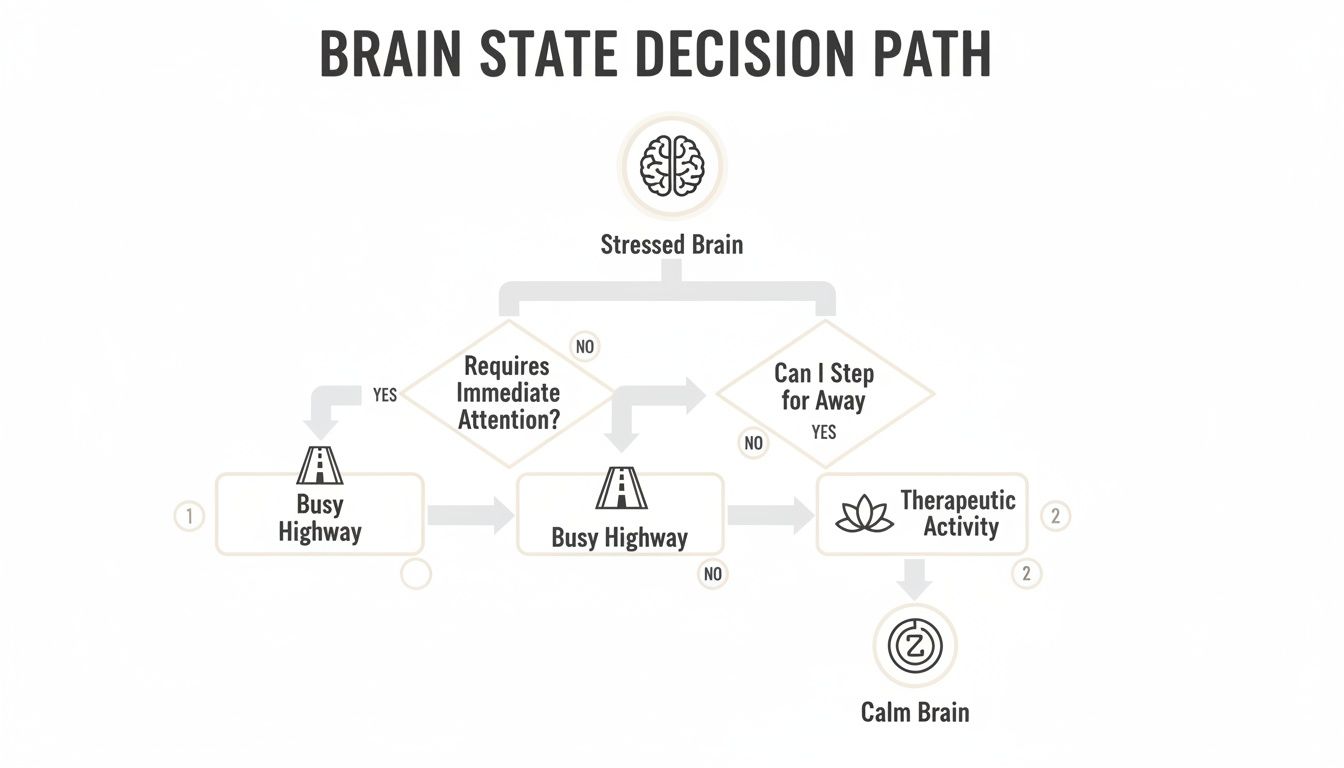
It’s a powerful reminder that we have a choice: stay stuck in the mental traffic jam of stress, or take a deliberate exit toward something that brings us back to ourselves.
The Ultimate Decision-Free Sanctuary
When your brain is already overloaded, the last thing you need is more choices. The best therapeutic activities in these moments are the ones that demand absolutely nothing from you.
This is exactly where the Mono Moment monochrome coloring book shines. It’s been designed from the ground up to be a true decision-free sanctuary, removing all the usual friction that can get in the way of creative mindfulness.
You open the book to find a striking, self-contained illustration on thick, 160gsm bleed-proof paper. There are no colors to choose, no complex shading techniques to master. Your only job is to fill the space with a single pen. That’s it.
It’s a ritual you can feel. This simple act turns the vague concept of "mindfulness" into a concrete, deeply satisfying experience. In just 15 to 30 minutes, you can finish an entire design, giving you a tangible sense of completion that quiets the noise in your head and soothes your nervous system.
Your 20-Minute Mental Health Reset Menu
Feeling overwhelmed and not sure which activity to pick? This quick-glance table helps you match the right practice to your current state of mind.
| Activity (15–30 Mins) | Best For | Key Benefit |
|---|---|---|
| Monochrome Coloring | Overthinkers and perfectionists seeking a structured, decision-free task. | Induces a flow state quickly by eliminating color choice, providing a tangible sense of completion and calm. The Mono Moment book is ideal. |
| Mindful Walking | Feeling physically restless or stuck indoors all day. | Reconnects mind and body by focusing on sensory details like the feeling of your feet on the ground or the cool air. |
| Single-Prompt Journaling | When your thoughts feel tangled and overwhelming. | Provides clarity and emotional release by externalizing one specific thought or feeling without pressure. |
| Focused Music Listening | Needing a quick mood lift or an escape from environmental noise. | Engages the auditory cortex, helping to drown out anxious thoughts and synchronize your mood with the music. |
Each of these offers a different path, but they all lead to the same destination: a calmer, more centered you. The only rule is to pick what genuinely calls to you in the moment.
Crafting Your Coloring Ritual
To really get the benefits from your coloring time, a little intention goes a long way. This isn't just about doodling; it's about actively down-regulating your stress response. Here’s how to set yourself up for success:
- Set Your Space: Find a quiet corner where you can be undisturbed for 20 minutes. Maybe you dim the lights, put on some ambient music, or just soak in the silence.
- Choose Your Tools: One of the best things about the Mono Moment book is that it works with almost any pen or water-based marker, thanks to its no-bleed paper. If you're not sure where to start, our guide to coloring books and pens can point you toward the perfect creative partner.
- Engage Your Senses: This is the most important part. Pay attention to the physical sensations of the activity. Feel the smooth glide of the pen across the thick paper. Listen to the soft sound it makes. Notice the steady, rhythmic motion of your hand. Anchor yourself in this.
The goal is not to create a masterpiece but to find a moment of peace. The illustration is merely a vessel for your attention, a structured path leading your mind away from worry and toward stillness.
By embracing this simple practice, you’re giving yourself a reliable, on-demand tool for navigating daily stress. It’s proof that finding even twenty minutes of peace isn’t just possible—it’s one of the most effective things you can do for your mental health.
Building a Self-Care Ritual That Sticks
Knowing that something is good for you is the easy part. The real work is actually weaving it into your life so it becomes as second-nature as pouring your morning coffee. Consistency is what separates a nice idea from a life-changing habit, but it’s usually the first thing to disappear when life gets overwhelming.
This is exactly where most of us stumble. We shoot for perfection, and the moment we miss a day, we feel like a failure and just… stop. But the secret isn’t about having superhuman willpower. It's about starting so small and making it so easy that it feels harder not to do it.
The Power of Habit Stacking
One of the smartest ways to lock in a new routine is a simple method called habit stacking. The idea is brilliant: you just tack on your desired new habit to something you already do automatically.
Instead of trying to carve out a whole new block of time from a packed schedule, you just piggyback the new activity onto a behavior that’s already wired into your brain. This creates an effortless trigger, taking the mental gymnastics out of "remembering" to do your self-care.
Here’s what it looks like in the real world:
- After I pour my evening tea, I will open my Mono Moment coloring book for 15 minutes.
- After I shut down my work laptop, I will walk around the block for 10 minutes, phone-free.
- After I get into bed, I will write down three good things from the day in my journal.
The formula couldn't be simpler: After [Current Habit], I will [New Habit]. This little trick transforms a vague intention into a concrete, actionable plan.
Meet Alex: An Overthinker's Story
Let’s talk about Alex. A project manager by day, Alex spent their evenings replaying every single work conversation, their mind a whirlwind of what-ifs. Their nights were a draining cycle of mindless scrolling and a low hum of anxiety that left them exhausted for the next day.
They decided to try something new. Alex committed to a simple ritual with a Mono Moment monochrome coloring book. Their habit stack was crystal clear: “Right after I finish washing the dinner dishes, I will sit at the kitchen table and color one page.”
The first couple of nights felt a little clunky. But because the activity was so straightforward—no agonizing over colors, just the simple, satisfying motion of filling in a pattern—there was zero friction to getting started.
Before long, the simple act of drying their hands after doing the dishes became a powerful cue. Their brain started to anticipate the feeling of calm that would follow, and those 20 minutes of quiet focus transformed from a chore into something they genuinely craved. Alex wasn't just coloring; they were taking back their evenings, one mindful moment at a time.
From All-or-Nothing to Something-is-Everything
The pressure to be perfect is the ultimate saboteur of new habits. We tell ourselves that if we can't do a full hour of meditation, then five minutes is pointless. This "all-or-nothing" thinking is the enemy of real, lasting change.
The most sustainable self-care isn’t built on grand, sweeping gestures. It’s built on small, consistent acts of kindness to your future self. The goal is just to prove you can keep a promise to yourself, even a tiny one.
This philosophy of ditching the pressure is central to everything we do. It’s why every Mono Moment product comes with a satisfaction guarantee. We want to remove any risk or hesitation you might have about trying something new, so you can focus on building a routine that supports you without worrying if you made the "right" choice.
The statistics are sobering: about half of all people globally will experience a mental health disorder at some point, with mental conditions being a leading cause of disability worldwide. Therapeutic activities offer a proactive shield against the rising tide of daily stress that disrupts so many lives. You can find more powerful mental health statistics here.
Ultimately, building a ritual that sticks means choosing compassion over perfection. Whether it’s 15 minutes of coloring or five deep breaths before a meeting, every small act is a victory. For more practical ideas, check out our guide on how to create a self-care routine.
Creative and Mindful Practices Beyond Coloring
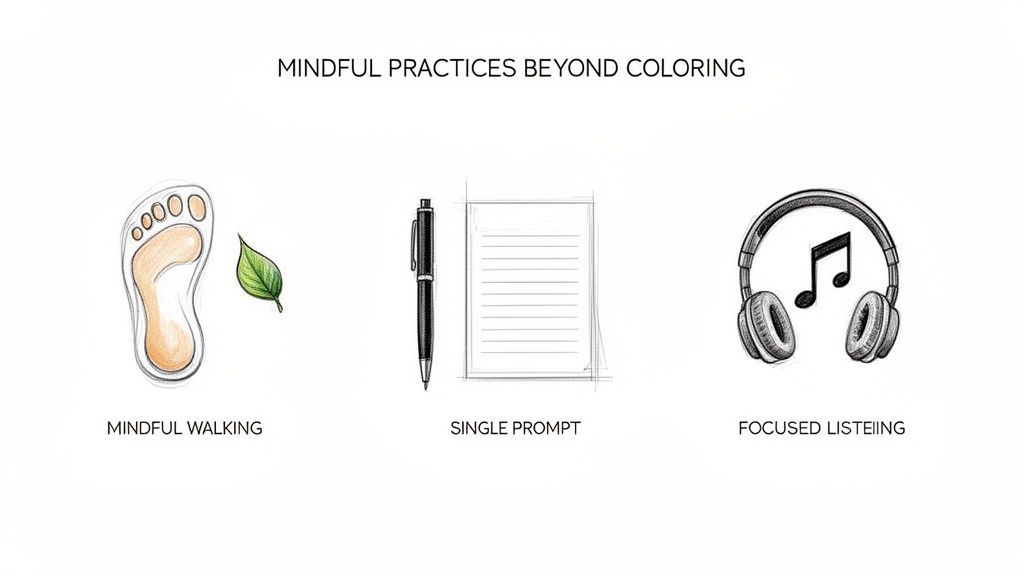
While a structured coloring book offers a wonderfully simple path to calm, think of it as just one of many tools you can have ready in your mental wellness toolkit. The real magic happens when you build a rich, personal menu of options, allowing you to pick the perfect practice for your mood and energy on any given day.
What makes these practices so effective? They all share the same core principles found in our Mono Moment monochrome coloring book: simplicity, a single point of focus, and removing overwhelming decisions. These are the ingredients that quiet a racing mind, guiding you effortlessly into the present moment. It's not about selling a product; it’s about sharing a genuine understanding of what your mind needs to find stillness.
Once you grasp these principles, you'll start seeing opportunities for peace everywhere.
The Art of Mindful Walking
Mindful walking is probably one of the most accessible therapeutic activities out there. It takes a completely ordinary movement and turns it into a powerful, grounding meditation. The idea is simple: instead of walking on autopilot while your mind spins, you bring your full attention to the physical experience of each step.
You tune into the rhythm of your breath, the sensation of your feet connecting with the ground, and the tiny adjustments your body makes to stay balanced. This act of anchoring your awareness in the body is a potent antidote to overthinking.
- How it Calms the Mind: The practice quite literally pulls you out of your head and into your body. By zeroing in on sensory details—the crunch of gravel, the feeling of a breeze on your skin, the warmth of the sun—you interrupt the brain’s default mode of worrying about the past or stressing about the future. You're giving your prefrontal cortex a simple, concrete job to do, which makes it much harder for anxious thought loops to take hold.
Single-Prompt Journaling for Clarity
Let’s be honest, staring at a blank page when your mind is already a chaotic storm can feel completely overwhelming. That’s where single-prompt journaling comes in. It strips away all that pressure by giving your mind a single, focused starting line. You aren't trying to solve every problem at once; you're just gently exploring one feeling without judgment.
A prompt can be as straightforward as, "What is one thing I’m grateful for right now?" or "What does my body need in this moment?" The point isn't to write a masterpiece. It's simply to get one specific thought out of your head and onto the page, which immediately creates distance and perspective.
By focusing on a single prompt, you give your mind a clear directive, reducing the cognitive load that comes with open-ended reflection. This structured approach makes journaling less intimidating and more effective for untangling a specific knot of worry.
The Power of Focused Music Listening
We all listen to music, but how often do we just listen? For most of us, music is the backdrop to a commute, a workout, or doing chores. Focused music listening is a completely different experience. It’s the simple act of dedicating 10-15 minutes to doing nothing but absorbing a single piece of music.
Find a quiet spot, pick a song (instrumental tracks often work best to avoid distracting your brain's language centers), and close your eyes. Give it your complete attention. Notice the individual instruments, the rise and fall of the melody, the texture of the sound, and how it makes you feel.
This works because it fully engages your auditory cortex, leaving very little mental bandwidth for runaway thoughts. Much like the structured patterns in our Mono Moment monochrome coloring book, the music provides a framework for your attention to follow, gently guiding you into an observant, present state. Each of these practices proves that the simplest activities often hold the most profound power for our well-being.
Knowing When to Seek Professional Support
Therapeutic activities are fantastic tools for navigating the everyday tides of stress and anxiety. Think of them as your personal anchor when you feel overwhelmed—a reliable way to self-regulate and find your footing. But it's important to remember they're one part of a bigger picture, not a substitute for professional mental healthcare.
Recognizing you might need more support is a sign of strength, not a failing. If anxiety starts to feel less like a wave and more like a constant fog that disrupts your daily life, it might be time to talk to a therapist. Reaching out is one of the bravest, most proactive steps you can take for your well-being.
A Powerful Partner to Therapy
Here’s the good news: these activities and professional therapy aren't mutually exclusive. In fact, they work brilliantly together. Many therapists actively encourage clients to use practices like mindful coloring between sessions. It becomes a practical, hands-on tool for managing intense emotions and grounding yourself when things feel like too much.
It’s a bit like this: therapy is where you do the deep, foundational work of understanding why you think and feel the way you do. Activities like coloring offer immediate, in-the-moment relief that helps you stay steady along the way.
Engaging in a simple, structured ritual can help you process what you discuss in therapy, turning abstract insights into a felt sense of calm and control.
How Our Products Support Your Journey
This is precisely where something like the Mono Moment monochrome coloring book can become such a trusted ally. We designed it to be completely decision-free, making it perfect for those moments when your mind is already buzzing and the last thing you need is more pressure.
The goal isn't to run away from your feelings. It's about giving you a safe, contained space to sit with them. As you focus on the simple, repetitive motion of filling in a pattern, you carve out a small pocket of peace. That space can make navigating the tougher emotions feel far more manageable.
Using the Mono Moment book alongside therapy gives you a tangible way to practice self-regulation, building your resilience and reinforcing the very skills you're working on with a professional. It's a reflection of our belief in supporting the full spectrum of mental wellness, creating tools that help on their own and as a powerful complement to expert guidance.
Common Questions About Therapeutic Coloring
As you start exploring different ways to find a little peace of mind, it's totally normal for questions to pop up. Let's tackle some of the most common ones about structured, creative practices like coloring, and I'll explain how the Mono Moment approach is built from the ground up to quiet a busy mind.
Think of these as the quick, clear answers you need to feel confident that sometimes, the simplest tool is the most powerful one for finding calm.
How Can a Coloring Book Without Colors Be Therapeutic?
The real magic of a monochrome coloring book is its beautiful simplicity. For anyone whose mind races or gets stuck in overthinking loops, a box of 64 crayons can be surprisingly stressful. You start second-guessing every choice: "Does this green work? What if I pick the wrong blue?"
By taking that one decision—what color to use—off the table, the activity shifts entirely. It becomes purely about the mindful, repetitive motion of filling in the space. The Mono Moment monochrome coloring book is designed specifically for this. This intentional constraint is a shortcut to that elusive 'flow state,' calming the brain's alarm system without the pressure to create a "perfect" piece of art. It’s one of the most direct and frictionless paths to relaxation you can find.
Is 15 Minutes a Day Really Enough to Matter?
Absolutely. When it comes to building mental resilience, consistency beats intensity every single time. Research has shown that even short, daily mindfulness practices have a massive and cumulative effect on lowering stress and literally rewiring the brain for more calm. A 15-minute daily ritual is far more impactful than a single, long session once a month.
This is exactly why Mono Moment illustrations are designed to be finished in one 15–30 minute session. It's built to give you a tangible sense of accomplishment and deliver a reliable dose of tranquility that can actually fit into your packed schedule, which makes the habit stick.
What if I'm Not "Artistic" at All?
That's the best part—you don't have to be! This isn't about talent; it's a mental health practice. The intricate, pre-drawn illustrations in the Mono Moment book provide all the structure you need.
Your only job is to get lost in the simple, soothing sensation of the pen moving across the page. There's no right or wrong way to fill in the lines. The goal isn't to create a masterpiece for a gallery wall; it's to give your mind a much-needed break from the constant noise of daily life.
Ready to feel the calm of decision-free mindfulness for yourself? Discover how the Mono Moment monochrome coloring book can become your go-to ritual for finding a little peace and quiet. Find your moment of calm today at mono-moment.com.

The One Color Coloring Book
A single-pen, decision-free coloring book on 160 gsm cream paper — engineered for the wind-down ritual described above.
 Pair it with the 3 Dual Tip Brush Pens — $5 instead of $9.95 in the Book + Pens bundle.