About the author
Published February 7, 2026 · Last reviewed April 26, 2026 · 15 min read
In this article · 7 sections
Ever snapped at someone in traffic or felt a wave of pure panic after reading a work email, only to regret it moments later? If that sounds familiar, you’ve probably experienced an amygdala hijack.
It’s an immediate, overwhelming emotional reaction that feels completely out of proportion to what just happened. This is your brain's emotional center, the amygdala, taking over and hitting the fight-or-flight button before your rational mind even has a chance to weigh in.
Your Brain's Overzealous Security Guard
Think of your amygdala as a well-meaning but jumpy security guard for your brain. Its job is to scan for danger and sound the alarm. This system is ancient, hardwired into us to keep us safe from very real, physical threats—like a predator lurking in the bushes.
The problem is, in our modern world, this system often misfires. It can't always tell the difference between a tiger and a terse email from your boss. A looming deadline or a critical comment can be perceived as a life-or-death threat, triggering the same flood of stress hormones.
How the Hijack Happens
This emotional takeover isn't a character flaw; it's just brain wiring. Sensory information hits the amygdala first, and it can react in milliseconds—way faster than the prefrontal cortex, which handles all the logical thinking and impulse control. When things get intense, the amygdala basically hijacks the controls, shouting over the quiet, reasonable voice of your rational brain.
The term amygdala hijack was coined by psychologist Daniel Goleman in his 1995 bestseller, Emotional Intelligence. He used it to describe that precise moment when this small, almond-shaped part of our emotional brain seizes control from our more evolved, logical prefrontal cortex. This is what leads to those impulsive reactions we often wish we could take back. You can dive deeper into the amygdala's critical function in our emotional lives over at Physio-pedia.
The process is simple but incredibly powerful, as this visual illustrates.
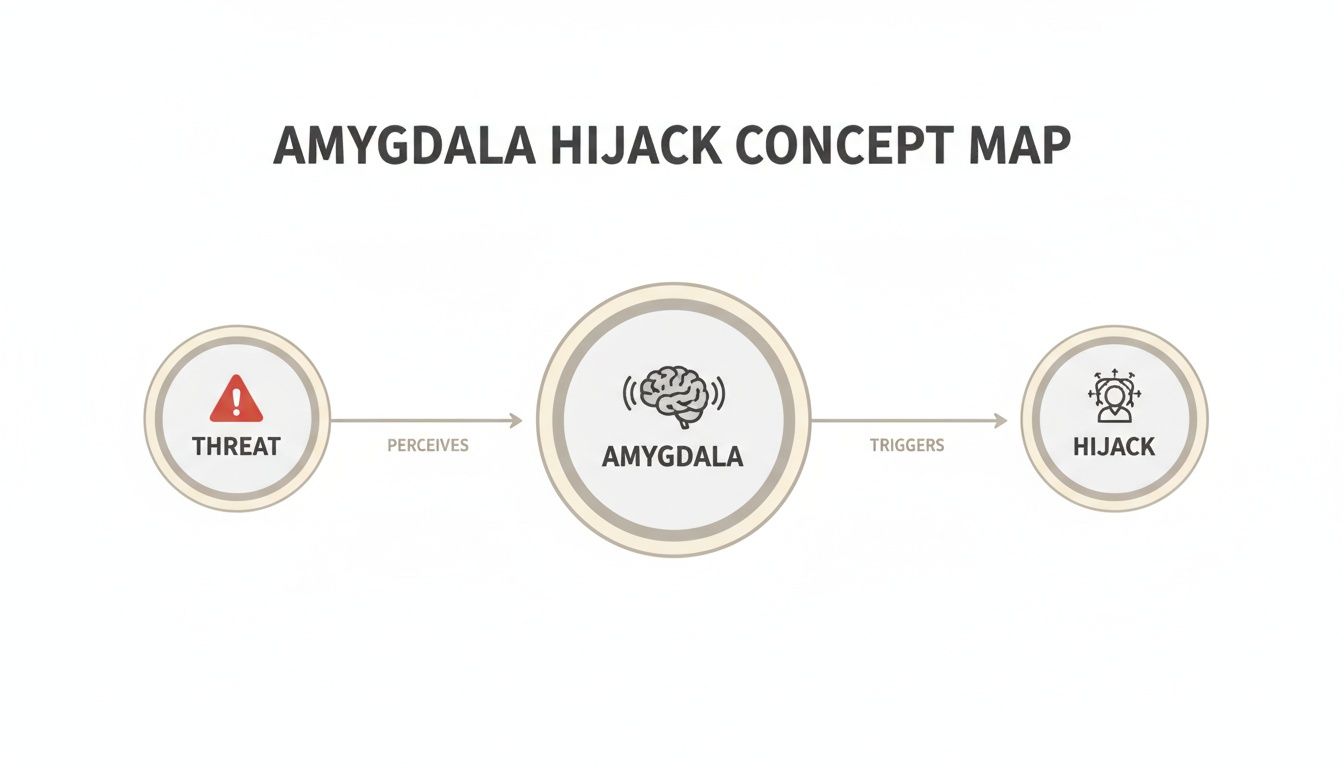
As you can see, any perceived threat—whether it's real or just in your head—can instantly light up the amygdala and kickstart a hijack, sidelining your ability to think clearly.
To really get a feel for this internal tug-of-war, let's break down what's happening inside your head.
Emotional Brain vs Rational Brain During a Hijack
| Component | Emotional Brain (Amygdala) | Rational Brain (Prefrontal Cortex) |
|---|---|---|
| Speed | Instantaneous, reacts in milliseconds | Slower, more deliberate |
| Function | Scans for threats, triggers survival instincts | Logic, reasoning, planning, impulse control |
| Priority | SURVIVAL. "Am I safe?" | ANALYSIS. "What's the best way to handle this?" |
| Communication | Loud, urgent, and emotional | Quiet, nuanced, and logical |
| Outcome | Fight, flight, or freeze response | Considered, thoughtful action |
Essentially, the amygdala makes a snap judgment based on raw emotion, while the prefrontal cortex needs time to process the facts. During a hijack, the amygdala wins the race, and the rational brain gets temporarily shut out.
Why Understanding This Matters
Simply knowing what an amygdala hijack is can be a game-changer. When you feel that sudden, hot rush of emotion, you can start to recognize it for what it is: a primitive brain response, not a true reflection of who you are or what you want to do.
By understanding this dynamic, you shift from being a passenger on an emotional rollercoaster to learning how to operate the brakes. This is where intentional practices, designed to calm the brain's alarm system, become essential.
This is exactly why Mono Moment products, like our signature Mono Moment One Color Coloring Book, were created. The focused, repetitive act of coloring in a structured pattern is a simple, decision-free task that gives your agitated amygdala a chance to cool down. It creates just enough mental space for your rational brain to come back online, helping you turn a moment of chaos into an opportunity for calm and control.
Recognizing the Signs of an Amygdala Hijack
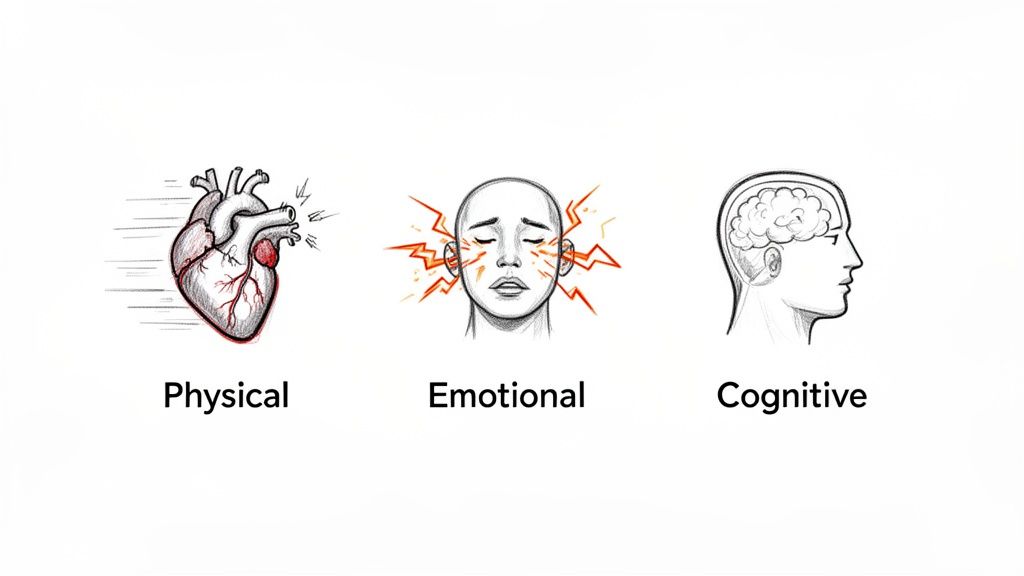
Have you ever completely overreacted to something and wondered, “Where did that come from?” That’s your first clue. The only way to stop an amygdala hijack in its tracks is to first realize it’s happening. This isn’t just a bad mood; it’s a full-body, all-systems-go event that slams into you physically, emotionally, and mentally.
Your brain’s ancient alarm system has been pulled, and it’s screaming "danger!"
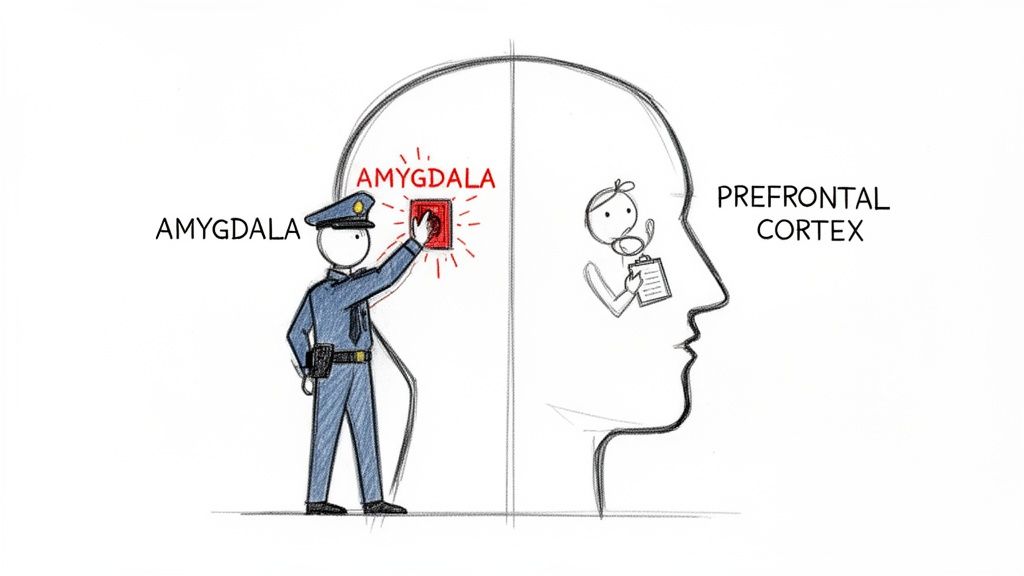
This internal takeover is your body preparing for a fight, whether the "threat" is a car cutting you off in traffic or a pointed comment from your boss. Spotting these red flags as they pop up is your chance to hit the brakes before you go completely off the rails.
Physical Alarm Bells
When your amygdala seizes control, it doesn't ask permission. It instantly floods your system with adrenaline and cortisol, the classic stress hormones. This isn't just "feeling stressed"—your body is physically preparing for a life-or-death battle.
These physical tells are raw, primitive, and often the first things you'll notice.
- Pounding Heart or Chest Tightness: Your heart hammers in your chest, trying to get blood to your limbs for a quick getaway.
- Shallow, Rapid Breathing: You might notice you're almost panting. Your body is trying to suck in as much oxygen as possible.
- Sweaty Palms and Muscle Tension: Your fists might clench, your jaw tightens, and you feel coiled like a spring, ready for action.
Emotional and Cognitive Shutdown
At the very same moment your body goes on high alert, your emotional landscape gets completely rewritten. The key here is disproportion. A minor inconvenience suddenly feels like a five-alarm fire. This emotional tidal wave is so powerful it actually short-circuits your rational mind.
This is where the hijack truly takes hold. Logic goes out the window, and pure, raw instinct takes the wheel. Your ability to think clearly, weigh consequences, or even see another person's point of view simply vanishes.
You’re hit with a flash of white-hot rage or a sudden, suffocating wave of panic. At the same time, your thinking narrows into tunnel vision—you can only see the threat, nothing else. Trying to reason with yourself is like trying to have a calm debate in the middle of a hurricane; the part of your brain built for that is temporarily offline.
Catching this cascade of symptoms is your signal to do something. Instead of being swept away by the storm, this awareness gives you a tiny window of opportunity—a moment to pause and grab a lifeline. This is exactly where our Mono Moment One Color Coloring Book can be a game-changer. Its simple, repetitive patterns demand nothing from you, offering an immediate, grounding activity that calms your nervous system, silences the amygdala’s alarm, and helps your thinking brain come back online.
Why Modern Life Puts Our Ancient Brain on High Alert
Our brains are truly remarkable, but they were wired for a world that has long since vanished. For thousands of years, that lightning-fast amygdala response was the difference between life and death—it helped our ancestors instantly decide if that rustling in the bushes was just the wind or a predator about to pounce.
Fast forward to today, and that same ancient survival system is trying to navigate a world of overflowing inboxes, tight deadlines, and constant social media notifications. The problem? It can’t always tell the difference between a real, physical threat and a psychological one.
To your amygdala, a critical email from your boss can feel just as threatening as a saber-toothed tiger. It doesn't analyze the context; it just senses danger and slams the panic button, flooding your system with adrenaline and cortisol.
This becomes a huge issue when stress isn't a brief, isolated event but a constant, low-grade hum in the background of our lives. For busy professionals and chronic overthinkers, the nervous system often gets stuck in "on" mode, leaving the brain primed for an overreaction. That persistent stress is like dry kindling, just waiting for one tiny spark to set off an emotional inferno. You can learn more about how this mental overload saps your energy in our guide on what is decision fatigue.
The Everyday Triggers We All Face
It isn't just the big, dramatic life events that can set us off. A fascinating 2021 aviation study pinpointed seven universal threats that can trigger a hijack and completely shut down rational thought—including something as subtle as a negative tone of voice.
This lines up with what we see in the broader mental health landscape. It helps explain why anxiety now affects an estimated 4% of the global population (301 million people) and costs the global economy a staggering $1 trillion in lost productivity each year. For a deeper dive into the science behind this, you can explore the mechanics of an amygdala hijack in this detailed breakdown.
This constant exposure to modern triggers isn't just tiring; it actively trains your brain to be more reactive. Your amygdala learns to fire faster and more frequently, creating a cycle of stress and overreaction.
Breaking this cycle requires intentional, consistent practices that send a clear signal of safety to your nervous system. This is where something as simple as a 15-minute coloring session with a Mono Moment One Color Coloring Book transforms from a nice hobby into a necessary tool for modern survival. It’s a deliberate act of defiance against the daily barrage of triggers, helping you retrain your brain for calm and resilience, one mindful pattern at a time.
How to Stop an Amygdala Hijack in Its Tracks
When you feel that familiar rush of emotion—the one that threatens to take over your common sense—you need a plan. Think of it as having an emotional first-aid kit ready to go.
These simple, science-backed grounding techniques are your emergency brake. They won't make the feeling disappear, but they give your rational brain just enough time to get back in the driver's seat. That crucial pause can stop you from saying or doing something you’ll regret later.
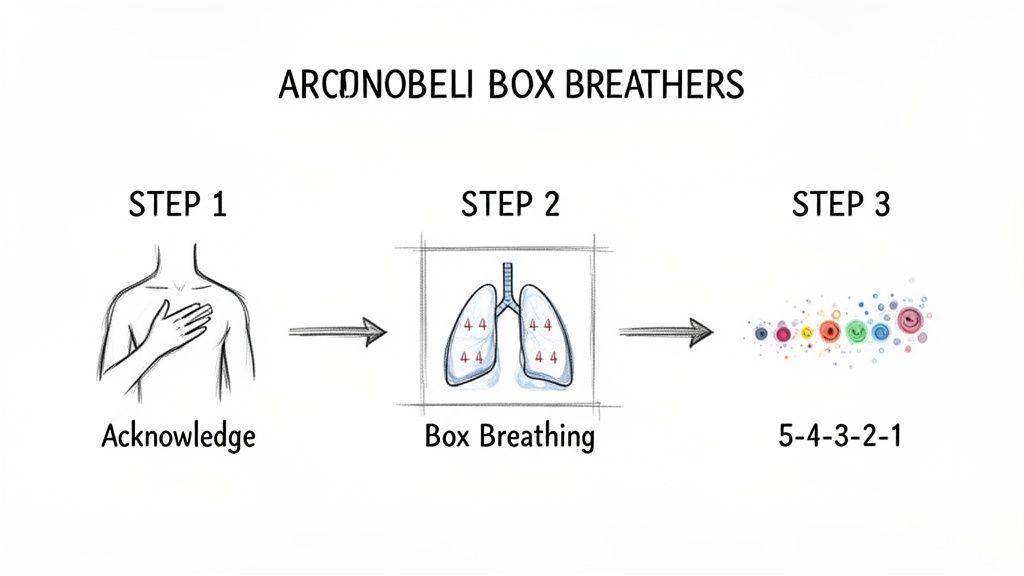
Your Three-Step Emergency Brake
This isn't complicated. It’s a simple, step-by-step process you can use anywhere, anytime. The whole point is to pull your focus out of the mental chaos and back into the physical world, which sends a powerful "all-clear" signal to your nervous system.
-
Name It to Tame It: The first step is to simply notice what's happening, without judging yourself for it. Silently say to yourself, "Okay, I'm feeling a massive surge of anger," or "My anxiety is going through the roof right now." Just putting a name to the feeling creates a sliver of space between you and the emotion itself.
-
Reset with Box Breathing: This technique is a powerhouse for calming your fight-or-flight response. Gently inhale through your nose for a count of four. Hold your breath for four. Slowly exhale through your mouth for four. Hold again for four. Just repeating this cycle three or four times can work wonders.
-
Ground Yourself with 5-4-3-2-1: This method yanks your attention right back into the present moment. Look around and mentally name 5 things you can see. Then, notice 4 things you can physically feel (the chair beneath you, your shirt sleeve). Listen for 3 distinct sounds. Identify 2 smells. And finally, name 1 thing you can taste.
These aren't tricks to ignore the problem. They're tools to create a crucial pause—that moment of intentional calm—that prevents an emotional reaction from becoming a destructive action.
Practicing these steps builds real mental muscle, making it easier to handle these intense moments when they strike. If you want to dive deeper, our detailed guide on grounding techniques for anxiety has even more strategies. Similarly, reaching for a simple, structured product like a Mono Moment One Color Coloring Book offers an immediate, screen-free way to ground yourself the second you feel a hijack coming on.
Building Long-Term Emotional Resilience
While those in-the-moment grounding techniques are crucial first aid for an emotional hijack, real, lasting control comes from building emotional resilience over time. Think of it as preventative care for your mind. You're creating a lifestyle that strengthens your rational brain and calms your nervous system, making you far less vulnerable to those sudden emotional floods in the first place.
It’s a bit like training a muscle. The more you consistently practice staying calm and centered, the stronger your brain becomes at holding onto that state, even when things get stressful.
The foundation of this whole approach is a regular mindfulness practice. Mindfulness teaches you to step back and simply observe your thoughts and feelings without getting tangled up and swept away by them. With time, this creates a vital gap—a pause—between a trigger and your reaction, giving your prefrontal cortex just enough time to step in and take charge.
The Power of Structured, Mindful Activities
Meditation is an amazing tool, but let's be honest, it’s not for everyone, and it’s certainly not the only way to get there. Structured, repetitive activities can bring on a similar meditative state, which is where the magic of creative mindfulness really comes into play. Activities that keep your hands busy and focus your mind on a single, simple task have been shown to quiet down an overactive amygdala.
An overactive amygdala is a hallmark of anxiety disorders. For instance, a long-term study from the UC Davis MIND Institute found that a staggering 69% of autistic children experienced anxiety, compared to just 8% of neurotypical children. The researchers even found that changes in amygdala volume could predict their outcomes. This really highlights how a dysregulated amygdala directly fuels emotional distress.
This is exactly why tools like structured coloring are so effective. Studies suggest they can calm the amygdala by 20-30%, helping you slip into that peaceful, meditative flow state. You can read more about the research connecting amygdala changes and anxiety at UC Davis Health.
Why Monochrome Coloring Is a Superior Tool for Calm
This is the whole reason the Mono Moment One Color Coloring Book was created. It's not just another coloring book; it's an engineered tool designed specifically to bring a sense of calm to overthinkers and busy adults.
By removing color choices, we eliminate the primary source of decision fatigue and perfectionism in creative activities. This decision-free format allows your brain to bypass analysis and settle directly into a gentle, restorative flow state.
Every feature of our products was intentionally designed to help you find that quiet space:
- Decision-Free Patterns: The black, white, and grey palettes in our coloring books mean you can dive right in without getting stuck wondering about the "right" colors.
- Premium Paper Quality: We use thick, 160gsm paper that won't bleed through, so you can enjoy a smooth, satisfying experience with markers or pens.
- Manageable Sessions: Each design is crafted to be finished in a single 15–30 minute session, making it the perfect, achievable daily ritual.
A Simple Routine for Retraining Your Brain
Building resilience doesn't demand hours of your day. It just demands consistency. Committing to a short, calming routine can fundamentally rewire your brain's default response to stress.
Here’s an easy way to get started. This simple routine helps you integrate mindfulness and creative expression to soothe your nervous system before bed, making it easier to unwind and rest.
Your 20-Minute Evening Wind-Down Routine
| Time | Activity | Purpose |
|---|---|---|
| 5 Mins | Mindful Breathing | Sit quietly and focus on your breath. Notice the sensation of air entering and leaving your body to anchor yourself in the present. |
| 15 Mins | Monochrome Coloring | Open your Mono Moment book to any page. Immerse yourself in the pattern without pressure, allowing your mind to quiet down. |
| After | Gentle Reflection | Notice how you feel. Acknowledge the calm without judgment, reinforcing the positive shift in your state. |
Just a simple 20-minute wind-down like this can lower cortisol levels, quiet your amygdala, and set the stage for a more peaceful evening and a less reactive tomorrow. This consistent practice is the secret to understanding how to practice mindfulness daily.
By weaving this simple, genuinely enjoyable activity into your life, you're actively building a strong foundation of emotional resilience. You're teaching your brain a new way to be, making an amygdala hijack a much, much less frequent visitor.
Your Path Forward to a Calmer Mind
We've covered a lot of ground together on this journey. By now, you can spot an amygdala hijack, you know the tell-tale signs, and you’re armed with real strategies to pull yourself out of an emotional spiral. You have tools for the heat of the moment and for building long-term resilience.
Remember, those intense emotional surges aren't a flaw; they're a deeply ingrained part of your brain’s ancient survival kit. But knowledge is power. Understanding the why and how means you're no longer at the mercy of your own reactions. You can shift from pure impulse to intentional response.
An Invitation to Proactive Calm
The real secret isn't just knowing how to react to a storm—it's learning how to build a stronger foundation before the clouds even gather. This is an invitation to practice proactive self-care, to make a conscious commitment to your own well-being.
The most powerful changes begin with a single, simple step. By intentionally carving out a calming ritual in your daily life, you start rewiring how your brain processes stress before it even begins.
The Mono Moment One Color Coloring Book was created for this exact purpose. It’s designed to be your partner in building that calm foundation. The decision-free patterns and quality paper offer a reliable sanctuary for your mind, making it effortless to slip into a state of meditative flow.
Think of it as more than just a coloring book. It’s a dedicated tool for building a more resilient, calm, and focused mind. Every session is an investment in your mental peace, helping you reclaim your focus, one simple pattern at a time.
Your Questions, Answered
Let's dig into some of the most common questions people have about amygdala hijacks. Getting a handle on these details is a huge step toward mastering your own emotional responses.
How Long Does an Amygdala Hijack Actually Last?
The initial lightning-bolt reaction? That's over in seconds. But the part we all feel—that lingering shakiness, the racing heart, the mental fog—that’s a different story.
Your body gets flooded with stress hormones like cortisol, and it can take 20 minutes or longer for them to clear out. This is why you can feel completely rattled and on edge long after the actual trigger is gone.
This is exactly why having a go-to calming activity is so powerful. Spending just 15 minutes with a Mono Moment One Color Coloring Book doesn't just feel good in the moment; it actively trains your nervous system to come back down to its baseline faster. Over time, you can dramatically shorten that recovery period.
Can You Just Stop an Amygdala Hijack from Happening?
In short, no—and you wouldn’t want to. That split-second response is a core part of our survival wiring, essential for keeping us safe from real, physical danger. The goal isn't to switch it off.
The real aim is to train your brain to tell the difference between a sabertooth tiger and a stressful email. Think of it like building a muscle. The more you practice grounding techniques and mindfulness, the stronger your prefrontal cortex—the rational, thinking part of your brain—gets at stepping in before the amygdala takes over completely.
With consistent practice using tools like our Mono Moment products, you're not eliminating the alarm, you're just training a smarter security guard who can recognize a false alarm.
What Makes Monochrome Coloring So Good for Anxiety?
Here's the secret: monochrome coloring completely removes decision fatigue. When your mind is already buzzing with anxiety or overthinking, the last thing you need is another choice. Staring at a rainbow of 64 colored pencils, paralyzed by which one to pick, can just add another layer of stress.
The black, white, and grey palettes in a Mono Moment book sidestep that trap entirely. You don't have to think about color theory or worry about picking the "wrong" shade.
This frees up your brain to sink into the simple, meditative rhythm of filling in the shapes. That repetitive motion is exactly what helps quiet an overactive amygdala. By eliminating choice, it provides a direct path to a calmer, more focused state of mind.
Ready to build your own toolkit for a calmer mind? The Mono Moment One Color Coloring Book is the perfect place to start. It’s more than just a creative outlet; it's a dedicated practice for reclaiming your peace, one simple pattern at a time.

The One Color Coloring Book
A single-pen, decision-free coloring book on 160 gsm cream paper — engineered for the wind-down ritual described above.
 Pair it with the 3 Dual Tip Brush Pens — $5 instead of $9.95 in the Book + Pens bundle.