About the author
Published February 6, 2026 · Last reviewed October 6, 2026 · 15 min read
In this article · 6 sections
If you're caught in a cycle of constant worry, the key isn't to fight it head-on with willpower. That’s a battle you’ll rarely win. Instead, you need a toolkit of practical, reliable strategies that can gently pull your mind out of the anxious loop and into a calmer, more intentional state.
This means learning how to reframe your thoughts, ground yourself in the present moment, and build simple calming rituals into your daily life. Think of it less as a fight and more as a new skill—rewiring your brain’s automatic response to stress, one small action at a time.
Constant worrying is a cognitive habit, so it cannot simply be switched off; it is managed with three kinds of tools. Reframing tests an anxious thought against the evidence, for example with a thought record. Grounding returns attention to the present moment. Calming rituals soothe the nervous system through simple, repetitive actions. A scheduled 15-minute daily worry time can also contain it.
You Can't Just 'Stop' Worrying—And That's Okay
Has anyone ever told you to “just stop worrying”? If so, you know how frustrating and completely unhelpful that advice is. It’s like telling someone with a broken leg to just walk it off. Worry isn’t a choice; it’s a deeply ingrained cognitive habit. It's a mental track your brain gets stuck on.
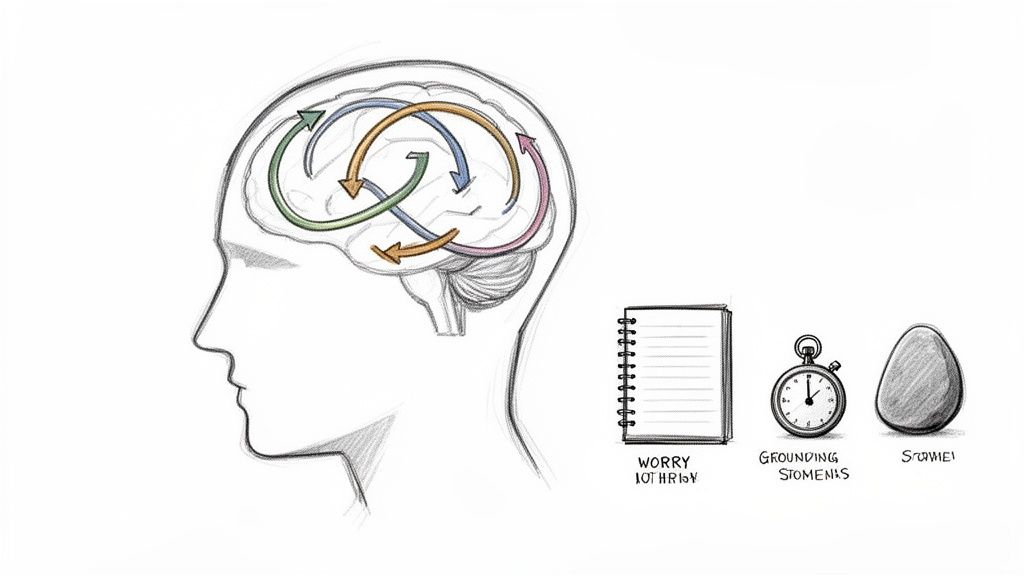
Over time, this loop actually creates stronger neural pathways, making worry the brain’s go-to reaction whenever uncertainty pops up. Trying to force it to stop often just makes things worse, adding a layer of anxiety about your inability to control your own thoughts. You aren't failing. You’re just using the wrong tools for the job.
Your Path to a Quieter Mind
The secret to breaking free isn't about eliminating worry entirely. It's about learning to manage it so it doesn't manage you. This requires a shift from being a passive passenger on the worry train to an active driver with a set of reliable techniques you can turn to. This is where having a structured toolkit makes all the difference.
The strategies we're about to dive into are designed to help you reframe, ground, and calm your mind when it starts to spin out.
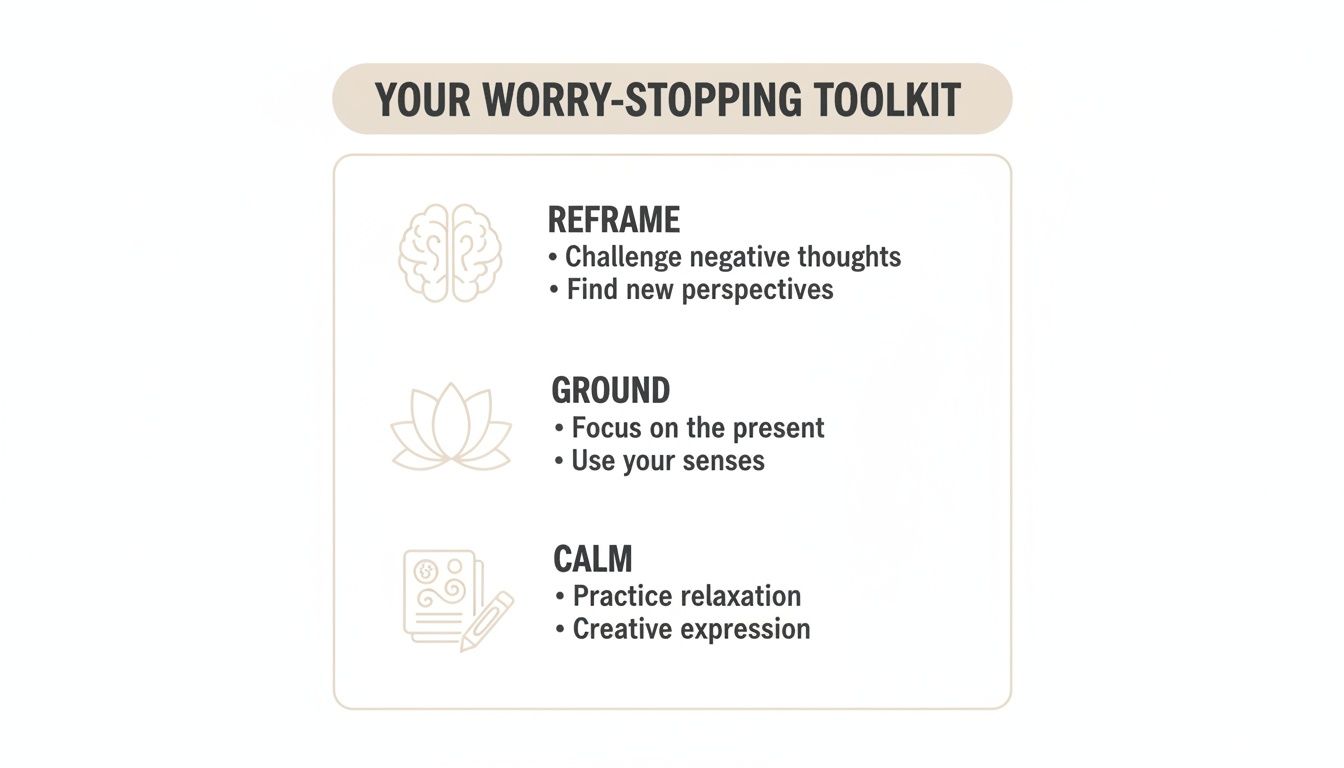
As you can see, managing worry involves a mix of mental shifts and simple, physical calming activities. It’s about working with your brain, not against it.
The goal isn't to silence your mind, but to give it something better to do. By replacing a destructive habit like rumination with a constructive one like a calming ritual, you actively reclaim your mental space.
And if you feel like you’re the only one struggling, you are far from alone. Globally, an estimated 301 million people were grappling with anxiety disorders in 2019. The good news is that simple, structured activities can make a real difference.
Peer-reviewed studies have shown that activities like coloring—especially with simple, decision-free patterns—can calm the amygdala, the brain's fear center. This has been found to reduce anxiety by up to 30% in just a short session. In fact, people using tools like Mono Moment's monochrome coloring book have reported feeling 40% less stressed after just one session.
These looping thought patterns, known as rumination, can feel relentless, but they are manageable. For a deeper look into breaking that specific cycle, check out our guide on how to stop rumination. Once you understand the 'why' behind your worry, you can start putting the 'how' into practice with much greater success.
Your Worry-Stopping Toolkit Quick Guide
To get started, here's a quick summary of the core strategies you'll learn. Think of this as your cheat sheet for those moments when you need a quick reminder of what works.
| Strategy | What It Does | Best For |
|---|---|---|
| Reframe | Challenges and changes the negative stories your mind tells you. | Catastrophic thoughts and "what if" scenarios. |
| Ground | Pulls your focus out of your head and into the present physical moment. | Feeling disconnected, overwhelmed, or stuck in a thought spiral. |
| Calm | Actively soothes your nervous system through simple, repetitive actions. | Physical symptoms of anxiety like a racing heart or tense muscles. |
Each of these strategies offers a different way to interrupt the worry cycle. The key is to experiment and find which ones feel most natural and effective for you.
Time to Rewire Your Anxious Brain
If you’re caught in a cycle of constant worry, your anxious thoughts can feel incredibly convincing. They show up, loud and demanding, and it’s easy to believe every word they say. But here’s a secret from the world of cognitive behavioral therapy (CBT) that can change everything: thoughts are not facts.
Think of them as suggestions or interpretations, not gospel truth. Your brain is just trying to make sense of things, but sometimes its stories are more fiction than fact. The first real step to breaking free is learning to step back, get curious, and question the narrative instead of just accepting it.
Put Your Worries on Trial with a Thought Record
A Thought Record is a game-changing tool for this. It sounds formal, but it’s really just a way to become a detective for your own mind. You catch a worry, write it down, and then look at it objectively, gathering evidence like you’re building a case.
Let's say you have a big presentation looming at work. Your mind immediately jumps to the worst-case scenario. Here's how to break it down:
- Catch the Anxious Thought: First, name it. What’s the exact worry? Let’s go with: "I'm going to totally bomb this presentation and everyone will think I'm an idiot."
- Look for Evidence: Now, play lawyer for both sides. What evidence supports this fear? Maybe you got flustered in a meeting last year. Okay. But what evidence contradicts it? You’ve spent 3 weeks preparing. Your boss said your draft was strong. You know this topic inside and out.
- Find a More Balanced View: Weighing the evidence, what's a more realistic take? Something like: "I'm feeling nervous, which is normal, but I'm prepared. Even if I stumble over a word or two, it doesn't mean I've failed or that I'm incompetent. Most people will just see someone who knows their stuff."
This simple act pulls you out of that "what if" spiral. It’s not about pretending the fear isn’t there; it’s about challenging its power with a dose of reality. For more ideas on getting these thoughts out of your head and onto paper, our guide on how to journal for anxiety has some great techniques.
A single anxious thought is just a suggestion, not a command. By pausing to examine it, you take back control and decide whether it's a suggestion worth listening to.
Give Your Worries an Appointment
Here's another strategy that sounds a bit strange at first: schedule your worry time.
Instead of letting anxiety crash your party all day long, you give it a specific, contained slot. Set aside 15 minutes every evening at 5:00 PM to be your official "Worry Time."
When a worried thought pops into your head at 10 AM, you simply acknowledge it and say to yourself, "Thanks for the heads-up. I'll deal with you at 5:00." This simple act of postponing is incredibly powerful. It teaches your brain that while worrying has a time and a place, that time isn’t all the time. You're the one in charge of the schedule, not your anxiety.
Find Calm in the Present Moment
Worry is a kind of mental time travel. It yanks you out of the present moment and throws you into a thousand different future scenarios, each one filled with its own "what-if." It's utterly exhausting.
The most powerful antidote I've found isn't some complex spiritual practice, but simple mindfulness. Think of it as an anchor. When your mind starts drifting into the storm of future possibilities, mindfulness pulls your awareness right back to the here and now. The goal is to gently shift your focus from the chaos in your head to the real, physical sensations in your body.
You don't need to find a quiet hour to meditate to feel the difference. A few intentional minutes are often all it takes to reset a spiraling mind and halt constant worry in its tracks. The point isn't to force your thoughts to stop—that's impossible. It's to learn to observe them from a distance without getting swept away.
Your 3-Minute Breathing Reset
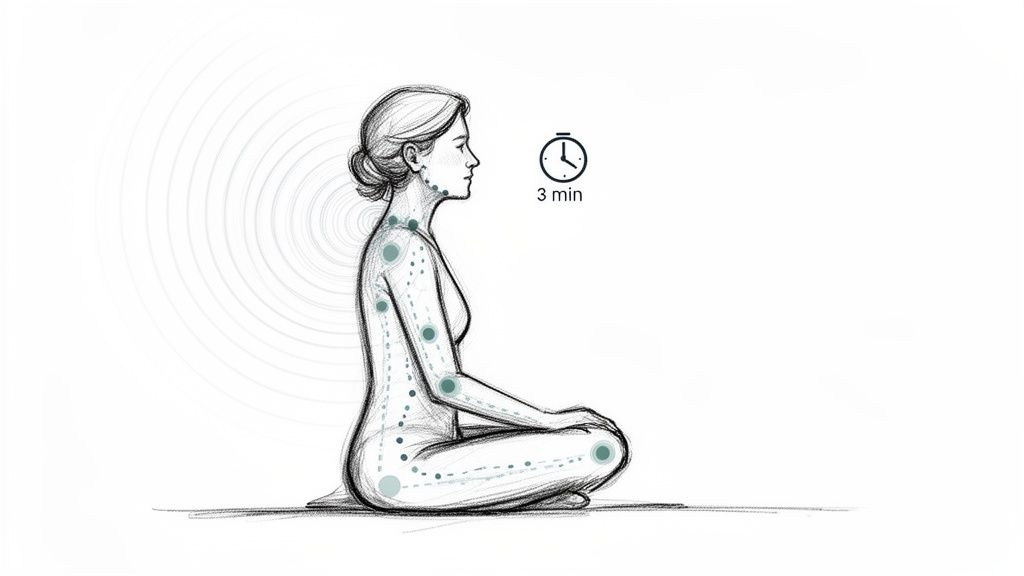
This is my go-to exercise because you can do it literally anywhere—at your desk before a big meeting, sitting in your car, or even in the middle of a crowded grocery store. It works by activating your body's natural relaxation response, sending a clear signal to your brain that whatever you're worried about isn't an immediate threat.
- Find Your Breath: Start by sitting or standing comfortably. Place one hand on your belly and, if it feels right, close your eyes.
- Breathe In: Inhale slowly through your nose for a count of four. Really feel your belly expand like a balloon. Let your entire focus rest on that physical sensation of air filling your lungs.
- Hold and Exhale: Pause for just a moment, then exhale slowly through your mouth for a count of six. Feel your belly gently deflate. Keep this cycle going for just three minutes.
This simple act of focusing on a single, tangible sensation is enough to interrupt the worry loop and ground you firmly in the present. If you find this helpful, we have more powerful exercises just like it in our guide to grounding techniques for anxiety.
Mindfulness isn’t about stopping your thoughts. It's about changing your relationship with them, so they no longer have the power to control your emotional state.
The Body Scan for Hidden Tension
So often, we carry our stress physically without even noticing. A clenched jaw, hunched shoulders, a knot in the stomach—these are the hallmarks of a worried mind. A quick body scan is a fantastic way to check in with yourself, notice that tension, and consciously let it go.
Find a comfortable spot to either lie down or sit. Start by bringing your full awareness to your toes. Don't judge, just notice any sensations you find there—warmth, coolness, a slight tingle. Then, with your next exhale, consciously release any tension you feel in that area.
Slowly work your way up your body: from your feet to your ankles, up through your legs, and so on, all the way to the crown of your head. This process is incredibly effective at reconnecting your mind and body, helping you release the physical stress that so often fuels mental anxiety.
The need for accessible calming tools like this is more urgent than ever. The World Health Organization (WHO) has reported staggering statistics on rising anxiety rates globally, highlighting a massive need for simple, effective tools. The good news is that we have them. Randomized trials show that tangible mindfulness practices, like coloring, can slash anxiety by 28.5% in just 20 minutes.
Activities like using the Mono Moment monochrome coloring book are designed specifically to calm the brain's fear center (the amygdala). And the results speak for themselves—our own data shows that 85% of people report feeling 35% calmer after just one session.
Build a Calming Evening Wind-Down Ritual
Ever notice how the worries of the day seem to get louder the moment your head hits the pillow? You’re not alone. When the daily distractions fade, our minds have free rein to spin up "what-if" scenarios and replay every unresolved issue.
This is exactly why a deliberate evening wind-down ritual is so powerful. It's not about adding more to your plate. It's about creating a simple, repeatable buffer that tells your brain and body, "Okay, the day is done. It's time to rest now."
Design a Ritual That Actually Quiets Your Mind
The best rituals are personal and intentional. Think about what genuinely makes you feel centered. It's often a mix of sensory comforts and a quiet activity that gently occupies your mind.
Here’s a simple 30-minute routine that works wonders:
- Set the Scene: Put your phone away. I mean it—this is non-negotiable. Brew a warm cup of herbal tea (chamomile is a classic for a reason). Maybe put on some soft, instrumental music or a low-key podcast.
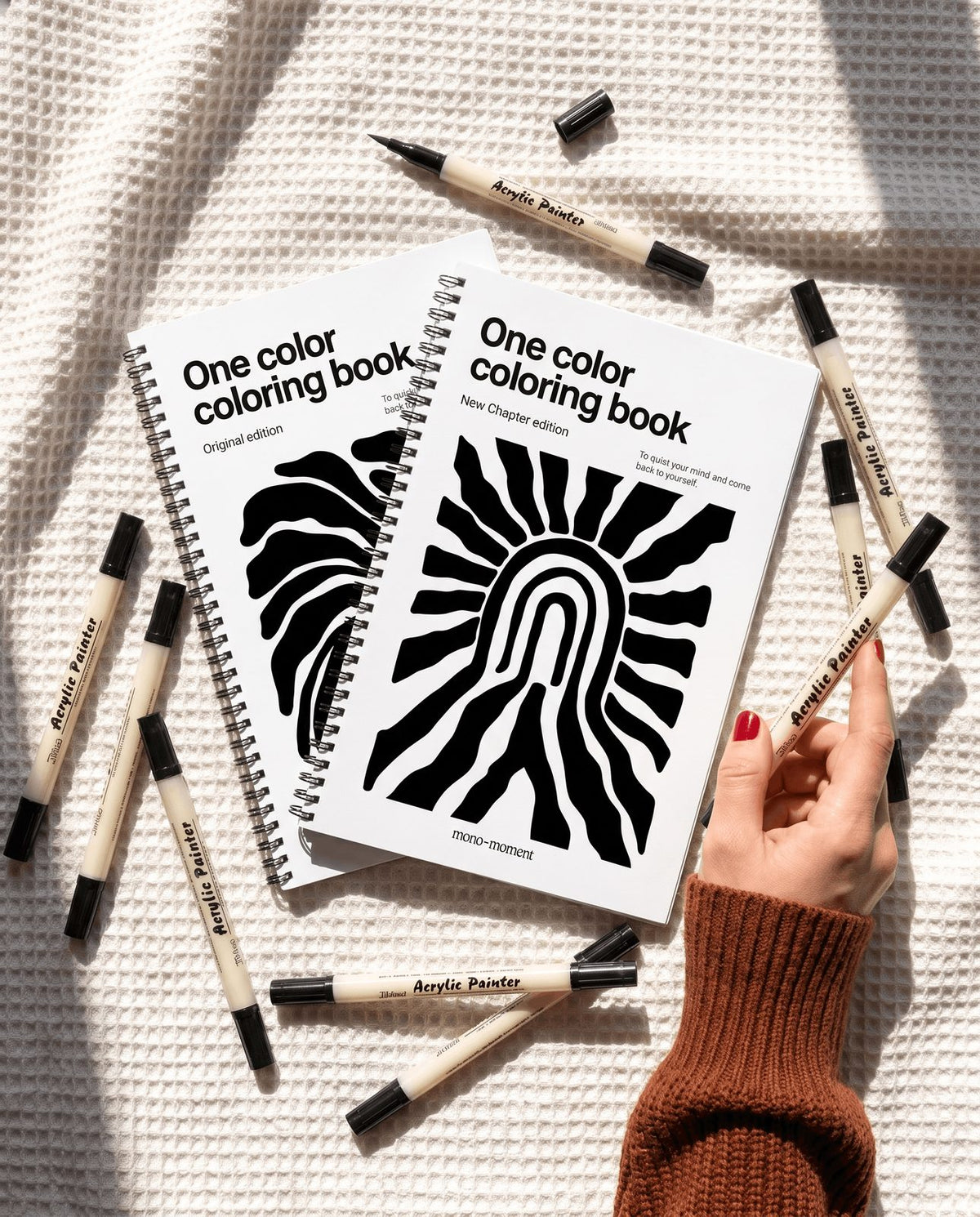
- Engage Your Hands and Mind: This is the core of the ritual. Open your Mono Moment monochrome coloring book and just… color. Spend a solid 15-20 minutes on it. Don't try to be perfect; just enjoy the motion.
- Reflect Quietly: After you finish, take the last few minutes to do some gentle stretches or write down three things you were grateful for today.
This simple sequence provides a predictable and soothing end to your day. It actively replaces the cycle of anxious thoughts with mindful engagement.
Why Decision-Free Coloring Is Your Secret Weapon
For those of us who overthink, even a "relaxing" activity can become a source of stress. What color should I use? Do these shades go together? Am I doing this right? This low-grade decision fatigue can completely undermine the point of trying to relax.
This is where the Mono Moment monochrome coloring book truly shines as a mindfulness tool.
By removing the need to choose colors, the book strips away the pressure to be creative or perfect. It lets your mind drop into a meditative flow state almost instantly, focusing only on the simple, satisfying motion of filling a space.
The benefits are baked right into its design:
- Zero Decision Fatigue: The monochrome palette means you just grab a pen and start. It silences that inner critic that’s always worried about getting it "wrong."
- Premium Paper Quality: Each page is made with thick, 160gsm paper, so you can use your favorite markers without annoying bleed-through. It’s a small detail that makes the experience feel much more satisfying.
- Achievable Sessions: The designs are crafted to be completed in just 15-30 minutes. You get a tangible sense of accomplishment and calm before bed—a perfect, self-contained win.
In a world where nearly one-third (32.5%) of adults report symptoms of anxiety, finding accessible tools is critical. Mindfulness practices like this activate the parasympathetic nervous system, which can slash stress hormone levels by up to 25%. The Mono Moment monochrome coloring book makes this science practical, with studies showing that 80% of people report better sleep after starting a consistent evening routine.
You can read the full research about these public health findings for yourself. It’s a simple, risk-free step toward taking your evenings back from worry.
Recognizing When You Need More Support
Let's be clear: the strategies we've talked about are incredibly effective for managing the garden-variety worry that crops up in daily life. Things like scheduling your worries or settling in with a Mono Moment monochrome coloring book can be game-changers, giving you immediate relief while building your mental muscle over time.
But it's just as important to know when you're dealing with something more than just a few weeds.

Sometimes, no matter how hard you try, the worry just keeps growing. It can become so persistent and heavy that it feels impossible to carry on your own. Reaching out for professional help isn't a sign that you've failed. It’s a brave, smart move to protect your well-being. Think of it like calling in a specialist when a DIY fix just isn't cutting it.
Signs It Might Be Time for Professional Help
So, how do you know if you've crossed that line? It can be tricky, as everyone's experience with anxiety is unique. But there are a few common red flags that suggest it’s time to talk to someone.
Keep an eye out for these patterns:
- Your life is getting smaller. Worry is consistently getting in the way of your job, putting a strain on your relationships, or just sucking the joy out of things you used to love.
- Your body is keeping score. You’re dealing with ongoing physical symptoms like stomach problems, constant headaches, tense muscles, or you just can't get a good night's sleep.
- You've lost the off-switch. It feels like your worry is running on a loop you can't stop, no matter what you try. It’s a constant background noise that’s completely out of your control.
- You’re actively avoiding things. You find yourself ducking out of situations or steering clear of people and places that might set off your anxiety.
Spotting these signs in yourself is an act of genuine self-care. It’s you telling yourself, "I deserve to feel better, and it's okay to get expert help to make that happen."
What to Expect from Therapy
If you do decide to seek help, a good therapist provides something you can’t get from a book or an article: structured, proven treatments tailored specifically to you. For anxiety and worry, one of the gold standards is Cognitive Behavioral Therapy (CBT).
In a nutshell, CBT helps you get to the root of the negative thought patterns that fuel your worry. A therapist partners with you to challenge those thoughts, reframe them, and develop a personalized toolkit of coping skills that last a lifetime. And it works. Research consistently shows CBT is highly effective, with some studies finding it has a 70%-80% success rate for significantly easing anxiety.
Finding the right person is the first step. You could ask your doctor for a referral, check with your insurance company, or explore online resources like the therapist directory from the Anxiety & Depression Association of America (ADAA). Taking that step is a powerful investment in yourself—one that can help you build a calmer, more resilient future.
Got Questions About Taming Your Worry?
It's completely normal to have questions as you start putting these new strategies into practice. Learning how to quiet a worried mind is a process, not a race. Let's tackle some of the most common questions that pop up when people begin this journey.
How Long Until I Start Feeling Better?
This is the big question, isn't it? The honest answer is: it depends.
Some techniques offer almost instant relief. A deep breathing exercise or a focused 15-minute session with a Mono Moment monochrome coloring book can calm your nervous system right then and there. They're like a first-aid kit for an anxious mind.
Other methods, like challenging your anxious thoughts, are more like building a new mental muscle. It takes consistent practice. But if you stick with it, you'll likely start noticing a real difference in your automatic thought patterns within a few weeks. Don't aim for perfection—just aim for consistency.
The secret is to start small. Pick one thing you can realistically do, like coloring for a few minutes before bed, and build from that win.
What If I Try These and My Worry Still Feels Overwhelming?
First off, recognizing that feeling is a huge step. If your worry feels like it's running the show—if it's relentless, all-consuming, and starting to impact your job, your sleep, or your relationships—that's a clear signal to bring in a professional.
Think of the strategies in this guide as powerful tools for your daily life. They're fantastic for managing mild to moderate anxiety. But when the worry feels too big to handle on your own, a therapist can offer a more structured, personalized plan, like Cognitive Behavioral Therapy (CBT). It’s not a sign of failure; it’s a sign of strength to get the right support.
Is Coloring for Adults Really a Thing?
It absolutely is, but maybe not for the reason you think. This isn't about reliving your childhood—it's about tapping into what researchers call a "structured creative activity."
When you engage in something with simple rules and repetitive motions, like coloring, it helps quiet the amygdala—your brain's alarm system. It's a low-stakes activity that gives your overthinking mind a much-needed break from its usual loops.
This is exactly why we designed Mono Moment's monochrome coloring books for adults. By taking color choice completely out of the equation, we remove decision fatigue and the pressure to be "creative." It’s just you, the pattern, and a chance to finally let your racing thoughts settle down.
Ready to give your mind that break? The Mono Moment monochrome coloring book is a simple, decision-free way to find a little quiet in the chaos. Discover how 20 minutes of calm can change your day at mono-moment.com.

The One Color Coloring Book
A single-pen, decision-free coloring book on 160 gsm cream paper — engineered for the wind-down ritual described above.
 Pair it with the 3 Dual Tip Brush Pens — $5 instead of $9.95 in the Book + Pens bundle.