About the author
Published January 5, 2026 · Last reviewed April 26, 2026 · 18 min read
In this article · 12 sections
- 1. Monochrome Coloring & Adult Coloring Books
- 2. Zentangle & Zen-Inspired Doodling
- 3. Mandala Creation & Coloring
- 4. Mindful Sketching & Contour Drawing
- 5. Water-Based Painting & Watercolor Meditation
- 6. Pattern Design & Textile-Inspired Illustration
- 7. Restorative Art Journaling with Minimal Pressure
- 8. Guided Meditative Coloring with Mindfulness Instruction
- 9. Scribbling & Expressive Mark-Making for Emotion Release
- 10. Therapeutic Collage & Mixed Media Assembly
- 10-Point Comparison: Adult Art Therapy Activities
- Your Next Creative Moment is Waiting
In a world that constantly demands our attention, finding a quiet space for your mind can feel impossible. Overthinking and anxiety often take the lead, leaving us feeling drained and disconnected. If you're searching for a simple, tangible way to manage daily stress, you've found the right place. This guide is built for non-artists, overthinkers, and anyone seeking a moment of peace without the pressure to be perfect.
This isn't just another list; it's a practical toolkit of 10 actionable art therapy activities for adults designed to be completed in just 15–30 minutes. We'll explore evidence-based techniques that shift your focus from ruminating thoughts to the restorative power of creative action. Each entry provides clear, step-by-step instructions, therapeutic benefits, and easy adaptations for any skill level.
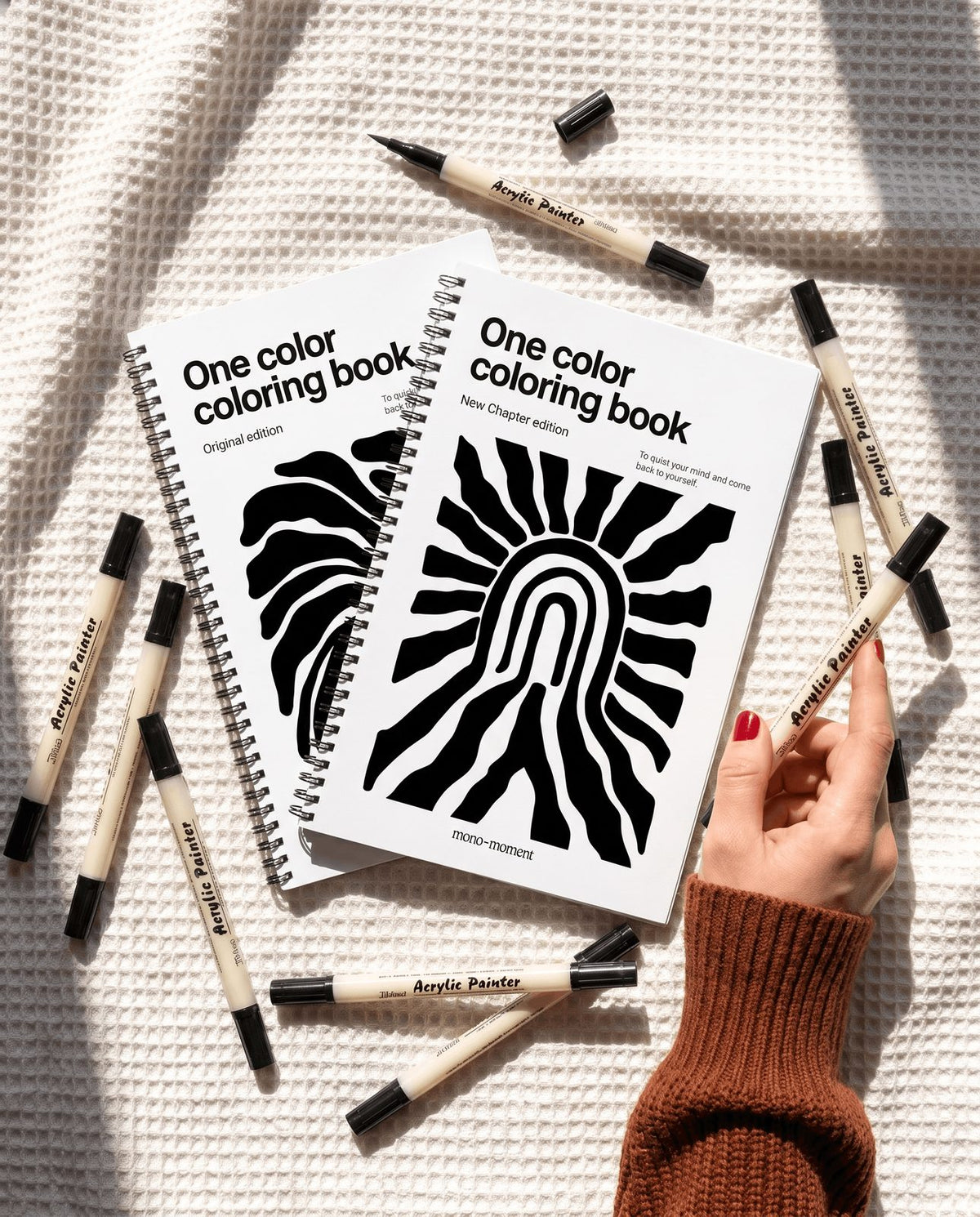
We'll place special emphasis on decision-free processes that lower the barrier to entry, particularly monochrome coloring. This powerful technique silences perfectionism and simplifies creativity. You’ll see how curated tools, like the premium paper and thoughtful designs in the Mono Moment One Color Coloring Book, can transform a short break into a reliable mental reset. Get ready to discover a new way to calm your mind, one simple, focused activity at a time.
Which art activities help most with overthinking?
Repetitive, low-decision formats work best: one-color coloring, Zentangle-style patterns, mandalas, blind contour drawing. They occupy the visual brain so the verbal loop quiets down, and none of them require skill. These are art-therapy-inspired practices for everyday stress — different from clinical art therapy, which is guided by a credentialed therapist.
1. Monochrome Coloring & Adult Coloring Books
Coloring isn't just for kids; it's one of the most accessible and effective art therapy activities for adults seeking immediate calm. Traditional adult coloring books, pioneered by Johanna Basford, brought this practice into the mainstream. However, the pressure to choose the "right" colors can be counterproductive for an overthinking mind. This is where monochrome coloring shines.
Monochrome coloring eliminates decision fatigue entirely. By using just one or two shades, you shift focus from outcome to process, allowing your brain to enter a meditative state. The repetitive, rhythmic motion of filling in spaces activates the parasympathetic nervous system, which helps lower cortisol levels and reduce anxiety. It’s a purely mechanical, soothing activity designed to quiet mental chatter.
How to Get Started
- Materials: A Mono Moment One Color Coloring Book, designed with thick, 160gsm paper to prevent bleed-through, and a single high-quality pen, marker, or colored pencil.
- Time: 15–30 minutes.
- Instructions: Choose a design. Select one color. Begin coloring without worrying about the final product. Focus on the sensation of the pen on the paper and the simple act of filling the space.
Turn It Into a Ritual
To maximize its calming benefits, create a consistent practice. Set aside the same time each day, put on calming music, and dedicate a small, quiet space to your coloring. This transforms a simple activity into a powerful mindfulness ritual. This approach is so effective that it’s used in corporate wellness programs and university counseling centers to manage stress. For a deeper dive into this unique style, you can learn more about grayscale and monochrome coloring books.
2. Zentangle & Zen-Inspired Doodling
Zentangle is a meditative drawing method that uses structured, repetitive patterns to create beautiful, intricate designs. Far from a free-for-all doodle, this practice is a form of active meditation that combines simple strokes into complex-looking "tangles." It is one of the most powerful art therapy activities for adults because it was specifically designed to be non-representational, eliminating the pressure to draw something "real."
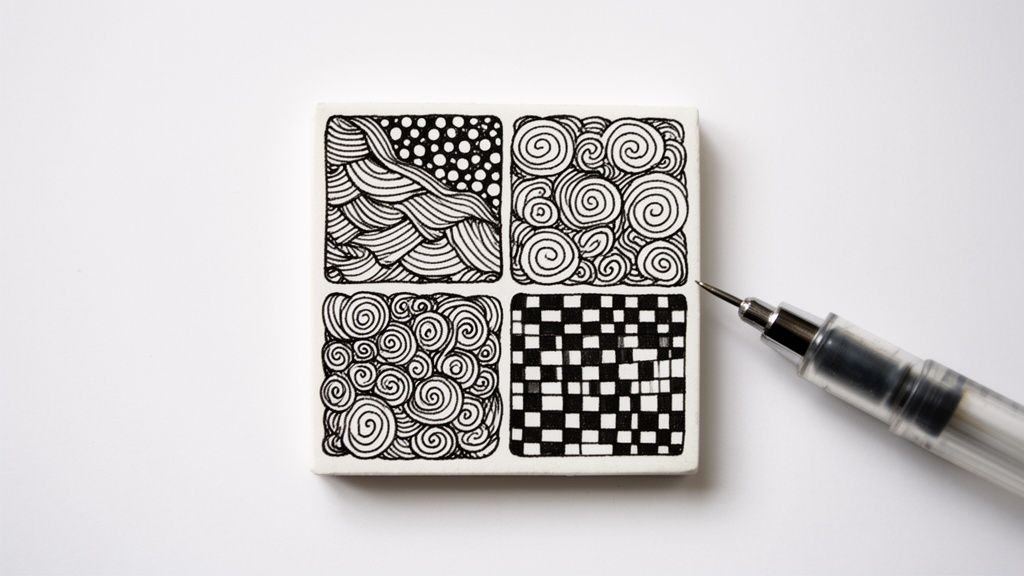
This method is especially effective for those dealing with perfectionism or anxiety, as its core philosophy states there are "no mistakes." Each stroke is an opportunity, not a potential error. By focusing on the simple, repetitive motions one stroke at a time, you engage your mind just enough to quiet intrusive thoughts and enter a state of relaxed focus. This process-over-product approach helps regulate the nervous system and builds creative confidence without demanding artistic skill.
How to Get Started
- Materials: A small piece of quality paper or a 3.5" square "tile," a fine-tipped black pen (like a Micron), and a pencil for initial string guides.
- Time: 15–30 minutes.
- Instructions: Lightly draw a border and a "string" (a simple, curving line) inside it with a pencil. Using your pen, begin filling the sections created by the string with different repetitive patterns, or "tangles." Focus on each stroke without planning the entire piece.
Turn It Into a Ritual
Make Zentangle a mindful break by committing to one small tile a day. Use a dedicated pen and find a quiet corner where you won't be disturbed. The small format is intentionally designed to be achievable and non-intimidating. For an even more focused experience, apply the principles of monochrome coloring: stick to one black pen on white paper to remove color decisions and deepen your meditative state. This practice is used in corporate wellness and rehabilitation centers to improve focus and reduce stress.
3. Mandala Creation & Coloring
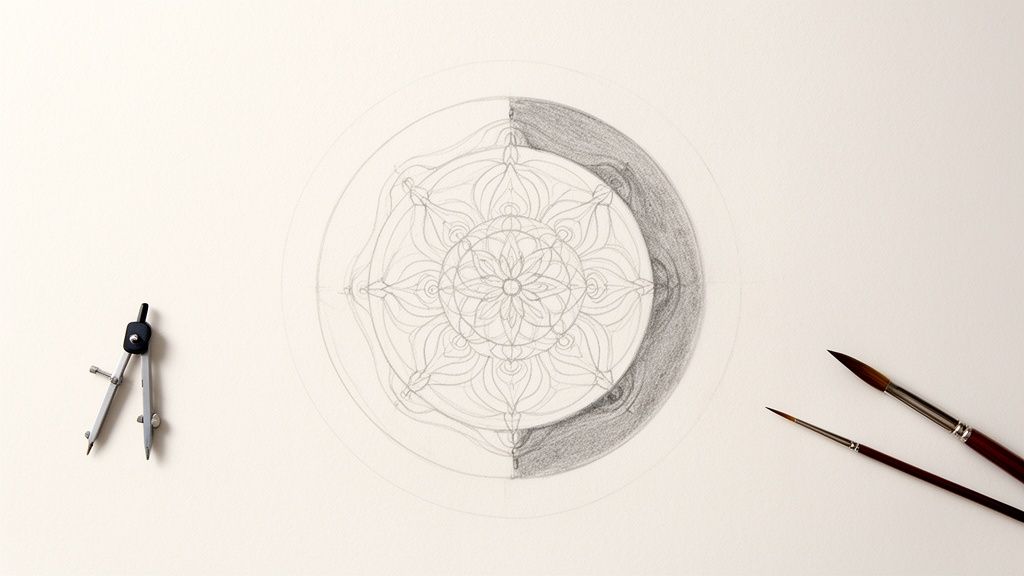
Creating or coloring mandalas is one of the most powerful art therapy activities for adults for quieting an overstimulated mind. Rooted in ancient spiritual traditions, mandalas are geometric, circular designs whose symmetry provides a natural sense of order and calm. The circular format creates a contained, safe creative space, which is especially comforting when feeling overwhelmed or anxious.
The therapeutic benefit lies in the repetitive, structured action of filling in the patterns. As psychoanalyst Carl Jung observed, the process of engaging with these universal symbols helps organize the psyche and promote a state of deep focus. This meditative quality is why mandalas are used in everything from mental health clinics to corporate wellness programs to facilitate mindfulness.
How to Get Started
- Materials: A mandala coloring book or a printable template, and a set of pens, markers, or colored pencils.
- Time: 15–30 minutes.
- Instructions: Choose a mandala that appeals to you. Select a limited color palette or just one color to start. Begin coloring from the center and work your way outward, focusing on the rhythmic motion and the symmetrical patterns. Let go of any expectation for the final outcome.
Turn It Into a Ritual
To deepen the benefits, make mandala coloring a consistent practice. For an even more focused session, try a monochrome approach. Using a single high-quality pen on a mandala design eliminates all color-related decisions, allowing your mind to fully settle into the meditative flow. The Mono Moment store offers products specifically designed for this purpose, transforming the activity into a powerful ritual for centering yourself.
4. Mindful Sketching & Contour Drawing
Mindful sketching shifts the goal of drawing from creating a perfect replica to engaging in pure, focused observation. It's one of the most powerful art therapy activities for adults for anchoring a racing mind. A key technique within this practice is contour drawing, where you capture an object's outline, often without lifting your pen from the paper. This forces your brain to slow down and synchronize with your hand, creating a direct link between seeing and doing.
This practice is incredibly effective because it bypasses the brain's critical, symbol-making left hemisphere and engages the intuitive, observational right hemisphere, a concept popularized by Betty Edwards. By focusing intensely on the lines and shapes of an object, you are unable to simultaneously worry or overthink. The continuous line becomes a meditative anchor, tethering your awareness firmly to the present moment and the simple act of creation.
How to Get Started
- Materials: A sketchbook or a few sheets of paper, and a single pen or fine-tipped marker. A high-quality pen, like those used for monochrome coloring, provides a smooth, consistent line that enhances the experience.
- Time: 10–20 minutes.
- Instructions: Choose a simple object like your hand, a piece of fruit, or a houseplant. Place it in front of you. Fix your eyes on one point of the object and place your pen on the paper. Slowly begin to trace the object’s outline with your eyes, letting your hand follow the same path on the paper. Try not to lift the pen until you are finished. For a classic challenge, try "blind contour drawing" where you don't look at your paper at all.
Turn It Into a Ritual
Dedicate a small pocket of your day to this practice. Keep a dedicated "mindful sketchbook" and your favorite pen on your desk or nightstand. Before starting, take three deep breaths to center yourself. Set a timer for 10 minutes and give yourself permission to create without judgment. This small, consistent ritual can train your brain to access a state of calm on command, building mental resilience against daily stressors.
5. Water-Based Painting & Watercolor Meditation
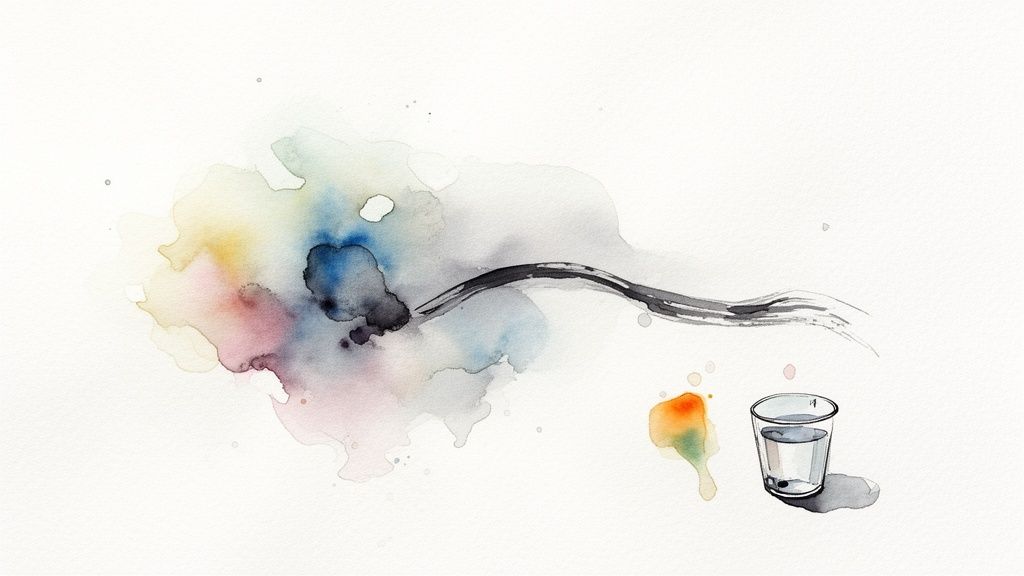
Engaging with watercolors is one of the most powerful art therapy activities for adults for confronting perfectionism. Unlike precise mediums, water has a mind of its own. This inherent unpredictability forces you to let go of control, making it an exercise in acceptance and flow. The practice is less about creating a masterpiece and more about observing how pigment and water merge, separate, and settle on the page.
This process of non-attachment is profoundly meditative. As you guide the brush, you learn to embrace so-called mistakes, which often lead to the most beautiful and unexpected results. This teaches resilience and helps quiet the inner critic that fuels anxiety, allowing you to find peace in the impermanent, fluid nature of the art itself.
How to Get Started
- Materials: A set of basic watercolors, a medium-sized brush, and watercolor paper (140gsm or higher to prevent warping).
- Time: 15–30 minutes.
- Instructions: Begin with a simple "wet-on-wet" technique. Lightly dampen a section of your paper with clean water. Add a drop of pigment and simply watch it spread and bleed. Focus on the movement and the way colors interact rather than trying to paint a specific object.
Turn It Into a Ritual
Dedicate a short session to this practice whenever you feel overwhelmed by the need for control. Set an intention to simply observe, not to create. To further reduce decision fatigue, try a monochrome approach by using just one or two colors, similar to the philosophy behind our monochrome coloring books. This simplifies the process even more, transforming your painting time into a dedicated mindfulness practice focused purely on acceptance and flow.
6. Pattern Design & Textile-Inspired Illustration
Creating repetitive patterns is a powerful method that blends meditative rhythm with artistic expression, making it one of the most effective art therapy activities for adults. Inspired by textile design and historical artists like William Morris, this practice involves building a larger illustration from a single, simple motif. The act of repeating a mark or shape provides a structured, predictable process that calms an overthinking mind.
This activity is deeply therapeutic because it builds a sense of mastery and control. As you repeat a simple shape, it evolves into a complex, beautiful design, offering tangible proof of progress. The structured nature of pattern-making reduces decision anxiety, especially when you limit your tools and colors. It channels focus into the physical act of creation, quieting internal noise and promoting a state of mindful flow.
How to Get Started
- Materials: A sketchbook or high-quality paper (like the 160gsm paper in Mono Moment coloring books), a fine-tipped pen, or a single marker. Grid paper can also be helpful for beginners.
- Time: 20–30 minutes.
- Instructions: Start with a simple motif like a leaf, a geometric shape, or even just a dot. Draw it once. Then, repeat it in a structured sequence, filling a small square. Focus on the rhythm of replication, not on making each one perfect.
Turn It Into a Ritual
Dedicate a small portion of your sketchbook to daily pattern practice. To make it even more decision-free, commit to a monochrome approach using only a black pen. This removes color choice entirely, deepening the meditative benefits. Create a "motif library" of simple shapes you enjoy drawing, so you can begin immediately without overthinking. This transforms pattern design from a one-off activity into a reliable tool for managing daily stress.
7. Restorative Art Journaling with Minimal Pressure
Art journaling is a private, process-oriented practice that serves as a powerful outlet for emotions without the pressure of creating a finished masterpiece. Unlike formal drawing, this is one of the most freeing art therapy activities for adults because it encourages a "messy middle" approach. It combines words, images, and mixed media in a personal journal, removing the fear of an audience and short-circuiting perfectionism.
This low-stakes creative documentation is ideal for processing complex feelings and building confidence. By focusing on raw, imperfect exploration, you give yourself permission to simply express what’s inside. The privacy of the journal creates a safe container for self-discovery, allowing you to document your inner world without judgment. It’s a technique widely used in therapeutic settings for its ability to unlock subconscious thoughts and promote healing.
How to Get Started
- Materials: A simple notebook or journal, a few pens, markers, old magazines for collage, or even a single high-quality pen.
- Time: 15–30 minutes.
- Instructions: Open to a blank page. Start with a simple prompt like, "What color is my mood today?" or "What do I need right now?" Use colors, shapes, words, or cut-out images to respond. Don’t aim for coherence or beauty; just focus on getting something on the page.
Turn It Into a Ritual
To make art journaling a restorative habit, dedicate a specific time and a quiet space for it, free from digital distractions. The key is allowing your pages to be "ugly" because this is where authentic expression happens. This practice is fundamentally about letting go of self-criticism, a critical step to learn how to stop perfectionism. By consistently showing up for this unstructured creative time, you build a powerful ritual of self-compassion and emotional release.
8. Guided Meditative Coloring with Mindfulness Instruction
This technique elevates simple coloring into a potent therapeutic practice by pairing it with guided mindfulness instruction. Instead of coloring silently, you follow a recorded or live audio guide that directs your attention to your breath, the physical sensations of coloring, and the thoughts that arise without judgment. This combination merges the neurological benefits of repetitive motion with evidence-based mindfulness, making it one of the most structured art therapy activities for adults.
The guide helps you stay anchored in the present moment, preventing your mind from wandering to anxious thoughts. This approach is frequently used in Mindfulness-Based Stress Reduction (MBSR) programs and by mental health apps like Calm and Headspace to transform a simple creative act into a deep, meditative experience. It’s particularly effective for those who find unguided meditation difficult, as the coloring provides a tangible focus point.
How to Get Started
- Materials: A high-quality monochrome coloring book from Mono Moment, a single pen or marker, and a guided coloring meditation (available on YouTube or mindfulness apps).
- Time: 15–30 minutes.
- Instructions: Find a quiet space and play your chosen guided meditation. Follow the facilitator’s prompts as you color, focusing on your breath and the sensation of the pen moving across the thick, bleed-proof paper.
Turn It Into a Ritual
Consistency is key to deepening your mindfulness practice. Choose the same guided session for a week to build familiarity and allow the instructions to sink in more deeply. By creating a dedicated time and space for this activity, you train your brain to associate the ritual with a state of calm and focused awareness. This practice is an excellent example of combining mindfulness and creativity for powerful results; explore other stress relief activities for adults that use a similar philosophy.
9. Scribbling & Expressive Mark-Making for Emotion Release
While structured activities calm the mind, sometimes what you need is a pure, unfiltered release. Expressive mark-making, or intentional scribbling, is one of the most powerful art therapy activities for adults for discharging pent-up emotions like anger, frustration, or anxiety. It completely removes the pressure to create something beautiful, focusing instead on the physical act of releasing emotional energy onto the page.
Unlike meditative coloring, this practice is about kinetic, spontaneous expression. The goal isn't art; it’s catharsis. By channeling intense feelings into rapid, energetic marks, you give them a physical form and a way out. This somatic approach helps regulate the nervous system by allowing for the completion of the stress response cycle, making it a go-to technique in trauma-informed therapy for processing difficult emotions safely.
How to Get Started
- Materials: Large paper (the bigger, the better), and bold, high-contrast markers, crayons, or charcoal.
- Time: 15–30 minutes.
- Instructions: Set an intention, such as "I am releasing frustration." Put on intense, energetic music if it helps. Begin making marks on the paper without thinking. Use your whole arm, vary the pressure, and let the marks reflect your feelings. When you feel a sense of release, you can stop.
Turn It Into a Ritual
To make this a complete emotional regulation tool, create a "release and restore" ritual. Dedicate a private space where you can be messy and expressive without judgment. After your scribbling session, symbolically destroy the paper by tearing it up to signify letting go of the emotion. Follow this intense activity with a calming one, like working on a page from a Mono Moment coloring book, to bring your nervous system back to a state of equilibrium and peace.
10. Therapeutic Collage & Mixed Media Assembly
Creating art by assembling existing materials like magazine cutouts, textured paper, and found objects offers a unique therapeutic path. Unlike drawing or painting, which demand mark-making from scratch, collage shifts the focus to selection, arrangement, and composition. This process removes the pressure of technical skill, making it one of the most freeing art therapy activities for adults for expressing complex emotions and telling stories.
Collage naturally invites you to explore themes of identity and personal narrative. The act of choosing images and textures that resonate with you is inherently symbolic, allowing for subconscious expression. It’s a powerful tool used in clinical settings for trauma work, grief processing, and exploring life transitions because it provides a safe, indirect way to externalize internal feelings. The finished piece becomes a unified whole created from disparate parts, a metaphor for integration and healing.
How to Get Started
- Materials: A sturdy base (like thick cardstock or a canvas), scissors, a glue stick, and a collection of materials (magazines, old books, fabric scraps, colored paper).
- Time: 20–30 minutes.
- Instructions: Gather your materials. Begin by mindfully tearing or cutting out images, words, and colors that catch your eye without overthinking why. Arrange them on your base, playing with composition until it feels right, then glue them down.
Turn It Into a Ritual
To deepen the therapeutic impact, create a themed and focused practice. For instance, try a monochrome collage. Limit your materials to a single color palette, similar to the concept behind Mono Moment’s monochrome coloring book. This constraint reduces overwhelm and encourages you to focus on texture and form. Pair this activity with a journaling prompt, such as "What does this color mean to me today?" to transform a simple craft into a profound self-reflection exercise.
10-Point Comparison: Adult Art Therapy Activities
| Practice | 🔄 Implementation Complexity | ⚡ Resource Requirements | ⭐ Expected Outcomes / 📊 Impact | 📊 Ideal Use Cases | 💡 Key Advantages |
|---|---|---|---|---|---|
| Monochrome Coloring & Adult Coloring Books | 🔄 Low — structured, decision-free | ⚡ Low — book + pen; premium paper optional | ⭐ Moderate–High anxiety reduction; quick completions 📊 | Short breaks, workplace wellness, clinic adjuncts | 💡 Accessible, low-cost, portable; immediate sense of progress |
| Zentangle & Zen-Inspired Doodling | 🔄 Low–Moderate — learn basic tangles | ⚡ Low — pen, small tiles | ⭐ High focus/flow; builds fine-motor skill 📊 | Rehab, art therapy, mindful journaling | 💡 Nonjudgmental, scalable complexity; tangible results |
| Mandala Creation & Coloring | 🔄 Moderate — symmetry tools or templates helpful | ⚡ Low–Moderate — templates, compass, color tools | ⭐ High grounding & centeredness; strong calming effect 📊 | Mindfulness retreats, trauma-informed groups, clinics | 💡 Symmetry-based soothing; culturally rooted practice |
| Mindful Sketching & Contour Drawing | 🔄 Moderate — technique practice needed | ⚡ Low — pen/paper; optional instruction | ⭐ High present-moment focus; improved observation 📊 | Mindfulness + skill-building, art education, grounding | 💡 Combines meditative attention with skill development |
| Water-Based Painting & Watercolor Meditation | 🔄 Moderate — medium technique & control | ⚡ Moderate — paints, brushes, quality paper, water | ⭐ High acceptance & flow; emotion-processing impact 📊 | Retreats, emotion-regulation therapy, mindful studios | 💡 Teaches letting-go; sensory, expressive medium |
| Pattern Design & Textile-Inspired Illustration | 🔄 Moderate–High — design/composition demands | ⚡ Moderate — tools (analog/digital), time | ⭐ High sense of mastery; visible progression 📊 | Perfectionist-friendly workshops, surface-design practice | 💡 Modular approach yields display-worthy work |
| Restorative Art Journaling with Minimal Pressure | 🔄 Low–Moderate — habit-forming, low structure | ⚡ Low — journal + mixed media basics | ⭐ High emotional processing & resilience over time 📊 | Personal therapy, trauma recovery, private reflection | 💡 Private, flexible; integrates words and images for meaning |
| Guided Meditative Coloring with Mindfulness Instruction | 🔄 Moderate — needs facilitator/audio structure | ⚡ Low–Moderate — recordings/facilitator + materials | ⭐ Very high anxiety reduction when guided 📊 | Group sessions, apps, clinical skill-teaching | 💡 Combines evidence-based mindfulness + art; reduces self-direction |
| Scribbling & Expressive Mark-Making for Emotion Release | 🔄 Low — immediate and unstructured | ⚡ Low–Moderate — large paper, bold media, space | ⭐ High immediate discharge for activated states 📊 | Anger/agitation release, high-energy workshops | 💡 Rapid catharsis; eliminates perfectionism; physically regulating |
| Therapeutic Collage & Mixed Media Assembly | 🔄 Low–Moderate — composition focus | ⚡ Moderate — materials, adhesives, workspace | ⭐ High symbolic meaning-making & narrative processing 📊 | Trauma work, identity exploration, group therapy | 💡 Tactile, accessible; produces polished, meaningful outcomes |
Your Next Creative Moment is Waiting
The journey toward a quieter, more present mind isn't about achieving artistic mastery or producing a masterpiece. It's about giving yourself permission to slow down, to engage your hands, and to focus on the simple, restorative act of creation. The ten art therapy activities for adults we've explored are more than just ways to pass the time; they are powerful, accessible tools for navigating the complexities of modern life. From the expressive freedom of scribbling to the structured peace of mandala creation, each activity offers a unique doorway into mindfulness.
The common thread weaving through all these practices is the shift from outcome to process. You've learned that you don't need a studio full of supplies or hours of free time to benefit. A few minutes with a pen and paper, focusing on the slow, deliberate lines of a Zentangle or the intuitive flow of watercolor, can be enough to reset your nervous system and untangle the knots of a stressful day.
Finding Your Personal Sanctuary
The most effective self-care practice is the one you consistently return to. For many, especially those wrestling with overthinking and decision fatigue, the simplest path is often the most profound. While art journaling and collage offer wonderful outlets for complex expression, the structured simplicity of coloring provides a reliable anchor in moments of overwhelm. This is where the barrier to entry truly matters.
Consider the activities that felt most inviting to you. Was it the rhythmic pattern-making? The tactile nature of collage? Or the contained, predictable comfort of a pre-drawn design? Your preference is your guide. The goal is to build a small, sustainable ritual that feels like a refuge, not another task on your to-do list. The true value lies in creating a dependable space where you can quiet the noise, even for just fifteen minutes.
The Power of A Single-Focus Ritual
Among all the powerful art therapy activities for adults, decision-free coloring stands out as a uniquely effective tool for the modern, overstimulated mind. The act of choosing colors, while creative, can sometimes introduce a layer of pressure that contradicts the goal of relaxation. By removing that single variable, you create a direct path to a meditative state.
The Mono Moment One Color Coloring Book was engineered with this specific principle in mind. It eliminates the paradox of choice, offering intricate yet achievable designs that invite you to lose yourself in the simple act of shading. With premium, bleed-proof paper designed for a satisfying tactile experience, each page is a self-contained sanctuary. It’s more than a coloring book; it's a dependable ritual waiting to anchor your busiest days and quiet your most restless nights. Your calm is not a distant destination; it's here, waiting in the next stroke of your pen.
Ready to embrace the calm of a decision-free creative ritual? The Mono Moment One Color Coloring Book is specifically designed to help you unwind without the pressure of choosing colors, making it one of the most accessible art therapy activities for adults. Find your focus and start your journey to a more peaceful mind by visiting Mono Moment today.

The One Color Coloring Book
A single-pen, decision-free coloring book on 160 gsm cream paper — engineered for the wind-down ritual described above.
 Pair it with the 3 Dual Tip Brush Pens — $5 instead of $9.95 in the Book + Pens bundle.
Questions about art activities and overthinking
What art activity should I start with if I overthink everything?
Start with the format that removes the most decisions. One-color coloring and pattern doodling need zero choices about composition or palette, which is exactly why an overactive mind settles into them faster than open-ended drawing or painting.
Do I need to be good at art for any of this to work?
No. The calming effect comes from repetitive attention, not from the result. Most of the activities in this list are deliberately skill-free: if you can fill a shape or trace a line, you have everything required.
Is this the same as seeing an art therapist?
No. Clinical art therapy is a guided process with a credentialed therapist and is the right path for processing trauma or persistent mental-health struggles. The activities here are self-guided practices for everyday stress and rumination.
How long should a session be?
Ten to twenty minutes is the sweet spot for most people. Long enough for the mental chatter to fade, short enough to fit an evening. Stopping while it still feels good makes you far more likely to come back tomorrow.
A note on the word "therapy": clinical art therapy is practiced by credentialed art therapists. This article covers self-guided, art-inspired practices for everyday stress — helpful, but not a substitute for professional mental-health care.
↑