About the author
Published December 30, 2025 · Last reviewed April 26, 2026 · 18 min read
In this article · 6 sections
If you're reading this, you probably know that feeling all too well. That relentless drive for flawlessness that masquerades as a strength—a superpower pushing you to be the best. And for a while, it even works.
But over time, the real cost of chasing perfection starts to show. It’s the chronic anxiety, the crippling self-doubt, and that nagging, exhausting feeling that you are never, ever good enough.
The Hidden Costs of Always Chasing Perfect
Let's be honest. This isn't just healthy ambition. It's a deep-seated fear of failure that holds you hostage. It’s the reason you never start that passion project—what if it isn't flawless? It’s why you get stuck in an endless loop of revisions, leaving you paralyzed and completely burnt out.

This cycle is fed by everything from cultural pressures to the perfectly curated lives we scroll past on social media. It creates this illusion that anything less than exceptional is a total failure.
The True Goal is Peace, Not Perfection
The good news? You can absolutely break free. Learning how to stop being a perfectionist isn’t about throwing your goals out the window or lowering your standards into the ground. It’s about a radical mindset shift.
The real aim here is to trade the constant stress of a perfect outcome for the genuine peace of an enjoyable process. I know that might sound a little abstract, but the path forward is built on small, concrete actions that slowly but surely retrain your brain. It all starts with carving out moments in your day that are completely free from judgment and the pressure to perform.
The journey to overcome perfectionism isn't about becoming less; it's about becoming more—more present, more self-compassionate, and more connected to the joy of the process itself.
A Simple First Step to Reclaim Your Calm
One of the most powerful things you can do to start this shift is to engage in a simple, decision-free activity. This is exactly why the Mono Moment One Color Coloring Book, our main product, can be such a game-changer. It was designed for overthinkers, stripping away the single most overwhelming part of coloring: choosing the colors.
There are no right or wrong choices to be made. There is only the simple, meditative act of filling in beautiful patterns.
By setting aside just 15-20 minutes for this, you’re doing so much more than just coloring. You're actively practicing a new way of being. You're teaching your mind to find deep satisfaction in the act of creating, without the heavy burden of expectation. It’s a practice that calms the nervous system and is a fantastic first lesson in how to reduce cortisol levels naturally.
Think of it as the first tangible step toward reclaiming your peace, one page at a time.
Understanding Where Your Perfectionism Comes From
To get a real handle on perfectionism, you have to dig down and figure out where it’s coming from. This isn't some simple personality quirk; it's a tangled web of thoughts, feelings, and habits that looks different for everyone. For some of us, it’s a constant internal pressure to be flawless. For others, it’s feeling crushed by what we think the world expects of us.

Knowing the source is everything. The strategies that will actually work for you depend entirely on what’s feeding your perfectionism. Once you identify your specific tendencies, the practical advice in this guide will become so much more powerful.
The Different Flavors of Perfectionism
Think of perfectionism as having three main dimensions. Figuring out which one sounds most like you is the first real step toward breaking free.
- Self-Oriented Perfectionism: This is the one you direct at yourself. You set incredibly high standards and then beat yourself up when you inevitably fall short. It’s that voice in your head whispering, "If it's not perfect, it's a failure."
- Other-Oriented Perfectionism: This is when you turn that critical eye outward. You hold everyone else—your team at work, your partner, your friends—to those same impossible standards and get frustrated when they don't meet them.
- Socially Prescribed Perfectionism: This is the heavy feeling that everyone else expects you to be perfect. You feel like you have to perform 24/7 to earn their approval and avoid being judged. It’s driven by a deep-seated fear that if you show a single flaw, you'll be rejected.
That last one—socially prescribed perfectionism—is running rampant these days. It’s not just in your head; it’s a documented cultural phenomenon, supercharged by the endless comparison on social media and the pressure of hyper-competitive workplaces and schools.
A massive study following over 41,000 college students revealed that this type of perfectionism shot up by an astonishing 33% between 1989 and 2016. Researchers directly link this surge to the rise in anxiety, depression, and burnout we’re seeing everywhere. The pressure you’re feeling is very, very real. You can read more about this generational shift in research published by the American Psychological Association.
Healthy Striving vs. Maladaptive Perfectionism
Let’s be honest: one of the biggest reasons we cling to perfectionism is the fear that if we let it go, we’ll become lazy and unambitious. That’s a powerful myth, but it’s based on confusing a healthy drive for excellence with the toxic patterns of perfectionism.
Healthy striving is what pushes you forward; it builds resilience and sparks growth. Maladaptive perfectionism does the opposite—it paralyzes you, fueling anxiety, burnout, and procrastination.
The goal isn't to stop caring about doing great work. It's to untangle your self-worth from the outcome. It's about trading a rigid, fear-based approach for a flexible, growth-oriented one where you celebrate your effort and see mistakes as information, not indictments.
To make this crystal clear, let's look at how they stack up.
Healthy Striving vs Maladaptive Perfectionism
Use this table to see the difference between a positive drive for excellence and the harmful patterns of perfectionism.
| Characteristic | Healthy Striving | Maladaptive Perfectionism |
|---|---|---|
| Focus | Centers on the process and personal growth. | Obsesses over the flawless outcome and external validation. |
| Motivation | Comes from a genuine desire to learn and improve. | Is driven by a deep fear of failure and judgment. |
| Response to Setbacks | Views mistakes as learning opportunities. | Sees any error as a catastrophic personal failure. |
| Self-Worth | Self-worth is stable and not tied to accomplishments. | Self-worth is fragile and entirely dependent on performance. |
| Enjoyment | Finds joy and satisfaction in the effort and the journey. | Rarely feels satisfied, even after achieving a goal. |
As you look at that table, where do you find yourself landing most of the time? Being brutally honest here is your most powerful first move. It gives you a clear map of your own mind, helping you catch those perfectionist thoughts as they pop up.
This awareness is your entry point to trying something new. Instead of spiraling into self-criticism, you can consciously choose a kinder, more effective way forward. This is where small, mindful habits can make a huge difference. For example, spending a few minutes with a Mono Moment monochrome coloring book is a simple way to practice focusing on the process, not the outcome. There's no right or wrong way to color—just the simple, calming act of doing it.
Your Toolkit For Silencing The Inner Critic
Alright, let's move from just understanding perfectionism to actually dismantling it. This is your practical playbook for taking real action, challenging the all-or-nothing thinking that fuels your anxiety, and finally breaking that exhausting procrastination-perfectionism loop.
The key is to start small. We’re not aiming for a massive overnight change; we're building a new set of habits, one intentional, imperfect step at a time. It’s about creating moments of process-focused joy that prove ‘good enough’ isn’t just acceptable—it’s liberating.
Embrace Intentional Imperfection
The perfectionist’s inner critic gets its power from an impossibly high bar. The quickest way to knock it off its pedestal? Purposefully welcome small, low-stakes imperfections into your life. Think of it as exposure therapy for your brain, slowly desensitizing you to the deep-seated fear of making a mistake.
Your perfectionism is basically an overactive alarm system, blaring at the slightest hint of a flaw. By creating tiny, harmless "false alarms," you're teaching that system to chill out. You're showing your brain, in a very real way, that a minor mistake isn't a catastrophe. It's just... human.
Here are a few ways you can start practicing this today:
- The Five-Minute Messy Start: When a task feels too big and scary to even begin, set a timer for just five minutes. The only goal is to make a messy, incomplete start. Don't try to do it well; just try to do something.
- Send the "Imperfect" Email: Spend one less minute proofreading your next low-stakes email. Let that tiny typo go. Hit send. Then, watch as the world continues to spin on its axis.
- Leave One Dish in the Sink: If you're someone who needs everything perfectly tidy, try a small act of rebellion. Purposefully leave one dish in the sink overnight. It’s a tiny protest against the tyranny of flawless order.
These little acts of defiance might feel incredibly uncomfortable at first, but they are surprisingly powerful. They build your tolerance for imperfection and start to sever the link between your performance and your self-worth.
The Power of a Decision-Free Ritual
If you’re a perfectionist, your mind is probably a constant storm of overthinking and "what-if" scenarios. Even well-intentioned advice like "just meditate" can feel like another thing to get "right," which just adds to the pressure. This is where a truly decision-free activity can feel like a sanctuary.
The magic is in the simplicity. When you remove the burden of choice and the pressure to perform, you create the mental space you need to actually rest. You sidestep the analysis paralysis that perfectionism feeds on and drop into a state of gentle focus.
This is exactly why we created our main product, the Mono Moment One Color Coloring Book. It's designed specifically for the overthinking mind by getting rid of the most stressful part of any creative activity—choosing colors. There are no palettes to agonize over, no pressure to create a masterpiece.
The patterns are detailed enough to hold your attention but simple enough to be deeply calming. You just pick up a pen and fill in the spaces. For chronic overthinkers, this is more than just relaxing. Peer-reviewed studies on structured creativity, like the kind explored in this report from the American Psychological Association, show how these practices can reduce anxiety by quieting the amygdala—your brain's fear center.
Your Evening Wind-Down: A Mono Moment
Imagine ending your day not by obsessing over every little thing that went wrong, but with 15-30 minutes of quiet, meditative coloring. Our monochrome coloring books use high-quality, 160gsm bleed-proof paper, so you can use your favorite brush pens or markers without a second thought. This isn't just about unwinding; it’s a tangible, physical practice in letting go of control.
Every session is a small win against perfectionism. You're actively teaching your brain to find satisfaction in the process itself, not just the final outcome. It's a powerful way to build your tolerance for 'good enough' and cultivate a kinder, more self-compassionate inner dialogue.
This ritual gets right to the heart of perfectionist anxiety. It carves out a reliable space in your day where there are zero expectations, no standards to meet, and absolutely no possibility of failure. It's just you, a pen, and the simple joy of a quiet mind. To explore more ways to quiet a busy brain, check out our guide on how to stop overthinking.
Reframe Your Self-Talk
That inner critic of yours is loud and relentless, but it's also predictable. It uses a very specific script. Learning to recognize that script is the first step toward rewriting it entirely. Perfectionistic self-talk is almost always harsh, absolute, and full of words like "must," "perfect," and "always."
- "I must not fail at this."
- "This has to be perfect."
- "If I make one mistake, everyone will think I'm a complete idiot."
The way to fight back is to consciously introduce a more compassionate and realistic voice. You're not trying to pretend the anxiety isn't there; you're just challenging the distorted thoughts that are causing it.
| Instead Of This Harsh Thought... | Try This Compassionate Reframe... |
|---|---|
| "I completely messed that up. It's a total disaster." | "That didn't go as planned. What can I learn for next time?" |
| "I have to get this right on the first try." | "My goal here is just to make progress, not to be perfect." |
| "Everyone is going to judge me for this mistake." | "Honestly, most people are focused on their own lives, not my tiny flaws." |
Changing your self-talk is a skill, and like any skill, it takes practice. At first, just try to notice the harsh thoughts as they pop up, without judgment. Then, gently, offer one of these kinder alternatives. Over time, that new, more supportive voice will get stronger, creating an internal environment where it’s actually possible to thrive.
Your 30-Day Plan to Ditch Perfectionism and Reclaim Your Calm
Let’s be honest: real change isn't born from a single, dramatic moment. It’s built brick by brick, through small, consistent actions that eventually become second nature. This 30-day plan is your roadmap—a flexible guide to help you build healthier habits without piling on more pressure.
I’ve broken it down into four weekly themes to keep things focused and manageable. Think of this less as a rigid test and more as a series of gentle invitations to try a new way of living.
Week 1: Just Notice
Your first week is all about becoming an observer, a detective of your own mind. You can't change a pattern if you don't even see it happening. So, for the next seven days, your only job is to notice when and where your perfectionist voice pipes up. No judgment, no fixing—just awareness.
- Your Daily Task: At the end of each day, take two minutes to jot down one moment you felt the pull toward perfection. What was going on? What thought or feeling popped up? That's it. Just acknowledge it.
- Weekend Reflection: Glance back at your notes. See any patterns? Maybe it’s a specific colleague’s emails, your workout routine, or the state of your kitchen counter. Pinpointing these triggers is the first step to taking your power back.
This initial phase gives you the raw data you need. You'll start to see just how sneaky that inner critic can be, which is the key to finally telling it to take a hike.
Week 2: Take Small, Imperfect Action
Okay, now that you have some awareness, it's time for a few low-stakes experiments. The goal this week is to gently push back against your old habits. Remember that idea of intentional imperfection? This is where we put it into practice.
- Your Daily Task: Each day, pick one tiny act of 'good enough.' It could be as simple as sending an email with a minor (but harmless) typo. Or maybe you leave one dish in the sink overnight. You could even stop a project when it’s 90% done instead of pushing to 110%.
- Focus on the Feeling: After your small act of rebellion, pay close attention to what happens. Spoiler alert: the world won’t end. Experiencing this for yourself is far more powerful than just reading about it.
We're not aiming for recklessness here. The point of these tiny experiments is to gather hard evidence against your perfectionism. Each one proves that 'good enough' is not only safe—it’s liberating.
Week 3: Build in a Moment of Mindfulness
This week is all about calming your nervous system. We're going to create a reliable sanctuary from stress, a ritual that tells your brain it's safe to let go of the day's anxieties.
So much of perfectionism is fueled by a vicious cycle of procrastination and pressure. In one study, a staggering 85.4% of participants reported perfectionist traits around academics, and 79% procrastinated because of it—making the pressure even worse. Research-backed strategies show that reframing these standards through consistent mindfulness is a powerful way out. You can dive deeper into these findings on perfectionism's impact via the American Psychological Association.
This is where a simple, decision-free activity can work wonders.
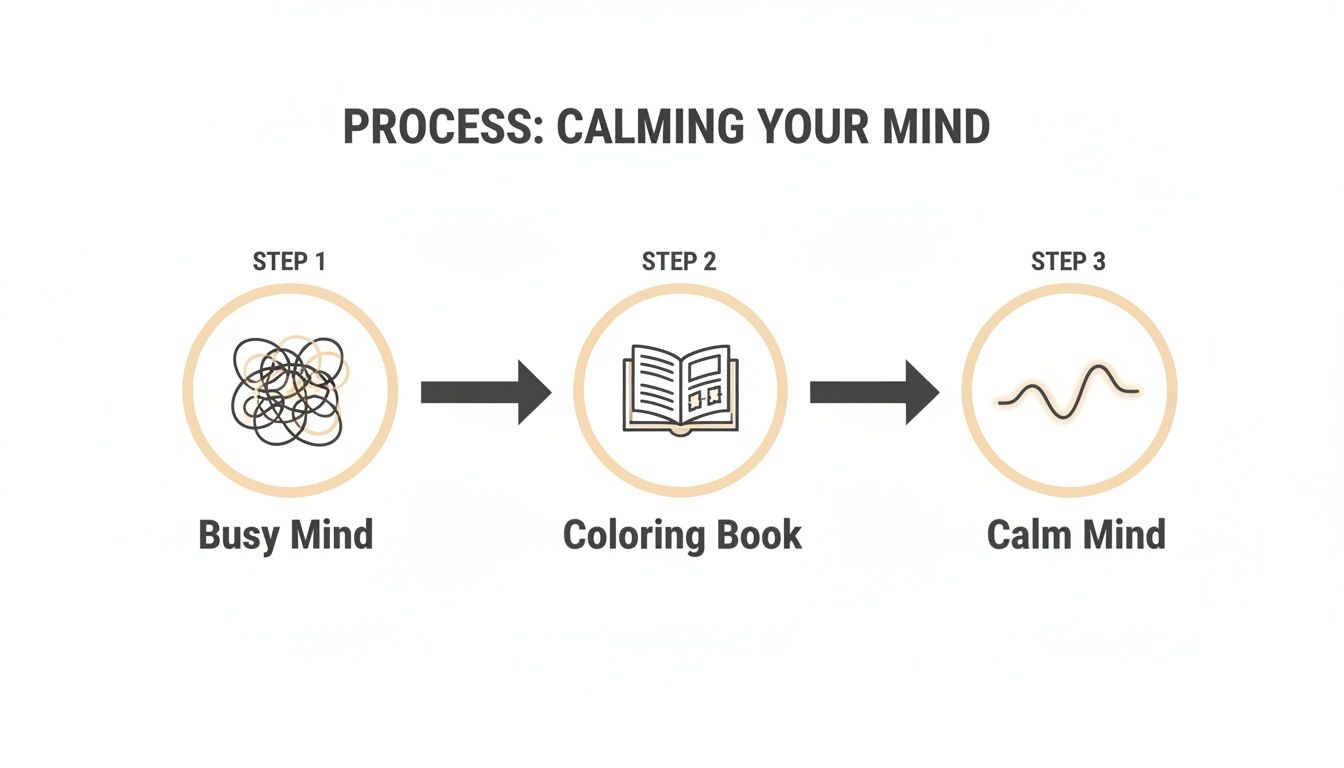
The idea is to intentionally shift from a busy, chaotic mind to a calm state using a focused tool like a monochrome coloring book.
- Your Daily Task: Schedule a 20-minute 'Mono Moment' with your One Color Coloring Book every evening. Treat this like an appointment you can’t miss.
- The Ritual: Put your phone in another room. Put on some quiet music. And just color. There are no shades to choose, no masterpiece to create. The only goal is to feel the pen moving across the paper. This consistent ritual gives your mind a break and reinforces all the progress you're making.
Week 4: Practice Self-Compassion
The final week is about one thing: learning to be kind to yourself when you slip up. Because you will. Overcoming perfectionism isn't a straight line—old habits will creep back in on tough days. How you respond in those moments makes all the difference.
- Your Daily Task: When you catch that harsh, critical voice in your head, pause. Ask yourself, "What would I say to a friend who was feeling this way?" Then, try saying that to yourself.
- Celebrate Your Progress: At the end of the week, write down three small wins you’ve had this month. Acknowledge your effort, not just the final result. This trains your brain to look for progress, not perfection.
Think of this 30-day plan as your launchpad. It’s here to give you the structure and tools to start rewriting the rules, empowering you to move forward with more calm, confidence, and kindness.
Making Progress Stick for The Long Haul
Let's be honest: getting a handle on perfectionism isn't a one-and-done deal. It's more like a muscle you have to keep working. The real challenge, and where the most meaningful change happens, is learning how to keep the momentum going long after that initial burst of motivation fades.
It's about learning to ride the waves—handling those inevitable moments when that old, critical inner voice tries to take over again. This isn't about gritting your teeth and forcing yourself to be different. It’s about gently weaving new, supportive habits into your life that reinforce a kinder way of thinking.
Create Your Support System
You absolutely do not have to do this alone. In fact, trying to go it solo is one of the quickest ways to fall back into old patterns. Surrounding yourself with the right people and resources creates a powerful buffer against the external pressures that feed perfectionism.
This is especially true in our high-pressure world. A global analysis found that workplaces and schools are where perfectionism hits hardest, fueling burnout on a massive scale. The research shows a clear link between perfectionist tendencies and rising anxiety, with perfectionism itself increasing by a staggering 10-33% since 1989. You can dig into the data on perfectionism across adolescence to see just how deep this runs.
Your support system could look like:
- A "Good Enough" Buddy: Team up with a friend who's also working on self-growth. You can check in, share your wins (no matter how small!), and celebrate the beautifully imperfect progress you're both making.
- Curate Your Social Feed: Unfollow the accounts that leave you feeling like you're not enough. Instead, fill your feed with artists, writers, and creators who show the messy, real-world process, not just the glossy final result.
- Professional Guidance: A good therapist can give you targeted strategies and a safe space to explore where your perfectionism really comes from. It's an incredible investment in yourself.
Anchor Your Day with a Gentle Ritual
When life gets chaotic, our brains love to default to what they know best—and for many of us, that's the familiar, well-worn path of perfectionism. A small, consistent ritual can act as a powerful anchor, giving you a moment to consciously reset and return to a calmer state of mind.
This is where something like the Mono Moment One Color Coloring Book can make a real difference. Think of it less as "just coloring" and more as a non-negotiable appointment with peace. Committing to just 15 minutes with it each evening builds a reliable foundation for your mental well-being. It carves out a predictable space in your day that is completely free from judgment or the need to perform. It reinforces the core lesson you're trying to learn: the value is in the process, not the outcome.
For more ideas, check out our guide on how to create a self-care routine that you'll actually stick with.
Setbacks aren't a sign of failure; they are a sign that you're trying. The goal isn't to never fall back into old habits, but to get better at treating yourself with compassion when you do.
A Risk-Free Way to Start
I get it. For a perfectionist, the fear of making the "wrong" choice can be paralyzing—even when you're just buying something meant to help you. That’s exactly why we stand behind our products completely.
Every Mono Moment purchase is backed by our 30-day satisfaction guarantee. If you find our monochrome coloring books aren’t the right fit for your journey, there’s no stress and no risk. We wanted to remove that purchase anxiety so you can feel good about taking that first, supportive step for yourself. Learning how to stop perfectionism is a commitment to a kinder, more peaceful way of living, and having the right tools can make all the difference.
Common Questions About Overcoming Perfectionism
As you start pushing back against those perfectionist urges, you're bound to have questions. This isn't just about changing a few habits; it's about unlearning patterns that have been with you for years. Getting clear on the common sticking points can make the whole process feel much less overwhelming. Let's tackle some of the questions I hear most often.
Can I Stop Being a Perfectionist Without Lowering My Standards?
Yes, absolutely. This is probably the biggest myth out there about overcoming perfectionism, and it’s what keeps so many people stuck.
The goal is not to abandon high standards or start producing sloppy work. It’s about untangling your self-worth from the outcome. We're shifting from a rigid, all-or-nothing mindset driven by fear to a more flexible, growth-oriented approach that focuses on the process itself.
Healthy striving feels good—you find satisfaction in the effort and see mistakes as information, not indictments. Maladaptive perfectionism, on the other hand, treats any tiny flaw as a catastrophe. This is where a tool like our Mono Moment monochrome coloring book can be surprisingly powerful. There's no "right" way to fill in the lines, so you're forced to let go and just enjoy the act of creating. It helps you build that mental muscle for a healthier, more sustainable way of pursuing your goals.
How Long Does It Take to See Real Changes?
There’s no magic number here, because you’re essentially rewiring years of ingrained thinking. But with consistent effort, most people start to feel a real shift—a noticeable drop in daily anxiety—within just a few weeks. The secret is consistency over intensity.
Think of it like building new neural pathways. By committing to small, manageable actions every day—like that 20-minute coloring session with a Mono Moment product we talked about in the 30-day plan—you're creating a new road for your brain to travel. These little rituals build on each other, proving there's a calmer, more effective way to operate. The aim is to make these new, healthier habits feel as automatic as the old, draining ones.
My Mind Is Too Busy for Mindfulness. How Is Coloring Different?
I hear this all the time, and it's a completely valid point. For a perfectionist, traditional meditation can easily become another thing to "get right," which just piles on more pressure. It backfires.
This is exactly why structured, creative practices can be a game-changer. The Mono Moment One Color Coloring Book is specifically designed to sidestep that overactive internal critic. Since the intricate design is already there and you don't have to make any color decisions, you're giving your racing mind a simple, engaging job to do.
It’s a gentle way to quiet the noise without the pressure to perform that comes with typical meditation. It's a form of active mindfulness that’s perfectly suited for a perfectionist's brain, offering a sanctuary from the constant demand to be flawless.
The link between this kind of focused, creative outlet and mental well-being isn't just anecdotal. A study of over 7,800 university students confirmed that high perfectionism is a strong predictor of major depressive disorder. Giving your brain a non-judgmental, calming activity is a powerful way to counteract that. You can dive into the full research on perfectionism and mental health links if you want to see the data for yourself.
Ready to trade perfection for peace? Discover how the simple act of decision-free coloring can calm your inner critic. Explore the Mono Moment One Color Coloring Book and start your journey today at https://mono-moment.com.

The One Color Coloring Book
A single-pen, decision-free coloring book on 160 gsm cream paper — engineered for the wind-down ritual described above.
 Pair it with the 3 Dual Tip Brush Pens — $5 instead of $9.95 in the Book + Pens bundle.