


About the author
Published January 2, 2026 · Last reviewed April 26, 2026 · 16 min read
In this article · 7 sections
When your mind is racing, you need a two-pronged approach: immediate relief to ground yourself in the moment, and long-term habits to build lasting calm. The most powerful way I've found to achieve this is by pairing quick physiological resets—like a simple breathing exercise—with a consistent, structured creative practice designed to gently untangle all that mental noise, such as engaging with the Mono Moment monochrome coloring book.
Your Guide to Quieting a Racing Mind

Does your brain ever feel like a web browser with a hundred tabs open at once? If so, you know how utterly exhausting it is. An overactive mind is constantly replaying conversations, spinning out worst-case scenarios about the future, and dissecting every tiny detail of the day.
This relentless mental chatter is more than just annoying; it’s a sign that your nervous system is stuck in "fight or flight" mode, burning through your energy reserves and leaving you drained.
This guide is your practical roadmap to finding some stillness. We’re going to cut through the fluff and get straight to actionable, evidence-backed techniques you can start using today. Instead of wrestling with your thoughts, you'll learn how to gently guide your mind back to a place of peace, with powerful tools like mindful coloring products from Mono Moment.
What You Will Learn in This Guide
This is all about taking back the controls. It begins with understanding why your mind is so busy in the first place, and then it’s about applying the right tools to break the cycle. We'll walk through a whole toolkit of strategies, so you'll have an answer for any situation—whether you need a two-minute reset at your desk or a deeper, more restorative practice at home.
Here’s a glimpse of what’s ahead:
- Immediate Grounding Exercises: We'll cover powerful sensory techniques that can anchor you in the present moment when your thoughts start to spiral out of control.
- Cognitive Reframing Strategies: You'll learn how to shift your relationship with anxious thoughts, which is key to stripping them of their power over you.
- Building a Sustainable Calming Routine: Discover how to create simple, consistent rituals that actually retrain your brain for tranquility over time.
- A Unique Tool for Overthinkers: I'll also introduce you to a purpose-built creative practice—the Mono Moment monochrome coloring book—specifically designed to soothe mental chaos through a decision-free, meditative process.
The goal isn't to force your mind into silence. That’s impossible. It's about learning to turn down the volume, shifting from being a victim of your thoughts to becoming a calm observer of them.
Ultimately, learning to calm an overactive mind is a skill. Like any skill, it takes practice. But with the right methods, you absolutely can build mental resilience and find a genuine, lasting sense of inner peace. This guide gives you the foundational steps to start that journey, one quiet moment at a time.
Find Immediate Relief with Grounding Techniques
When your mind is caught in a spiral, trying to think your way out is usually a losing battle. You can’t rationalize with a brain in overdrive. What you need is a hard reset—a quick, decisive anchor to the here and now.
This is exactly what grounding techniques are for. They offer a powerful, physiological shortcut that pulls your focus from the chaos inside your head to the physical world around you.
These aren't just clever distractions; they are deliberate actions that send a direct "all clear" signal to your nervous system. By focusing on your senses or consciously controlling your breath, you flip the switch from the "fight or flight" response to your body's "rest and digest" mode. The result? A tangible feeling of calm that you can feel almost instantly.
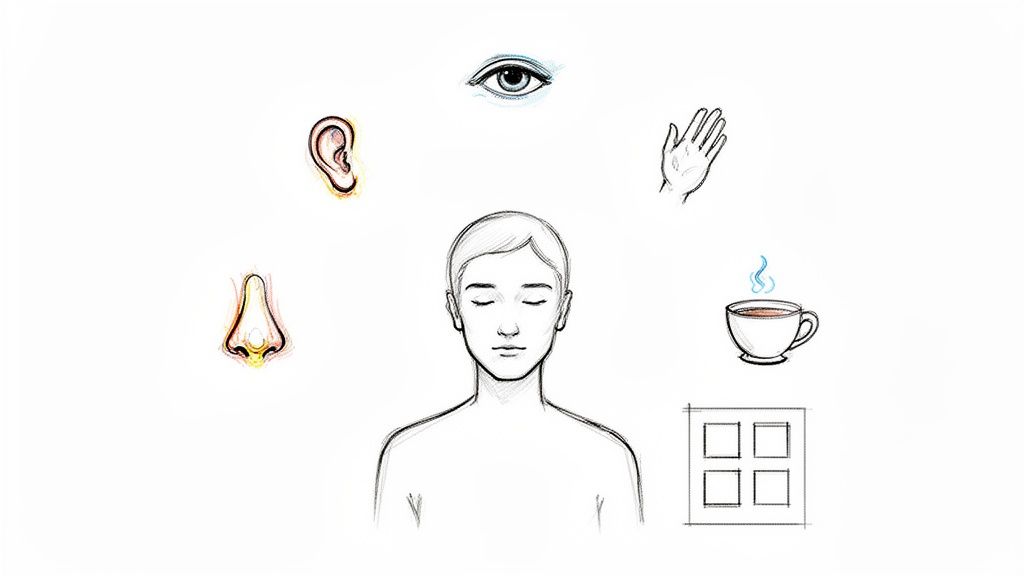
Use Your Senses with the 5-4-3-2-1 Method
One of the most reliable tools I’ve ever used to quiet a racing mind is the 5-4-3-2-1 technique. It’s brilliant because it forces your brain to drop its worries and process concrete, neutral information from your environment. Best of all, it's totally discreet and can be done anywhere, anytime.
Let's say you're at your desk, heart pounding before a big meeting. Instead of letting that anxiety snowball, just pause. Take a quiet moment and mentally walk through these steps:
- Five Things You Can See: Really look. Don't just list them; notice the details. "I see the blue ink of my pen, a tiny scuff mark on the wall, the way the light hits my water bottle, a single plant leaf, the dark grain of the wooden desk."
- Four Things You Can Feel: Shift your focus to physical sensations. "I can feel the cool, smooth surface of the table under my palms, the soft fabric of my sweater against my skin, the firm support of the chair, and my feet planted solidly on the floor."
- Three Things You Can Hear: Tune in your ears. What's in the background? "I can hear the low hum of the computer fan, the distant city traffic, and the quiet tapping of my own fingers on the keyboard."
- Two Things You Can Smell: This one might take a bit more concentration. "I can smell the faint aroma of coffee from the kitchen and the clean scent of a book on my desk."
- One Thing You Can Taste: Notice any lingering taste. "I can still taste the mint from my morning tea."
This simple sensory inventory acts as an emergency brake for a thought spiral, yanking you right back into the present moment.
By systematically engaging each sense, you create a buffer between you and your racing thoughts. You’re not fighting them; you’re just shifting your attention to something more tangible and immediate.
Regulate Your Nervous System with Box Breathing
Another powerhouse technique is Box Breathing. It’s so effective at managing acute stress that everyone from Navy SEALs to surgeons relies on it. Why? Because it directly slows your heart rate and deepens your breath, which is one of the fastest ways to tell your nervous system that you're safe.
The method is simple. Just visualize a square and trace the sides with your breath:
- Inhale slowly for a count of four.
- Hold your breath for a count of four.
- Exhale slowly for a count of four.
- Hold at the bottom for a count of four.
Repeating this cycle just a few times can make a world of difference, especially when you feel panic creeping in or when you're lying awake at night with a busy brain. Both of these exercises are fantastic examples of quick mindfulness activities for adults you can weave into your day without missing a beat.
Reframe Your Thoughts with Cognitive Strategies
While grounding techniques are fantastic for putting out immediate fires, lasting peace comes from changing your relationship with your thoughts. It’s less about fighting your mind and more about gently retraining the habits that keep you stuck in a cycle of anxiety. Cognitive strategies are the tools that help you do this. They teach you to step back, observe what's happening in your head, and strip those overwhelming thoughts of their power.
The goal isn't to stop thinking—that’s impossible and usually just makes things worse. Instead, you learn to become a calm observer, watching your thoughts float by without getting swept away by them. This creates just enough distance to break the cycle of rumination, preventing every anxious thought from ruining your day.
Try Worry Scheduling
One of the most powerful things I've learned is to give my worries a specific time and place. This is the simple but brilliant idea behind worry scheduling. Instead of letting anxious thoughts ambush you all day long, you set aside a dedicated, limited block of time—maybe 15 minutes every afternoon—to deal with them head-on.
It works like this: a worry about an upcoming deadline pops into your head at 10 AM. Instead of letting it derail your morning, you make a mental note: "Okay, I see that thought. I'll give it my full attention at 4:30 PM during my worry time." This simple act of postponement is incredibly freeing. It gives you permission to focus on what's in front of you.
When your "worry appointment" arrives, you can journal about what's on your mind, brainstorm solutions, or just let yourself feel the anxiety without trying to fix it. The crucial part? When the timer goes off, you're done. You consciously close the book on those worries until your next scheduled session.
Practice Thought Labeling
Another game-changer is thought labeling. This is all about recognizing that your thoughts are just that—thoughts. They are temporary mental events, not absolute truths carved in stone. When an anxious thought surfaces, you simply and gently label it.
By observing and naming your thoughts ("There's the 'I'm not good enough' thought again"), you create a crucial separation. The thought is no longer you; it's just a fleeting pattern your brain has produced.
This practice takes the sting out of your inner monologue. It’s like turning down the volume on that nagging, critical voice. You’re not arguing with the thought; you’re just identifying it.
Here are a few labels you might find helpful:
- "Worrying": For thoughts about what might happen in the future.
- "Judging": When you catch yourself being critical of yourself or someone else.
- "Catastrophizing": For those moments when your mind leaps to the worst-case scenario.
This kind of cognitive reframing gives you the space to respond thoughtfully instead of reacting automatically. With practice, you build the mental muscle to choose where you put your focus, creating a calmer inner world and making it much easier to settle into a relaxing activity, like a session with a Mono Moment monochrome coloring book, without constant mental chatter.
Create a Calming Ritual with Mindful Coloring
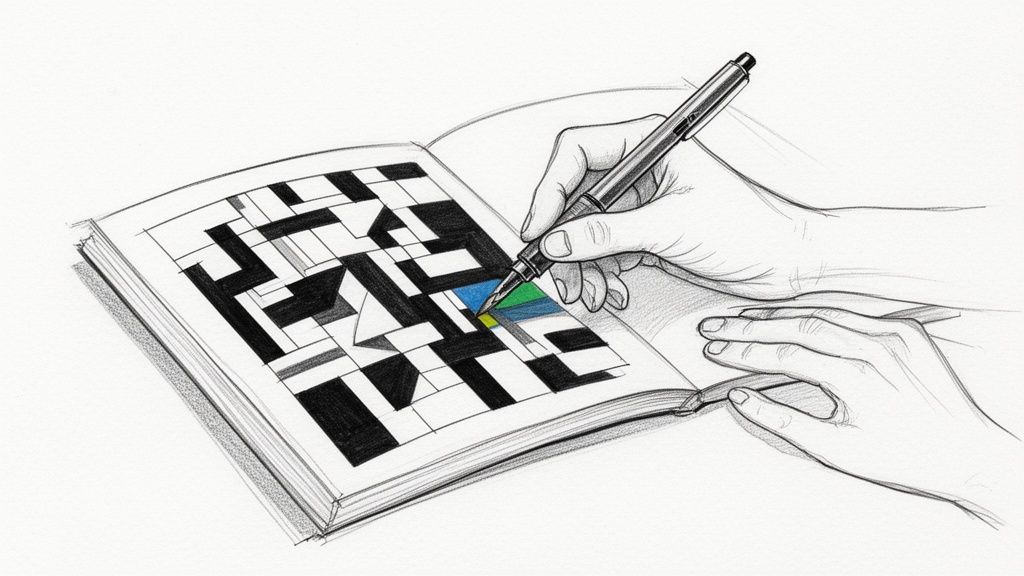
While the quick exercises we've covered are fantastic for in-the-moment relief, the real long-term win against an overactive mind comes from building a consistent, calming ritual. Think of it as an appointment you keep with yourself—a reliable signal to your brain that it’s finally time to power down and shift from high alert into a state of rest.
This is where an activity like mindful coloring truly shines. The simple, structured act of coloring engages your brain's creative, focused centers while gently soothing the amygdala—your brain’s always-on-duty fear hub. It’s a low-pressure activity that gives your racing thoughts a quiet, safe place to land.
But here’s the catch for many of us overthinkers: the simple act of choosing colors can trigger a whole new wave of stress and perfectionism. This is exactly the problem the Mono Moment monochrome coloring book was built to solve. Its brilliance is in its decision-free design, a feature that makes it an exceptionally powerful tool for quieting a busy mind. All our products are designed with this philosophy in mind.
The Power of Decision-Free Creativity
When your brain is already running on fumes, the last thing you need is another decision. Which color goes where? Do these shades even look good together? This kind of creative anxiety can completely derail a relaxing activity before you even get started.
Mono Moment sidesteps that friction entirely. By removing the pressure of choosing colors, our products let you bypass the analytical, self-judging part of your brain and sink right into the simple, repetitive motion of filling in beautiful patterns. That effortless entry into a meditative flow state is what makes Mono Moment so uniquely effective for anxious minds.
The point isn't to create a perfect masterpiece; it’s to lose yourself in the soothing process. By focusing on the texture of the pen on paper and the steady rhythm of your hand, you anchor yourself in a gentle, mindful present.
This kind of structured creativity gives your brain just enough to do, preventing it from spiraling into worries about yesterday or tomorrow. You’re not trying to force your mind to be empty; you’re just giving it a peaceful, singular task to hold onto.
Your 20-Minute Evening Wind-Down Routine
Imagine ending your day not by endlessly scrolling through your phone, but with a quiet, restorative practice that actually recharges you. Here’s a simple ritual you can start tonight with your Mono Moment coloring kit to reclaim your evenings from mental chatter.
- Set the Scene: Find a comfortable spot away from all screens. Brew a cup of herbal tea, maybe put on some soft, instrumental music. Make the space feel like a sanctuary.
- Choose a Design: Open your Mono Moment coloring book and flip through until a pattern catches your eye. The illustrations are intentionally designed to be completable in a single 15–30 minute session.
- Engage Your Senses: Pick up one of the brush pens from your kit. Notice how it feels in your hand. As you start to color on the premium 160gsm paper (which is thick enough to prevent any bleed-through), listen to the soft, quiet sound it makes.
- Focus on the Motion: Let your attention rest on the simple back-and-forth movement. Your mind will wander—that’s what minds do. When it does, just gently guide your focus back to the point where the pen meets the page.
- Close the Ritual: Once you're done or your time is up, take a final moment. Look at your finished work and acknowledge this small, intentional act of kindness you just did for yourself.
This simple, repeatable routine trains your brain to associate this time and this activity with relaxation and safety. If you're curious about the science behind why this works so well, our guide to mindfulness coloring books for adults goes into much more detail.
By consistently showing up for this small ritual, you create a reliable sanctuary from the noise, one pen stroke at a time.
Design Your Environment for Mental Peace
While we spend a lot of time working on what’s inside our heads, the world outside has a huge, often overlooked, influence on our mental state. Your surroundings can either add to the chaos or become your greatest ally in finding calm.
By making a few conscious tweaks to your space and schedule, you’re not just redecorating; you’re building an environment that actively supports a quieter mind. Think of it as creating an external ecosystem that encourages internal peace, reducing the mental friction that keeps you on high alert.
Create Your Personal Calm Corner
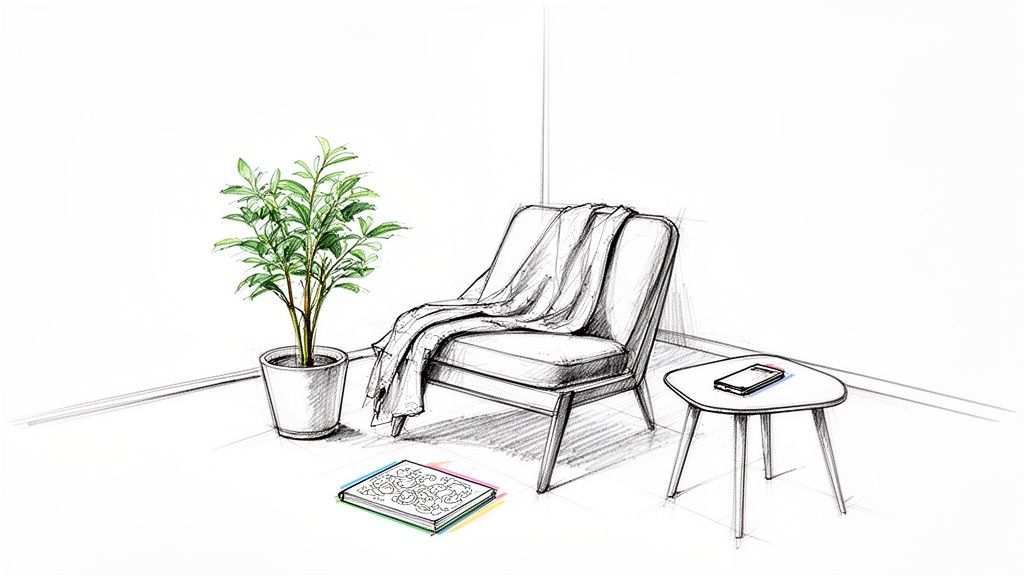
I can't recommend this enough: designate one specific spot in your home as a "calm corner." This is your sanctuary, a place with a single, simple rule: it’s only for relaxation and quiet activities. No work, no doomscrolling, no stressful phone calls. Just peace.
This doesn't need to be an entire room. It could be a comfy chair by a window, a few cushions on the floor, or any little nook you can make your own. The key is to fill it with things that soothe your senses—maybe a soft blanket, a thriving plant, or a candle with a scent you love.
Your calm corner becomes a powerful psychological cue. Over time, just sitting there will start to signal to your brain that it’s time to unwind. It's the perfect spot for your Mono Moment coloring session or a few rounds of deep breathing.
Implement a Digital Sunset
Let's be honest: our screens are a huge source of mental chatter. The blue light, the endless notifications—they’re designed to keep our brains buzzing, which is the last thing you need before bed.
This is where a "digital sunset" becomes non-negotiable. The idea is simple: shut down all screens at least 60 to 90 minutes before you want to fall asleep. That means phones, tablets, laptops, and the TV.
This screen-free time is a buffer zone, giving your brain a chance to shift gears from the day’s constant stimulation. Instead of scrolling, try one of these:
- Journaling: Get those nagging thoughts out of your head and onto paper. Physically writing them down can stop them from replaying on a loop all night.
- Coloring: Unwind with a session in your Mono Moment coloring book. It’s a perfect screen-free way to settle your mind.
- Reading a real book: Pick up a physical book—something enjoyable that doesn’t require intense focus or stir up anxiety.
- Gentle stretching: Release the day's tension from your body. A relaxed body often leads to a relaxed mind.
These small, consistent changes build a powerful foundation for mental well-being. Tweaking your space and habits can even help balance your stress hormones. If you're interested in the science behind it, you can learn more about how to reduce cortisol levels naturally through these kinds of lifestyle adjustments. When you intentionally design your environment for peace, you create a framework that makes quieting the noise inside so much easier.
Know When Your Mind Needs More Than Self-Help
The tools we’ve covered in this guide are incredibly effective for quieting the everyday chatter of a busy brain. From simple breathing exercises to engaging in a focused Mono Moment coloring session, these practices build mental muscle and resilience over time.
But it’s just as important to recognize when that internal static is more than just a bad habit. Sometimes, a mind that simply won't quit is a sign of something deeper, like an underlying anxiety disorder or depression.
Reaching out for professional help isn't admitting defeat. It's one of the strongest, most proactive things you can do for your long-term well-being.
Red Flags: When It Might Be Time to Talk to a Pro
So, how do you know when it's time to make that call? If your racing thoughts are consistently getting in the way of your life, that's a pretty clear signal.
Look for patterns like these:
- Your sleep is suffering. You lie awake for hours, unable to shut your brain off, or wake up in the middle of the night with your mind already racing.
- Daily life feels overwhelming. Focusing at work, finishing simple chores, or even just listening to a friend feels impossible because you're so stuck in your head.
- It’s straining your relationships. Constant worrying or mental preoccupation is causing friction with the people you care about most.
- Your body is feeling it. You're dealing with chronic tension, unexplained headaches, or digestive problems that seem tied to your stress levels.
Recognizing that your current toolkit isn't quite enough is a sign of self-awareness, not weakness. It means you’re listening to what you truly need and are ready to find the right support.
Therapies like Cognitive Behavioral Therapy (CBT) are fantastic for this, as they offer structured, proven methods to help you identify and reshape the thought patterns that keep you stuck.
There's a huge cultural shift happening around mental health. The mental wellness market saw a 7% jump between 2019 and 2020 alone, but the real story is in the mindfulness space, which skyrocketed by 25% in that same period. People are actively seeking solutions for a calmer mind, including products like ours at Mono Moment. You can dive deeper into these trends in mental wellness on the Global Wellness Institute's site.
If your mind’s relentless pace feels like too much to handle on your own, a good therapist can offer a diagnosis, a personalized roadmap, and a supportive partnership to guide you toward a place of genuine, lasting peace.
Your Questions, Answered
"How Quickly Can I Expect to Feel Better?"
This is probably the most common question I get, and the answer is two-fold. Some of these techniques, especially the breathing exercises, can offer a sense of relief almost instantly. Think of them as your first-aid kit for a racing mind—they can bring you back from the edge in just a few minutes.
But for a deeper, more lasting sense of calm, consistency is everything. When you start building a small daily habit, like coloring with a Mono Moment book or practicing cognitive reframing, you're not just putting out fires; you're building a more resilient mental foundation. You’ll likely start feeling a difference within the first week, but the real, noticeable changes often emerge after a few weeks of sticking with it.
"But I'm Not Artistic at All. Can I Still Do Mindful Coloring?"
Yes, and you're exactly who this is for! The entire point of Mono Moment's monochrome coloring books is to remove the pressure. There are no color palettes to agonize over, no complex techniques to master. You don't need a single artistic bone in your body.
It’s not about creating a masterpiece. It’s about the simple, rhythmic motion of your hand, a quiet act of mindfulness that gives your brain a much-needed break.
The goal here is the process, not the final product. All our Mono Moment products are designed with this calming, accessible experience in mind.
"What If I Try These Exercises and My Mind Still Wanders Everywhere?"
Welcome to the club! That's not a sign of failure; it's a sign that you're human. The purpose of mindfulness isn't to force your mind into a state of perfect, empty silence. That’s an impossible standard.
Instead, the real practice is in noticing. Notice when your thoughts have drifted off to your to-do list or a conversation from yesterday. And then, without judging yourself, gently guide your focus back to your breath or the coloring page. Every time you do this, you're strengthening your ability to manage your attention, which is the whole point.
Ready to build a simple, calming ritual that actually works? Take a look at the decision-free world of Mono Moment and pick out the perfect monochrome coloring book to start soothing your busy mind today.

The One Color Coloring Book
A single-pen, decision-free coloring book on 160 gsm cream paper — engineered for the wind-down ritual described above.
 Pair it with the 3 Dual Tip Brush Pens — $5 instead of $9.95 in the Book + Pens bundle.


0 comments