About the author
Published January 7, 2026 · Last reviewed April 26, 2026 · 16 min read
In this article · 9 sections
- 1. Box Breathing (4-4-4-4 Technique)
- 2. Progressive Muscle Relaxation (PMR)
- 3. Grounding Techniques (5-4-3-2-1 Sensory Method)
- 4. Mindful Breathing and Body Scan Meditation
- 5. Guided Visualization and Imagery
- 6. 4-7-8 Breathing and Vagal Toning
- 7. Monochrome Coloring for Mindful Focus
- Quick Anxiety-Relief Techniques Compared
- Build Your Personal Anxiety Toolkit, One Moment at a Time
Anxiety often feels like a relentless hum in the background, a storm of 'what-ifs' that hijacks your focus and steals your peace. The conventional wisdom to 'just relax' is frustratingly vague and unhelpful when your mind is racing. You need concrete, actionable tools that work now, not in an hour, but in the few precious minutes you can spare between meetings, before a difficult conversation, or when you’re trying to quiet your mind for sleep.
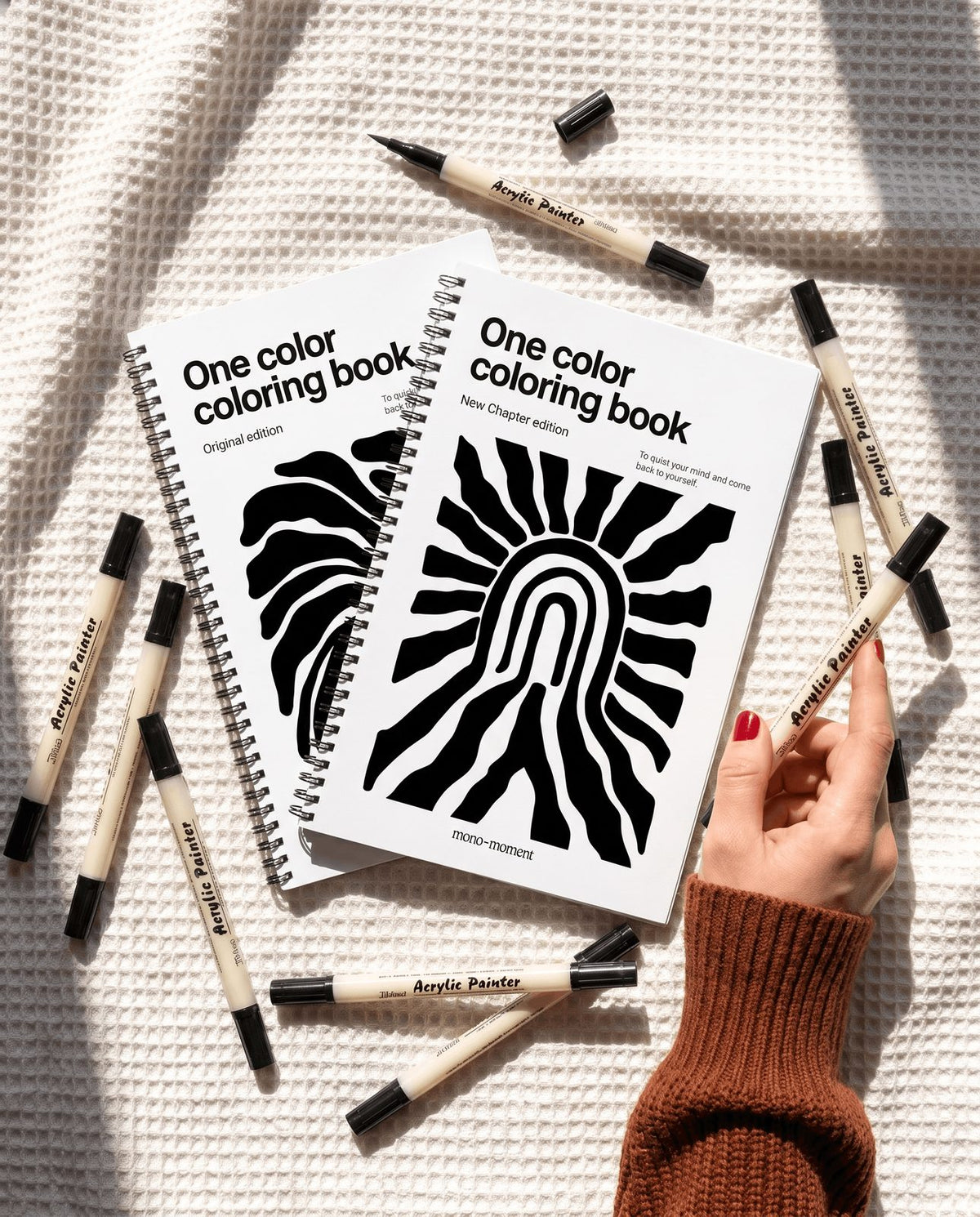
This isn't just another list of generic advice. This is your practical guide to seven evidence-backed, quick relaxation techniques for anxiety, each specifically designed for the overthinking mind. We will explore structured methods that provide the clarity and predictability your brain craves in moments of overwhelm. You'll learn everything from the rhythmic precision of box breathing to the immersive, decision-free focus of monochrome coloring—a practice perfected by our Mono Moment coloring books to deliver a powerful, calming experience.
Get ready to reclaim your calm with strategies you can implement immediately. This guide transforms overwhelming moments into opportunities for genuine, measurable relief, equipping you with a versatile toolkit to find stability whenever you need it most.
1. Box Breathing (4-4-4-4 Technique)
When your mind is racing, your thoughts tangled in a knot of "what-ifs," the last thing you need is a complicated relaxation exercise. Box breathing, also known as the 4-4-4-4 technique, is a powerfully simple and structured method that offers immediate relief. It’s one of the best quick relaxation techniques for anxiety because it requires no equipment and forces your mind and body to sync up, breaking the cycle of panic.
The process is as straightforward as its name suggests: you breathe in a four-sided pattern. This rhythmic breathing directly stimulates the vagus nerve, activating your parasympathetic nervous system. This is your body's "rest and digest" mode, the natural antidote to the fight-or-flight response that anxiety triggers.
How to Practice Box Breathing
Follow this simple, four-step cycle:
- Inhale slowly through your nose for a count of four seconds.
- Hold your breath for a count of four seconds.
- Exhale slowly through your mouth for a count of four seconds.
- Hold your breath again for a final count of four seconds.
Repeat this cycle for 1-3 minutes, or until you feel your heart rate slow and a sense of calm return. For an easy visual cue, imagine tracing the sides of a square with your finger as you complete each step.
Why It Works: The rigid structure of box breathing gives an overthinking mind a clear, simple task to focus on. Instead of battling anxious thoughts, you're just counting to four. This predictability is what makes it a go-to technique for U.S. Navy SEALs and first responders managing stress in high-stakes environments.
Amplify the Calming Effect
To deepen your relaxation, try pairing box breathing with a mindful activity. As you regulate your breath, engage your hands with a simple, repetitive motion. Using a Mono Moment monochrome coloring book is an ideal companion. The simple act of filling in patterns while maintaining your 4-4-4-4 breath count creates a powerful, multimodal calming experience. It anchors your mind in the present moment, making it nearly impossible for anxiety to take hold.
2. Progressive Muscle Relaxation (PMR)
Anxiety isn't just a mental state; it's a physical one. When you feel anxious, your muscles instinctively clench, creating a feedback loop that keeps your body locked in a state of high alert. Progressive Muscle Relaxation (PMR) directly targets this physical tension, offering a systematic way to release it. As one of the most tangible quick relaxation techniques for anxiety, PMR teaches your body the profound difference between tension and true relaxation.
Developed by Dr. Edmund Jacobson in the 1920s, this method involves sequentially tensing and then releasing different muscle groups. This deliberate contrast makes you keenly aware of where you hold stress and gives you a clear, actionable method to let it go. It’s a foundational technique in cognitive-behavioral therapy (CBT) precisely because it gives an overthinking mind a concrete, step-by-step process to follow.
How to Practice Progressive Muscle Relaxation
Find a comfortable position, either sitting or lying down, and follow this general sequence:
- Tense a specific muscle group (e.g., your feet and toes) as you inhale, holding the tension tightly for 5-10 seconds.
- Release the tension completely as you exhale, allowing the muscles to go limp.
- Pause for 10-20 seconds, noticing the feeling of deep relaxation in that area.
- Repeat this process, moving progressively up your body from your feet to your face.
Here is a guided video to walk you through your first few sessions:
Why It Works: PMR interrupts the physical anxiety cycle. By forcing your muscles into a state of deep release, you send a powerful signal to your brain that the perceived threat has passed, which in turn quiets anxious thoughts. It's an active, physical process that anchors you firmly in your body and away from abstract worries.
Amplify the Calming Effect
PMR is an ideal practice for an evening wind-down routine, especially for those with anxiety-related insomnia. After completing a full-body scan, your mind and body are primed for deeper calm. Extend this state by engaging in a quiet, mindful activity. Using a Mono Moment monochrome coloring book after your PMR session can solidify the feeling of tranquility. The simple, repetitive act of coloring within the minimalist designs keeps your mind focused and your body relaxed, creating a perfect transition into a restful night.
3. Grounding Techniques (5-4-3-2-1 Sensory Method)
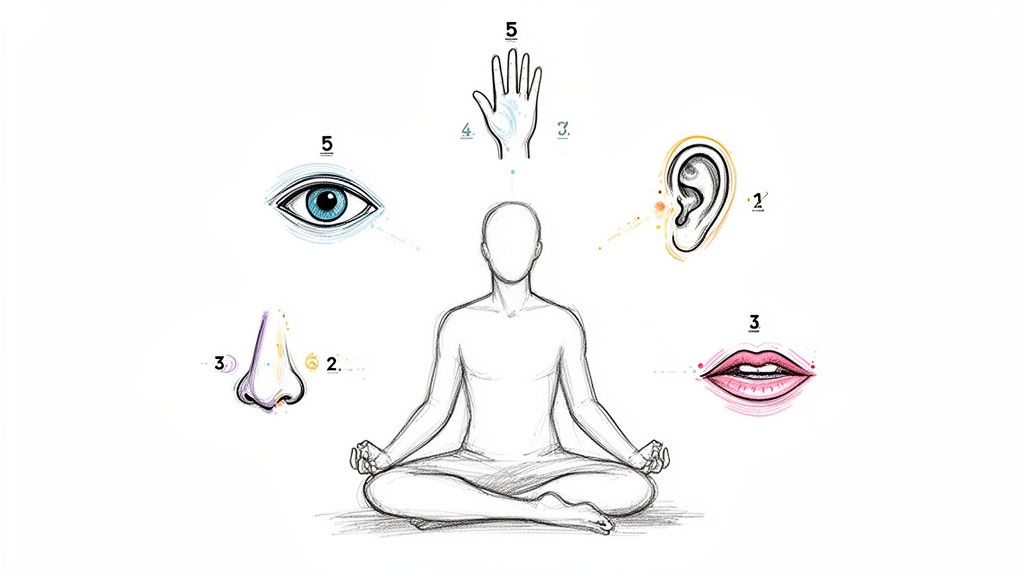
When anxiety pulls you into a vortex of future worries or past regrets, the 5-4-3-2-1 sensory method acts as an emergency brake. This powerful grounding technique pulls your attention out of your racing thoughts and anchors it firmly in the present moment. As one of the most effective quick relaxation techniques for anxiety, it interrupts the cycle of rumination by systematically engaging each of your five senses, making it incredibly difficult for abstract fears to maintain their grip.
The beauty of this method lies in its concreteness. Instead of fighting your thoughts, you simply shift your focus to the tangible reality around you. This process calms your nervous system by redirecting mental resources away from the amygdala (your brain's fear center) and toward the sensory cortex, providing immediate relief from overwhelming feelings.
How to Practice the 5-4-3-2-1 Method
Work through the following sequence, noticing your surroundings without judgment:
- See: Acknowledge five distinct objects you can see around you. Notice details like their color, shape, and texture.
- Feel: Bring your awareness to four things you can physically feel. This could be the texture of your clothes, the solid ground beneath your feet, or the smooth surface of your desk.
- Hear: Listen for three different sounds. Pay attention to both loud and subtle noises, like the hum of a computer, birds chirping, or your own breathing.
- Smell: Identify two distinct smells in your environment. It might be the scent of coffee, a nearby flower, or the pages of a book.
- Taste: Acknowledge one thing you can taste. This could be the lingering taste of your last meal, or you can simply notice the sensation of your tongue in your mouth.
Why It Works: Popularized by Dialectical Behavior Therapy (DBT), the 5-4-3-2-1 method forces a cognitive shift from internal chaos to external observation. By cataloging sensory input, you are proving to your brain that you are safe in the here and now. Therapists often recommend it as a first-line defense against panic attacks because of its immediate, practical nature.
Amplify the Calming Effect
Once you feel more grounded, you can extend that state of present-moment awareness with a focused activity. Use the 5-4-3-2-1 method as a primer to quiet your mind before engaging in a simple, repetitive task. Our Mono Moment monochrome coloring book is a perfect next step. The tactile sensation of the pencil on paper (feel), the subtle sound it makes (hear), and the stark visual contrast (see) continue to anchor you in your senses. This combination creates a seamless transition from acute anxiety relief to sustained, mindful calm. Find more insights on how to calm an anxious mind on Mono Moment's blog.
4. Mindful Breathing and Body Scan Meditation
When anxiety makes you feel disconnected from your body, a body scan meditation combined with mindful breathing serves as a powerful anchor. Instead of controlling your breath like in paced exercises, this technique trains you to observe your natural rhythm and bodily sensations without judgment. It’s one of the most effective quick relaxation techniques for anxiety because it builds acceptance, teaching you to sit with discomfort without reacting to it.
This practice, a cornerstone of Mindfulness-Based Stress Reduction (MBSR) developed by Jon Kabat-Zinn, helps you tune into your physical self. You systematically move your attention through your body, noticing whatever is present-warmth, tingling, tension, or nothing at all. This simple act of noticing grounds you firmly in the present moment, interrupting anxious thought loops about the past or future.
How to Practice Mindful Breathing and Body Scan
Follow this guided mental journey, typically lasting 10-20 minutes:
- Get Comfortable: Lie down or sit in a supported, comfortable position. Close your eyes and take a few moments to settle in.
- Focus on Breath: Bring your awareness to your natural breath. Notice the sensation of air entering and leaving your body without trying to change it.
- Scan Your Body: Begin at your toes. Bring a gentle, curious awareness to them, noticing any sensations. Slowly move your attention up through your feet, ankles, legs, and continue all the way to the top of your head.
- Observe Without Judgment: If you notice tension or discomfort, simply acknowledge it. Your goal is not to fix it but to observe it with kindness and curiosity. If your mind wanders, gently guide it back to the part of the body you are focusing on.
Repeat this practice daily to build the mental muscle of non-reactive awareness.
Why It Works: Anxiety often creates a feedback loop where physical tension fuels anxious thoughts, and anxious thoughts create more physical tension. A body scan systematically breaks this cycle by fostering a calm, observational relationship with bodily sensations. You learn that feelings of discomfort are temporary and don't require an immediate panicked response.
Amplify the Calming Effect
To create a deeply restorative wind-down ritual, follow your body scan meditation with a focused, hands-on activity. After tuning into your body, continue that present-moment awareness by engaging with a Mono Moment monochrome coloring book. The simple, repetitive act of coloring within the elegant black-and-white patterns helps solidify the calm you’ve cultivated. This pairing transitions you from internal observation to gentle external focus, making it a perfect sequence to quiet an anxious mind before sleep. Explore more about these quick mindfulness activities for adults and how they complement meditation practices.
5. Guided Visualization and Imagery
When anxiety floods your mind, it often feels like you're trapped in a negative thought loop. Guided visualization offers a mental escape hatch, allowing you to intentionally build a sanctuary within your own mind. This technique involves creating a detailed, multisensory mental image of a calm, safe place, a powerful tool among quick relaxation techniques for anxiety because your brain responds to vivid imagination almost as if it were real.
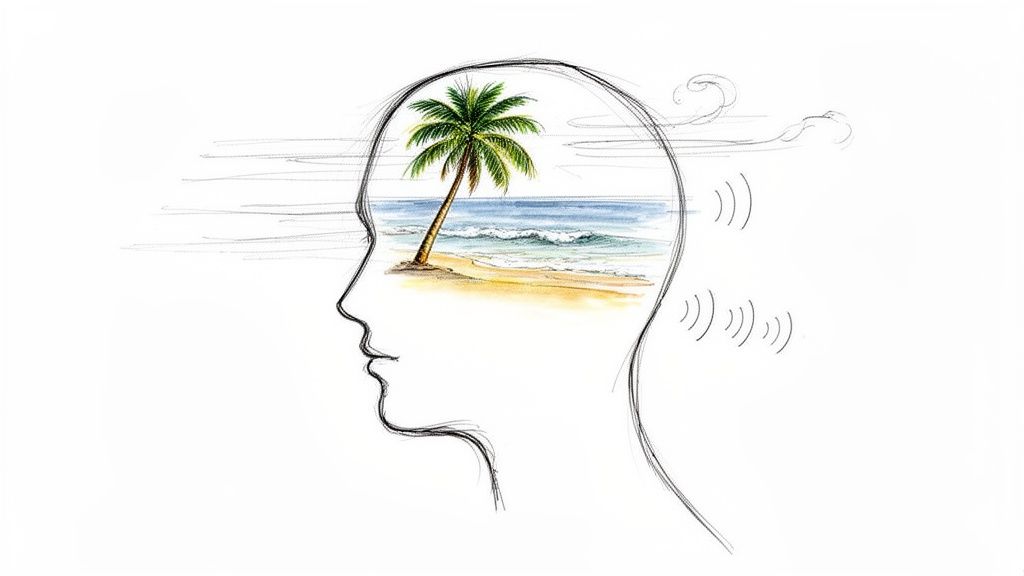
By deliberately channeling your mental energy toward a peaceful construct, you activate your parasympathetic nervous system, easing your body out of its fight-or-flight state. This method is used by athletes to manage performance anxiety and by medical professionals to help patients cope with pain, proving its effectiveness in high-stress situations.
How to Practice Guided Visualization
Follow these steps to create your mental safe haven:
- Find a quiet space and get into a comfortable position, sitting or lying down.
- Choose your sanctuary. This can be a real place you love or an imagined one, like a secluded forest clearing, a quiet beach, or a cozy cabin.
- Engage all your senses. What do you see (the color of the water, the leaves on the trees)? What do you hear (gentle waves, birds chirping)? What do you feel (warm sun on your skin, a soft breeze)? What do you smell (pine needles, salty air)?
- Stay in your scene for 5-15 minutes, exploring it and allowing the feelings of peace and safety to wash over you.
If you find it difficult to guide yourself at first, search for guided imagery recordings online to help lead you through the process.
Why It Works: Your brain cannot easily distinguish between a vividly imagined experience and a real one. When you immerse yourself in a detailed mental image of a safe place, your body responds accordingly. Your heart rate slows, your muscles relax, and your stress hormone levels decrease, effectively short-circuiting the anxiety response.
Amplify the Calming Effect
Visualization is a perfect transition into a focused, mindful activity. Use a 5-minute guided imagery session to quiet your mind before you begin a creative practice. This prepares you for a deeper state of flow. For a seamless calming ritual, pair your visualization with a Mono Moment monochrome coloring book. After mentally visiting your serene place, bring that focused calm to the simple, repetitive motion of coloring. This combination anchors you firmly in the present, creating a powerful buffer against intrusive anxious thoughts.
6. 4-7-8 Breathing and Vagal Toning
When anxiety feels like a rising tide, the 4-7-8 breathing technique offers a powerful anchor to pull you back to solid ground. Popularized by integrative medicine pioneer Dr. Andrew Weil, this method is a tranquilizer for the nervous system. It stands out among quick relaxation techniques for anxiety for its deliberate and extended exhale, designed to supercharge your body's natural relaxation response.
This specific breathing ratio is engineered to directly stimulate the vagus nerve, which is the main highway of your parasympathetic nervous system. A longer exhale tells your brain and body that the threat has passed and it's safe to calm down. The 7-second hold also helps build a tolerance to carbon dioxide, which can reduce the physical symptoms of panic and make your breathing more efficient over time.
How to Practice 4-7-8 Breathing
Follow this simple, three-step cycle, which is best done while seated with your back straight:
- Inhale quietly through your nose for a count of four seconds.
- Hold your breath for a count of seven seconds.
- Exhale completely through your mouth with a "whoosh" sound for a count of eight seconds.
Repeat this cycle for 3-4 breaths, especially when you are first starting. You can work your way up to 8 cycles as you become more comfortable. This technique is particularly effective for calming anxiety before sleep or during moments of acute stress.
Why It Works: The magic is in the ratio. The exhale is intentionally twice as long as the inhale, which powerfully activates the "rest and digest" system. It effectively slams the brakes on your fight-or-flight response, slowing your heart rate and lowering blood pressure almost immediately.
Amplify the Calming Effect
To create an even deeper state of tranquility, combine this potent breathing exercise with a focused, sensory activity. Perform 2-3 cycles of 4-7-8 breathing to calm your nervous system, then open a Mono Moment monochrome coloring book. The deep, rhythmic breathing primes your brain for focus and calm, making the simple, repetitive act of coloring feel even more meditative. This pairing anchors you firmly in the present, creating a powerful synergy that melts away anxious thoughts.
7. Monochrome Coloring for Mindful Focus
Sometimes, the best way to quiet a racing mind isn't to fight it, but to give it something simple and satisfying to focus on. Monochrome coloring, especially using a purpose-built tool like the Mono Moment coloring book, has emerged as one of the most effective modern quick relaxation techniques for anxiety. It eliminates decision fatigue—no colors to choose, no complex scenes to interpret—and provides a structured, predictable path to calm.
The act of filling in black-and-white patterns engages your brain's focus centers while calming the amygdala. This low-stakes creative process lowers cortisol levels, reduces rumination, and provides a tangible sense of accomplishment that can be incredibly grounding during moments of overwhelm. It’s a meditative ritual that works in just 15 minutes.
How to Practice Mindful Coloring
- Set the Stage: Find a quiet space and choose a page from your Mono Moment monochrome coloring book. Select a black pen or marker.
- Breathe and Begin: Take one deep breath in and out. Start coloring in one section of the pattern, focusing on the simple sensation of the pen on the high-quality paper.
- Engage Your Senses: Notice the stark contrast of the black ink, the sound the pen makes, and the texture of the page. Let your anxious thoughts fade as your attention narrows to this simple, repetitive task.
- Color Without Judgment: There's no right or wrong way to do it. The goal is the process, not the outcome. Allow yourself 10-20 minutes to become absorbed.
Why It Works: Unlike traditional art therapy, monochrome coloring is designed to be decision-free. This simplicity is its superpower. It provides structure and predictability, which is incredibly soothing for an anxious brain. The repetitive motion activates the parasympathetic nervous system, creating a state of restful awareness similar to meditation.
Quick Anxiety-Relief Techniques Compared
| Technique | Implementation complexity 🔄 | Resources & time ⚡ | Expected outcomes 📊 | Ideal use cases 💡 | Key advantages ⭐ |
|---|---|---|---|---|---|
| Monochrome Coloring | Very Low — No decisions, just simple action | 15-20 min; Mono Moment coloring book & pen | Reduces rumination, lowers cortisol, provides tangible sense of calm | Evening wind-down, creative escape, breaking thought loops | High ⭐ — Decision-free, tactile, provides satisfying completion |
| Box Breathing (4‑4‑4‑4) | Very low — rule‑based and easy to learn | Minimal time (1–2 min); no equipment; highly portable | Rapid parasympathetic activation; quick cortisol reduction | Acute anxiety, performance prep, on‑the‑go regulation | High ⭐ — immediate, predictable, easy to teach and combine |
| Progressive Muscle Relaxation (PMR) | Moderate — sequential protocol requiring attention to groups | Longer session (10–20 min typical); no equipment; quiet/comfortable space preferred | Reduces muscle tension, lowers BP, improves sleep and body awareness | Chronic tension, insomnia, guided therapeutic sessions, workplace wellness | High ⭐ — direct somatic relief; builds interoception; scalable duration |
| Grounding (5‑4‑3‑2‑1 sensory) | Low — stepwise sensory counts; straightforward | Very brief (1–5 min); no equipment; works anywhere | Interrupts rumination, anchors present‑moment attention quickly | Panic attacks, public stressors, immediate rumination breaks | High ⭐ — fast, portable, concrete sensory anchor; easy to teach |
| Mindful Breathing & Body Scan | Moderate — requires sustained attention and nonjudgmental stance | Moderate time (10–20 min); guided helpful but optional; no equipment | Reduces rumination, rewires attention networks, long‑term anxiety reduction | Daily mindfulness practice, MBSR, building decentering skills | High ⭐ — evidence‑based, durable effects on anxiety and neural regulation |
| Guided Visualization & Imagery | Low–Moderate — guided prompts ease practice; vividness varies by person | Short (5–15 min); quiet space or audio guide helpful; no materials | Parasympathetic activation via multisensory imagery; immediate mental refuge | Pre‑performance, acute distress, pre‑coloring priming | Moderate–High ⭐ — powerful if vivid; portable and flexible |
| 4‑7‑8 Breathing & Vagal Toning | Low — simple ratio but more demanding breath hold | Short (2–4 min); no equipment; may require gradual adaptation | Strong vagal activation, promotes sleep onset and deep relaxation | Pre‑sleep routines, acute anxiety relief, respiratory training | High ⭐ — potent parasympathetic effect; quick results when tolerated |
Build Your Personal Anxiety Toolkit, One Moment at a Time
You've just explored a powerful collection of quick relaxation techniques for anxiety, each one a potential key to unlocking a calmer, more centered state of being. The path to managing anxiety isn't about finding a single, perfect solution that works every time. Instead, it’s about curating a personal and versatile toolkit, much like a craftsman selects the right tool for a specific task. Think of this journey not as a battle to be won, but as a skill to be cultivated.
The true power lies in understanding that you have options. The structured rhythm of Box Breathing or the 4-7-8 method can be your immediate anchor in a storm of overwhelm. When physical tension is the primary symptom, Progressive Muscle Relaxation can melt away stress.
Finding Your Go-To Rituals
Your next step is to move from reading to doing. The goal is to make these practices so familiar that they become second nature. Experimentation is crucial.
- For Acute Overwhelm: Try the 5-4-3-2-1 Grounding Technique. It forcefully pulls your attention back to the present moment, breaking the cycle of spiraling thoughts.
- For Lingering Tension: A 10-minute Body Scan Meditation can reveal where you're holding stress without even realizing it, offering a gentle path back to equilibrium.
- For Proactive Calm: Dedicate 15 to 30 minutes to a creative, mindful activity. This is where a practice like monochrome coloring truly shines. It provides a structured, decision-free escape that quiets the mental chatter. The Mono Moment coloring book is designed specifically for this purpose, offering a reliable path to tranquility.
This is the essence of building resilience: knowing you have a reliable method to turn to, whether you have 30 seconds or 20 minutes. The value isn’t just in the immediate relief these techniques provide; it’s in the confidence you build each time you successfully navigate a moment of anxiety. You are actively retraining your nervous system and reclaiming your peace.
Key Takeaway: Consistent practice, even for just a few minutes each day, transforms these techniques from intellectual concepts into deeply ingrained, instinctual responses to stress.
Embrace the process of discovery. Your preferred technique might change from day to day, and that’s perfectly okay. The ultimate goal is to create a rich and varied set of quick relaxation techniques for anxiety, ensuring you are always equipped to support your own well-being. Your peace of mind is not a luxury; it is a necessity worth protecting, one breath, one sensation, and one moment at a time.
Ready to add a powerful, creative ritual to your anxiety toolkit? Discover how the simple, structured patterns in the Mono Moment coloring book can provide a reliable 15-minute escape from mental clutter. Explore the collection and find your moment of calm at Mono Moment.

The One Color Coloring Book
A single-pen, decision-free coloring book on 160 gsm cream paper — engineered for the wind-down ritual described above.
 Pair it with the 3 Dual Tip Brush Pens — $5 instead of $9.95 in the Book + Pens bundle.