About the author
Published February 3, 2026 · Last reviewed April 26, 2026 · 16 min read
In this article · 6 sections
If you want to stop ruminating, the goal isn't to wrestle the thought into submission. It's about learning how to interrupt the pattern entirely. The trick is to disengage from the thought loop—not to solve it. Using simple grounding techniques or a mindful distraction, like a Mono Moment monochrome coloring book, can gently redirect your focus, calm your mind, and break the cycle. That first act of interruption is everything.
What Is Rumination and Why Is It So Hard to Stop?
Have you ever felt like your brain is stuck on a single, looping track, replaying an old mistake or a nagging worry? That's rumination in a nutshell. It’s a mental habit where you chew on a problem over and over without ever moving toward a solution. It feels like you're doing something productive, but you're just spinning your wheels in the mud, getting more anxious and drained with every rotation.
This is completely different from healthy self-reflection, which actually leads somewhere—a new insight, a lesson learned, or a plan of action. Rumination, on the other hand, is passive and circular. It keeps you mentally trapped, obsessing over the same issue without finding any real conclusion. This is precisely why figuring out how to stop ruminating is so vital for your mental health.
The Sticky Nature of Negative Thoughts
So, why is it so easy to get caught in this mental replay? Our brains are actually hardwired to give extra weight to threats and negative experiences; it’s a leftover survival instinct. Rumination hijacks this system, fooling your brain into thinking it's tackling a genuine threat. It dangles a false sense of control, whispering that if you just think it over one more time, you'll finally crack the code.
This sets up a powerful, self-sustaining loop:
- The Trigger: An uncomfortable memory or an intrusive thought pops into your head.
- The Compulsion: You immediately start engaging with it, turning it over and analyzing it from every possible angle.
- The False Relief: For a fleeting moment, you might feel like you're getting somewhere, but the feeling of uncertainty rushes back, often even stronger than before.
The real trap of rumination isn’t the first negative thought; it's the compulsive engagement with it. The key to breaking free is learning to notice the thought without getting swept away by the analysis.
This whole process is mentally exhausting. It reinforces the false belief that your worries are urgent problems demanding an immediate solution. But the truth is, most of what we ruminate about involves things we can't change (the past) or can't control (the future).
That's why a simple, decision-free activity can be a game-changer. Something like a Mono Moment monochrome coloring book gives your busy mind a gentle, focused task. It starves the thought loop of the attention it craves, pulling you back into the present moment without any pressure to "figure things out."
Ground Yourself in the Present Moment
When your mind gets stuck on that relentless loop, the single most powerful thing you can do is pull it back to right here, right now. Forget the chaotic past or the anxious future for a moment. The goal is to anchor yourself firmly in the present.
Think of these techniques as your mental first-aid kit. They're simple, effective "pattern interrupts" that can stop a rumination cycle in its tracks before it gains any real momentum. Best of all, you can do them anywhere, anytime.
Engage Your Senses with the 5-4-3-2-1 Method
One of the quickest ways out of your head is to get into your environment. The 5-4-3-2-1 method is a classic for a reason—it forces your brain to shift focus from your internal monologue to the physical world, essentially starving those looping thoughts of the attention they crave.
Here’s how it works. Just pause and notice:
- 5 things you can SEE: Don't just glance. Really look. Notice the texture of the wall, the way light hits a glass of water, the specific shade of blue on a book cover.
- 4 things you can TOUCH: Actively feel four different textures. Maybe it’s the smooth, cool surface of your desk, the soft knit of your sleeve, or the rough grain of a wooden chair.
- 3 things you can HEAR: Listen past the noise in your head. Can you pick out three distinct sounds? It could be the low hum of your computer, a bird outside the window, or even the sound of your own quiet breathing.
- 2 things you can SMELL: What scents are in the air? Maybe it’s the lingering aroma of your morning coffee or the clean scent of soap on your hands.
- 1 thing you can TASTE: Focus on one taste. Take a slow sip of tea, pop a mint in your mouth, or simply notice the neutral taste inside your mouth right now.
Calm Your Nervous System with Box Breathing
Another powerhouse technique is something often called "box breathing." First responders and military personnel use it to stay centered under extreme pressure because it has a direct, calming effect on the nervous system. It sends a biological signal to your body that says, "You are safe."
It couldn't be simpler:
- Breathe in slowly through your nose for a count of four.
- Hold that breath for a count of four.
- Breathe out slowly through your mouth for a count of four.
- Hold the exhale for a final count of four.
Repeat this cycle four or five times, letting your focus rest entirely on the rhythm. If you're looking for more ways to get centered, you might find our guide on grounding techniques for anxiety helpful.
The real beauty of grounding is its simplicity. It requires no special equipment or setting—just your willingness to redirect your focus for a few minutes. You're giving your mind a different, more constructive job to do.
This need for simple, accessible tools is more critical than you might think. Rumination isn't just a bad habit; it affects an estimated 3.1% of the global population. This is where intentional mindfulness practices, like using our Mono Moment monochrome coloring books, can offer such tangible relief.
Research shows that structured creative activities can slash anxiety by up to 30% in just 15 minutes by calming the brain's fear center. Digging deeper, a UK study found that a daily 10-minute analog creative ritual cut participants' rumination scores by 25% over four weeks. This highlights the profound impact of carving out quiet, intentional moments for yourself. You can explore the full research on creative rituals and mental health.
Practice Mindful Distraction That Actually Works
Once you've pulled yourself back into the present moment with a grounding technique, the next step is to give your overactive mind a better, more engaging job. I'm not talking about mindlessly scrolling through your phone or zoning out in front of the TV—activities that often just give rumination more space to creep back in. This is about mindful distraction, a deliberate, strategic activity that demands just enough of your focus to starve the negative thought loop of its power.
Think of it like this: your brain is wired to chew on something. If you don't give it a constructive task, it's going to default to what it knows best—chewing on old worries, replaying conversations, and second-guessing decisions. A good mindful distraction acts as a healthy alternative, redirecting all that mental energy into a gentle, present-moment task.
It's a quiet act of rebellion against the chaos in your head. You're making a conscious choice to shift your attention, proving to yourself that you are in control of where your focus goes. The secret is finding an activity that is immersive but not stressful.
Choosing a Distraction That Calms, Not Overwhelms
The best mindful distractions share a common trait: they reduce decision fatigue. When your mind is already spinning, the absolute last thing you need is a new activity that presents a dozen choices and a high potential for frustration. This is precisely why our Mono Moment monochrome coloring books are designed the way they are.
By taking color choices completely off the table, we eliminate a major source of creative anxiety and perfectionism. Your only job is to fill the space with a single pen. That simplicity is its greatest strength.
This infographic lays out a few other simple techniques you can use when you feel that mental spiral starting.
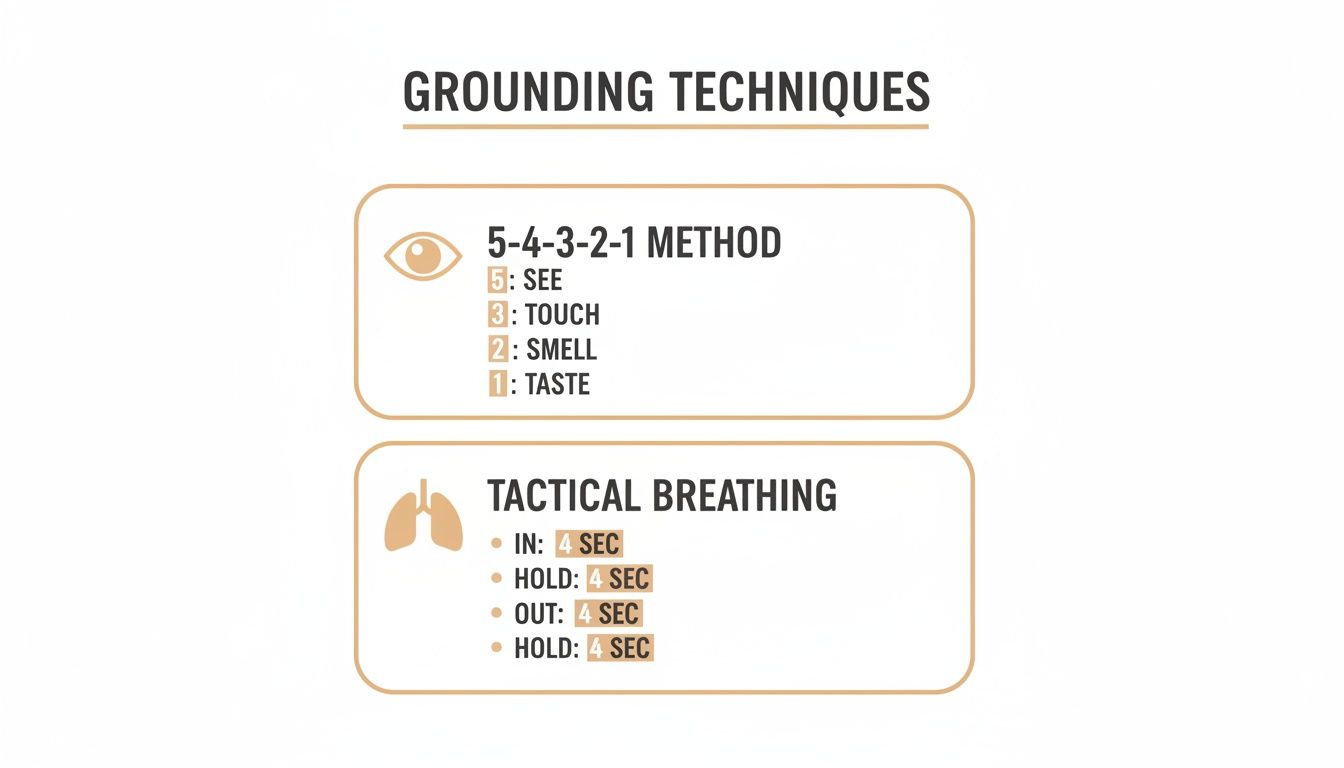
These methods show just how effective structured, sensory-based tasks can be at interrupting a racing mind.
The goal isn't just to keep busy; it's to create a peaceful, reliable ritual. Using our premium, no-bleed paper ensures the experience is smooth and satisfying, preventing the kind of minor frustration that could easily pull you out of a flow state. It’s an immersive experience designed to be frustration-free, gently guiding your brain away from rumination and toward a state of calm focus. Our monochrome coloring books and fine-liner pens are the perfect tools for this.
Distraction gets a bad rap, but when you're stuck in a rumination loop, it’s not about avoiding your problems—it's about choosing your focus. However, not all distractions are created equal. Some calm the mind, while others can inadvertently fuel the fire.
Mindful Distraction vs Mindless Distraction
| Activity Type | Mindful Distraction (Reduces Rumination) | Mindless Distraction (Can Worsen Rumination) | Why It Works (Or Doesn't) |
|---|---|---|---|
| Creative | Monochrome coloring, knitting, sketching a specific object | Aimlessly doodling while stressed | Mindful: The structured, repetitive motion engages focus and calms the nervous system. Mindless: Lacks enough structure to fully occupy the mind, leaving room for worry. |
| Physical | A brisk walk focusing on your breath, stretching, yoga | Pacing around the house | Mindful: Connects you to your body and the environment, forcing present-moment awareness. Mindless: Can just be a physical manifestation of your inner anxiety. |
| Media | Listening to an engaging podcast or audiobook | Scrolling social media, channel surfing | Mindful: Requires active listening and cognitive engagement, leaving little room for intrusive thoughts. Mindless: Passive and often leads to negative social comparison or information overload. |
| Household | Organizing a single drawer, polishing shoes | "Stress cleaning" in a frenzy | Mindful: A contained task with a clear start and finish provides a sense of accomplishment. Mindless: Can feel overwhelming and just another item on a never-ending to-do list. |
The key difference is intention. Mindful distractions pull you into the "now" with a gentle, focused activity, while mindless ones often just numb you out, leaving the root of the rumination untouched and ready to resurface.
The Proven Power of Creative Engagement
The link between rumination and mental health struggles is undeniable, but so is the effectiveness of intentional distraction. A landmark study that tracked 1,300 adults over ten years found that people who ruminate have three times higher rates of depression. But here's the hopeful part: participants who actively used distraction techniques managed to cut their odds of developing depression by an incredible 55%. That’s not a minor adjustment; it’s proof that redirecting your focus can fundamentally rewrite your mental narrative.
Rumination is a fire that needs fuel. Mindful distraction is the act of methodically cutting off its oxygen supply.
This principle is the entire philosophy behind Mono Moment's focus on decision-free coloring. It’s an approach backed by research where 219 participants coloring mandalas for just 30 minutes reduced their anxiety levels by 41%. Interestingly, this specific, structured activity even outperformed free-form drawing, making it an ideal tool for anyone looking to stop rumination in its tracks. Our monochrome coloring books are designed specifically to leverage this power.
By engaging your hands and eyes in a simple, repetitive motion, you give your brain’s fear center—the amygdala—a chance to quiet down. This creates a genuine, restorative pocket of peace in your day. You can learn more about the research behind rumination and distraction and see for yourself why this works.
Learn to Reframe Your Negative Thoughts
Okay, so you've managed to interrupt the thought-loop. That's a massive win. But what do you do in that newfound moment of quiet? This is your window of opportunity—a chance to stop just listening to your worries and start talking back to them.
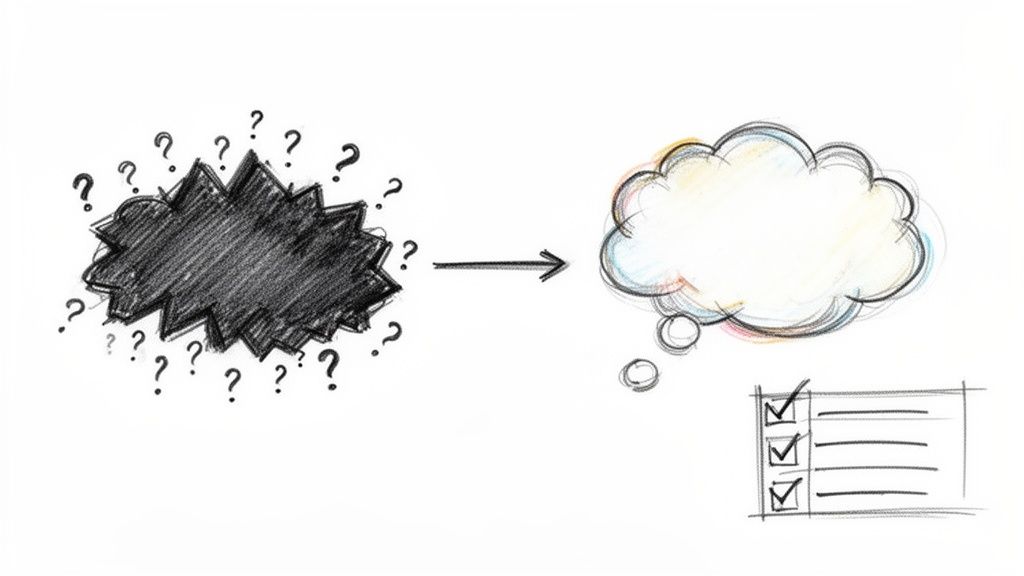
This is where you can borrow a powerful tool from Cognitive Behavioral Therapy (CBT) and take back the driver's seat. The core idea is simple but profound: a thought is just a mental event, not a command or an undeniable fact. You can learn to put your thoughts on the stand, cross-examine them, and consciously choose a more balanced perspective.
Spot the Distorted Thinking Patterns
Let's be honest, rumination isn't exactly a logical process. It's almost always fueled by what experts call cognitive distortions—basically, common tricks your mind plays on you that twist reality and amplify negativity. Learning to recognize these is like finally seeing the magician's sleight of hand.
Here are a few of the most common culprits:
- All-or-Nothing Thinking: Seeing everything in black-and-white terms. If a project isn't a runaway success, you label it a total failure. There's no room for nuance.
- Catastrophizing: Your mind immediately jumps to the worst-case scenario. You send an email with a typo and instantly picture yourself getting fired.
- Personalization: You automatically blame yourself for things you have little or no control over. A coworker is in a bad mood, and you're convinced it's because of something you did.
- Mind Reading: You act as if you know what others are thinking—and you're certain it's negative. "They all thought my idea was stupid."
Just being able to put a name to it—"Ah, that's just my old friend catastrophizing again"—can break the spell. It creates a little bit of distance, allowing you to observe the thought instead of being swept away by it. Recognizing these patterns is a huge part of learning https://mono-moment.com/blogs/news/how-to-stop-overthinking and taking your power back.
Try a Simple Thought Record
A thought record sounds clinical, but it's really just a straightforward way to put your worries on trial. You become the detective, calmly gathering evidence for and against a nagging thought.
The goal here isn't to force yourself into some kind of fake, "good vibes only" positivity. It's about finding the middle ground—a more realistic and less emotionally draining viewpoint that you can actually believe.
Let's say you're stuck on the thought, "I completely bombed that presentation, and now everyone thinks I'm incompetent." Instead of letting it spin, grab a notebook and break it down:
- The Accusation: Write down the thought exactly as it appears in your head.
- Evidence "For": List every piece of "proof" your mind offers. ("I stumbled over a few words." "One person in the back looked bored.")
- Evidence "Against": Now, challenge it. Be a fair lawyer for yourself. ("My boss said I made some good points." "A few people came up with great questions afterward." "I was really well-prepared.")
- The Balanced Verdict: Looking at all the evidence, what's a more realistic take? ("I was nervous and fumbled a bit, but I also shared valuable information and handled the Q&A well. One imperfect presentation doesn't define my entire competence.")
This simple exercise moves a huge, vague feeling out of your head and onto paper, where it becomes a manageable problem to solve.
These cognitive techniques are incredibly effective, especially when you pair them with mindfulness. Research shows that a 12-week course in mindfulness-based cognitive therapy can slash rumination by 45%. In another study, just 20 minutes of a simple activity like coloring dropped rumination scores by 37%. Brain scans even revealed a calming effect similar to meditation. You can dig into the research behind these powerful techniques for yourself.
Schedule Time to Worry—On Your Own Terms
I know it sounds completely backward, but one of the best ways to get a handle on a racing mind is to actually give your worries a designated slot in your day. Think of it as containment. This technique, often called "Worry Time," is all about taking back control from those thoughts that seem to hijack your attention whenever they please.
When you constantly try to shove a worry away, it just gets louder, doesn't it? By scheduling an appointment with your anxieties, you’re not ignoring them—you’re just putting them in their place. You're essentially telling your brain, "Okay, I hear you. We'll deal with this later at 4 PM."
Suddenly, you’ve regained control. Rumination loves to be an unexpected, unwelcome guest. But when you put it on the calendar, it’s just another item on your to-do list—one you manage on your own terms.
How to Create Your Worry Window
Putting this into practice is pretty simple, but the real magic is in the consistency. You're building a new mental habit here, turning that constant drip of anxiety into something you can manage.
Here’s how you can set one up:
- Pick a time and place. Set aside a specific 15-20 minute slot each day. Just try not to schedule it right before bed; you don't want these thoughts to be your last ones before you try to sleep.
- Acknowledge and park it. When a worry pops into your head during the day, make a mental note. Say to yourself, "That’s a good point. I'll think about that during my worry time," and then gently bring your focus back to what you were doing.
- Go all in during your session. When your scheduled time arrives, let it all out. Write it down, say it out loud, or just sit and think. If you’re a writer, you might find our guide on how to journal for anxiety gives you a great framework for this.
- Stop when the timer goes off. This is the most crucial part. When the alarm sounds, you stop. That’s it. Close your journal and immediately shift to something else.
That last rule is the key. By ending the session on schedule, you're training your brain that the time for worrying is finite and, most importantly, that you are the one who decides when it's over.
The goal of a worry window isn't to solve every problem in fifteen minutes. It's to teach your mind that you are in charge of the schedule, breaking the cycle of constant, intrusive rumination.
To make this switch from worrying to not-worrying easier, have a pleasant activity ready to go. This is the perfect moment for a mindful distraction that helps you change gears. For example, grabbing a Mono Moment monochrome coloring book gives your brain a simple, decision-free task to focus on. It acts as a clear signal that the worry session has officially ended and helps you ease into a more peaceful headspace.
Knowing When to Reach for Professional Support
The strategies we’ve walked through are fantastic for reining in that looping-thought habit. Grounding yourself in the moment, scheduling a "worry time," even getting lost in a creative flow—these can absolutely change the game. But it's just as crucial to be honest with yourself about when those tools aren't quite enough.
Sometimes, rumination isn't just a stubborn habit we can unlearn on our own. It can be a deep-seated symptom of something more, like an anxiety disorder or depression. Making the call to get professional help isn't admitting defeat. It’s an act of profound self-care and strength, a sign that you're ready for dedicated, expert support.
Is it Time to Talk to Someone?
So, how do you know when you've tipped from "I'm overthinking a lot" into territory that needs a clinical eye? The real tell is the impact it’s having on your life. Is it just an annoying background noise, or is it taking over the driver's seat?
It might be time to reach out if you're experiencing any of this:
- Your daily life is getting derailed. Are those thought loops making it impossible to focus at work? Are you struggling to get basic chores done or finding no joy in your hobbies anymore?
- Your relationships are feeling the strain. Maybe you're pulling away from people you love or finding yourself in more arguments because your mind is constantly spinning elsewhere.
- Sleep has become a battle. If you lie awake for hours, unable to shut down the mental chatter, or wake up in the middle of the night with your mind already racing, that’s a big red flag.
- Your emotions feel out of control. Is the rumination paired with a constant sense of dread, sadness, hopelessness, or irritability that just won’t lift?
The most powerful thing you can do is recognize when these mental patterns are genuinely hurting your quality of life. Therapy provides a safe, structured space to unpack all of this with someone who knows exactly how to guide you through it.
Finding the Right Kind of Help
Think of therapy as a proactive way to reclaim your mental space. A therapist who specializes in Cognitive Behavioral Therapy (CBT) can be particularly effective here. They're trained to help you pinpoint the triggers and root causes of your rumination and will work with you to build a personalized toolkit of evidence-based strategies.
You’re far from alone in this. A massive 2022 study revealed that rumination affects an estimated 3.1% of the global population. The research also confirmed its tight link to both anxiety and depression, which really underscores why getting professional guidance is such a game-changer for so many people. If you're curious, you can read more about these findings on global rumination rates. Taking that first step to find a therapist is a powerful move toward finding real, lasting relief.
As you consider your options, don't forget the power of small, restorative daily rituals. We created our Mono Moment products, especially our monochrome coloring books, for this very reason—to offer a simple, decision-free escape hatch from the mental noise. Just giving yourself fifteen minutes to focus on a gentle, creative act can be an incredible circuit-breaker, helping you find a pocket of calm whenever you need it most. You can find your own quiet moment at https://mono-moment.com.

The One Color Coloring Book
A single-pen, decision-free coloring book on 160 gsm cream paper — engineered for the wind-down ritual described above.
 Pair it with the 3 Dual Tip Brush Pens — $5 instead of $9.95 in the Book + Pens bundle.