About the author
Published June 25, 2026 · Last reviewed October 6, 2026 · 9 min read

In this article · 7 sections
- What "bold and easy" coloring pages actually are
- Why simple designs calm you down more than intricate ones
- The decision-load problem (and why it's the real culprit)
- The simple-coloring family: mindfulness, grayscale, zen, and monochrome
- What the research actually says
- How to use bold and easy pages to actually wind down
- The case for keeping it simple
TL;DR. Bold and easy coloring pages — large shapes, thick clean outlines, lots of open space — calm you down faster than intricate designs because they remove the mental work. Detailed pages flood you with tiny decisions (which color, which section, stay inside this hair-thin line); simple ones let your attention settle into a smooth, repetitive rhythm. Less to decide, less to get wrong, more calm. The simplest version of all is single-color coloring, where even the palette decision is gone.
For years I assumed that the more detailed a coloring page was, the more "worth it" it would be. Intricate mandalas, dense botanical scenes, those impossibly fine geometric patterns — they looked like the serious version of the hobby. So that's what I bought. And every time, I'd sit down to relax and get up forty minutes later vaguely tense, squinting, with a cramp in my hand and half a flower finished.
It took me an embarrassingly long time to notice the obvious: the intricate pages weren't relaxing me. They were giving me a tiny, low-grade job. The pages that actually settled my mind were the plain ones — big bold shapes, thick outlines, nothing to fuss over. The "easy" ones I'd been quietly looking down on.
That's the whole case for bold and easy coloring pages, and there's real logic behind it. This is a guide to why simple, large-print, low-detail designs calm adults more reliably than complicated ones — what's actually happening in your head, the different styles you'll run into (bold and easy, mindfulness, grayscale, zen), and how to use them to genuinely wind down instead of giving yourself one more thing to get right.
Bold and easy coloring pages are designs built from large, simple shapes with thick outlines and plenty of open space. They tend to calm adults more reliably than intricate pages because there is little to decide, staying inside the lines is effortless, and each shape fills quickly, which keeps a steady rhythm. The fewer decisions a page asks for, the more restful it feels.
What "bold and easy" coloring pages actually are
A bold and easy coloring page is exactly what it sounds like: a design built from large, simple shapes with thick, clean outlines and plenty of open space inside each section.
No hair-thin lines. No clusters of tiny fragments you have to color one by one with a fine-tip pen. No dense, overlapping detail that demands a magnifying glass and a steady hand. Just bold, generous shapes you can fill in comfortably — sometimes called large-print or low-detail coloring pages, and especially popular with adults who want the calming part of coloring without the eye strain and the fiddliness.
The key word is low-friction. You can sit down and start immediately. You don't need good lighting, a precise pen, or a plan. You fill a shape, then the next one, then the next — and that easy, uninterrupted rhythm is the entire point. It's the difference between a walk and an obstacle course. Both are "exercise," but only one of them lets your mind wander somewhere pleasant.
Why simple designs calm you down more than intricate ones

Here's the counterintuitive part: the relaxing power of coloring doesn't come from the detail. It often comes from the absence of it.
The Cleveland Clinic explains why coloring works as a calming activity in the first place. Clinical psychologist Dr. Scott Bea describes three reasons adult coloring relaxes your brain: it pulls your attention away from yourself and your worries onto a simple present-moment task ("very much like a meditative exercise"), it quiets your own anxious appraisals, and — crucially — it's low-stakes. As he puts it, "It is hard to screw up coloring, and, even if you do, there is no real consequence."
Now look at what an intricate page does to those three benefits. The dense detail constantly pulls you back into evaluation: which of these forty tiny sections gets which color, am I staying inside this microscopic line, does this look right? Instead of escaping your appraising mind, you've handed it a fresh project. The "low-stakes" quality erodes too — when a page took an hour and one slip is visible forever, it suddenly feels like there is something to get wrong.
Bold and easy pages protect all three benefits by design. The shapes are big enough that staying in the lines is effortless, so there's no performance pressure. There's little to decide, so attention can rest instead of constantly choosing. And because each shape fills fast, you stay in the steady, rhythmic motion that does the actual calming. Simplicity isn't a lesser version of coloring. For relaxation, it's the better-engineered one.
Looking for a bound book instead of loose pages? Here is how to choose a bold and easy coloring book.
The decision-load problem (and why it's the real culprit)
If I had to name the single thing that turns coloring from soothing into subtly stressful, it's this: decision load.
Every intricate page is a stack of small choices. Which color next? Which section? Light or dark here? Do these two areas clash? Each decision is tiny, but they add up — and your capacity to make them is finite. The Cleveland Clinic describes decision fatigue as a real phenomenon where "the more decisions a person makes over the course of a day, the more physically, mentally and emotionally depleted they become."
That matters enormously for when most of us reach for coloring. We pick it up in the evening — precisely when we're already running on empty, having spent the whole day deciding what to wear, what to reply, what to prioritize, what to make for dinner. Asking a depleted mind to then make a hundred more small aesthetic decisions on a complicated page isn't relaxation. It's overtime.
This is the deeper reason bold and easy pages work, and it points at something useful: the fewer decisions a design asks of you, the more genuinely restful it is. A page with ten big shapes asks less than one with two hundred tiny ones. And a page where you're using a single color — where even which color is already decided — asks the least of all. That's the whole idea behind what monochrome coloring is: strip the choices down to almost nothing, and what's left is pure, uninterrupted flow.
The simple-coloring family: mindfulness, grayscale, zen, and monochrome

"Bold and easy" is one label in a whole family of simple, low-pressure coloring styles. They overlap heavily and people use the terms loosely, so here's a clear map.
Mindfulness coloring pages describe the intent more than the design. The idea is to color as a present-moment practice — slowing down, noticing the motion, letting the activity anchor your attention the way breath does in meditation. Bold, simple designs are ideal vehicles for this, because there's nothing demanding enough to pull you out of the calm. (If you want to go deeper on the practice itself, our piece on mindfulness coloring for adults covers it.)
Zen coloring pages are essentially the same idea under a different name — coloring framed as a quieting, meditative ritual. The emphasis is on the calm, repetitive process rather than the finished picture.
Grayscale coloring pages are a technique rather than a difficulty level. Instead of a flat black-and-white outline, you color over a printed image that's already shaded in grays, and your color picks up that shading to create a realistic, dimensional result. It can be beautiful — though, worth noting, it quietly reintroduces decision load (you're judging tone and blending), so it's less of a pure wind-down and more of an absorbing craft.
Minimalist and single-color coloring sit at the simplest end of the spectrum. Minimalist coloring pages keep the design spare and uncluttered. Monochrome coloring goes one step further and removes the color decision entirely — you work in a single pen, filling bold shapes, with no palette to plan. It is the most distilled possible expression of "bold and easy."
The thread running through all of them: less to manage, more room to settle. They differ mainly in how far they take that principle.
What the research actually says
It's fair to ask whether any of this holds up beyond personal preference. The honest answer is: the evidence is encouraging but modest, and worth stating carefully.
A randomized controlled study by Koo, Chen and Yeh, published in Evidence-Based Complementary and Alternative Medicine, found that a single 20-minute session of structured coloring significantly reduced anxiety in older adults compared with a control group. Worth being precise here: that study tested a structured geometric pattern, and it's one study in a specific population — not proof that any particular design is best. What it does support is the broader principle this whole article rests on: a quiet, structured, low-decision visual task can settle an anxious mind in a short window.
There's also a reassuring finding for anyone who thinks they're "not artistic enough." A study by Kaimal, Ray and Muniz in the journal Art Therapy measured cortisol — a primary stress hormone — before and after art-making and found reductions in cortisol following art making that did not depend on the participant's prior art experience or skill. In other words, you don't need talent to get the calming benefit. Which is exactly why bold and easy pages, with nothing to plan and nothing to ruin, are such a good fit.
One honest caveat, echoed by clinicians: coloring is a supportive wind-down activity, not a treatment for anxiety or depression. Use it as a tool to manage stress in the moment — not as a substitute for proper care when you need it.
For a clear, calm overview of why this kind of simple, focused activity quiets the mind, this short explainer is worth a few minutes:
How to use bold and easy pages to actually wind down

The mechanics are simple, but a few choices make the difference between "nice" and "genuinely settling."
Pick the boldest design you can find. Counterintuitive, but trust it: the simpler the page, the deeper the calm. If you're choosing between an intricate page and a plain one, plain wins for relaxation almost every time. Save the intricate ones for when you want an absorbing project, not a rest.
Don't overthink the tools. Big open shapes fill beautifully with a single broad-tip marker or brush pen — you don't need a precise fine-tip pen, and you don't need a 50-color set. Fewer supplies is fewer decisions. Heavier paper (around 160gsm) helps a lot, because it won't bleed through and you can press without worry. If you want a full primer on starting simple, simple coloring books for adults walks through it.
If you want to test the feel before committing to supplies, grab our free printable coloring pages and print a couple of bold, large-shape designs at home.
Set a small, unambitious window. Ten to twenty minutes is plenty — the research above used a single 20-minute session. You're not trying to finish anything. You're giving your mind one quiet place to rest.
Make it the same every time. A fixed ritual — same spot, same pen, same kind of page — means there's no setup to think about. The less you have to decide before you start, the faster you drop into the calm.
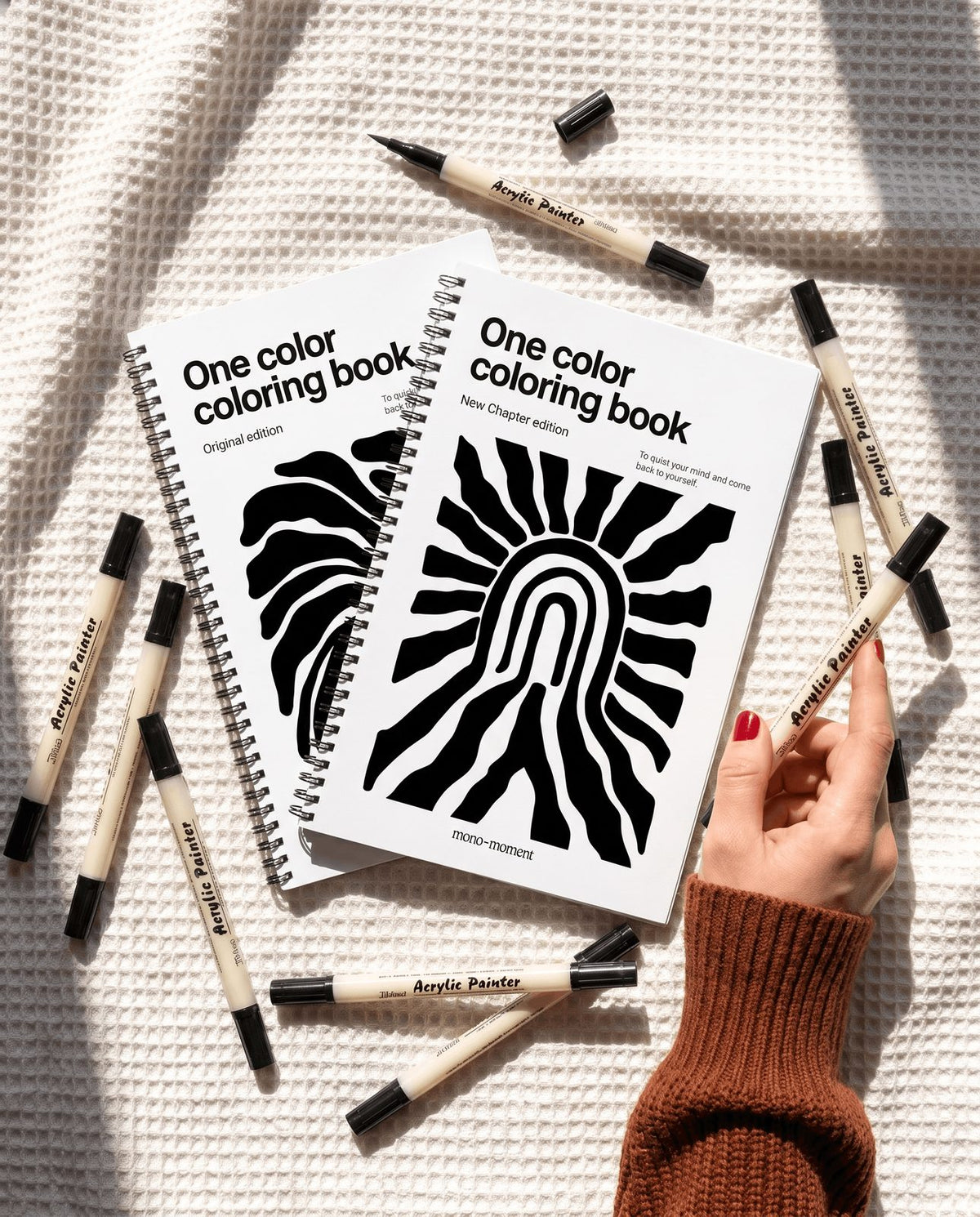
Go single-color when you want the deepest reset. This is my own default. After a day full of decisions, I reach for a one color coloring book: bold black shapes, one pen, no palette to choose and nothing to plan. It's "bold and easy" taken to its logical end: every decision already made for you, so all that's left is the filling-in. On the evenings I'm most fried, that complete absence of choice is the entire reason it works.
The case for keeping it simple
I spent a long time believing the detailed pages were the "real" hobby and the easy ones were for people who weren't trying hard enough. I had it backwards.
For relaxation, the bold and easy page is the more sophisticated choice. It understands that you came to rest, not to perform — and it removes everything that would get in the way of that. No eye strain, no decision overload, no fear of ruining something you spent an hour on. Just big shapes, a steady rhythm, and a mind that finally gets to be quiet for a few minutes.
If you're new to this, start as simple as you possibly can. A handful of bold shapes, one or two pens, ten unhurried minutes. And if you want the purest version of the idea — no color to choose, no design to plan, nothing to get wrong — the single-pen coloring book is built entirely around it. Bold shapes, one color, complete calm. That's the whole point.

The One Color Coloring Book
A single-pen, decision-free coloring book on 160 gsm cream paper — engineered for the wind-down ritual described above.
 Pair it with the 3 Dual Tip Brush Pens — $5 instead of $9.95 in the Book + Pens bundle.
Sources & further reading
- Cleveland Clinic — 3 Reasons Adult Coloring Can Actually Relax Your Brain
- Cleveland Clinic — 8 Signs of Decision Fatigue and How To Cope
- Koo, Chen & Yeh (2020), Evidence-Based Complementary & Alternative Medicine — Coloring Activities for Anxiety Reduction (RCT)
- Kaimal, Ray & Muniz (2016), Art Therapy — Reduction of Cortisol Levels Following Art Making