In this article · 10 sections
- First, the one rule: subtract, don't add
- 1. Cut the input — immediately
- 2. Slow your exhale (the fastest lever you have)
- 3. Get warmth and dim light around you
- 4. Give your brain one single-channel task
- 5. Move your body gently — but don't go hard
- 6. Name it and lower your own stakes
- 7. What NOT to do (the moves that make it worse)
- 8. Build a no-decision reset you can repeat
- 9. Protect your recovery before the next wave
TL;DR. When you are overstimulated, the answer is less, not more. Cut the input first — dim the lights, mute the noise, put the phone in another room. Then slow your exhale (in for 4, out for 6–8), get warmth and dim light, and give your brain one quiet, low-decision task to land on. Do not push through, scroll, caffeinate, or make big decisions. The whole playbook is below, in the order to actually do it.
It usually arrives without warning. One second you are fine, and the next the lights are too bright, everyone is talking at once, your phone will not stop buzzing, and something in you just trips. Your chest tightens, your thoughts scatter, and you want to claw your way out of the room. You are not being dramatic and nothing is wrong with you. You are overstimulated — your nervous system has taken in more than it can process, and it has flipped into a stress response.
I have been there more evenings than I can count. For a long time I had no plan for that moment, so I did the worst possible thing: I pushed harder. I finished the task, I stayed in the conversation, I picked up my phone to "switch off." Every one of those made it worse, because every one of those added input to a system that was already over its limit.
This is the in-the-moment playbook I wish I had taped to my wall back then. Not the long explainer of why it happens — if you want that, start with what does overstimulated mean, which covers the causes and the nervous-system science in full. This article is the action companion: nine concrete things to do, in order, to bring an overstimulated system back down right now — plus the things to stop doing immediately.
When overstimulated, the guiding rule is to subtract input, not add more. First dim the lights, cut the noise, put the phone in another room and move somewhere quieter. Next, lengthen the exhale to six to eight counts, add warmth and low light, and settle on one undemanding repetitive task. Pushing through, scrolling, caffeine and intense exercise tend to make it worse.
First, the one rule: subtract, don't add
Before any specific technique, understand the single principle that makes all of them work. You cannot calm an overloaded nervous system by giving it more to do. Overstimulation is, by definition, too much input. So the entire job — every step below — is some version of less.
The Cleveland Clinic describes sensory overload as what happens when input from your senses feels overwhelming and triggers a physiological fight-or-flight reaction — the same machinery your body would fire to escape real danger. When that switch is flipped, your job is not to be clever or productive. It is to lower the tide. Everything that follows is in deliberate order, because the order matters: you reduce input first, then you steer your body toward calm, and only then do you give your mind somewhere soft to land.
1. Cut the input — immediately

This is step one and it is non-negotiable. Before you try to breathe, before you try to think, reduce what is coming in.
- Lower the light. Turn off overhead lights or switch to a single lamp. Bright, blue-heavy light keeps the alert system switched on.
- Kill the noise. Mute the TV, pause the music, leave the loud room. If you cannot leave, noise-cancelling headphones or even basic earplugs buy you instant relief.
- Put the phone in another room. Not face-down on the table — in another room. A phone within reach is a promise of a hundred more micro-demands on your attention.
- Physically change rooms. Step somewhere quieter, even if it is the bathroom, a stairwell, or your car for two minutes. New, low-input space tells your body the flood is over.
You are not solving anything yet. You are lowering the water level so the rest of the playbook can work.
2. Slow your exhale (the fastest lever you have)
Once the input is down, your breath is the quickest physical switch you can reach. Specifically, lengthen the exhale. Breathe in for about four counts, then out slowly for six to eight. Do it a handful of times.
The long out-breath is not a wellness cliché — it directly nudges the parasympathetic nervous system, the "brake" that brings your heart rate and blood pressure back down. The NIH's complementary health center notes that breathing exercises and other relaxation techniques help bring about the body's "relaxation response": slower breathing, a lower heart rate, lower blood pressure — the literal opposite of the overstimulated state. You do not need a perfect technique. Just make the out-breath longer than the in-breath, and repeat.
3. Get warmth and dim light around you

Now stack a few calming signals. A warm drink in your hands, a blanket over your knees, lamps instead of overhead bulbs. Warmth and low light are genuine cues to the nervous system that you are safe and can stand down — not just comforting habits.
This is also the moment to drop your shoulders and unclench your jaw, two places overstimulation hides without you noticing. A warm shower or even just warm water over your hands works for the same reason: it floods your senses with one steady, soothing, non-threatening input instead of ten competing ones.
4. Give your brain one single-channel task
Here is the step that, for me, does not just turn the volume down — it actually pulls me out. An overstimulated brain is being yanked in ten directions at once. The relief of a single, undemanding, repetitive task is that it gives all that scattered attention one quiet place to rest.
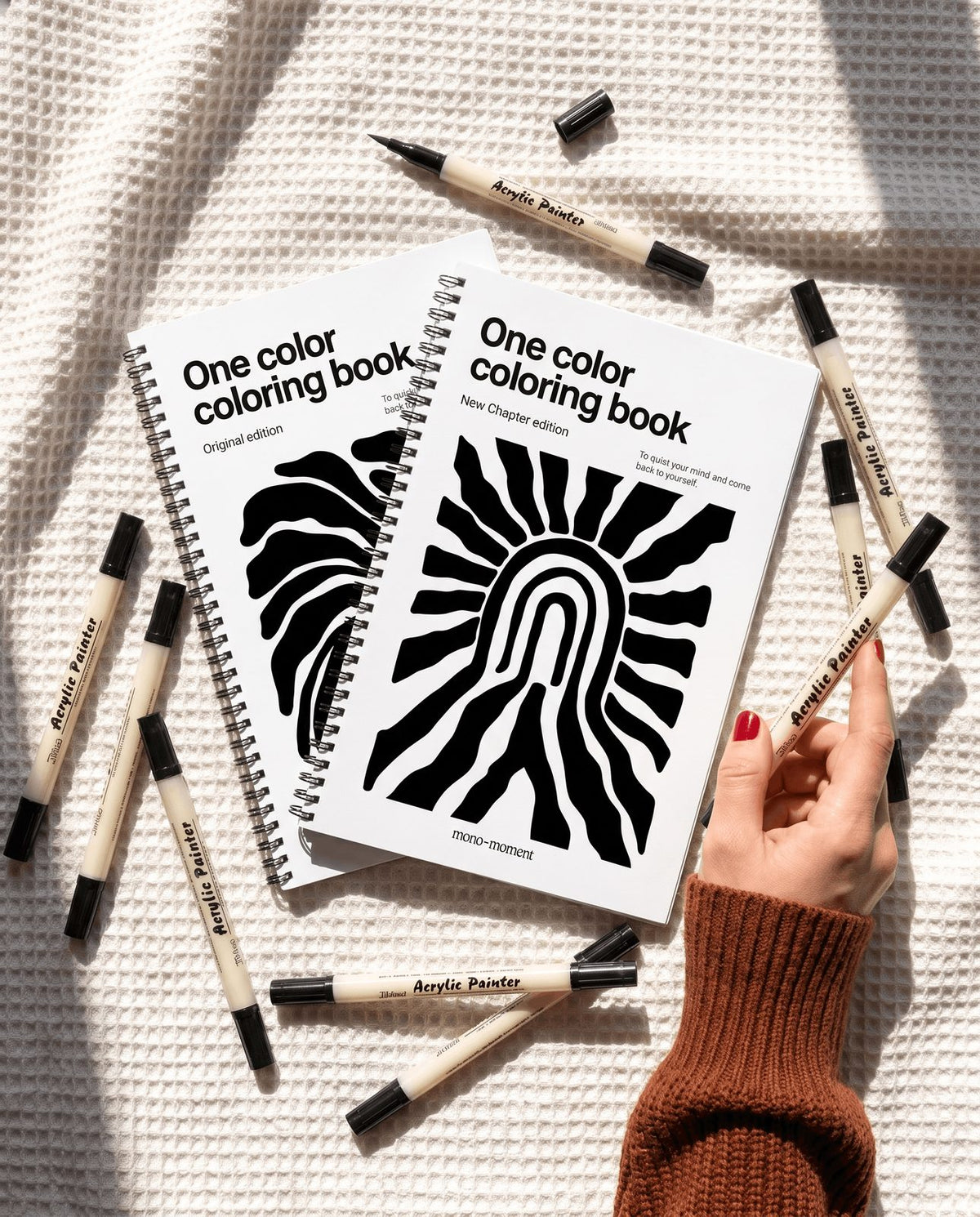
The key word is single-channel: one input, low stakes, no choices. A slow walk works. So does washing dishes by hand, folding laundry, or sorting something simple. My own default is single-color coloring — and the reason it works so well in this exact moment is worth saying plainly: there are no decisions to make. After a day that already drained my capacity to choose, an activity with nothing to plan and nothing to get wrong is rest for the part of me that is tired, not just for my body. If you want a fuller menu, these low-stimulation activities for adults all run on the same principle.
For a clear, practical walk-through of calming an overloaded system in the moment, this short video is worth a few quiet minutes:
5. Move your body gently — but don't go hard

A little movement helps discharge the jittery, wired feeling that overstimulation leaves in your limbs. Emphasis on gentle: a slow walk around the block, a few easy stretches, rolling your shoulders, swaying, or simply standing up and changing your posture.
What you are not doing is a punishing workout. Intense exercise spikes your stress hormones further, which is the last thing an already-activated system needs in this moment. Save the hard session for a calmer day. Right now, you want movement that says "we're okay," not movement that says "we're under attack." This is exactly why my go-to reset is a low-decision activity like the One Color Coloring Book paired with a short walk, rather than anything that ramps me back up.
6. Name it and lower your own stakes
Overstimulation is made worse by the panicky story we tell about it — what is wrong with me, why can't I cope, I'm ruining the evening. That self-talk is itself more input, and it keeps the stress response lit.
So name it, flatly: "I'm overstimulated. This is a normal nervous-system limit, and it passes." That single reframe lowers the stakes and takes the threat out of the feeling. You are not broken and you are not failing. You hit a physiological ceiling that every human has — some of us just reach it faster. Understanding the mechanism behind that, and how to widen the ceiling over time, is what how to regulate your nervous system is for; in the acute moment, just naming it is enough to take the edge off.
7. What NOT to do (the moves that make it worse)
Half of getting out of overstimulation is stopping the things that deepen it. When you feel the overload hit, deliberately avoid:
- Pushing through. Finishing the task or "powering down the list" adds load to a maxed-out system. Stop. The task will survive ten minutes.
- Reaching for your phone. Scrolling to "switch off" is the opposite of less input — it is a firehose of new stimulation. This is the single most common mistake.
- Caffeine and energy drinks. Stimulants pour fuel on a fight-or-flight fire. So does alcohol later, which fragments the sleep you need to recover.
- Making big decisions. Decision-making draws from the same depleted well. Postpone anything important; your judgment is not at its best mid-overload.
- Venting in a heated way. Snapping, arguing, or doom-talking keeps your sympathetic system switched on. Step away first, talk later when you are settled.
If you only remember one thing from this list: do not add a different stimulation. The cure for too much input is not better input — it is less.
8. Build a no-decision reset you can repeat
The fastest way out of overstimulation in the future is to not have to think your way out. When you are overloaded, even choosing how to calm down is one more decision you do not have the budget for. So the most reliable reset is one you have decided on in advance and can run on autopilot.
Mine is the same every time: lamp on, phone in the other room, kettle on for tea, and ten minutes filling shapes in a single color. It is almost aggressively boring, and that is precisely why it works — a fixed cue plus one quiet task with no choices, every time. Over weeks, your nervous system learns the off-ramp and starts taking it faster. The repeatability matters more than the specific activity: pick one calm, low-input thing, attach it to a simple cue, and let it become the thing you reach for without deciding.
9. Protect your recovery before the next wave
This last one is not for the acute moment — it is for tomorrow. Overstimulation is cumulative. A single overwhelming moment passes quickly, but overload stacked on poor sleep and weeks of unrecovered stress takes far longer to come down from, as the American Psychological Association notes in its overview of stress effects on the body: when activation is near-constant, the restoration cycle never fully completes.
The fix is to treat your daily capacity for stimulation like a finite budget. Build genuine low-stimulation gaps into the day rather than only collapsing into them at night. Say no to a second loud thing in one evening. Protect your sleep the way you would protect a deadline. And keep that boring, repeatable wind-down ritual going on the good days too, so the off-ramp stays well-worn for the days you really need it. A few minutes most evenings with the single-pen coloring book is, for me, less a treat than basic maintenance — the quiet, no-decision input that keeps the tank from overflowing in the first place.
You are not too sensitive, too much, or failing at being a calm person. You are a normal nervous system living in an environment built to exceed it. When it tips, you do not need to be stronger. You need to be quieter — cut the input, slow the breath, and give your mind one soft, single place to land.

The One Color Coloring Book
A single-pen, decision-free coloring book on 160 gsm cream paper — engineered for the wind-down ritual described above.
 Pair it with the 3 Dual Tip Brush Pens — $5 instead of $9.95 in the Book + Pens bundle.