About the author
Published June 25, 2026 · Last reviewed July 5, 2026 · 10 min read

In this article · 7 sections
- How to use this list (the energy-first rule)
- 5-minute self-care resets (when you have almost nothing left)
- Low-energy self-care (for depleted, flat, or anxious days)
- Mental & emotional self-care (for an overloaded or racing mind)
- Physical self-care (for restlessness, tension, or low energy)
- Social & connection self-care (and the solitude kind)
- Creative & evening wind-down self-care
TL;DR. The best self-care activities are the ones that match your current energy and time — not the most impressive ones. This list sorts 60 ideas into 5-minute resets, low-energy options, and mental, physical, social, creative, and evening categories, so you can pick something you'll actually do when you're depleted, not just when you're inspired.
Most self-care lists fail for the same reason: they assume you have energy. They tell a person running on empty to take a two-hour bath, meal-prep a week of food, and journal three pages of gratitude — and when that person can't, they feel like they've failed at resting, which is its own special kind of demoralizing.
I've kept a self-care habit for years now, through good stretches and genuinely awful ones, and the single most useful thing I've learned is this: match the activity to your energy, not your aspirations. On a flattened-out Tuesday, the right self-care is a glass of water and ten minutes outside, not a wellness production. On a rare open Sunday, sure, run the bath.
So I've sorted these 60 activities by what they actually cost you — time and energy — rather than dumping them in a motivational pile. Skim to the category that fits how you feel right now. The National Institute of Mental Health makes the same point in its guide to caring for your mental health: self-care simply means "taking the time to do things that help you live well." Small things count. Most of mine are small.
How much time does self-care actually need?
Less than most lists suggest. Pick by energy, not ambition: 5 minutes is enough to reset (breathing, stepping outside, one page of one-color coloring), 20 minutes can shift a whole evening. Consistency beats duration — a small daily anchor does more than a rare all-day recharge.
How to use this list (the energy-first rule)
Before the activities, the one idea that makes all of them work.
Self-care has a cost — in minutes, in effort, and in decisions. The reason a face-mask-and-candles evening feels restorative one day and impossible the next is that your available energy moved, even though the activity didn't. So instead of asking "what's the ideal self-care routine," ask a better question: how much do I have to give right now?
- Almost nothing left → 5-minute resets, or low-energy care. Subtract effort.
- A normal, slightly tired day → mental, physical, social, or creative care. Pick one.
- Genuinely some fuel in the tank → stack a couple, or do the longer evening wind-down.
The activities below are grouped exactly that way. You're not meant to do all of them — that would be its own stressor. You're meant to keep this as a menu and point at one. If you want to turn the ones that work into a repeatable habit rather than a one-off, that's a separate (and worthwhile) project — I've written a full walkthrough on how to create a self-care routine, and on the very common problem of how to make time for self-care when your calendar is already full. This article is the ideas; those are the systems.
5-minute self-care resets (when you have almost nothing left)

These are the ones I reach for mid-collapse — when there's no time and no energy, but I need to interrupt a bad stretch before it gets worse. None of them fix the day. They just lower the temperature a notch, which is often all you need.
- Drink a full glass of water. Unglamorous and genuinely effective; mild dehydration quietly worsens mood and focus.
- Step outside for two minutes of daylight. Even on a grey day, outdoor light helps reset a frazzled system.
- Take three slow breaths with a long exhale. In for four, out for six or eight. The extended out-breath nudges your nervous system toward calm.
- Put your phone in another room. Not face-down on the table — in another room. Remove the input.
- Stretch your neck, shoulders, and jaw. Stress lives there; release it on purpose.
- Write down the one thing weighing on you. Getting it out of your head and onto paper shrinks it.
- Splash cold water on your face or run cold water on your wrists. A fast, physical reset for a spinning mind.
- Color a single shape. Fill in one shape in a coloring book or doodle — sixty seconds of one quiet, low-stakes task.
- Step away from the screen and look at something far away for 30 seconds. Eyes and brain both unclench.
- Make a warm drink and do nothing else while you drink it. No scrolling. Just the cup.
The point of a five-minute reset isn't transformation — it's a circuit-breaker. Use one, then carry on. You can do several across a hard day.
Low-energy self-care (for depleted, flat, or anxious days)
Some days you have a little more than five minutes but still not much capacity — the flat, foggy, slightly anxious days where ambitious self-care feels like a cruel joke. These ask very little of you.
- Take a slow walk with no destination or step goal. Movement without performance.
- Lie down with a blanket and your eyes closed for ten minutes. Not a nap necessarily — just horizontal and quiet.
- Tidy one small surface — a single drawer, the nightstand, the kitchen counter. Tiny order, outsized relief.
- Listen to one album start to finish instead of a shuffled, decision-heavy playlist.
- Do a low-decision creative task like single-color coloring, where the design is already made and there's nothing to plan or get wrong.
- Take a warm shower with the lights dimmed. Warmth and low light are real calming signals.
- Eat something nourishing without multitasking. Just the meal, no screen.
- Reread a comforting book or rewatch a familiar show. Novelty costs energy; familiarity doesn't.
- Open a window for fresh air even if you can't get outside.
- Give yourself permission to do nothing for an hour — and mean it, without guilt.
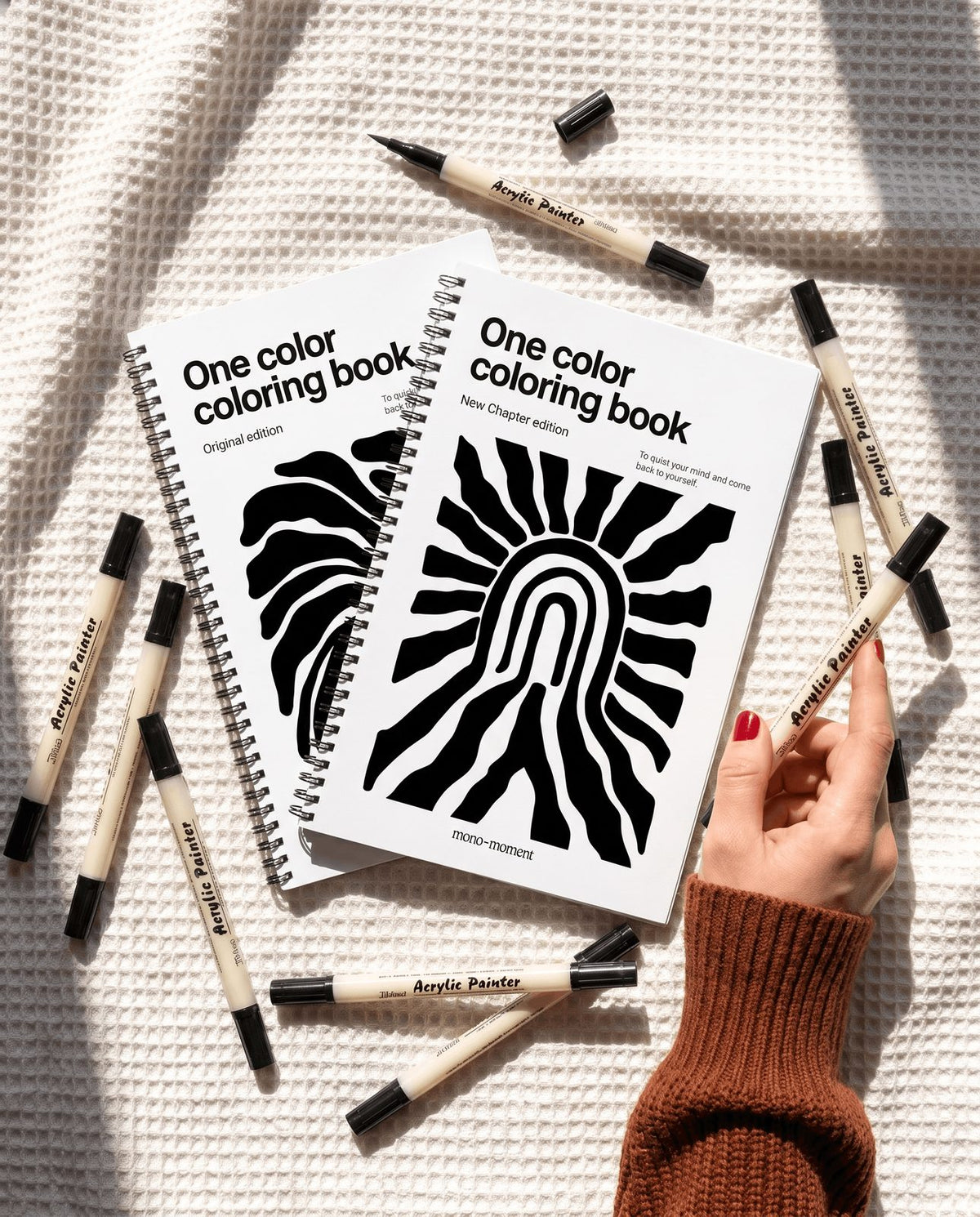
I want to dwell on number 15 for a second, because it's the one I lean on hardest. After a depleting day, the last thing I have energy for is deciding — what to do, where to start, whether it's good enough. That's exactly why my default low-energy activity is a one color coloring book: one pen, one color, designs already drawn, no palette to choose and nothing to ruin. It removes the very thing — choice — that a tired mind has run out of. More on why that works later, but on a flat day it's the difference between "self-care" actually happening and not.
Mental & emotional self-care (for an overloaded or racing mind)

This category is for when your body is fine but your head is the problem — racing, foggy, churning, or stuck. These give an overactive mind somewhere to land.
- Brain-dump everything onto paper. Every open loop, task, and worry. Don't organize it — just empty it.
- Name what you're actually feeling. "I'm anxious" is more useful than "I'm fine." Naming an emotion takes some of its charge away.
- Do a single-channel hobby — coloring, knitting, a puzzle, an instrument. One quiet input for a scattered mind.
- Set a worry window. Give yourself ten minutes to worry on purpose, then close it. Worries respect appointments more than you'd think.
- Unfollow or mute accounts that reliably make you feel worse. Curating your input is self-care.
- Write down three things that went okay today. Not a forced gratitude performance — just three true things.
- Talk it through with someone you trust. Saying a worry out loud usually shrinks it.
- Read fiction. A story pulls your attention out of your own head — a clean, underrated mental reset.
- Do one thing slowly and deliberately — wash the dishes by hand, make coffee with full attention. Single-tasking is a calming act.
- Limit decisions for the rest of the day. Decision fatigue is real; on an overloaded day, fewer choices means more relief.
A note on decisions, because it underpins a lot of these: every choice you make spends from the same mental budget. By evening, after hundreds of micro-decisions, your capacity for any more is low — which is exactly why a low-decision activity feels so much better than a "fun" one that still demands choices. The relief isn't laziness; it's giving a depleted system a rest from the thing that depleted it.
Physical self-care (for restlessness, tension, or low energy)
When the tension is in your body — wired, restless, stiff, sluggish — these help discharge it. Physical movement is one of the most evidence-backed wellbeing tools we have. The NHS lists "be active" among its 5 steps to mental wellbeing, and the Mental Health Foundation puts "keep moving" near the top of its research-backed tips — not because exercise is virtuous, but because it measurably lifts mood and eases stress.
- Take a brisk 20-minute walk, ideally somewhere green.
- Stretch or do gentle yoga for ten minutes — no class, no mat required.
- Protect your sleep tonight. Pick a wind-down time and a screen cut-off. Sleep is the foundation everything else sits on.
- Cook one proper meal from scratch. The chopping and stirring is its own calming rhythm.
- Get sunlight in the morning, even ten minutes. It steadies your body clock and your mood.
- Dance to a few songs in your kitchen. Mood-lifting and slightly ridiculous, which is part of the point.
- Do a body scan, tensing and releasing each muscle group from feet to head.
- Drink water consistently across the day, not just when you remember.
- Take a real lunch break away from your desk. Eating while working isn't a break.
- Go to bed 30 minutes earlier than usual as a deliberate gift to tomorrow-you.
You don't need a gym membership or a new routine for any of this. The most reliable physical self-care is the boring, repeatable kind — water, walks, daylight, sleep — done most days rather than perfectly some days.
Social & connection self-care (and the solitude kind)

Connection is one of the strongest predictors of wellbeing — and both NHS and NIMH name relationships explicitly as a pillar of good mental health. But "social self-care" cuts both ways: sometimes it's reaching out, and sometimes it's protecting your solitude. Read your own energy and pick the right direction.
When you need connection:
- Text one person something real, not just a meme — "thinking of you," or "rough week, how are you?"
- Call a friend or family member instead of texting. Voices land differently.
- Make a plan to look forward to. Anticipation itself is good for you, even before the event.
- Do something kind for someone — a small favor, a genuine compliment. Giving lifts the giver, too.
- Join something low-pressure — a class, a walk, a group — where connection is a side effect, not the goal.
- Sit with a pet, or borrow one. Animal company is a real nervous-system soother.
When you need solitude:
- Say no to one thing this week to protect your capacity. "No" is a complete sentence.
- Schedule deliberate alone time and treat it as a real appointment.
- Take a solo outing — a café, a museum, a long walk by yourself. Solitude isn't loneliness when you chose it.
- Mute the group chats for an evening without explaining yourself.
Social care is about matching, not maximizing. An extrovert running on empty may need a phone call; an introvert running on empty may need exactly the opposite. Both are self-care. Neither is the "right" one universally.
Creative & evening wind-down self-care
The end of the day is when most overload arrives — and when the right ritual does the most good. Creative, low-stakes activities work especially well here because they occupy your hands and a little of your attention without demanding performance. There's even controlled evidence for one of them: a randomized trial published in Evidence-Based Complementary and Alternative Medicine found that just 20 minutes of structured coloring measurably reduced anxiety compared with a control activity.
- Color for ten minutes before bed. A structured, low-decision visual task that settles an overactive mind.
- Keep a tiny journal — three lines about the day, no pressure to be profound.
- Do something with your hands — knitting, modeling clay, baking, sketching. Hands busy, mind quiet.
- Make a calming playlist and let it run while you potter.
- Dim the lights an hour before bed and switch from overheads to lamps.
- Read fiction in bed instead of scrolling. A clean off-ramp from the day.
- Do a simple skincare or stretching ritual — the repetition matters more than the products.
- Write tomorrow's three priorities so your brain can stop holding them overnight.
- Have a no-screens wind-down hour. The single highest-leverage evening change most people can make.
- Build a fixed, boring, repeatable evening ritual you don't have to think about — the lack of novelty is the feature.
My own wind-down is almost aggressively unexciting, and that's the point. Lamp on, phone in the other room, chamomile tea, and ten minutes filling shapes in a single-pen coloring book. There's no color to choose, no picture to plan, nothing to get wrong — which is exactly the rest a tired, decision-fatigued brain needs. That's why I keep recommending decision-free coloring specifically: it's one of the few creative activities that removes effort instead of adding it. If you want to go deeper on the calming side of all this, my list of stress-relief activities for adults covers the same ground from the stress angle.
Whatever you pick from these 60, hold the energy-first rule above the activity itself. The "best" self-care isn't the most photogenic or the most ambitious — it's the one you'll actually do on the day you need it most, when you have the least to give. A glass of water counts. Ten quiet minutes count. You don't have to earn rest, and you don't have to perform it.

The One Color Coloring Book
A single-pen, decision-free coloring book on 160 gsm cream paper — engineered for the wind-down ritual described above.
 Pair it with the 3 Dual Tip Brush Pens — $5 instead of $9.95 in the Book + Pens bundle.
Sources & further reading
Frequently asked questions
What are good self-care activities?
What is the 'rule' for self-care?
What self-care can I do in 5 minutes?
Why does self-care feel like a chore sometimes?
How often should I do self-care?
This guide is general information for everyday wellbeing, not medical or mental-health advice. If low mood, anxiety or exhaustion sticks around, a licensed professional is the right next step.
↑