In this article · 8 sections
- Your "stimulation threshold" — and why it varies so much
- Reason 1: You may be a highly sensitive person (HSP)
- Reason 2: ADHD, autism, anxiety and a different filter
- Reason 3: Poor sleep shrinks your capacity overnight
- Reason 4: Chronic stress keeps the accelerator stuck on
- Reason 5: Hormones, hunger and being run-down
- Reason 6: An environment engineered to exceed you
- So what do you actually do about it?
TL;DR. You get overstimulated easily because of a combination of how your nervous system is wired and what is depleting it. Some people — highly sensitive people, and those with ADHD, autism, anxiety or chronic stress — take in more input by default, so they hit their ceiling faster. On top of that, poor sleep, ongoing stress, hormones, hunger and an always-on environment all lower the threshold further. It is rarely one cause, and it is almost never a flaw.
If you have ever wondered why a normal supermarket, a normal open-plan office, or a normal family dinner can leave you frayed and desperate to escape while everyone around you seems fine, you are not imagining it. Some people genuinely do get overstimulated more easily than others — and there are real, understandable reasons why.
I asked this exact question about myself for years. Why does the same birthday party that energizes my husband flatten me by hour two? Why can I feel a flickering light or a too-loud restaurant in my whole body? For a long time I assumed I was just dramatic, or fragile, or doing adulthood wrong. It turns out the answer is far more mechanical — and far more reassuring — than "something is wrong with you."
This is the explainer I wish I had found back then. If you want the basics first — the definition, the signs, the physiology — start with what does overstimulated mean, which covers the groundwork. This article is about the next question: why you, why so easily, and what is actually lowering your threshold.
Getting overstimulated easily usually points to a low stimulation threshold, the line above which the nervous system tips into a stress response. Baseline wiring sets part of it: high sensitivity, ADHD, autism or anxiety can all change how input is filtered. Current state sets the rest, since poor sleep, chronic stress, hormonal shifts and hunger can lower the threshold from day to day.
Your "stimulation threshold" — and why it varies so much
The simplest way to understand overstimulation is to picture a threshold: a line your nervous system can stay below comfortably, above which it tips into a stress response.
Below the line, you cope. Input comes in — sound, light, conversation, decisions — and your brain filters it smoothly, deciding what matters and what to ignore. Above the line, the filtering stops keeping up. Your sympathetic nervous system switches on a fight-or-flight response to ordinary things, and you feel wired, irritable, foggy and desperate to escape.
Here is the crucial part: that line sits at a different height for different people, and a different height for the same person on different days. Two things move it. First, your baseline wiring — how much input your nervous system takes in and how hard it has to work to filter it. Second, your current state — how rested, fed, stressed and hormonally steady you are right now.
So "why do I get overstimulated so easily" really splits into two questions. Is my threshold naturally low? And what is pushing it even lower today? The rest of this article walks through both — the wiring you were born with, and the everyday factors that quietly drag the line down.
Reason 1: You may be a highly sensitive person (HSP)

For roughly 15 to 30 percent of people, the threshold is naturally lower because of a temperament trait researchers call sensory processing sensitivity — the everyday name for which is being a highly sensitive person, or HSP.
This is not a disorder and not a diagnosis. It is a normal, well-documented trait describing nervous systems that take in and process more sensory and emotional detail than average. A large research review by Greven and colleagues, published in Neuroscience & Biobehavioral Reviews, describes sensory processing sensitivity as a trait involving deeper cognitive processing of stimuli, greater emotional reactivity, and — importantly here — a tendency to be more easily overstimulated by intense or prolonged input.
If you are an HSP, you are not taking in worse information than other people. You are taking in more of it, in finer detail: the hum of the fridge, the tension in someone's voice, the texture of a fabric, the third conversation across the room. That depth has genuine upsides — empathy, attention to nuance, rich inner life — but it also means your filtering system is processing a heavier load all the time. Naturally, you reach the ceiling sooner.
If a great deal of this article is ringing true, it is worth reading specifically about calming activities for highly sensitive people, because a more sensitive system needs more deliberate, more frequent recovery than the standard advice assumes.
Reason 2: ADHD, autism, anxiety and a different filter
Beyond temperament, several conditions are associated with a lower or differently-tuned stimulation threshold. The Cleveland Clinic notes that people with anxiety, ADHD, autism, PTSD or fibromyalgia are more prone to sensory overload, because the systems that filter and prioritize incoming input are already working differently or harder.
A quick, honest caveat first: getting overstimulated easily is not, on its own, evidence of any condition. Sensitivity is common and largely benign. What follows is context, not a checklist to diagnose yourself with — only a qualified professional can do that.
With that said, the patterns are real. In ADHD, the brain's filtering of relevant versus irrelevant input works differently, so background stimulation that others tune out can stay in the foreground, crowding the system faster. In autism, sensory input is often processed more intensely, and specific inputs — certain sounds, textures, lights — can be genuinely painful rather than merely annoying. With anxiety, the threat-detection system runs hot, so the nervous system is already partway up the activation curve before any sensory load is added, leaving less headroom before overload.
The common thread is that the filter itself is set differently. None of these makes you weak; they mean your nervous system manages input on a tighter margin, and that the recovery strategies that work for an average threshold may not be enough for yours.
Reason 3: Poor sleep shrinks your capacity overnight

Now we move from wiring to the day-to-day factors — the ones that drag the line down regardless of how you are built. The biggest is sleep.
Sleep is when your nervous system completes its recovery cycle and your brain restores its capacity to filter and prioritize. Skimp on it, and that filtering runs on a smaller budget the next day. The NIH's heart, lung and blood institute notes that sleep deprivation impairs attention, emotional regulation and the ability to think clearly — exactly the faculties you rely on to manage incoming input without tipping into overwhelm.
In practice this is why the same day can feel completely different depending on the night before. After good sleep, a noisy commute and a busy meeting are just background. After four hours, the same commute is abrasive, the meeting is exhausting, and you are snapping at people by mid-afternoon. Your wiring did not change — your available capacity did. If you only fix one thing on this list, protecting sleep raises your threshold more reliably than almost anything else.
Reason 4: Chronic stress keeps the accelerator stuck on
Overstimulation is cumulative, and chronic stress is what makes the running total dangerously high.
Your autonomic nervous system has an accelerator (the sympathetic, fight-or-flight branch) and a brake (the parasympathetic, rest-and-digest branch). In a balanced day you tip gently between them. But as the American Psychological Association explains in its overview of stress effects on the body, under ongoing stress the sympathetic system keeps releasing adrenaline and cortisol, and the recovery that the parasympathetic system is supposed to handle never fully completes.
The result is that you start each day already partway up the activation curve. With less headroom before the ceiling, far less input is needed to push you over. This is why people in a stressful season — a hard job stretch, a new baby, caregiving, grief — often notice they have become "so easily overwhelmed." Their sensitivity did not spike; their baseline did. The accelerator got stuck slightly on, and now everything reaches the threshold faster.
Reason 5: Hormones, hunger and being run-down

A cluster of bodily-state factors round out the picture, and they explain a lot of the day-to-day, hour-to-hour variability.
Hormones. Hormonal shifts across the menstrual cycle, in perimenopause, in pregnancy and postpartum measurably change sensitivity and emotional reactivity. Many people notice a clear, predictable window each month where noise, light and demands feel far harder to tolerate. That is not imagination — it is a real fluctuation in threshold.
Hunger and blood sugar. A dropping blood-sugar level nudges the body toward irritability and stress reactivity. "Hangry" is a genuine lowering of your overload threshold: hunger spends some of the same regulatory budget that filtering input draws on, so an empty stomach leaves less in reserve.
Being run-down. Illness, dehydration, a hangover, or simply the back end of a long, depleting week all temporarily lower the line. On these days, you are not more sensitive as a person — you are operating with a smaller battery, and the same load drains it sooner.
The takeaway is that your threshold is not a fixed number. It moves, often dramatically, with your physical state — which is also why the answer is so often less input plus better recovery rather than try harder to cope.
Reason 6: An environment engineered to exceed you
The final reason is not about you at all. It is about the world you are doing this in.
The average modern day is louder, brighter and more interruptive than any environment human nervous systems evolved to handle. Screens deliver a near-constant stream of micro-demands; every notification is a small hit of sympathetic activation. Open-plan offices, background TV, traffic and overlapping conversations run all day whether you consciously register them or not. And decision fatigue quietly drains the same well as sensory load — every choice, from what to reply to what to make for dinner, spends a little of the regulatory budget, so by evening your capacity for any more input is depleted.
For a short, clear walk-through of how a sensitive nervous system handles all this — and why some of us hit the wall sooner — this explainer is worth a few minutes:
None of these inputs is a problem alone. The problem is the stack: five "minor" sources running at once, all day, with no real gaps. Even an average threshold gets overwhelmed by that; a naturally lower one never stood a chance. When people tell me they "can't handle" modern life, my honest reply is that modern life is, by design, a lot to handle — and noticing that is the opposite of weakness.
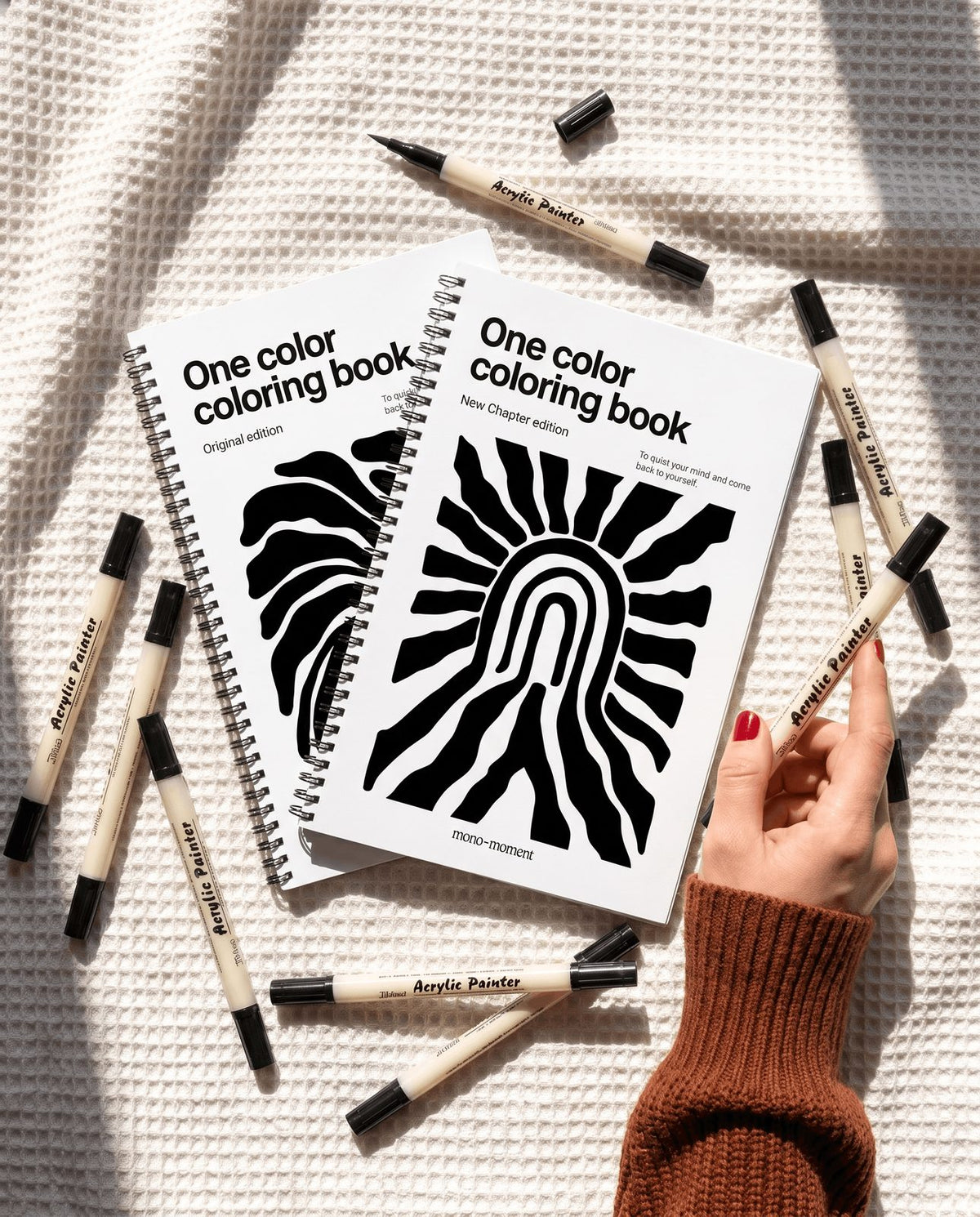
This is exactly where a deliberate, low-input reset earns its place. After a day of stacked input, the most reliable way I have found to bring my own system back under the line is a single, undemanding, repetitive task with no decisions in it. For me that has been the One Color Coloring Book — a single-pen, single-color book where the design is already made and all I do is fill the shapes. After a day of decisions, that absence of choice is the entire point: there is no palette to pick, no picture to plan, nothing to ruin. If you want a wider menu, these low-stimulation activities for adults run on the same principle of one quiet channel, low stakes, no choices.
So what do you actually do about it?
Here is the reframe that changed how I manage all of this: you cannot rewire your sensitivity, but you can raise your effective threshold by protecting the factors that lower it.
That means treating your daily capacity for stimulation like a finite resource — input budgeting — and defending recovery the way you would defend sleep. In practice:
- Protect sleep first. It is the single highest-leverage factor on the entire list.
- Eat and hydrate on a schedule. Do not let hunger silently lower your threshold.
- Reduce constant low-grade input where you can: phone in another room, notifications off, one screen at a time, lights down in the evening.
- Build genuine low-stimulation gaps into the day rather than only collapsing into them at night.
- Make your wind-down require no decisions. Choices are part of the load, so the most effective rituals are boring and identical every time.
That last point is the one that matters most for people who overstimulate easily. My own reset is the same every evening — lamp on, phone in the other room, herbal tea, ten quiet minutes filling shapes in the same book. It is almost aggressively unexciting, and that is precisely why it works: there is nothing in it to process, so my nervous system finally gets to stop.
If you take one thing from all of this, let it be this: getting overstimulated easily is not a character flaw or a failure of willpower. It is a nervous system with a particular threshold, meeting an environment built to exceed it. You are not too sensitive, too fragile, or too much. You are a normal person with a real limit — and once you understand what raises and lowers that limit, you can finally start working with it instead of against it.

The One Color Coloring Book
A single-pen, decision-free coloring book on 160 gsm cream paper — engineered for the wind-down ritual described above.
 Pair it with the 3 Dual Tip Brush Pens — $5 instead of $9.95 in the Book + Pens bundle.