Tests every pen, paper and design she recommends — most evenings around 10:30pm.
Updated September 1, 2026 · 6 min read
In this article · 7 sections
If you've heard the term "monochrome coloring" in passing — maybe in a wellness newsletter, on a TikTok, or from a friend who started doing it before bed — and wondered what specifically distinguishes it from regular adult coloring books, this is the explainer.
Monochrome coloring (also called single-color coloring, one-pen coloring, or decision-free coloring) is a mindfulness practice that strips the adult coloring book format down to its most essential elements: one color, large shapes, no decisions. It's not a new trend exactly — its roots are centuries old — but the modern adult-coloring-book format emerged in the early 2020s as a reaction to the visual overwhelm of mandala-style books that had dominated the previous decade.
This article covers what it is, why it works, who it's for, and how it compares to adjacent practices.
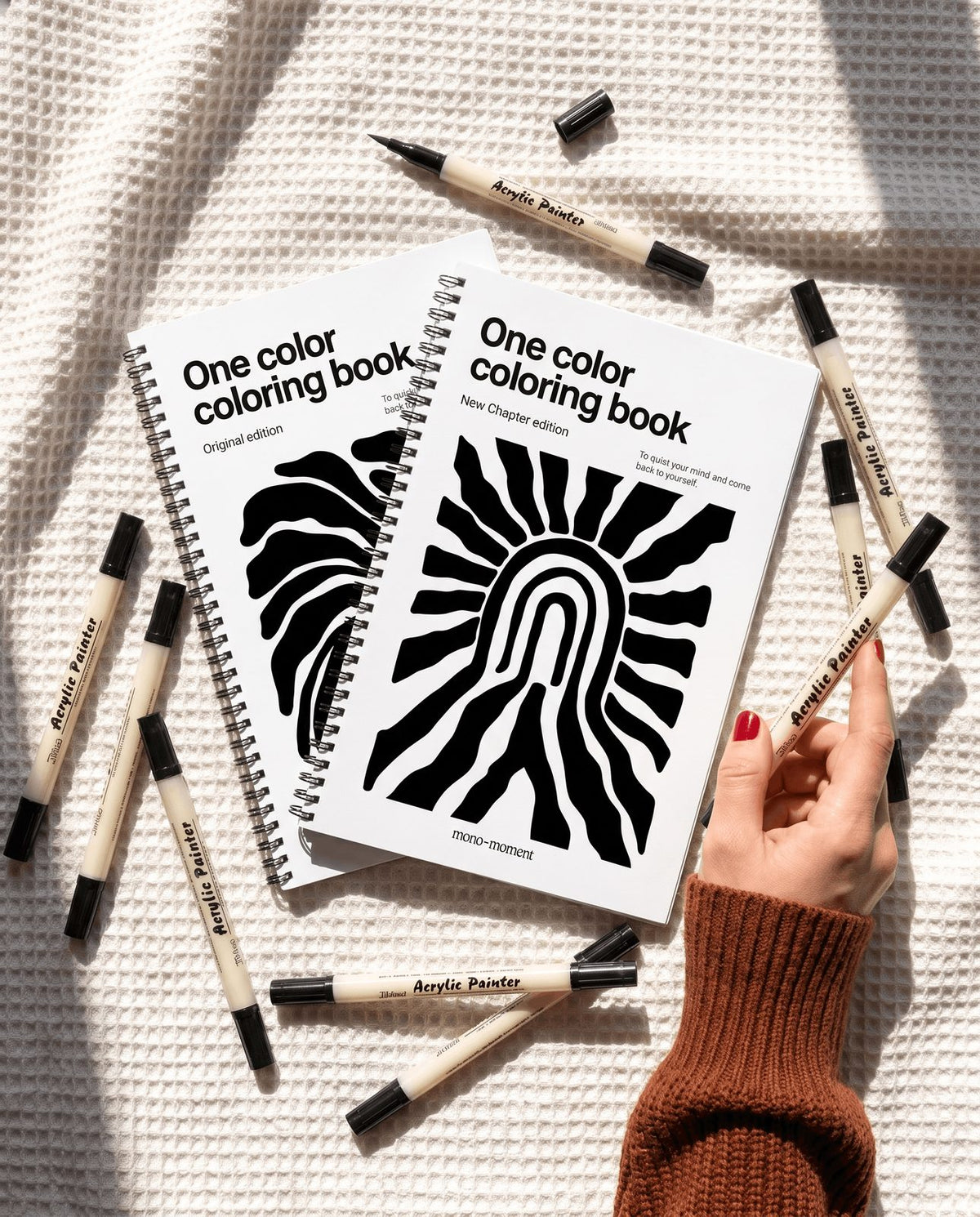
Monochrome coloring is a mindfulness practice in which printed designs are filled with a single color, usually a black brush pen, across large abstract shapes. Three traits set it apart: one color in total, large shapes and no representational subject. With no palette or precision to manage, the act of filling matters more than the result, typically in sessions of 5 to 15 minutes.
The simplest definition
Monochrome coloring is the practice of filling printed designs with a single color — usually a black brush pen — across large abstract shapes, one shape per page.
In the UK, Australia and Canada the same practice is spelled monochrome colouring, and the books are sold as a monochrome colouring book or a one colour colouring book. The spelling changes, the idea does not: bold shapes, one pen, no palette. You can see every edition in our one color coloring books collection.
Three traits make it distinct from traditional adult coloring:
- One color total. No palette, no shade selection, no "what color goes where" decisions.
- Large abstract shapes. Not tiny mandala details, not realistic landscapes — big, organic, often flowing shapes that span most of the page.
- No representational subject. You're not coloring a cat, a sunset, or a Klimt painting. The shape is the shape.
The combined effect: the practice ceases to be a craft (where output matters) and becomes something closer to a rhythmic meditation (where the act of doing matters more than the result).
Why these three constraints change everything

Most adults who try traditional coloring books and quietly quit do so for the same reasons:
- The mandala has 200 tiny shapes per page and they don't know which color goes where.
- They've made a "mistake" (one section is the wrong shade) and the page now feels ruined.
- The intricate detail requires more focus and steady-handedness than a tired evening can summon.
Each of these failure modes is a feature of the traditional format, not a bug. Mandala coloring is built around completion satisfaction (you finished a beautiful detailed page) and color expression (you chose how it looks). Both of those are real benefits, for some people, sometimes.
But for an exhausted adult at 9pm whose decision-making capacity is already depleted (a real and well-studied phenomenon — Vohs et al. (2008) Making Choices Impairs Subsequent Self-Control), the demands of traditional coloring become another thing to do, instead of a relief from doing.
Monochrome coloring removes those demands by design:
- No color decisions. One pen. The decision is pre-made.
- No precision pressure. The shapes are large and abstract — going slightly outside a line doesn't ruin anything.
- No "right" outcome. You can't fail a single-color abstract page.
What's left is the rhythmic motion of filling, the visible progress as the shape darkens, and 5-15 minutes where the brain has nothing to decide and nothing to perform.
This is exactly what a purpose-built one color coloring book is engineered to deliver: one pen, bold shapes, and no palette to choose from, so the practice stays effortless from the very first page.
The science underneath
Three threads of research converge on why monochrome coloring works:
1. Decision fatigue. Vohs et al. (2008) and subsequent ego-depletion research demonstrated that repeated decision-making (even trivial decisions) progressively impairs willpower and self-control. By 7pm, most adults have used most of their decision-making capacity. Activities that demand more decisions (color matching) feel taxing; activities that demand none (monochrome coloring) feel like rest.
2. Cortisol reduction during art-making. Kaimal et al. (2016) found a measurable 75% drop in cortisol after just 45 minutes of art-making — regardless of the participant's artistic skill level. The mechanism appears to be the rhythmic, low-stakes engagement of the hands, not the artistic outcome. Monochrome coloring is structurally a low-stakes art-making activity, which suggests similar cortisol effects.
3. Structured flow. Csikszentmihalyi's flow research (1990 onwards) describes a state of optimal absorption that occurs when a task is engaging enough to crowd out rumination but not so demanding that it generates new tension. Single-color coloring sits squarely in the structured-flow window for many adults — engaged, but not strained.
For a deeper dive on decision fatigue specifically and how single-color formats interrupt it, see our decision-free coloring guide.
Where it actually comes from

The modern adult coloring book version of monochrome coloring is recent (early 2020s onwards), but the underlying practice is centuries old.
Japanese sumi-e (墨絵) is the practice of single-ink brush painting — black ink, white paper, single strokes. It's a meditative discipline taught in Zen Buddhist contexts going back to the 12th century. The constraint of one color and one brush is intentional: it forces presence and removes the cognitive escape route of "deciding what to do next."
Ensō (円相) is the Zen practice of drawing a single circle in one breath, in one stroke. The result is read by Zen practitioners as a snapshot of the artist's state of mind in that moment — calm or scattered, focused or rushed. Monochrome coloring inherits something of this lineage: the act of filling a single shape with a single color is a small, secular cousin of ensō.
Adult coloring book history. The modern adult coloring book trend started around 2012-2013 (Johanna Basford's Secret Garden in 2013 sold over 1.4 million copies and launched the category). Mandala and intricate-pattern books dominated until roughly 2018-2020. Monochrome and decision-free formats emerged as a deliberate reaction to that complexity.
Who monochrome coloring is for
The practice resonates particularly well with:
- Overthinkers. Adults whose evening is dominated by recursive thinking. The activity removes the thinking.
- Highly sensitive people (HSPs). Lower stimulation = better fit for HSP nervous systems. (See our calming activities for HSPs guide.)
- Adults with ADHD or executive function fatigue. The reduced decision-load and shorter session length (5-15 min) is more compatible with ADHD attention rhythms than long-form mandala work.
- Wind-down rituals. Cream paper + warm bedside lamp + monochrome book matches the low-light, low-input requirements of a sleep-friendly evening practice.
- Workplace lunch breaks. Small enough to live in a desk drawer, fast enough to fit a real lunch break.
It's not ideal for:
- People who specifically want a finished representational image to frame.
- People who genuinely enjoy color choice and find it energizing rather than depleting.
- Children younger than 5-6, who often prefer brighter, more representational subjects.
How to actually try it
If the practice sounds compatible with what you need:
- Get a purpose-built book. Not all "abstract coloring books" are designed for monochrome practice — many still expect a multi-color palette. Look for spiral-bound, single-sided, large-shape, no-color-suggestion books. The Mono Moment Monochrome Coloring Book is built specifically for this — 50+ pages, single black brush pen included, 160gsm cream paper, abstract designs.
- Get one black brush pen. Not a fineliner (too thin for filling). A 3-6mm brush tip pen with archival ink. (The Mono Moment book ships with one.)
- Pick a 5-15 minute window. Evening before sleep is the canonical use, but morning and lunch break also work. (See our morning anxiety routine guide and lunch break stress relief guide.)
- Don't overthink the first page. The first page often feels weird — you'll be reaching for color choices that aren't there. By the third page the practice settles in.
The goal isn't to be "good at" monochrome coloring. The goal is to give an over-engaged brain 10 minutes of nothing to decide.
Sources & further reading
- Vohs, K. D. et al. (2008) Making Choices Impairs Subsequent Self-Control, Journal of Personality and Social Psychology.
- Kaimal, G., Ray, K., & Muniz, J. (2016) Reduction of Cortisol Levels and Participants' Responses Following Art Making, Art Therapy.
- Csikszentmihalyi, M. (1990) Flow: The Psychology of Optimal Experience. Wikipedia overview of flow.
- Stuckey, H. L., & Nobel, J. (2010) The Connection Between Art, Healing, and Public Health, American Journal of Public Health.
- Wikipedia: Sumi-e (Ink wash painting) — for the historical Japanese tradition.
- Wikipedia: Ensō — for the Zen single-circle practice.

The One Color Coloring Book
65+ bold designs, one single color, zero decisions — on 160 gsm paper with a lay-flat spiral, engineered for the wind-down ritual described above.
 Pair it with the 3 Dual Tip Brush Pens — $5 instead of $9.95 in the Book + Pens bundle.
Frequently asked questions
What's the difference between monochrome coloring and regular adult coloring?
Do you have to use black? Can I use a different color?
Is monochrome coloring just for adults?
How is monochrome coloring different from paint by numbers?
Where did monochrome coloring originate?
Know someone who needs a quieter evening? Pin it · Share on Facebook ·
↑