In this article · 5 sections
TL;DR. The best coloring book for relaxation is not the most intricate one, it is the simplest. Bold shapes, few decisions and good paper let your nervous system actually settle, while dense detailed pages quietly add pressure. Look for large simple designs, low or no color choices, and thick bleed-free paper. A single-color, one-pen approach removes the last bit of friction, which is why it calms you faster and keeps you there longer.
If you have ever bought a coloring book to unwind and ended up feeling more wound up, you are not imagining it, and it is not a personal failing. It is usually the book.
I have been coloring almost every evening for a couple of years now, first as a way to get off my phone before bed and then, once I noticed how much calmer it made me, as a deliberate ritual. Along the way I bought a lot of coloring books. Most of them were beautiful. A surprising number of them were also, quietly, stressful to use. The pages were so packed with tiny detail that finishing one felt like a project, the paper let my pens bleed through, and every page started with the same small decision fatigue: which of these forty colors goes where?
This guide is what I wish someone had told me before all those purchases. What actually makes a coloring book relaxing, why the intricate ones so often backfire, what to look for when you buy, and why, for pure relaxation, a simple single-color book is hard to beat.
The best coloring book for relaxation is a simple one, because the calm comes from low-effort, repetitive, low-decision coloring. Look for bold shapes over dense detail, few or no color choices, heavier paper around 160 gsm and single-sided pages. A one color coloring book, completed with a single pen, removes the choosing that many people find most stressful.
Why coloring relaxes you in the first place
Before we talk about which book to buy, it helps to understand why coloring works at all, because that is what tells you which features matter.
Coloring relaxes you by giving your mind one gentle, repetitive thing to do. When your attention is occupied by a simple motion, filling a shape, following an outline, it has less room to spin on the stressful thoughts running in the background. Cleveland Clinic psychologist Scott Bea puts it plainly in the clinic's explainer on why adult coloring relaxes your brain: coloring "takes us outside ourselves" in the same way mowing the lawn, knitting or a Sunday drive can, refocusing attention modestly and reducing the self-critical inner chatter that keeps us tense.
There is measurable physiology underneath the good feeling, too. Making art has been shown to lower cortisol, the body's main stress hormone. In a well-known Drexel University study, researchers found that after just 45 minutes of art-making, cortisol levels dropped in 75 percent of participants, and the effect held regardless of whether people considered themselves artistic. You do not need talent to get the calming benefit.
And coloring specifically has been tested for anxiety. In a randomized controlled study by Koo, Chen and Yeh, published in Evidence-Based Complementary and Alternative Medicine, a single 20-minute session of structured coloring significantly reduced anxiety compared with a reading control group. Twenty minutes. That is the entire case for keeping a coloring book on the nightstand.
The reason all of this matters for choosing a book is simple: the relaxation comes from the low-effort, repetitive, low-decision nature of the activity. So anything a book does to make coloring more effortful, more detailed, more decision-heavy, works directly against the thing you bought it for.
Why intricate coloring books often backfire

Walk down the coloring aisle and the loudest books are the intricate ones: dense mandalas, hyper-detailed gardens, pages with a thousand tiny cells. They photograph beautifully and they sell well. But for relaxation specifically, they often do the opposite of what you want.
Here is the trap. An intricate page is essentially a long list of small tasks and small decisions. Which color goes in this sliver? And the next one? And the two hundred after that? Every one of those micro-choices spends a little of the same mental energy that stress already drains. Instead of switching your thinking mind off, a busy page keeps it switched on, just pointed at coloring logistics rather than your worries. The activity that was supposed to empty your head ends up refilling it.
There is a completion problem, too. A detailed page can take hours, so it turns into an unfinished obligation, one more thing hanging over you. And the fine motor precision required, staying inside minuscule lines, adds a low hum of tension in your hand and shoulders that is the enemy of winding down.
None of this means intricate books are bad. If the detail itself is what you find meditative, wonderful, keep going. But if your goal is relaxation and you have felt oddly frustrated by your coloring books, the detail is very likely why. The fix is not to try harder. It is to go simpler. If you want to go deeper on this, I have written more about coloring for stress relief and how the mechanism actually works.
What to look for in a relaxing coloring book
When I buy a coloring book now, I evaluate it against four things, in this order. Get these right and the book will actually deliver the calm.
1. Bold, simple shapes over dense detail. Large, clear areas to fill are the single most important feature. They let you settle into a smooth, repetitive motion instead of hunching over tiny cells. Big shapes are forgiving, fast to complete, and far more meditative. This is the feature most buyers underrate and most regret ignoring.
2. Low or no color decisions. The fewer choices a book forces on you, the faster you relax. A page that works beautifully with one or two colors is far more calming than a page that demands a full palette. If choosing colors is a source of stress for you, and for a lot of people it is the exact moment the tension creeps back, look for a book built to be completed with a single pen.
3. Good paper. This is the detail people forget until it ruins a page. Thin paper means bleed-through, ghosting on the next page, and the small anxiety of wondering whether your marker will wreck the design. Look for heavier stock, ideally around 160 gsm, which holds pens and even light marker work without bleeding. Thick, quality paper turns coloring from a gamble into a genuinely pleasant tactile experience. I go deeper on this in my guide to relaxing coloring for adults.
4. Single-sided pages. A small thing that matters a lot. Single-sided printing means you never have to worry about a design bleeding onto the artwork behind it, and you can tear out a finished page to keep or display. It removes a background worry, and removing worries is the whole game.
Notice what these four features have in common: every one of them is about removing friction and decisions, not adding beauty or complexity. That is the north star for a relaxing book. The more the book asks of you, the less it relaxes you.
Why single-color coloring is the most relaxing of all

If the goal is to strip away decisions, there is a natural endpoint: a book you complete with one pen, in one color, on purpose.
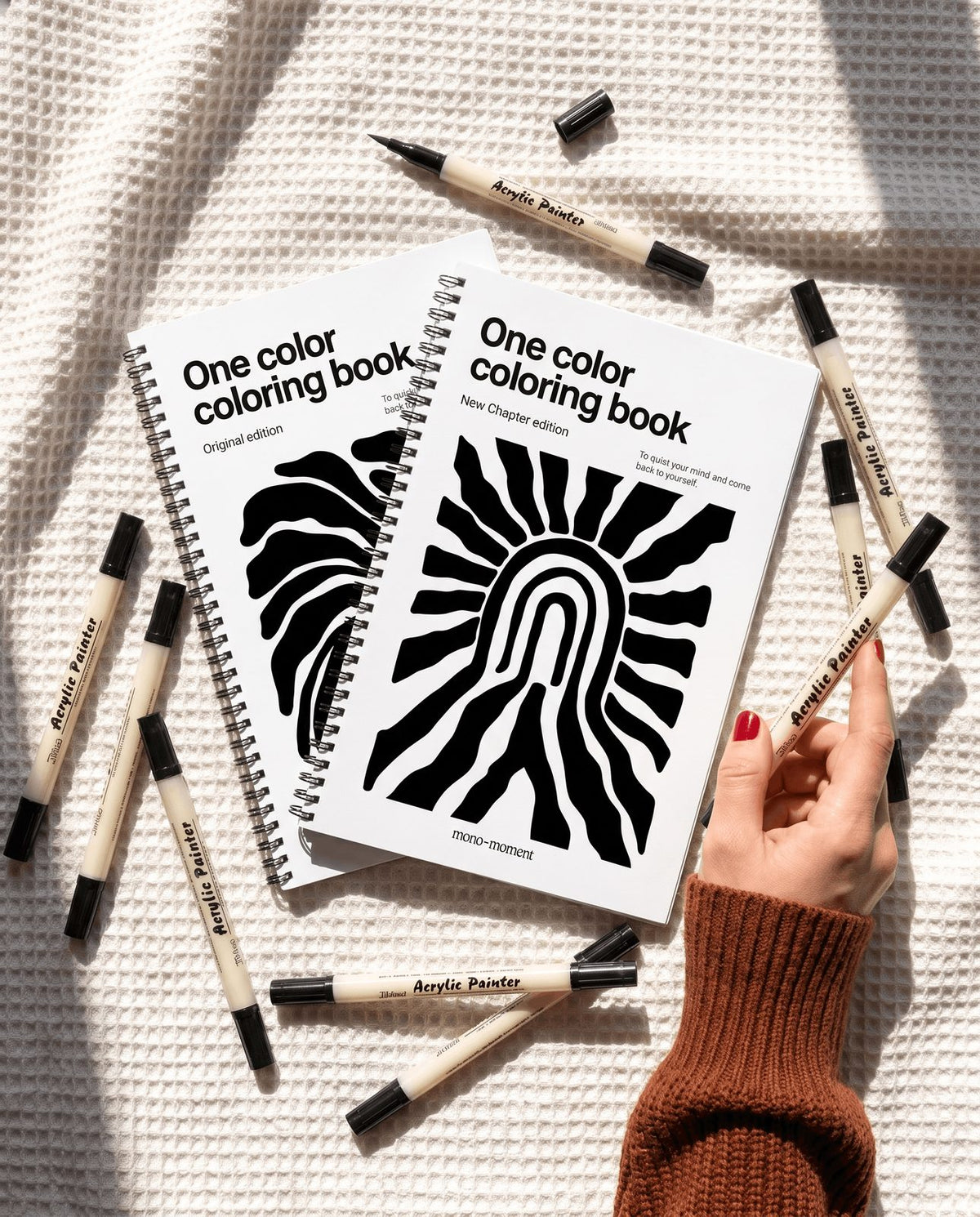
This is the idea behind the coloring book for relaxation I use myself, the One Color Coloring Book. It is built around a single insight I only understood after years of coloring: the most stressful part of coloring is not the coloring. It is choosing. Which color, which combination, will these two clash, did I ruin it. Take that away and what is left is pure, unhurried, meditative filling-in.
Monochrome coloring, sometimes called single-color or one-pen coloring, works because it embraces constraint instead of fighting it. You pick one color, or use the pen the book is designed around, and you simply fill the bold shapes. There is nothing to plan, nothing to coordinate, and, crucially, nothing to get wrong. That last part matters more than it sounds. A huge amount of the low-grade stress people feel while coloring is the quiet fear of ruining the page. When there are no color decisions, that fear evaporates, and you can finally drop all the way into the calm. If the concept is new to you, this short explainer on what monochrome coloring is walks through it.
The result is bold and modern rather than fussy, more like a piece of graphic art than a busy pattern, which is a big part of why finished pages actually feel satisfying to look at. And because the shapes are large and the palette is settled, sessions are short and low-effort. You get the full 20-minute anxiety-reducing benefit the research describes without the multi-hour commitment an intricate page demands.
I am not going to pretend a single book is the only path to calm. But if you have bounced off relaxation coloring before, the single-color approach removes the exact features, dense detail and endless color choices, that were most likely getting in your way.
How to use a coloring book to actually relax (a simple ritual)
A relaxing book helps most inside a small, repeatable ritual. This is the wind-down I use almost every night, and it takes about fifteen minutes.
Set the scene first. Lower the lights, silence your phone and put it in another room, and make a warm drink. You are lowering the sensory volume before you start, which does half the work.
Slow your breathing for a minute. Before you pick up the pen, take a few slow breaths with a longer exhale than inhale. The NIH's health center notes that simple breathing and relaxation techniques help trigger the body's relaxation response, slower breathing, a lower heart rate. It primes you to settle faster once you start coloring.
Color one shape at a time, with no goal. Do not aim to finish the page. Just fill one shape, then the next, and let the motion be the point. If your mind wanders to your to-do list, gently bring it back to the edge of the shape you are filling. That returning is the practice.
Stop while it still feels good. Ten to twenty minutes is plenty. You are not trying to complete a masterpiece, you are trying to change your state, and the research suggests that even a short session does exactly that.
Curious to try the ritual before you order anything? Download our free printable coloring pages and print a few single-color designs to keep by the bed.
The magic is not in any single step, it is in the fact that all of them point the same direction: less input, fewer decisions, one gentle repetitive task. A well-chosen relaxing coloring book is simply the easiest on-ramp to that state I have found. Keep the single-pen coloring book on the nightstand where you can see it, and the ritual gets easier to reach for on the exact evenings you need it most.
If you take one thing from all of this, let it be this: when you are shopping for relaxation, simple beats intricate, every time. The book that asks the least of you will give you the most calm back.

The One Color Coloring Book
A single-pen, decision-free coloring book on 160 gsm cream paper — engineered for the wind-down ritual described above.
 Pair it with the 3 Dual Tip Brush Pens — $5 instead of $9.95 in the Book + Pens bundle.
Sources & further reading
- Cleveland Clinic — 3 Reasons Adult Coloring Can Actually Relax Your Brain
- Drexel University — At Any Skill Level, Making Art Reduces Stress Hormones (Kaimal, 2016)
- Koo, Chen & Yeh (2020), Evidence-Based Complementary & Alternative Medicine — Coloring activities for anxiety reduction (RCT)
- NIH / NCCIH — Relaxation Techniques: What You Need To Know