About the author
Published December 28, 2025 · Last reviewed April 26, 2026 · 20 min read
In this article · 6 sections
You know the feeling. The house is quiet, the lights are out, but your mind is running a marathon. To stop this nightly spiral, you need something simple and completely decision-free that short-circuits your brain’s worry loop.
The trick is to give your mind a gentle task—just enough to distract it from racing thoughts without causing more stress. This is exactly why a structured, low-effort activity like monochrome coloring works so well. It shifts your focus from abstract, spiraling anxieties to a concrete, calming action, helping your brain ease into a state of rest. A product like the Mono Moment One Color Coloring Book is specifically designed for this purpose.
Why Your Brain Spirals at Night and What to Do Right Now
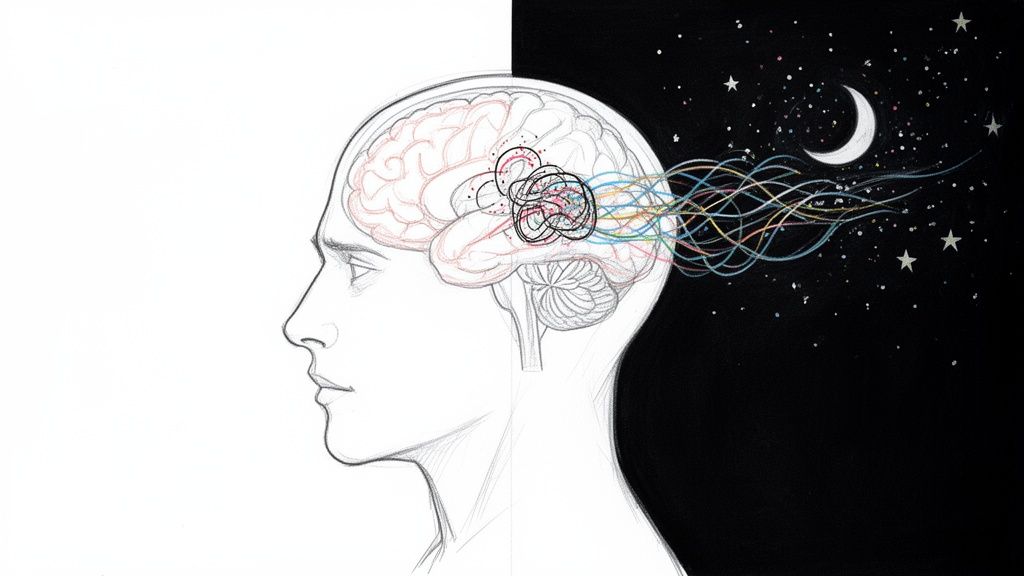
If your mind kicks into high gear the second your head hits the pillow, you're in good company. That frustrating late-night brain buzz isn't a character flaw—it’s actually a predictable pattern hardwired into our biology.
As your day winds down, the logical, problem-solving part of your brain (the prefrontal cortex) starts to power down for the night. Simultaneously, your brain’s emotional center and alarm system, the amygdala, gets a little louder. This shift creates the perfect storm for worry and rumination to creep in and take over.
All the stress and decisions you made during the day just add fuel to this fire. Your brain is tired from making choices, so its ability to filter out intrusive thoughts weakens. This is precisely why a minor worry can balloon into a full-blown crisis at 3 a.m.
Interrupting the Cycle with Mindful Action
But you don't have to just lie there and let it happen. The most effective way to reclaim your peace is to interrupt the pattern with a structured, engaging, and completely decision-free activity. This is where having the right tool can make all the difference.
We designed the Mono Moment One Color Coloring Book for this exact moment. It’s built on a unique principle that removes the single biggest obstacle to creative relaxation: the stress of choosing colors.
The goal isn't to create a masterpiece. It's to give your overactive mind a gentle, focused job. By engaging in the simple, repetitive motion of coloring with a single pen, like one of our smooth Mono Moment Brush Pens, you redirect your mental energy away from the spiral of "what ifs" and anchor it firmly in the present moment.
This intentional design engages your mind just enough to quiet the amygdala's alarms without adding any new mental strain. It’s a simple, evidence-backed first step you can take tonight.
Your Immediate Action Plan to Stop Nighttime Overthinking
When you're caught in the middle of a thought spiral, you need a quick, reliable game plan. Here are the three most effective actions you can take the moment you feel your mind starting to race.
| Action | Why It Works | Quick Tip |
|---|---|---|
| Monochrome Coloring | Shifts focus from abstract worry to a concrete, sensory task. The repetitive motion is meditative and calms the nervous system. | Use a single color, like in the Mono Moment Coloring Book, to eliminate decision fatigue. Just focus on the feeling of the pen on paper. |
| Controlled Breathing | Directly activates the parasympathetic nervous system, signaling to your body that it's safe to relax. Slows your heart rate. | Try the 4-7-8 technique: Inhale for 4 seconds, hold for 7, and exhale slowly for 8. Repeat 3-5 times. |
| "Brain Dump" Journaling | Gets swirling thoughts out of your head and onto paper, which helps you see them more objectively and reduces their power. | Use a dedicated notebook, like a Mono Moment Journal, to capture everything that's bothering you in a stream-of-consciousness style for 5-10 minutes. |
These techniques are your go-to toolkit for immediate relief. Pick one that feels right and commit to it for just a few minutes.
The Science Behind the Calm
This isn't just a distraction tactic; it's about actively calming your nervous system. Peer-reviewed research shows that mindful coloring can calm the amygdala, reducing anxiety by up to 30% in short sessions.
And the results speak for themselves. Thousands of our users report falling asleep faster, with 85% noticing less overthinking after just one week of making the Mono Moment One Color Coloring Book part of their nightly routine. You can learn more about the global impact of mental health and the growing need for simple, accessible wellness tools.
The Mono Moment Coloring Book is more than just paper and ink. It's a clear invitation to step away from the noise and find a moment of stillness. By focusing on the simple act of filling in patterns with a single pen, you create a tangible barrier between you and your racing thoughts, giving your mind the permission it finally needs to rest.
Build Your Decision-Free Wind-Down Routine
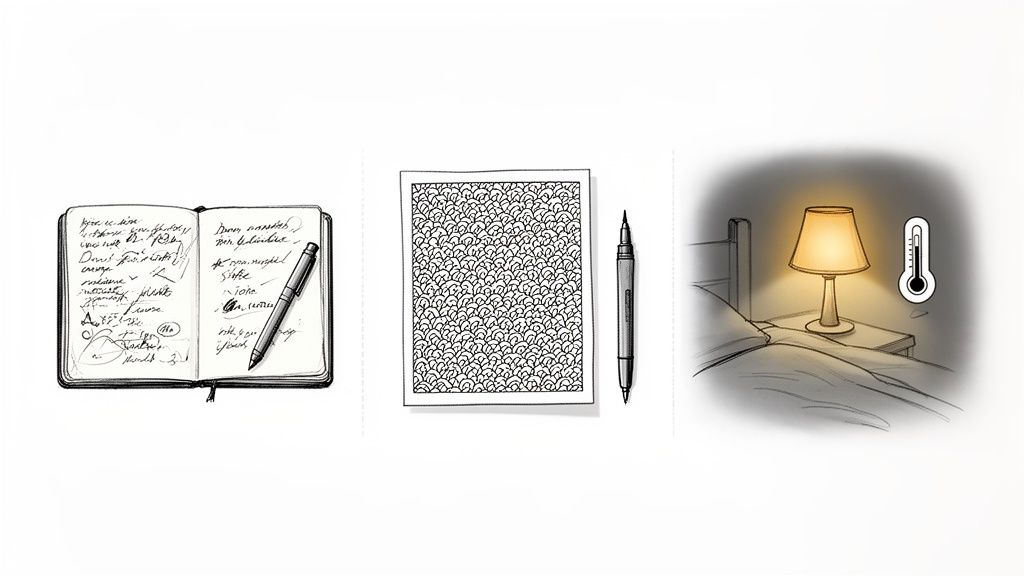
When your mind is racing, generic advice like "read a book" or "just meditate" can feel completely useless. Honestly, for a truly overactive brain, those suggestions can feel like just one more thing to fail at. You need something different—a predictable, comforting ritual that sends a clear signal to your mind and body: the day is done, and it’s time for rest.
A powerful wind-down routine isn't about piling more tasks onto your day. It's about systematically stripping away the noise and the stress. The secret sauce? Making it completely decision-free. The very last thing your exhausted brain needs is another choice, which is why this 30-minute plan is designed to be automatic, soothing, and incredibly effective at quieting the mental chatter.
Think of it as a gentle off-ramp from the mental superhighway you've been on all day. It’s your dedicated space to process, release, and finally transition into a state of calm.
Minutes 0-10: The Brain Dump
First things first, you have to get all those thoughts out of your head. When worries are just bouncing around in there, they feel huge and urgent. But the moment you put them on paper, they immediately lose some of their power. You create distance.
This isn’t about writing beautiful prose; it's a raw "brain dump." For ten minutes, grab a Mono Moment Journal or notebook and just write down everything swirling around in your mind. Don't judge it, don't edit it. No thought is too small or too silly.
If you're staring at a blank page, try these prompts to get started:
- The Nagging To-Do List: What unfinished tasks are bugging you? Get them on paper so your brain doesn't have to keep reminding you all night.
- The "What Ifs": What worst-case scenarios are playing on a loop? Write them down, even the ones that feel totally irrational.
- Replayed Conversations: Are you stuck on a conversation from earlier? Or stressing about one you need to have? Get it all out.
This simple act tells your brain, "Okay, these thoughts are captured. We can deal with them tomorrow." You're officially giving yourself permission to let go for the night.
Minutes 10-25: A Mono Moment of Mindful Coloring
Now that you've cleared out the mental clutter, it's time to gently occupy your mind with a focused, calming activity. This is the heart of the routine—a dedicated "Mono Moment" with our One Color Coloring Book. We designed this book for this exact purpose: to be the perfect, zero-stress bridge between a hectic day and a peaceful night.
Here’s the problem with a lot of "relaxing" hobbies: they secretly harbor decisions. Which color should I use? Am I doing this right? Will this even look good? These little questions can actually feed the anxiety and perfectionism you’re trying to escape.
Our monochrome patterns are the antidote. They eliminate decision fatigue. With just one pen, you bypass the stress of choice and can sink into a meditative flow. The focus isn't on the final product; it's on the simple, satisfying feeling of the pen gliding across the paper.
The experience is meant to be tactile and grounding. The premium 160gsm paper in every Mono Moment product is thick and smooth, so there's no bleed-through, and our Brush Pens just glide effortlessly. It's more than just coloring—it’s a sensory anchor that pulls you out of your head and plants you firmly in the present moment. If you want to explore more ways to ground yourself, check out our guide on quick mindfulness activities for adults.
We also created the illustrations to be completable in this 15-minute window. This is crucial. It means you can actually finish a pattern and feel that little spark of accomplishment, instead of leaving another half-done project looming. It’s a small, achievable win that builds a sense of calm control right before you get into bed.
Minutes 25-30: Prepare Your Sleep Sanctuary
The final five minutes are all about setting the stage. Your physical environment plays a massive role in signaling to your brain that it’s time to shut down. These small tweaks can make a huge difference in how easily you fall—and stay—asleep.
Your Final Five-Minute Checklist:
- Dim the Lights: Harsh overhead lights kill melatonin, the hormone you need for sleep. Switch to a soft, warm lamp to create a cozy, calming vibe.
- Cool It Down: A cooler room is scientifically better for sleep. Experts recommend somewhere between 60-67 degrees Fahrenheit (15-19 degrees Celsius).
- Cut the Noise: If you're in a loud environment, a white noise machine or simple earplugs can create a consistent, peaceful soundscape that won't be interrupted.
- Put Your Phone to Bed: The blue light from your phone is a notorious sleep disruptor. Plug it in across the room and make a pact with yourself not to touch it again until morning.
This 30-minute sequence is more than a list of things to do; it's a powerful anchor. By consistently walking through these decision-free steps, you're training your brain to recognize the shift from "on" to "off." You're teaching it how to let go of the day, stop the overthinking, and finally get the deep, restorative rest you deserve.
Master Your Thoughts with Proven Cognitive Techniques
A calming wind-down routine is your secret weapon for immediate, in-the-moment relief. But if you want to win the war against nighttime overthinking for good, you need to go deeper. Lasting change comes from reshaping the very thought patterns that send your mind spiraling in the first place.
Think of it this way: distraction is a temporary fix, but building new mental habits is the permanent solution.
Here, we’ll get into a few powerful—yet surprisingly simple—cognitive techniques to help you regain control. These methods, inspired by proven therapeutic approaches, are the mental tools that complement the physical calm you create with your Mono Moment One Color Coloring Book.
Instead of just putting a lid on your thoughts for one night, these strategies teach you how to manage them around the clock. It’s time to get back in the driver's seat.
Schedule a Time to Worry
I know this sounds completely backward. Why would you schedule time to feel anxious? But one of the most effective ways to stop your brain from ambushing you at 2 a.m. is to give your worries a designated time and place to live.
This is called “Scheduled Worry Time.”
It’s simple. Just set aside a specific 15-minute window earlier in the day—late afternoon often works well—to intentionally think through your anxieties. During this slot, you have full permission to worry about anything and everything on your mind.
The magic here is in the containment. When a worry pops into your head as you're trying to sleep, you can gently tell yourself, "Not now. I'll deal with this during my worry time tomorrow." You're not dismissing the thought; you're just postponing it. This simple act trains your brain to respect boundaries.
By creating a container for your worries, you teach your brain that it doesn't need to ambush you when you're most vulnerable. You’re reassuring your mind that these issues will be addressed, just not at the expense of your sleep.
This practice dials down the urgency that fuels so much nighttime anxiety. Over time, your brain learns a new rule: bedtime is for rest, and worry time is for... well, worrying.
Learn to Reframe Your Thoughts
Cognitive reframing is a fancy term for a simple idea: changing how you look at a situation to change how you feel about it. It’s all about challenging the automatic negative thoughts that kickstart the overthinking spiral.
When your mind is racing, it loves to jump straight to the worst-case scenario. A thought like, "What if I completely bomb my presentation tomorrow?" can quickly morph into a full-blown catastrophe involving job loss and epic failure. Reframing is how you interrupt that pattern.
Instead of letting that thought run wild, you stop and challenge it. You reframe it.
- Original Thought: "What if I fail the presentation?"
- Reframed Thought: "Okay, what's one small thing I can do right now to feel more prepared?" or "I've handled tough presentations before. What worked for me then?"
See the difference? This tiny shift moves you from passive, helpless worry to active, empowered problem-solving. You aren’t ignoring the fear—you’re just steering it down a more productive path. We dive into more strategies like this in our guide on how to calm an anxious mind.
Putting It All Together
These mental techniques are powerful on their own, but they become unstoppable when you pair them with your physical wind-down routine. Combining mind and body strategies creates a robust defense against nighttime overthinking.
Here’s how it all fits together in a typical day:
- Scheduled Worry Time (Afternoon): First, you intentionally deal with your anxieties earlier in the day. This drastically reduces the "worry load" you're carrying by bedtime.
- Brain Dump (Evening Routine): Next, you jot down any leftover thoughts, physically getting them out of your head before you even start to relax.
- Monochrome Coloring (Evening Routine): Then, you settle in with your Mono Moment book for a mindful, decision-free activity that quiets your mind and grounds you in the present. This gives your brain a much-needed break from all that hard work.
- Cognitive Reframing (As Needed): Finally, if a rogue anxious thought still manages to sneak in as you lie in bed, you have the tool to meet it head-on, challenging it before it can spiral out of control.
When you adopt these practices, you're doing more than just coping with overthinking—you're fundamentally changing your relationship with your own thoughts. You’re building a toolkit that empowers you to guide your mind toward peace, making restful nights the rule, not the exception.
Journaling Prompts That Actually Calm a Racing Mind
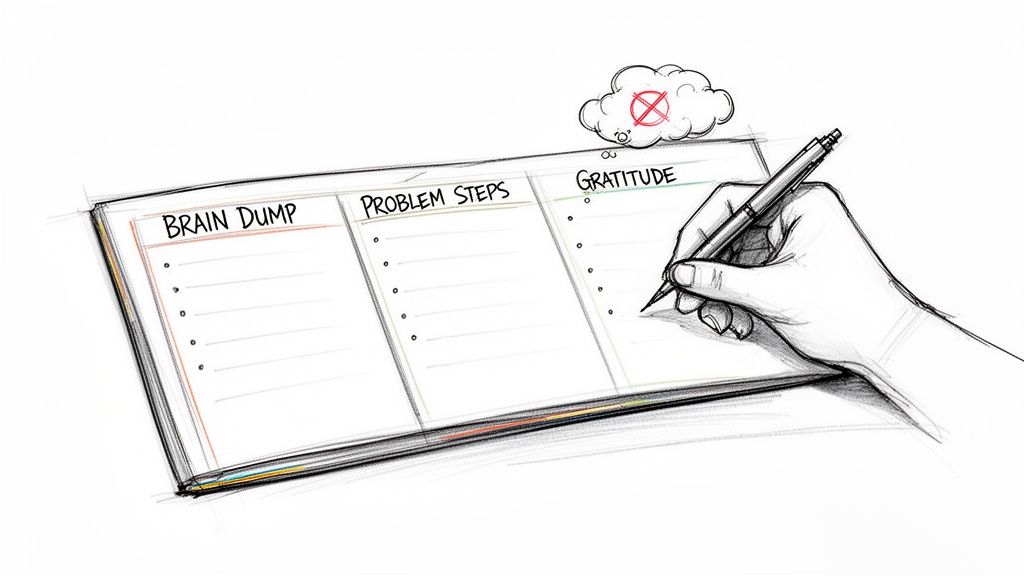
Let's be honest: when your mind is spinning, the last thing you want to hear is "just write your feelings down." That vague advice can feel like a trap, forcing you to stare at a blank page and marinate in the very anxiety you're trying to escape. A generic diary entry often just amplifies the noise.
To make journaling work for overthinking, you need a strategy. The goal isn't just to write, it's to systematically get the thoughts out of your head, give them some structure, and shrink them down to size. This isn’t about deep emotional excavation at midnight; it’s about mental decluttering.
First, The Uncensored Brain Dump
Before you can organize the chaos, you have to get it all out on the table. This is the simplest, most liberating first step.
Set a timer for 5-10 minutes and just write. Pour out every single thing on your mind without any filter. Using a high-quality journal, like our Mono Moment Journal, can make this process feel more intentional. Don't worry about grammar, spelling, or if it even makes sense. The point is to empty your brain's cache onto the page, creating a clear space for calm to settle in.
Next, Pivot to Gratitude
Once the mental clutter is out, you need to deliberately shift your focus. It’s not about ignoring your worries; it's about rebalancing the scales. Research has shown time and again that practicing gratitude yanks your attention away from negative feedback loops and roots you in the positive.
Skip the generic lists and get specific with prompts like these:
- What was one small, simple pleasure I experienced today? (Think: the taste of your morning coffee, a song you loved on the radio, a moment of sunshine on your face.)
- Who is one person who made today a little better, and how?
- What is one thing about my body I can appreciate right now? (Maybe its ability to rest, or its strength that carried you through the day.)
These questions force your brain to scan for the good stuff, creating a powerful counterbalance to the anxieties you just dumped onto the page.
By focusing on what is present and positive, you actively disrupt the brain's tendency to spiral into future-based "what if" scenarios. It’s a gentle but powerful way to retrain your attention and anchor yourself in a more peaceful reality.
Tame Your Worries with Problem-Solving Prompts
For those big, sticky anxieties that just won't let go, you need to switch from worrier to strategist. This framework takes a massive, overwhelming thought and breaks it down into small, manageable pieces, putting you back in control.
Pick the one worry that's buzzing the loudest. Then, answer these questions in your journal:
- What is the problem in one single, clear sentence? (Forcing yourself to be concise strips away the drama.)
- What's the absolute worst-case scenario? (Seriously, write it down. Seeing it in black and white often reveals how unlikely or survivable it really is.)
- What is one tiny, practical step I could take tomorrow to address this? (The key is focusing on the very next action, not solving the entire thing at once.)
This approach turns your journal into a powerful tool. You stop being a passive victim of your thoughts and become an active problem-solver. It’s a signal to your brain that a plan is in place, giving it the permission it needs to finally switch off.
Once you’ve put your thoughts on paper, you can transition into a completely different state of mind. Pairing this structured journaling with a calming, decision-free activity like our Mono Moment One Color Coloring Book is the ultimate one-two punch for a quiet mind. You clarify, then you calm. This simple sequence is a proven path to more peaceful nights.
Make Your Bedroom a True Sleep Sanctuary

Think of it this way: all the mental techniques and routines we've discussed are the engine for calming your mind. But your bedroom? That's the track they run on. If your environment is working against you, it’s like trying to find quiet in the middle of a construction zone.
Your surroundings can either feed your anxiety or become your strongest ally in the quest for calm. Creating a real sleep sanctuary is about more than just fresh sheets; it's about intentionally designing a space that sends your brain a clear, consistent signal: it’s time to power down.
Embrace the Darkness
Light is the single most powerful cue controlling your internal clock. Even a sliver of light—especially the blue light from screens—can fool your brain into thinking it's still daytime, slamming the brakes on melatonin, the very hormone you need to feel sleepy.
About an hour before you plan to sleep, start your mission: systematically eliminate every source of blue light. This means putting your phone, tablet, and laptop to bed long before you get there. Ditch the endless scroll and transition to something analog that actually encourages rest, like spending fifteen minutes with your Mono Moment One Color Coloring Book.
Find Your Cool Spot
Ever noticed how hard it is to drift off when you feel even a little too warm? There's a biological reason for that. Your body’s core temperature has to drop slightly to initiate and maintain deep sleep, and a warm room actively works against that process.
Most sleep experts agree that the sweet spot is somewhere between 60 and 67 degrees Fahrenheit (15 to 19 Celsius). It might feel a bit cool at first, but this temperature gives your body the helping hand it needs to achieve that crucial temperature dip for restorative rest. If your feet get cold, a pair of socks is an easy fix that won't overheat your core.
Creating a cool, dark, and quiet environment isn't just about comfort; it's a non-negotiable step in managing your body's stress response. A calm external space reduces cortisol spikes and makes it significantly easier to achieve internal peace.
Getting your environment right is one of the most direct ways to manage your stress hormones. If you're curious to learn more, you can dive deeper with our guide on how to reduce cortisol levels naturally.
Build a Wall of Sound
Just as light can sabotage sleep, so can sound. A sudden noise—a car alarm, a neighbor's door slamming—can instantly jolt you out of a peaceful state and kickstart the mental hamster wheel. The goal is to create a consistent, predictable soundscape that masks those jarring interruptions.
Here are a few options to build your ideal sound environment:
- White Noise: A simple white noise machine or a phone app can create a blanket of sound that effectively blocks out disruptive noises. It’s like a privacy shield for your ears.
- Nature Sounds: The gentle rhythm of rain, rolling waves, or a soft breeze can be incredibly soothing, helping to transport your mind far away from the day's worries.
- Guided Meditations: Sleep-specific guided meditations are fantastic for gently redirecting your focus from anxious thoughts to your breath and body, easing you into slumber.
When you deliberately tune your bedroom for sleep, you start removing the environmental triggers that feed nighttime anxiety. This sets the perfect stage for your wind-down routine and mental strategies to truly work their magic, paving the way for peaceful nights to become your new normal.
Got Questions? Let's Talk It Through.
As you start to put these ideas into practice, you're bound to have questions pop up. That's a good thing—it means you're engaged in the process. I've been there, and I've heard from countless others who have asked the very same things.
Let's get into some of the most common questions that come up when you’re learning to quiet a racing mind.
How Do I Know If This Is More Than Just Overthinking?
This is probably the most important question of all. It’s crucial to know the difference between a tough patch of worry and something that needs more support. While the strategies in this guide are incredibly helpful for managing overthinking, they aren't a replacement for professional mental health care.
It might be time to talk to a doctor or therapist if:
- The worry and overthinking are messing with your daily life—making it hard to focus at work, connect with friends, or even enjoy your hobbies.
- You’re noticing physical symptoms of anxiety pretty often, like a pounding heart, shortness of breath, or stomach issues.
- That feeling of dread just won't let up. It feels constant, overwhelming, and has been sticking around for weeks or even months.
Reaching out is a sign of strength, not weakness. A professional can help you get to the root of what’s going on and give you the targeted support you deserve.
Seriously, How Long Until I Start Feeling Better?
I get it. When you're bone-tired and fed up with sleepless nights, you want relief, and you want it now. The good news? You can get some. The physical techniques, in particular, can make a difference right away.
For example, spending just 15 minutes with your Mono Moment One Color Coloring Book can help slow your heart rate and quiet the mental noise tonight. But for lasting change, we’re playing the long game. This is a practice, not a magic pill.
Think of it like training a muscle. The more consistently you do your wind-down routine and practice redirecting your thoughts, the stronger those new, calmer neural pathways become. You could feel a real difference in just a week, with the habit feeling more ingrained and automatic after several weeks.
Just be kind to yourself. Some nights will be better than others, and that’s completely okay. We’re aiming for progress, not perfection.
What If I Wake Up at 3 a.m. and My Brain Turns On?
Ugh, the dreaded middle-of-the-night wakeup. Your mind goes from zero to a hundred in seconds. The trick is to have a simple, gentle plan ready so you don’t get sucked into a frustrating battle with your own thoughts (or, even worse, reach for your phone).
Your mission here is to soothe, not to solve.
- Acknowledge, Don't Engage: Just tell yourself, "Okay, a thought. We can deal with this in the morning." This simple acknowledgment acts like a boundary, letting the worry know it’s not welcome right now.
- Come Back to Your Breath: Take a few slow, deep belly breaths. The 4-7-8 method is a powerhouse for this—breathe in for 4, hold for 7, and exhale slowly for 8. It’s a direct signal to your nervous system to calm down.
- The 20-Minute Rule: If you’re still wide awake after about 20 minutes, get out of bed. Go to another room and do something quiet and calming in very dim light. Coloring another pattern from your Mono Moment book is perfect for this. Head back to bed only when you feel sleepy again.
Why Monochrome Coloring? What's Wrong With Colors?
With a million coloring books on the market, why go with something so simple? It all boils down to one powerful idea: eliminating decision fatigue.
If you're someone who already overthinks things, staring at a box of 72 colored pencils can become another source of stress. Which blue should I use? Do these colors even look good together? What if I mess it up? These tiny decisions pile up, adding more mental clutter when you’re desperately trying to clear it.
The Mono Moment One Color Coloring Book was designed to sidestep that trap entirely. With just one pen, all that pressure to choose and perform vanishes. Your mind is finally free to settle into a peaceful, meditative rhythm, focusing only on the simple, satisfying motion of filling in the beautiful patterns. It’s the perfect balance—engaging enough to stop the mental chatter, but simple enough to add zero new stress.
Ready to build a wind-down routine that’s truly decision-free? The Mono Moment product line, including the One Color Coloring Book, Journals, and Brush Pens, provides the tools you need to calm your busy mind and set the stage for deep, restful sleep.
Find your moment of calm at mono-moment.com

The One Color Coloring Book
A single-pen, decision-free coloring book on 160 gsm cream paper — engineered for the wind-down ritual described above.
 Pair it with the 3 Dual Tip Brush Pens — $5 instead of $9.95 in the Book + Pens bundle.