Tests every pen, paper and design she recommends — most evenings around 10:30pm.
Updated August 28, 2026 · 6 min read
In this article · 6 sections
- What the research actually shows (the honest version)
- Why simpler designs calm faster: the decision-fatigue link
- The seven benefits, ranked by how strong the evidence is
- What 162 readers told us (our own data, no ad copy)
- How to actually get the benefit (a 10-minute protocol)
- When coloring is not the answer
Quick answer: Coloring gives adults a measurable calm-down effect: randomized studies show ~20 minutes of structured coloring reduces anxiety, a 2016 study found lower cortisol after simple art-making, and the repetitive, low-decision nature of filling shapes gives a racing mind one gentle track to follow. The simpler the design — fewer choices, bolder shapes — the faster the effect.
I'll be honest about something: when I started coloring as an adult, I half-expected it to be a placebo with nice packaging. I was a stressed-out person holding a pen, wanting it to mean something. Three years, one ritual, and a lot of reading later, I can tell you the truth is more interesting than the marketing — coloring does real, modest, repeatable things to an adult nervous system, and the research explains why better than any product page.
This is what the studies actually show, where the limits are, and what 162 verified readers of our own books report when nobody is writing ad copy for them.
What the research actually shows (the honest version)
The evidence base for adult coloring is small, young, and more consistent than you'd expect:
- Anxiety reduction is the most replicated finding. In the study that started the field, Curry and Kasser (2005) found that adults who colored structured designs after an anxiety induction calmed down significantly more than those who free-drew on a blank page. The effect has been replicated several times since, including a 2020 randomized trial with older adults that found coloring sessions reduced anxiety where comparable unstructured activities did not.
- Stress hormones drop after simple art-making. Kaimal, Ray and Muniz (2016) measured salivary cortisol before and after 45 minutes of undirected art-making: roughly 75% of participants showed lower cortisol afterward — and skill level made no difference. You do not need to be "good at art" for your biology to respond.
- Structure matters more than artistry. The consistent thread across studies: structured coloring (pre-drawn designs with clear boundaries) outperforms open-ended creativity for calming purposes. A blank page asks something of you. A bold shape only asks to be filled.
That last finding deserves its own section, because it is the part almost everyone gets backwards.
Why simpler designs calm faster: the decision-fatigue link

By evening, you have made thousands of decisions — the Cleveland Clinic describes decision fatigue as the mental exhaustion that follows a full day of choosing, and its signature symptoms are irritability, avoidance, and that wired-but-drained feeling that makes you reach for your phone.
Here is the problem with most adult coloring books: they add decisions back. Forty pens. Intricate mandalas with two hundred tiny cells. Which color goes where? What palette? What if the purple was a mistake? Several of our readers describe exactly this — buying beautiful, detailed books and abandoning them because, in one reader's words, they "stressed me out more than they ever relaxed me."
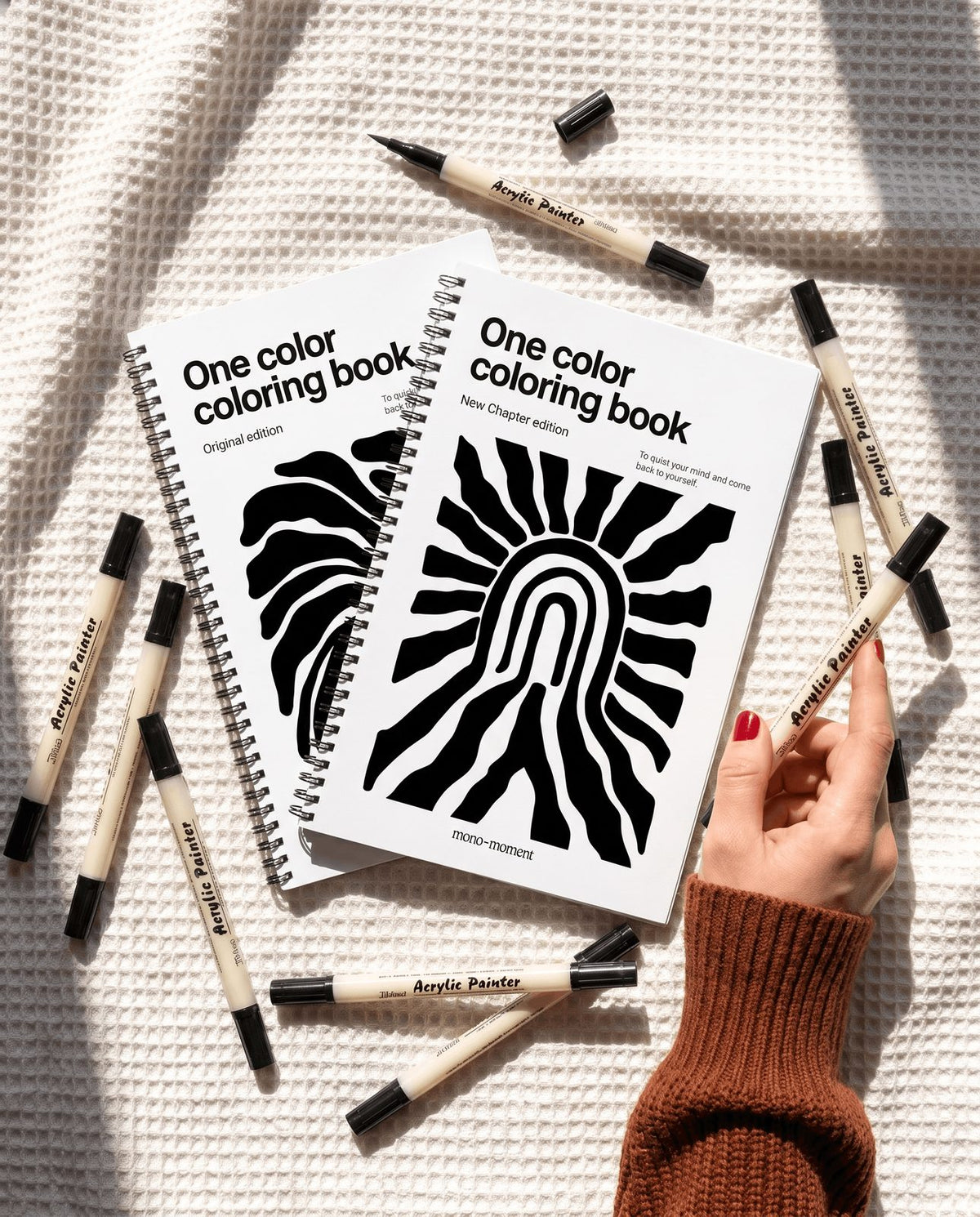
This is what monochrome coloring is built to solve: one pen, one color, bold shapes with nowhere to go wrong. When the page asks nothing, the mind can finally stop answering. If you've ever wondered why a "simpler" book works better than an impressive one, this is the whole mechanism — fewer choices per page means a shorter path to the quiet.
The seven benefits, ranked by how strong the evidence is
- Lower in-the-moment anxiety. The most replicated effect (multiple RCTs, ~20-minute sessions). Best used as a circuit-breaker: mid-afternoon spiral, post-work buzz, pre-bed racing mind.
- A measurable stress-hormone downshift. Cortisol drops after simple art-making regardless of skill (Kaimal 2016).
- A practical off-ramp from screens. Not a lab finding — a behavioral one. Coloring occupies the same "hands + eyes + light attention" slot as scrolling, which is why it substitutes so well. Readers who set a "no phone after nine" rule tell us the book is what makes the rule survivable.
- Gentler evenings and easier sleep onset. Downstream of #1 and #3: no blue light, lower arousal, a repeatable wind-down cue. Our readers' most common routine is 10-20 minutes of coloring before bed.
- A rest stop for overstimulated attention. For readers with busy sensory lives — and especially those coloring with ADHD — one bold shape per page gives attention a single, low-stakes anchor. Two of our most-cited reviews are from readers with ADHD who abandoned three mandala books before this format clicked.
- A light flow state. Repetitive strokes with visible progress meet the classic conditions for flow at low intensity: clear goal, immediate feedback, no threat of failure.
- A finished thing. Small but real: adults rarely finish anything in an evening. A completed page is a tiny, visible win — and finishing something, as one reader going through perimenopause wrote, "is medicine of its own."
What 162 readers told us (our own data, no ad copy)

We read every review of the One Color Coloring Book — 162 at the time of writing, averaging 4.7/5 — and some patterns repeat too often to be coincidence:
- Evening is the default. When readers mention a time of day, it is overwhelmingly the last hour before bed, usually paired with tea and explicitly framed as a scrolling replacement: "Used to watch Netflix until I fell asleep. Now I do 5-10 mins of this with a tea and I'm calm by 10pm."
- The "too simple" objection converts into the reason it works. Skeptics say some version of the same sentence: "I was skeptical because it's just one color and looks too simple. That's the point apparently. There's nothing to decide so my brain finally has a break."
- Partners get curious. An unexpected recurring theme — spouses who thought it was weird and then asked to try it. Two readers now report couples' sessions before bed, phones in another room.
- The hard cases are the most specific. A reader coloring through chemotherapy waits. An account manager keeping the book in a desk drawer for mid-afternoon anxiety spirals. Readers with ADHD who describe every other format as overstimulating. These are the reviews that made us take the "modest but real" framing seriously — this is a tool people reach for in genuinely difficult moments.
None of this is a clinical trial, and we would never dress it up as one. But when independent strangers keep describing the same mechanism the studies describe — fewer decisions, quieter mind — the convergence is worth taking seriously.
How to actually get the benefit (a 10-minute protocol)
The research and the reviews point to the same simple recipe:
- Pick a fixed slot — the 30-60 minutes before bed is the most popular, because it replaces the scroll at its strongest.
- One pen, one color, one page. Do not lay out a palette. The setup should take under 30 seconds; every extra choice is friction.
- Phone in another room — not face-down next to you. The book works partly because it gives your hands something to do instead.
- Stop when your shoulders drop. Usually 10-20 minutes. Finishing the page is optional; the downshift is the point.
- Repeat tomorrow. The studies measure single sessions, but every long-term reader describes the same thing: the benefit compounds when it becomes a cue — same chair, same tea, same pen.
When coloring is not the answer
Trust requires saying this plainly: coloring is a decompression tool, not a treatment. If anxiety is interfering with your work, relationships or sleep most days, the right move is a professional, not a pen. Coloring also won't suit everyone — some people decompress better through movement, and forcing stillness on a body that needs to walk is counterproductive. And if you already love intricate coloring and find it relaxing, keep going: the research favors structure, and detailed books are still structured. The simplicity argument matters most for the people detailed books have already failed.
What coloring does reliably is smaller and more repeatable: twenty minutes where nothing needs choosing, deciding, or performing. Most adult evenings have no slot like that at all — and building one, on paper, with one pen, turns out to be one of the cheapest well-supported calm-down tools there is.

The One Color Coloring Book
65+ bold designs, one single color, zero decisions — on 160 gsm paper with a lay-flat spiral, engineered for the wind-down ritual described above.
 Pair it with the 3 Dual Tip Brush Pens — $5 instead of $9.95 in the Book + Pens bundle.
Sources & further reading
- Koo, Chen & Yeh (2020), Evidence-Based Complementary & Alternative Medicine — Coloring Activities for Anxiety Reduction (RCT)
- Kaimal, Ray & Muniz (2016), Art Therapy — Reduction of Cortisol Levels Following Art Making
- Curry & Kasser (2005), Art Therapy — Can Coloring Mandalas Reduce Anxiety?
- Cleveland Clinic — Decision Fatigue: Signs and How To Cope
Frequently asked questions
Is coloring actually good for adults, or is it just a trend?
How long should an adult color to feel a benefit?
Why is coloring more relaxing than watching TV or scrolling?
What kind of coloring book is best for stress relief?
Does coloring help with anxiety at night?
Know someone who needs a quieter evening? Pin it · Share on Facebook ·
↑