Adult Coloring Statistics & Research
TL;DR: The calming effect of adult coloring is not marketing folklore — controlled studies have measured it, replicated it, and identified why it works: structure. This page collects the key statistics and studies on adult coloring, anxiety and decision fatigue in one citable place, with sources linked for every number.
Key statistics at a glance
Every figure below links to its primary source. Feel free to cite this page — a suggested citation format is at the bottom.
- Coloring structured designs significantly reduced anxiety in a randomized study of 84 undergraduates, while unstructured free-form drawing did not produce the same effect (Curry & Kasser, 2005, Art Therapy).
- The result replicated: a 2012 study of 50 participants again found structured coloring lowered anxiety, confirming the original finding (van der Vennet & Serice, 2012, Art Therapy).
- A 2020 randomized controlled trial found short coloring sessions reduced anxiety in test-anxious students, supporting coloring as a practical pre-stressor intervention (Koo, Chen & Yeh, 2020, Evidence-Based Complementary and Alternative Medicine).
- About 75% of participants showed lower cortisol (the primary stress hormone) after just 45 minutes of art-making — regardless of skill or experience (Kaimal et al., 2016, Drexel University).
- Decision quality collapses with fatigue: in the landmark study of 1,112 judicial rulings, favorable decisions fell from roughly 65% to nearly 0% as sessions wore on, recovering after each break (Danziger, Levav & Avnaim-Pesso, 2011, PNAS).
- Adults are widely estimated to make ~35,000 decisions a day — an estimate popularized by Cambridge neuroscientist Barbara Sahakian's work on decision-making; treat it as an order of magnitude, not a laboratory count (University of Cambridge).
- The adult coloring boom was real and measurable: US sales of adult coloring books grew from roughly 1 million copies in 2014 to an estimated 12 million in 2015, per Nielsen Bookscan figures widely reported at the time (The New York Times, 2016).
What the research actually says — and what it doesn't
Reading the studies closely, three honest conclusions emerge. First, the calming effect is consistently tied to structure: pre-drawn designs with clear boundaries outperform blank-page drawing. The activity works because it narrows attention to a single, bounded task — what researchers compare to meditative states — not because coloring is inherently magical.
Second, skill is irrelevant. The Drexel cortisol study found no meaningful difference between experienced artists and complete beginners. This matters because "I'm not creative" is the most common reason adults never try.
Third, the honest caveat: these are mostly small studies measuring short-term state anxiety, not clinical treatments for anxiety disorders. Coloring is a legitimate, evidence-supported relaxation practice — not a therapy replacement. We would rather say that plainly than oversell it.
Decision fatigue: why one-color coloring exists
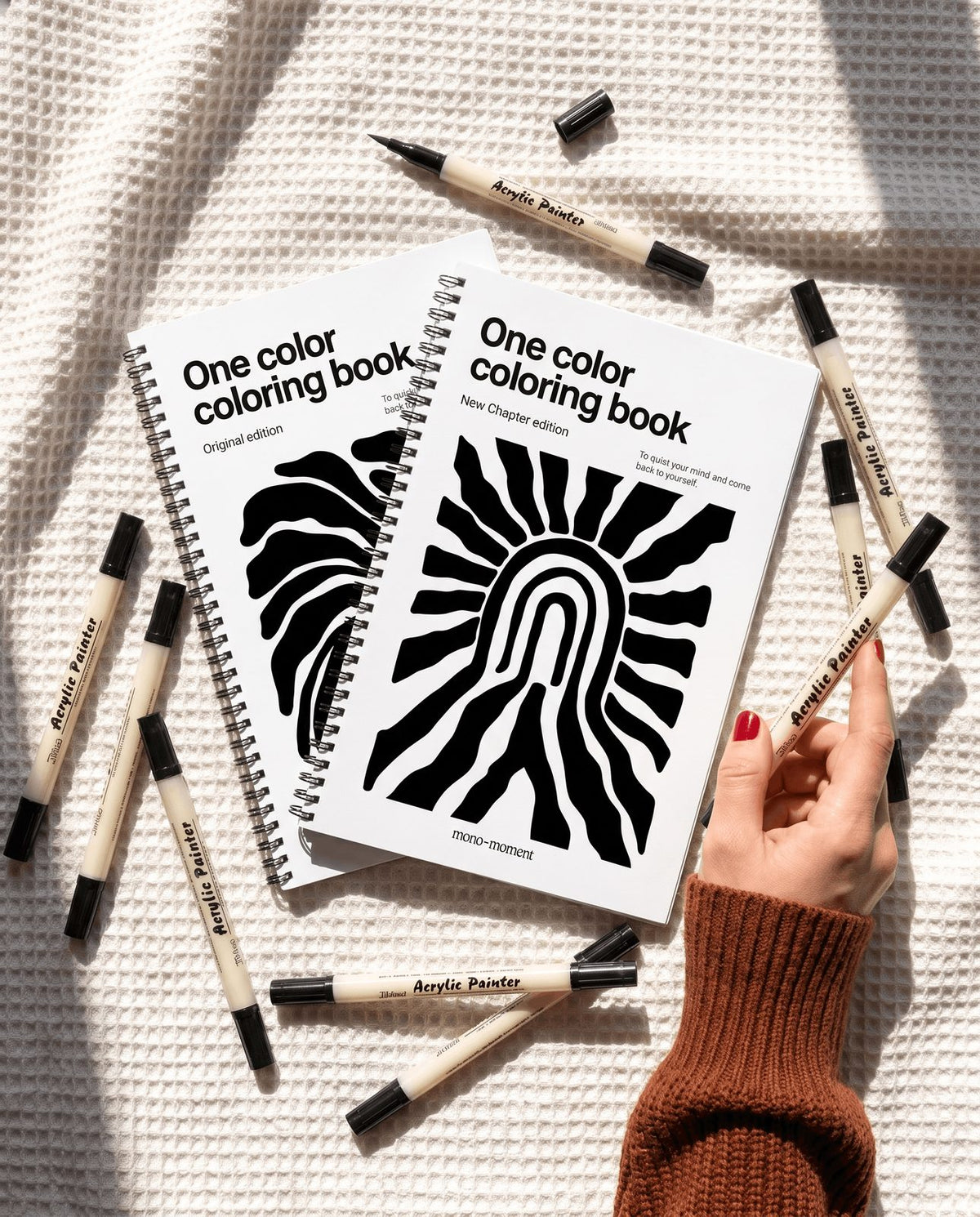
The Danziger ruling study and the 35,000-decisions estimate explain a design problem in traditional coloring books: a 48-pencil palette turns every shape into another decision, at exactly the hour of the day when decision quality is lowest. That is the research basis for the one-color format — remove the palette, keep the structure — and it is why our own book uses a single pen and pre-marked shapes. The full reasoning is in our explainer on monochrome coloring.
Our own numbers
For transparency, the figures from our own store that we can verify publicly: the One Color Coloring Book holds a 4.7/5 rating across 186 verified customer reviews (live count, updated automatically), and the most common phrase in those reviews is some version of "I wish I'd found this sooner." We publish real customer-colored pages — not stock images — on the product page.
How to cite this page
Mono Moment, "Adult Coloring Statistics & Research," mono-moment.com, 2026. Individual figures should be attributed to their primary sources, linked above. This page is reviewed and updated as new research is published.
Frequently asked questions
Does coloring actually reduce anxiety?
Controlled studies say yes, for short-term state anxiety: Curry & Kasser (2005) found structured coloring reduced anxiety significantly, van der Vennet & Serice (2012) replicated it, and a 2020 randomized trial confirmed the effect in test-anxious students. The consistent condition is structure — pre-drawn designs, clear boundaries — rather than free drawing.
Is coloring as effective as meditation?
Researchers describe structured coloring as producing a meditation-like state of narrowed attention, and it is often easier to access for beginners because it gives the mind a concrete task. The studies do not claim it replaces a meditation practice or therapy — it is best understood as a low-barrier relaxation tool.
Do you need artistic skill to get the benefits?
No. The Drexel University cortisol study found stress hormones dropped for about 75% of participants regardless of experience or skill level. Formats built on bold pre-drawn shapes — like one-color coloring — are specifically designed so skill never becomes a barrier.
Where do the "35,000 decisions a day" figures come from?
It is a widely-cited estimate popularized through Cambridge neuroscientist Barbara Sahakian's work on decision-making, not a precise laboratory count. We cite it as an order of magnitude for daily cognitive load — the reliable, laboratory-grade evidence on decision fatigue is the Danziger 2011 PNAS study of judicial rulings.