About the author
Published April 26, 2026 · Last reviewed August 3, 2026 · 7 min read

In this article · 8 sections
- Why coloring can help an ADHD brain (when the book is right)
- What goes wrong with the wrong coloring book
- What works better: low-decision, monochrome books
- A simple test before you buy any coloring book
- How to actually use coloring as an ADHD calming tool
- What about hyperfocus?
- A small honesty note
- If you want to try it this week
TL;DR. Most adult coloring books are designed for stress relief in general — they assume you have plenty of focus to spend on choosing colors and tracking complex patterns. ADHD brains often work better with the opposite: simple line work, larger regions, and ideally a single-color (monochrome) book that removes color decisions entirely. This piece is what to look for, what to avoid, and how to actually finish the book this time.
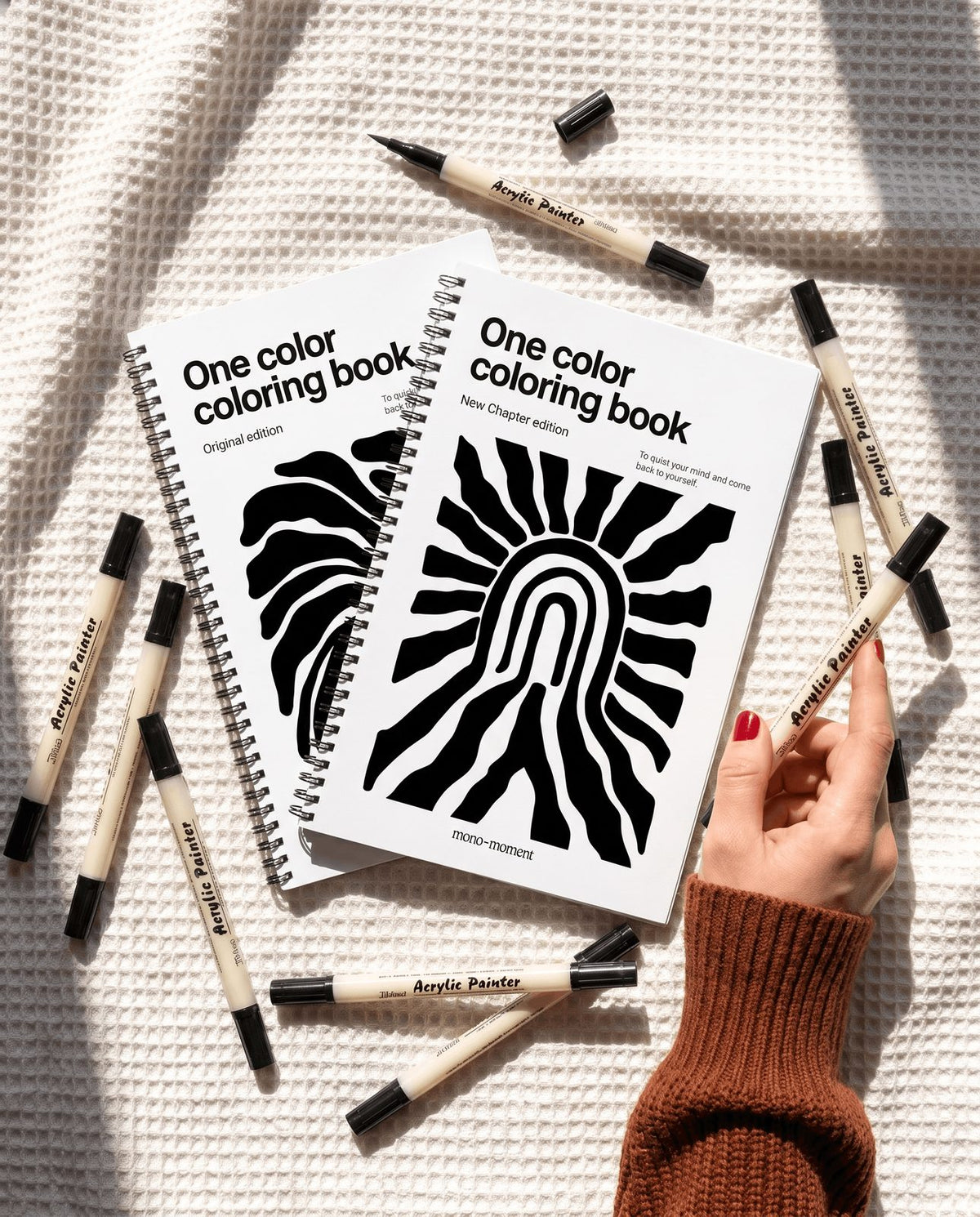
Many readers with ADHD land here looking for our one color coloring book — designed to remove the choice paralysis that makes classic coloring books hard to start.
I have ADHD. I have also bought a lot of coloring books, started most of them, and finished maybe two. For years I assumed that was a personal-failure problem. It turned out to be a book-choice problem.
The standard adult coloring book — dense mandalas, intricate florals, twelve micro-regions in every quarter-inch — is built around the assumption that complexity equals calm. For neurotypical adults that often holds up. For ADHD adults, it frequently does the opposite. You sit down to color, you spend three minutes deciding which color goes where, you start, you lose track of which areas are "the same shape," your eye gets pulled in twelve directions, you put the book down. You do not feel calmer. You feel slightly more frustrated than when you started.
This piece is not therapeutic advice. I am not a clinician. It is the practical version of what I have figured out from coloring with an ADHD brain for the last several years and from talking to a lot of customers who have written in to say variations of the same thing: I keep buying coloring books and they keep not working — what should I look for?
Why coloring can help an ADHD brain (when the book is right)
There is real signal here. A 2023 study in PMC on mandala coloring interventions and ADHD symptoms found measurable improvements in executive functioning and emotional self-regulation in children, with some carryover into the adult literature in pilot studies. The proposed mechanism is straightforward: rhythmic, low-stakes hand activity that occupies the visual-motor system gives the wandering attention something to anchor on without demanding much of working memory.
That is not magic. It is the same reason ADHD adults often think better while walking, doodle through long meetings, or fidget with a pen during a phone call. The ADHD brain is not bad at attention; it is bad at attention that is boring. Coloring is interesting enough to hold attention and undemanding enough to release the rest of the mind.
But — and this is the part most generic articles skip — the size of that effect depends almost entirely on the book.
What goes wrong with the wrong coloring book

Three failure modes show up over and over:
The book is too complex per page. Intricate 200-region mandalas look beautiful in the store. They are intimidating in the moment. The ADHD brain, presented with overwhelming choice, is more likely to disengage than to settle. Pages that take three hours and need to be rationed across multiple sessions are particularly risky — you forget where you were, you lose the mental thread, the book becomes another half-finished thing.
The color decisions multiply. Every region added is another small decision: which color, will it clash with the next region, are you using the "good" pencils on the wrong area. This is decision overhead and it is exactly the kind of cognitive load the activity was supposed to relieve.
There is no clear sense of progress. A page with hundreds of micro-shapes never feels half-done; it feels 4% done. The ADHD brain runs partly on visible progress. Without it, motivation crashes around minute fifteen.
If you have started and stopped coloring books, it is very likely you bought books optimized for an entirely different kind of brain.
What works better: low-decision, monochrome books
The features that make a coloring book ADHD-friendly are unglamorous:
- Simple line work. Fewer micro-regions, larger fillable areas, clear shapes.
- Single-color (monochrome) design. No color decisions to make. Pick up one black pen and start.
- Pages that can be finished in 15 to 25 minutes. Long enough to settle in, short enough to feel done.
- Variety of subject matter so you do not get bored ten pages in.
- Heavy paper (140 to 170 gsm) so your gel pens do not bleed and add another small frustration.
This is the design space we built our One Color Coloring Book for. It is not branded as an "ADHD coloring book" — many of those exist and some are good — but the underlying design choices happen to fit ADHD brains particularly well, because the same constraints that calm a busy adult mind in general are the ones that work for an ADHD adult specifically.
A simple test before you buy any coloring book

Open it to a random page. Ask yourself, honestly:
- Do I want to start this right now, or does it feel like work?
- Could I finish this page in one sitting if I wanted to?
- Are the shapes large enough that my hand can move at a relaxed pace, or am I going to be doing precision work for the next two hours?
- If I imagine using only one color, does the page still feel doable?
If any of those is a no, the book is not wrong — it is just not the right tool for an ADHD-friendly calming session. Save it for a different mood.
How to actually use coloring as an ADHD calming tool
Strategy matters more than effort.
Use it for transitions. Coloring is excellent for the awkward in-between moments: after work and before dinner, after a stressful call and before the next task, in the wind-down hour before bed. Setting it up as a transition activity gives it a purpose and a predictable container, which ADHD brains thrive on. The general ADHD calming techniques guide from Life Skills Advocate makes this point well across many activities — coloring is just one good fit.
Time, not pages. Set a 15-minute timer. When it goes off, stop, even mid-page. Pages are arbitrary; the timer is what trains the brain. (Yes, this is the same advice as "use a timer for everything." It works for coloring too.)
Keep the kit ready and visible. Book open to the next blank page, single black pen on top of it, on the table or counter where you can see it. Hidden in a drawer is hidden forever. Visible reduces the activation cost.
Pick a single pen and stick with it. Choosing a pen is a decision. The fewer decisions in your routine, the more likely it survives. A 0.7 mm black gel pen is the easiest default — smooth on heavy paper, opaque, fast.
Pair it with a podcast or instrumental music, not silence. ADHD adults often calm faster with mild background audio than with quiet — quiet leaves the wandering mind room to wander. Avoid vocal music or lyrics-heavy content if you are using coloring to come down from overstimulation; instrumental or low-talk podcasts are better. Lo-fi works for many people.
Forgive the start-stop pattern. You will do it for two weeks, lose the habit for a month, come back. That is the ADHD experience of habits in general. The book does not judge you; it is exactly where you left it.
What about hyperfocus?
Worth naming. Some ADHD adults will sit down for "fifteen minutes" of coloring and look up three hours later. This is fine if you are not behind on something else and you have not eaten in six hours. It is less fine if it is happening at 1 a.m. when you have an early meeting.
Two practical guards:
- Use a timer with an alarm sound, not a silent visual countdown.
- Color in a place you cannot become invisible to other things — a kitchen counter is better than a closed bedroom for evenings when hyperfocus could be costly.
You do not have to fight hyperfocus on a free Saturday afternoon. Channel it into the page. The book will be done by Monday.
A small honesty note
Coloring is not therapy. If you are dealing with ADHD that is significantly impacting your life, please talk to a clinician — there are real treatments, behavioral and pharmacological, that change outcomes. Coloring is a small, free, low-risk regulation tool that fits alongside, not instead of, anything else you are doing.
What it can do is give you a reliable, calming activity that does not demand that you be perfectly attentive to enjoy it. For ADHD adults, that combination — low-stakes, sustained, gentle — is a rarer thing than it should be.
If you want to try it this week
The minimal version:
- Get a monochrome or simple line-art coloring book. Ours is one option (the single-pen coloring book — single-pen design, 160 gsm paper, no decisions to slow you down). Any low-decision book will do.
- Get one black gel pen.
- Set a fifteen-minute timer.
- Color one page (or part of one) every day for a week.
- At the end of the week, ask yourself whether the activity has earned its place in your routine. If yes, keep going. If no, you have lost a week and learned something.
If you want more on the broader question of coloring as a calming practice, our piece on anxiety coloring books for adults covers adjacent territory, and the simple coloring books for adults guide may help you choose between options.
The point of all of this is the same: lower the cost of starting, raise the chance of finishing, and let the calm find you.

The One Color Coloring Book
A single-pen, decision-free coloring book on 160 gsm cream paper — engineered for the wind-down ritual described above.
 Pair it with the 3 Dual Tip Brush Pens — $5 instead of $9.95 in the Book + Pens bundle.
Cheapest way to test all of this: our free ADHD-friendly coloring pages — six printable one-color designs, so you can see how your brain responds before buying anything.