In this article · 16 sections
- What HSP nervous systems actually need
- 1. Single-color decision-free coloring
- 2. Silent fixed-loop walking
- 3. Lying flat on the floor for 10 minutes
- 4. Reading fiction in a single sitting
- 5. Cooking one repeatable meal you know by heart
- 6. Plant-tending (not plant-acquiring)
- 7. Listening to one album, all the way through, with eyes closed
- 8. Sorting one closed system (a single drawer, a basket, a shelf)
- 9. Sitting outside in the morning for 10 minutes (no agenda)
- 10. Tactile slow craft (knitting if you already know how, otherwise skip)
- 11. Sleeping in a fully-blacked-out room
- 12. Saying no to one social commitment per week
- What's NOT on this list (and why)
- Where to start (one practice, this week)
- Sources & further reading
If you've ever read a "10 ways to recharge" article and felt vaguely worse — because the suggested "social walk with a friend" sounds depleting, the "spin class" sounds like a nightmare, and the "journaling prompts" feel like another assignment — you might be a highly sensitive person, and standard self-care advice isn't calibrated for you.
The Highly Sensitive Person framework, identified by Dr. Elaine Aron in her 1996 book of the same name, describes a personality trait called Sensory Processing Sensitivity (SPS). About 15-20% of the population scores high on it. HSPs process sensory and emotional input more deeply, which has real benefits (empathy, attention to detail, creativity) and one consistent downside: a lower threshold for stimulation. What energizes a non-HSP often depletes an HSP.
This article is for HSPs who keep abandoning self-care advice because the advice isn't built for their nervous system. The 12 activities below share three traits:
- Low or zero novel input. No new instructions, no new recipes, no new YouTube class.
- Full personal control over duration. No 30-minute timer, no class schedule, no group expecting you.
- No social performance. Done alone, with no requirement to "show up" for anyone else.
What HSP nervous systems actually need
A brief frame before the list. Aron's research, replicated in subsequent studies (Acevedo et al., 2014; Greven et al., 2019), found that HSPs show heightened activation in brain regions associated with sensory processing, emotional response, and depth of processing. The implication: the same sensory load that's neutral to a non-HSP is taxing to an HSP. Recovery requires not just rest, but specifically low-input rest.
Most "calming" advice raises some kind of input — instruction, social, novelty. The 12 below intentionally lower it.
1. Single-color decision-free coloring

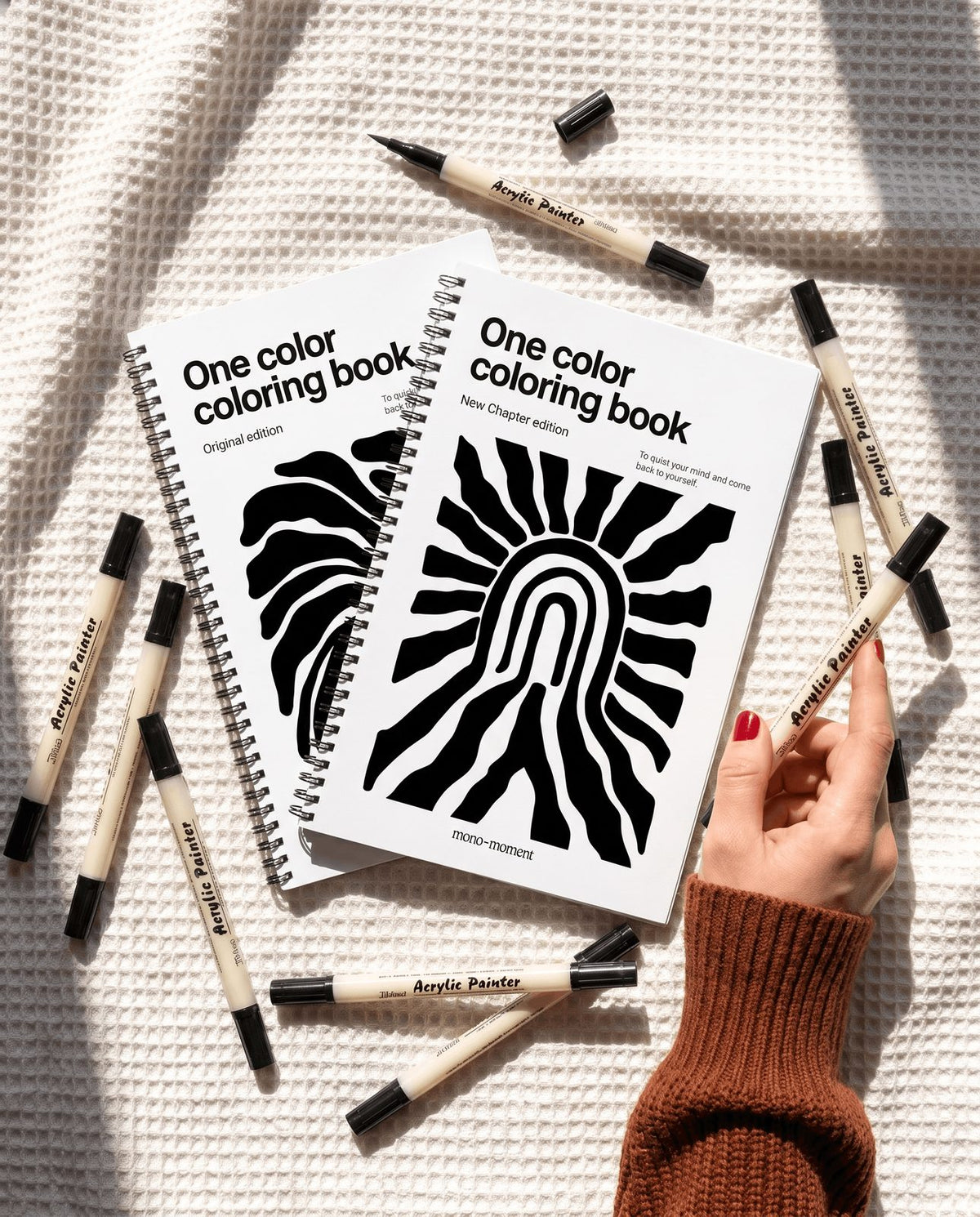
The lowest cognitive load on this list. One book, one black pen, large abstract shapes. No color choices, no precision pressure, no representational outcome to "get right."
For HSPs specifically: the absence of decisions is the relief. By the time most HSPs sit down at 7pm, the day's input has already been more than the system can comfortably process. What you need isn't more input — it's a 5-15 minute window where your hands move and your brain stops.
Mono Moment's One Color Coloring Book is purpose-built for this. 50+ pages, one black brush pen, 160gsm cream paper that handles ink without bleed-through.
2. Silent fixed-loop walking
Walk the same neighborhood loop. No podcast, no music, no audiobook. Same loop on purpose so navigation drops out.
For HSPs: the absence of additional audio input is critical. Many HSPs already feel "full" of input by mid-day; another podcast layer is more, not less. Silent walking on a familiar path is one of the lowest-stimulation outdoor activities available.
3. Lying flat on the floor for 10 minutes

Not yoga. Not stretching. Just flat on your back, on the floor, for 10 minutes. Eyes can be open or closed.
For HSPs: gravity-supported rest with proprioceptive feedback (the floor against your back) helps the nervous system downshift faster than seated rest. Almost every HSP I've spoken to has independently discovered this.
4. Reading fiction in a single sitting
Not non-fiction (which adds learning load). Light, well-written fiction. Genre fiction is fine — better than literary fiction in this case because cognitive demand is lower.
The University of Sussex's reading study found 68% stress reduction after just six minutes — and HSPs tend to be over-represented among avid readers, which makes sense given the trait.
5. Cooking one repeatable meal you know by heart
The same comfort meal, cooked from memory, no recipe consulted. The hands move automatically.
For HSPs: novel recipes add cognitive demand (which step next? did I miss an ingredient?). The same meal cooked for the 30th time is a moving meditation.
6. Plant-tending (not plant-acquiring)
Go around your home, water each plant, rotate them, snip a yellow leaf, return to your seat. 5-10 minutes.
Critical caveat for HSPs: don't take this on if you don't already have plants. Adding "buy plants and figure out their needs" to your to-do list will feel depleting. The activity only works if it's already a familiar task.
7. Listening to one album, all the way through, with eyes closed
Sit. Headphones. One album you've heard before. Eyes closed. No phone in hand.
For HSPs: familiar music engages reward circuits without demanding attention. Closing the eyes removes the visual input layer. The album-as-sequence (vs shuffle) removes decision points. Few activities are this low-input while still being engaging.
8. Sorting one closed system (a single drawer, a basket, a shelf)
Strict rule: one closed system. Not "the bedroom." Not "while I'm at it, the closet too."
For HSPs, the dopamine hit of contained completion (start → finish → done) without the open-ended "house cleaning" pit-of-no-end is calibrated correctly. Open-ended cleaning is a trap. One drawer is a rest.
9. Sitting outside in the morning for 10 minutes (no agenda)
Just sit. Outside. Morning. With a cup of something warm. No phone. The first 5 minutes you'll feel weird, then it lands.
The combination of natural light + bird sound + temperature gradient resets circadian rhythm and engages the parasympathetic nervous system. (For more on parasympathetic activation, see our parasympathetic nervous system activities guide.)
10. Tactile slow craft (knitting if you already know how, otherwise skip)
For HSPs who already know how to knit (or crochet, or hand-stitch): the rhythmic tactile work is genuinely calming. The needles, the wool, the predictable click.
For HSPs who don't already know: skip. The learning curve will not feel calming. Pick something else from this list.
11. Sleeping in a fully-blacked-out room
Not technically an activity, but worth listing because HSPs are disproportionately sensitive to ambient light, sound, and temperature during sleep. Blackout curtains, earplugs, a slightly cooler room — these are not luxuries for HSPs, they're load-reduction.
12. Saying no to one social commitment per week
The only "active" activity on the list. Pick one social commitment in the coming week. Send a kind decline. Use the recovered evening for any of the 11 above.
For HSPs, this is often the single highest-leverage practice — because without recovered time, none of the other practices have space to happen.
What's NOT on this list (and why)
To make the list useful, here's what I deliberately excluded that often appears on standard self-care lists:
- Group yoga / spin / meditation classes. Social + scheduled + instructional — three layers of input HSPs often don't need.
- New recipes / "30-day cooking challenge." Decision-heavy, novelty-heavy.
- Therapy apps with daily prompts. Notification-driven, gamified, often high-input.
- Big social gatherings labeled "self-care" (girls' nights, brunches). Can be lovely; rarely actually recharging for HSPs.
- Loud relaxation environments (noisy spas, busy yoga studios). The marketing says "rest"; the input level says otherwise.
None of these are bad. They're just not calibrated for HSP nervous systems. Standard advice exists; this list is the alternative.
Where to start (one practice, this week)
Don't try to install all 12. Pick one. Do it for a week. Notice the difference.
Most HSPs find #1 (single-color coloring) and #2 (silent walking) the easiest to start because they require no acquisition of skill. The One Color Coloring Book ships in 24 hours and lives well on a bedside table or kitchen counter.
The other practices — reading fiction, lying on the floor, plant-tending, sitting outside — cost nothing and require no purchases.
What HSPs need most isn't a new tool. It's permission to design a life that respects the trait — fewer simultaneous demands, more recovery time, lower-input activities. The 12 above are a starting toolkit.
Sources & further reading
- Aron, E. N. (1996) The Highly Sensitive Person: How to Thrive When the World Overwhelms You. The foundational text. Author's site.
- Acevedo, B. P. et al. (2014) The highly sensitive brain: an fMRI study of sensory processing sensitivity and response to others' emotions, Brain and Behavior, 4(4), 580-594.
- Greven, C. U. et al. (2019) Sensory Processing Sensitivity in the context of Environmental Sensitivity: A critical review and development of research agenda, Neuroscience & Biobehavioral Reviews, 98, 287-305.
- Lewis, D. (2009) Sussex University reading-stress study.
- Kaimal, G. et al. (2016) Reduction of Cortisol Levels Following Art Making, Art Therapy.

The One Color Coloring Book
A single-pen, decision-free coloring book on 160 gsm cream paper — engineered for the wind-down ritual described above.
 Pair it with the 3 Dual Tip Brush Pens — $5 instead of $9.95 in the Book + Pens bundle.