


In this article · 12 sections
- Step 0: Don't reach for your phone (the foundation)
- Step 1: Drink one full glass of water (immediately)
- Step 2: Get natural light in your eyes (within 10 minutes of waking)
- Step 3: One slow breathing cycle (4-7-8 or box breath)
- Step 4: Make warm beverage of choice (coffee comes after steps 1-3)
- Step 5: 5-15 minutes of low-cognitive-load activity (the central anchor)
- Step 6: Write 3 things (NOT a journal, just 3 things)
- Step 7: Eat protein within 60-90 minutes of waking
- Total time: 25-40 minutes
- Why most "morning routine" advice doesn't work for anxious adults
- Where to start (this week)
- Sources & further reading
If you've ever woken up with a tight chest, a brain already racing, and a vague sense that "something's wrong" before you've even processed what day it is — you're experiencing morning anxiety. It's not in your head, exactly. It's in your bloodstream.
The Cortisol Awakening Response (CAR) — first characterized by Pruessner et al. in 1997 — describes a sharp 50-160% rise in cortisol that peaks 30-45 minutes after waking. For non-anxious adults, this is a useful biological wake-up signal. For anxious or overthinking adults, the brain often misinterprets this normal cortisol spike as confirmation that "something is wrong," which triggers rumination, which compounds the cortisol response, which compounds the anxiety. By the time you've had your first coffee, you're already 90 minutes into a stress loop.
This routine is designed to interrupt that loop before the brain takes over the morning. It takes 25-30 minutes total, requires no apps, no meditation cushion, no productivity theater. It's calibrated specifically for adults whose anxiety arrives before they're fully awake.
Step 0: Don't reach for your phone (the foundation)
Before any of the steps below: do not look at your phone for the first 30-60 minutes after waking. This is the single highest-leverage morning intervention for anxious adults, and every step below is harder if you've already absorbed 12 work messages, 3 news headlines, and a friend's vacation post.
If your phone is your alarm, get a basic alarm clock. The friction of having to walk across the room to your phone is what enables every other step.
If you can't make the no-phone change permanent, start with 15 minutes. Build from there.
Step 1: Drink one full glass of water (immediately)

You are dehydrated. Most adults wake up mildly dehydrated, and dehydration amplifies cortisol response and physiological anxiety markers. A full glass of room-temperature water (16-20 oz) within the first 5 minutes of waking is the simplest intervention on this list.
Keep the glass on your bedside table the night before. Pre-filled. Zero friction in the morning.
Time: 1 minute.
Step 2: Get natural light in your eyes (within 10 minutes of waking)
Natural light early in the morning anchors the circadian rhythm and downregulates the cortisol response curve. Stand at a window with morning sky visible (clouds count) or step outside for 2-5 minutes. If you have a balcony or porch, use it. If you don't, lean out a window.
This is more powerful than it sounds. Andrew Huberman's lab work and decades of circadian research converge on early-morning light as one of the strongest anchors for nervous-system regulation.
Time: 2-5 minutes.
Step 3: One slow breathing cycle (4-7-8 or box breath)
After the water and light, before any caffeine: 3-5 cycles of slow breathing.
Box breath: inhale for 4, hold for 4, exhale for 4, hold for 4. Repeat 4-6 times.
Or 4-7-8: inhale 4, hold 7, exhale 8. Repeat 3-4 times.
The lengthened exhale is what does most of the work — it activates the parasympathetic nervous system through the vagus nerve. This is the cheapest, fastest physiological intervention on the list.
Time: 2-3 minutes.
Step 4: Make warm beverage of choice (coffee comes after steps 1-3)
If you're a coffee drinker, this is when you make your coffee — not before. Caffeine on an already-elevated cortisol curve sharpens the spike for many anxious adults. You'll metabolize the caffeine more cleanly if you've hydrated, gotten light, and breathed first.
Tea works equally well here. The point is the warmth and the small ritual of preparation. Stand in your kitchen, watch the kettle, hear it whistle. This is part of the practice.
Time: 5 minutes.
Step 5: 5-15 minutes of low-cognitive-load activity (the central anchor)
This is the longest step and the most important. Pick one of these:
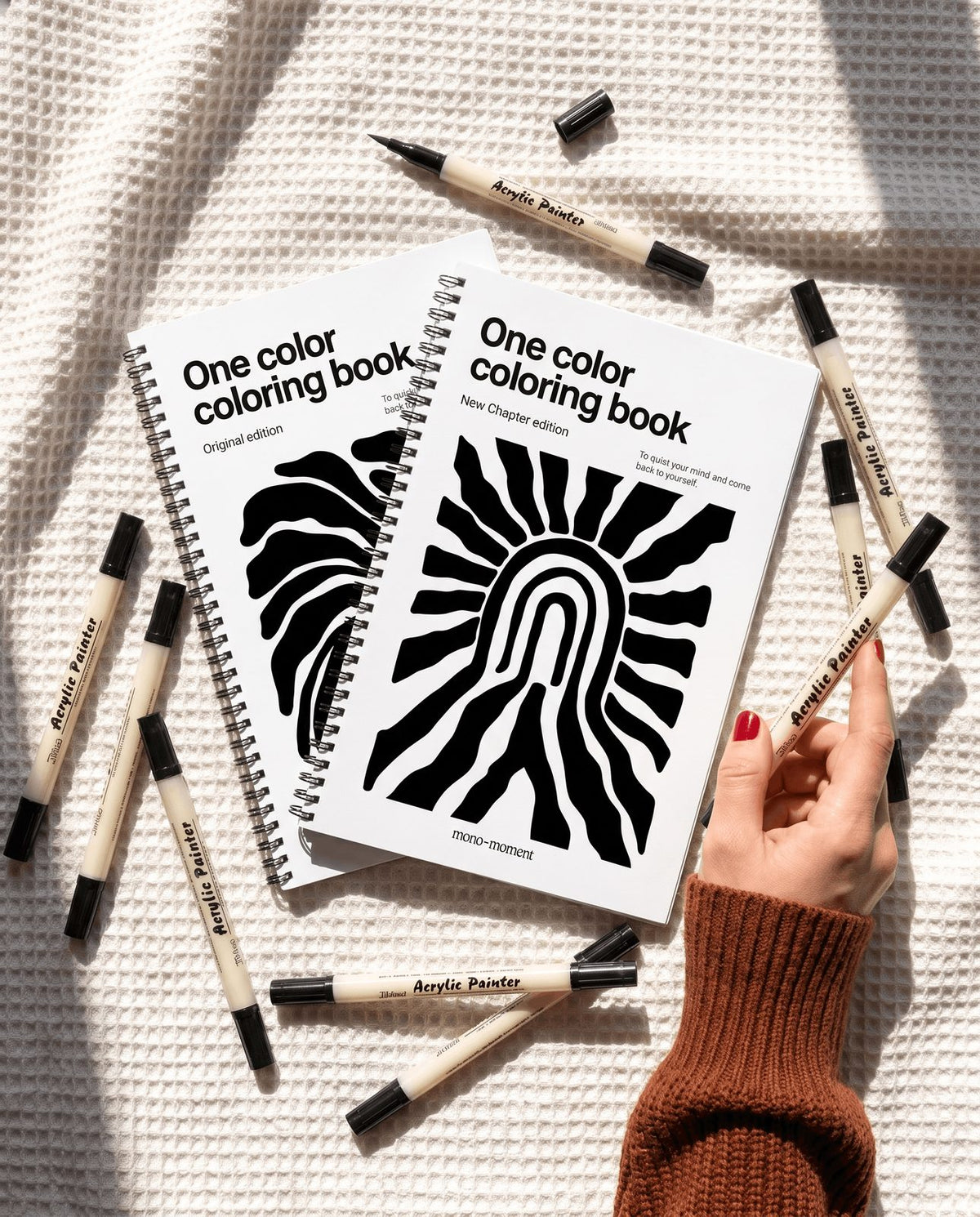
- Single-color coloring. A spiral-bound book, one black pen, fill one bold abstract shape. The rhythmic motion + low cognitive load + no decisions = direct nervous-system downshift. The Mono Moment One Color Coloring Book is built for exactly this kind of morning ritual — small enough to live on a kitchen counter, one pen, no setup.
- Reading fiction. Light novel, paperback. 10-15 minutes.
- Slow movement / stretching. Not a workout. Slow neck rolls, shoulder rolls, hamstring stretches. 10 minutes.
- Sitting outside with your warm beverage. No phone. Just sit.
Whatever you pick, the rule is: no decisions, no novel input, no productivity. This is before the brain is allowed to plan the day.
Time: 10-15 minutes.
Step 6: Write 3 things (NOT a journal, just 3 things)
Open a small notebook. Not a journal app. A paper notebook, pen.
Write three things. They can be:
- 3 things you're worried about (gets them out of the recursive loop in your head and onto paper).
- 3 things you're grateful for (CBT-validated mood lifter).
- 3 things you're going to do today (clarity, not a to-do list).
Pick one of the three formats. Same one each morning. Don't decide in the moment — that's another decision the morning brain doesn't need.
This isn't journaling. There's no prompt, no expected length, no "process my emotions." It's just three sentences on paper.
Time: 3-5 minutes.
Step 7: Eat protein within 60-90 minutes of waking
Not optional. Anxious adults often skip breakfast or do "coffee for breakfast" — both worsen the cortisol curve. Even a small amount of protein (eggs, Greek yogurt, leftover chicken, a protein shake) within 60-90 minutes of waking stabilizes blood sugar and reduces the afternoon anxiety dip that often follows a coffee-only morning.
Don't make it complicated. Same breakfast every day is fine — better, actually, because no decisions.
Time: 5-10 minutes.
Total time: 25-40 minutes
Let me re-stack the routine end-to-end:
- Wake up. Don't touch phone. (0 min)
- Glass of water from bedside. (1 min)
- Walk to window or step outside, get morning light. (3 min)
- 3-5 cycles of slow breath. (3 min)
- Make coffee/tea. (5 min)
- 15 min low-cognitive-load activity (single-color coloring is the closest match for anxious mornings). (15 min)
- 3 sentences in a paper notebook. (5 min)
- Eat protein. (5-10 min)
That's 35-45 minutes total before you've engaged with email, social media, or the day's demands. By the time you do, your cortisol curve has stabilized, your nervous system has been given a chance to wake up gently, and the morning anxiety spiral has been short-circuited.
Why most "morning routine" advice doesn't work for anxious adults
A note on what I deliberately excluded:
- Cold plunges or ice baths — sharpen cortisol response further; great for some, not for anxious mornings.
- High-intensity exercise — see above.
- Meditation apps with notifications — phone first thing, defeats step 0.
- Affirmations / journaling prompts — too much mental engagement before the brain is ready.
- Productivity-stack morning routines (eat the frog, etc.) — premature engagement with the day's demands.
These work for some people. They tend not to work for anxious adults whose mornings are already running too hot.
Where to start (this week)
Don't install all 7 at once. Start with steps 0, 1, and 2 (no phone, water, light). That's three things, costs nothing, takes 5 minutes total. Do those for a week.
When that's automatic, add step 6 (the 15-minute low-cognitive-load anchor). If you don't have a comfortable activity for it, the One Color Coloring Book is purpose-built for the slot — ships in 24 hours, lives well on a kitchen counter.
The remaining steps (3, 4, 5, 7) layer in over the following weeks once the foundation is automatic.
The goal isn't a perfect morning. It's a morning where the anxiety spiral doesn't get to set the tone of your day before 9am.
Sources & further reading
- Pruessner, J. C. et al. (1997) Free cortisol levels after awakening: a reliable biological marker for the assessment of adrenocortical activity, Life Sciences, 61(26), 2539-2549. Foundational CAR research.
- Adam, E. K., Hawkley, L. C., Kudielka, B. M., & Cacioppo, J. T. (2006) Day-to-day dynamics of experience–cortisol associations in a population-based sample of older adults, PNAS.
- Huberman Lab Podcast — multiple episodes on morning light, cortisol, and circadian biology.
- Kaimal, G. et al. (2016) Reduction of Cortisol Levels Following Art Making, Art Therapy.
- Cleveland Clinic. Cortisol Awakening Response: What It Is and How to Manage It.

The One Color Coloring Book
A single-pen, decision-free coloring book on 160 gsm cream paper — engineered for the wind-down ritual described above.
 Pair it with the 3 Dual Tip Brush Pens — $5 instead of $9.95 in the Book + Pens bundle.


0 comments