About the author
Published April 26, 2026 · Last reviewed May 9, 2026 · 7 min read

In this article · 5 sections
TL;DR. The parasympathetic nervous system — the rest-and-digest counterpart to fight-or-flight — does not need an app. The most reliable activators are slow exhales (longer than your inhale), warmth on the skin, gentle repetitive activity with low cognitive load, and the absence of new sensory input. A 20-minute session of any of those produces measurable physiological shifts. Coloring works because it stacks all four into one practice.
There is a reason most "relax" advice does not actually relax you. The body has a specific physiological mode for relaxing — parasympathetic dominance, sometimes called rest-and-digest — and it does not switch on because someone tells you to chill. It switches on when specific signals reach your nervous system: a long exhale, warmth, a slowing of input, gentle rhythmic activity.
This piece is about those signals. What your parasympathetic nervous system actually does, why most adults' systems are stuck in low-grade sympathetic activation, and a list of specific activities — not vague advice — that move you the other direction. Some you can do in three minutes. Some you can build into a nightly practice. None of them require an app or a class.
What the parasympathetic nervous system actually does
You have heard of fight-or-flight. The autonomic nervous system has two main branches:
- Sympathetic — fight-or-flight. Heart rate up, breathing fast, blood to muscles, digestion paused, alertness sharp. Useful for crises, sprints, deadlines.
- Parasympathetic — rest-and-digest. Heart rate down, breathing deep, blood to digestion, muscles release, attention diffuse. Used for sleep, recovery, social bonding, eating, healing.
Both are necessary. The problem most adults have is that the sympathetic branch never fully turns off. Modern environments — caffeine, deadlines, notifications, urgent group chats, ambient news anxiety — produce a low-grade activation that runs in the background continuously. The body never gets a clean signal that the day is done.
The result over time: sleep that does not restore, digestion problems, a "tired but wired" feeling, difficulty settling at bedtime, harder-than-usual recovery from minor stressors. Not a disease. A nervous system stuck in the wrong gear.
The work of shifting it back is mostly about giving the parasympathetic system the specific signals it responds to. Below are the ones with the strongest evidence behind them.
The four signals that activate parasympathetic mode

Across the research, four clusters consistently produce parasympathetic shift:
- Long exhales. Specifically, exhales that are longer than your inhales. The exhalation phase of breath naturally activates the vagus nerve, which is the main highway of the parasympathetic system.
- Warmth. Skin warmth — a hot drink, a warm shower, a warm pack — sends a safety signal. Cold can also work via a different mechanism (cold-water face exposure activates the diving reflex), but warmth is the easier daily lever.
- Slow, low-decision repetitive movement. Walking, knitting, coloring, gentle stretching. The combination of rhythmic motion + minimal cognitive load mirrors the body's natural parasympathetic state.
- Reduction of new sensory input. Phones, screens, ambient conversation, music with lyrics — all keep the sympathetic system mildly engaged. The parasympathetic system needs the volume turned down, not just different stimulation.
Most adult evenings violate at least three of these. Which is why most adults arrive at bedtime not relaxed.
Specific activities, ranked by leverage
1. The 4-7-8 or extended-exhale breath
Sit or lie down. Inhale through the nose for 4 counts, hold for 7, exhale through the mouth for 8. Three or four cycles. The exhale is what does the work — it is the longest part deliberately. Even simpler: inhale 4, exhale 6 to 8, no hold. Three minutes is enough to shift heart rate variability for most adults.
This is the most direct lever and the cheapest. Do it before bed, before a difficult meeting, in the car before going inside.
2. A warm drink, slowly, in a quiet place
Tea — chamomile, herbal, ginger, anything warm — held in both hands, in a chair, no phone, near a window or low light. The combination of warmth on the hands and lips, the slow pace of drinking, and the reduced sensory load produces a parasympathetic shift within ten or fifteen minutes. Sounds basic. Works.
3. A hot bath or shower, no podcast
Specifically without the podcast. Most adults default to running an audiobook or a podcast in the shower, which keeps the brain processing language. A silent, slow, hot shower is one of the highest-leverage interventions for sleep onset. The body's core temperature drops on the way out, which itself triggers sleep cues.
4. Slow walking outside, no headphones
Twenty to thirty minutes. Slower than your normal pace. No phone in your hand. The combination of rhythmic motion, environmental novelty (trees, sky, distant sounds), and the absence of input streams is one of the most consistent parasympathetic shifts in the literature. It is also free.
5. Gentle stretching on the floor
Not yoga as a class. Just slow, deliberate floor stretches — forward folds, gentle twists, lying on the back with legs up the wall. Floor contact itself sends a safety signal. Five to ten minutes of slow movement before bed shifts most adults toward parasympathetic.
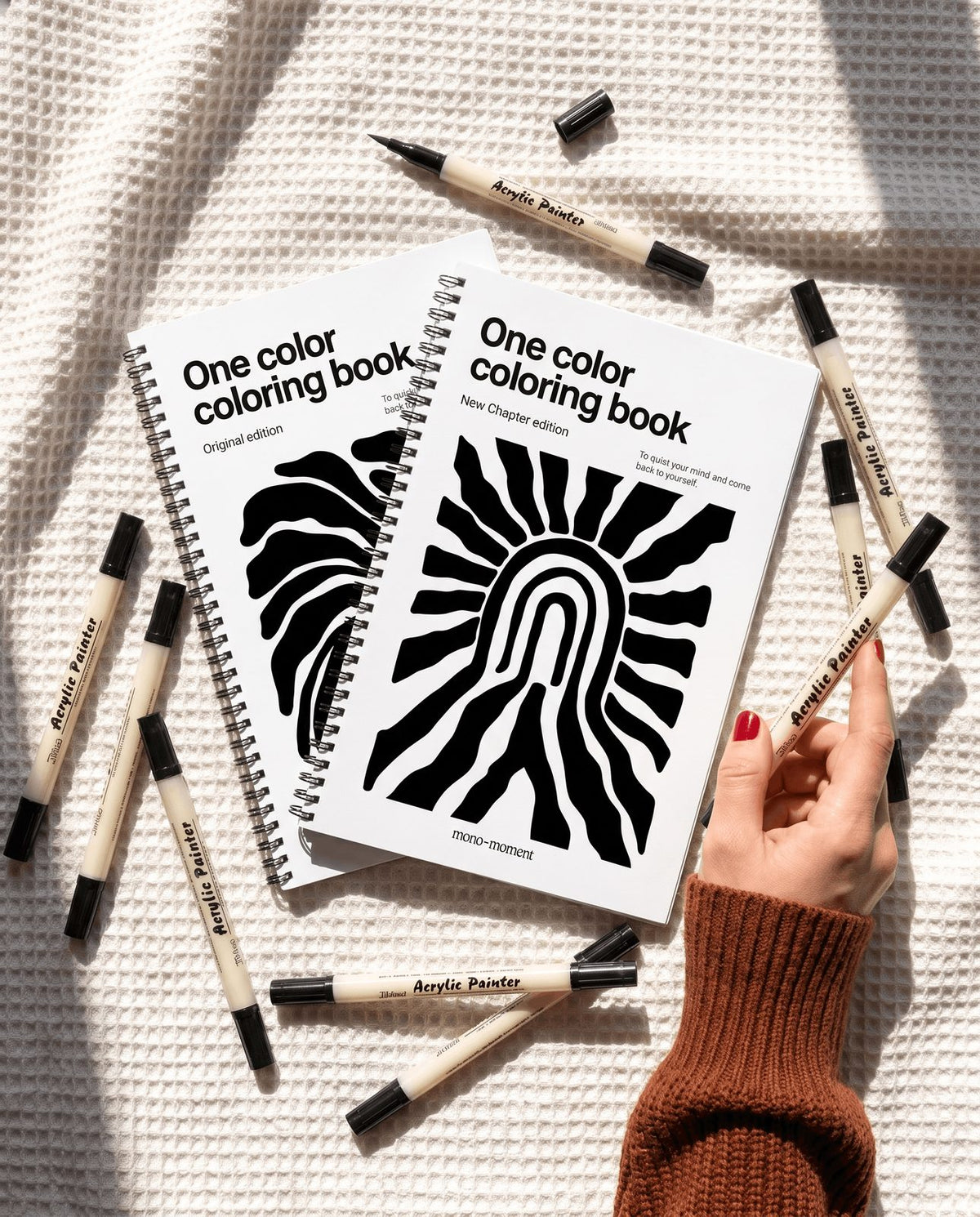
6. Single-pen coloring
The reason coloring activates parasympathetic mode so reliably is that it stacks all four signals into one activity:
- Slow rhythmic motion — the line work
- Warmth — sit at a desk with a warm drink, low lamp light
- No decision load — single pen, the book chooses the design (this is the central feature of decision-free coloring)
- Reduced sensory input — no phone, low light, no music with lyrics
A 20-minute coloring session shifts most adults from "tired but wired" to actually settled. I started doing it nightly almost two years ago specifically because nothing else was reliably producing that shift for me — meditation apps had failed, journaling helped on some nights, slow yoga helped intermittently. The coloring just worked, repeatedly, in a way that did not require any motivation.
This is the practice the One Color Coloring Book is designed around. But the principle stands whatever low-decision creative anchor you pick. Knitting works. Sketching works. Hand-copying a poem works. The book just removes the last bit of decision-making — what color, what design — that I personally found added load at the end of a long day.
7. Humming, gargling, or singing softly
This sounds like it should not work. It does. The vagus nerve runs through the throat, and vibration from humming or gargling stimulates it directly. A few minutes of low humming — to yourself, in the kitchen, in the car — produces measurable vagal-tone changes. Useful when you do not have time for a longer activity.
8. Cool water on the face
The opposite mechanism from warmth, but equally effective: a brief cold-water splash on the face triggers the mammalian diving reflex, which is a powerful parasympathetic activator. Useful in the moment of acute panic or anxiety. Splash, dab, breathe. Three or four times.
9. Being held, or holding a heavy object
Weighted blankets work for the same reason. Pressure on the body — gentle, distributed — sends a "safe and contained" signal to the nervous system. If you have a partner or a pet, that physical contact does the same. If not, a heavy blanket or a weighted lap pad has a real effect.
10. Watching moving water, fire, or trees in wind
The original parasympathetic activator. Humans evolved looking at these things. Watching a fountain, a fireplace, leaves moving, water in a glass — slow, predictable visual input — shifts the brain toward alpha-state activity. A few minutes is enough to start the shift. Twenty minutes deepens it.
Building a nightly parasympathetic ritual

You do not need ten activities. You need two or three you will actually keep doing. A simple weeknight version:
- Stop screen input by 9 p.m. — phones in another room, TVs off
- 15-minute warm-drink + low-decision activity — tea, coloring, knitting, paper book
- 5 minutes of extended-exhale breathing in bed — the 4-7-8 or just inhale 4, exhale 8
That is it. Twenty to thirty minutes total. After two or three weeks of this most adults notice the shift — falling asleep faster, sleeping deeper, waking less anxious. For deeper reading on the cortisol mechanism behind why this matters, see lowering cortisol naturally. For a more focused piece on the bedtime version specifically, see winding down before bed.
What does not work, and why
Three things adults reach for that feel parasympathetic but mostly are not:
- A glass of wine. Alcohol initially produces a parasympathetic-like sedation, but disrupts the second half of the sleep cycle. The shift you feel is followed by rebound sympathetic activation around 3 a.m. Net negative for nervous-system recovery.
- Scrolling "low-stim" content. TikTok, Instagram, and even "calming" YouTube channels keep the visual cortex actively processing change — color shifts, scene cuts, sound. The brain reads this as input, not rest.
- Productive "rest" — listening to a productivity podcast while folding laundry, reading a self-help book in the bath. Multitasking is sympathetic, even when one task is meant to be relaxing.
If your evening currently looks like one of these, the fix is not to do more. It is to remove the secondary activity. Just the bath. Just the book. Just the slow walk. The parasympathetic system reliably turns on when you stop asking the brain to do two things.
That is the broader point. Parasympathetic mode is not a thing you have to manufacture or earn. It is your body's default state when you stop fighting it. The activities above are mostly removing obstacles, not adding effort. Twenty minutes a night, mostly removing things — phone, podcasts, decisions — is enough for most adults to feel a shift within the first week.

The One Color Coloring Book
A single-pen, decision-free coloring book on 160 gsm cream paper — engineered for the wind-down ritual described above.
 Pair it with the 3 Dual Tip Brush Pens — $5 instead of $9.95 in the Book + Pens bundle.