In this article · 8 sections
- What diamond painting actually asks of you
- Alternative 1: Single-color decision-free coloring (the closest match in feel)
- Alternative 2: Cross-stitch (smaller projects only)
- Alternative 3: Latch hook rugs (very forgiving precision)
- Alternative 4: Pressed flower compositions
- Alternative 5: Sticker-by-numbers (a niche but effective dupe)
- How to pick the right alternative for you
- Sources & further reading
You started a diamond painting kit. The Pinterest thumbnail looked stunning. The first hour was meditative — placing those tiny resin diamonds on the sticky canvas, the satisfying click of each one settling, the slow reveal of color.
Then you hit hour 8. The canvas was 7% done. You realized you had 30+ hours of work ahead of you. The tweezers started to feel heavy. The sorting tray took up half your dining table.
You put it in a drawer. It's still there.
You're not alone, and the issue isn't your willpower. Diamond painting is a brilliant craft for a specific kind of person with a specific amount of time. For adults whose energy is already fractured between work, kids, and the chronic state of being tired, the time-and-precision math just doesn't work out.
This guide is for the person who tried and quietly stopped. Below are 5 alternatives that deliver the same feel — the rhythmic placement work, the meditative focus, the slow visible progress — without the 30-hour commitment.
What diamond painting actually asks of you
Before the alternatives, an honest accounting of what diamond painting demands. The kit looks innocuous. Then:
- Time. A typical 30x40cm canvas (the smallest commonly sold size) takes 8-15 hours. A 50x70cm canvas runs 30-50 hours. Pinterest mostly shows the latter. The math: you'd need to commit ~45 minutes per evening, every evening, for 6-8 weeks to finish one large piece. Most adults stop after 3-5 sessions.
- Precision. Each resin "diamond" is 2.5mm. They're placed onto numbered sticky squares. Misalignment is visible. After the first hour your eyes tire, after the second your fingers start to tremble.
- Setup and teardown. Sorting trays, drill pen, wax, tweezers, the partially-completed canvas. None of it stows easily. The "I'll just do 15 minutes" friction is real because there's no 15-minute version of the practice.
- Loss aversion. Once you're 6 hours in, abandoning feels worse than continuing. So it sits in a drawer, slowly accumulating quiet guilt.
These aren't reasons to dismiss the craft — diamond painting works beautifully for adults with consistent 1-2 hour evening blocks who genuinely enjoy long-form completion projects. If that's you, ignore this article and finish your canvas.
The alternatives below are for the rest of us.
Alternative 1: Single-color decision-free coloring (the closest match in feel)

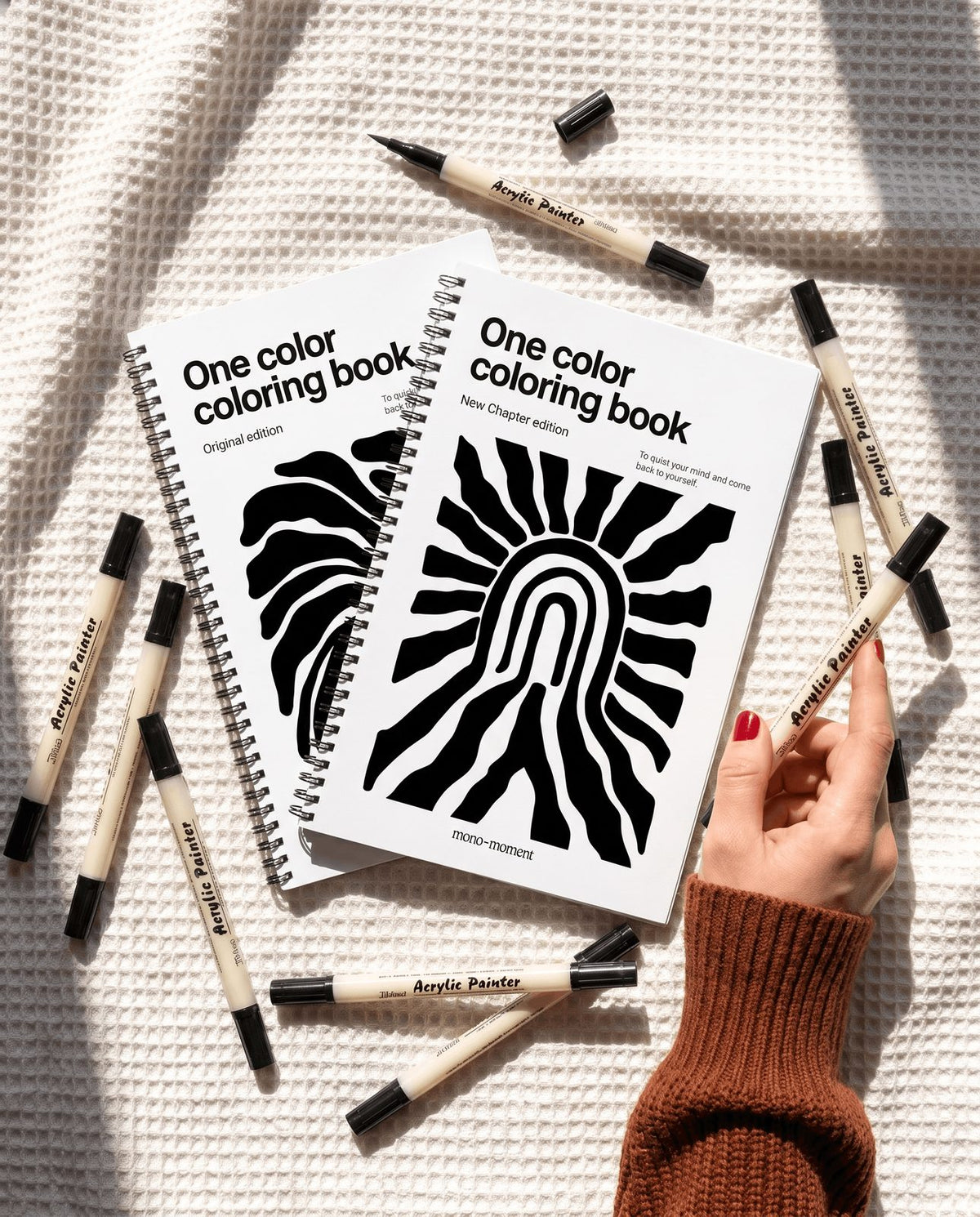
What it is: A spiral-bound book of large abstract shapes that you fill with one black brush pen. No numbered regions, no color matching, no precision work.
Why it's the closest match: It preserves the meditative repetition of diamond painting (the steady rhythm of filling) without the precision tax. Each page is a closed system — you finish it in one sitting (5-15 minutes), get the satisfaction of completion, and put the book on your bedside table for tomorrow.
What you give up: A representational image to frame. Your finished page is an abstract filled shape, not a portrait of your dog.
What you gain: Sessions that fit a real evening. Zero abandoned-project guilt. A finished page every day instead of 7% of a canvas every week.
Where to start: Mono Moment's One Color Coloring Book is purpose-built for exactly this comparison — 50+ pages, one black brush pen included, 160gsm cream paper. Ships in 24 hours. (For a deeper dive on why removing decisions calms an exhausted brain, see our decision-free coloring guide.)
Alternative 2: Cross-stitch (smaller projects only)
What it is: A pre-printed pattern with a needle and embroidery thread. You count stitches and fill the pattern.
Why it works: Same rhythmic placement work as diamond painting. Same satisfying slow reveal.
Honest critical note: Cross-stitch has the same time-trap risk as diamond painting if you pick a large project. The trick is to deliberately buy small kits — 5x5cm or 10x10cm pieces, finishable in 3-6 hours total. Resist the "ambitious 30x40cm landscape" urge. Small kits, small commitments.
Time per session: 15-30 minutes.
Total project time: 3-6 hours for small kits.
Where to start: Etsy has hundreds of small "mini" cross-stitch kits under $15.
Alternative 3: Latch hook rugs (very forgiving precision)
What it is: A pre-printed grid canvas where you tie short pieces of yarn into each square using a small hooked tool.
Why it works: Latch hook is mechanically similar to diamond painting (placement work on a printed grid) but the precision tolerance is much higher — yarn doesn't have to be perfectly aligned to look right. The output is a small textile (rug, wall hanging) which you can actually use.
Honest note: It's bulkier than diamond painting and the yarn ends are messy. Not for travel or a tidy apartment.
Time per session: 20-45 minutes.
Total project time: 5-15 hours for small projects.
Alternative 4: Pressed flower compositions
What it is: Pressing flowers and leaves between heavy books for 1-2 weeks, then arranging them on cards, in frames, or in a journal.
Why it works: It's not the same hand-motion as diamond painting, but it produces the same psychological reward — slow, low-stakes, contemplative composition with a tangible result. And unlike diamond painting, it requires near-zero materials beyond what you already have.
Honest note: The active "doing" time is small (5-10 min per session). Most of the work is waiting while the flowers press. If you need active hands, this isn't enough on its own.
Time per session: 5-15 minutes.
Total project time: 2 weeks of waiting + 30 minutes of arranging.
Alternative 5: Sticker-by-numbers (a niche but effective dupe)
What it is: A relatively new product category — books where each page is a numbered design and you place small numbered stickers into the matching squares. Same idea as paint-by-numbers but without paint, drying time, or fine-motor demand.
Why it works: Faster than diamond painting (no canvas adhesive, no drill pen, no sorting). Each page is a contained 30-60 minute session with a finished image at the end.
Honest note: The available designs are mostly representational (animals, landscapes) — if you specifically wanted abstract, this isn't your alternative.
Time per session: 30-60 minutes.
Total project time: Each page is its own complete project.
Where to find: Search "sticker by numbers book adult" on Amazon. The category is small, but growing.
How to pick the right alternative for you
The honest framework: pick based on what you actually missed about diamond painting.
| What you missed | Best alternative |
|---|---|
| The rhythmic, repetitive hand-work | Single-color coloring (#1) |
| The precision placement satisfaction | Small cross-stitch (#2) |
| Producing a usable textile | Latch hook (#3) |
| The contemplative slow practice | Pressed flowers (#4) |
| The numbered-region completion feel | Sticker-by-numbers (#5) |
If you've been honest with yourself and the missing element is the time-trap dynamic itself — the "long project to chip away at" feeling — your honest answer might be: you don't need an alternative, you need a smaller diamond painting kit. Buy a 15x15cm kit (3-5 hours total) and finish that one before deciding what comes next.
But if what you actually missed was the calm, and the project itself was just the vehicle, single-color coloring delivers the calm in 5-15 minute doses with no abandoned-project guilt waiting in your drawer.
Try the One Color Coloring Book — it's the closest functional match to diamond painting's feel, in pages that fit a real evening.
Sources & further reading
- Kaimal, G., Ray, K., & Muniz, J. (2016) Reduction of Cortisol Levels and Participants' Responses Following Art Making, Art Therapy, 33(2), 74-80 — measured 75% cortisol drop after 45 min of art-making across skill levels, no clinical art-therapist required.
- Forgeard, M. J. C. (2014) Creativity as a target and tool for positive interventions, Wiley-Blackwell Handbook of Positive Psychological Interventions.
- Conner, T. S. et al. (2018) Everyday creative activity as a path to flourishing, The Journal of Positive Psychology.
- Stuckey, H. L., & Nobel, J. (2010) The Connection Between Art, Healing, and Public Health, American Journal of Public Health, 100(2), 254-263 — review of how visual art-making lowers stress markers.

The One Color Coloring Book
A single-pen, decision-free coloring book on 160 gsm cream paper — engineered for the wind-down ritual described above.
 Pair it with the 3 Dual Tip Brush Pens — $5 instead of $9.95 in the Book + Pens bundle.