In this article · 10 sections
- 1. Single-color coloring (the lowest barrier on the list)
- 2. Pressed flowers
- 3. Friendship bracelets / simple knotwork
- 4. Photography (with one rule)
- 5. Collage
- 6. Plant arranging (not flower arranging — different skill)
- 7. Repetitive crafts: latch hook, cross-stitch, paint by numbers
- What these all share
- The 5-minute test for whether to start
- Sources & further reading
Most "easy creative hobbies for adults" lists are written by people who already enjoy creative hobbies. They list watercolor (six months to be passable), sketching (a year before your figures stop looking off), pottery (a wheel, a kiln, $300), or hand lettering (which sounds easy until your hand cramps and your "Y" looks like a "V").
These are real hobbies, and people who stick with them love them. But for the adult who's bought a sketchpad three times, started, gotten frustrated, and quietly shoved it under the bed — the issue isn't talent. The issue is the beginner penalty.
The beginner penalty is the 10-30 hour stretch where you're objectively bad at a craft and your output looks like a child's. For adults with already-depleted cognitive capacity, the ego cost of producing bad work is too high. We quit. We put the kit on a shelf. We feel guilty.
The 7 hobbies below have no beginner penalty. You can be "good" at them on day one. They're still creative — you're making something — but the skill ceiling and floor are basically the same height.
Creative hobbies that require no talent are those with no beginner penalty: the materials guide the result, nothing has to look realistic, and the first attempt is already presentable. Seven fit that test: single-color coloring, pressed flowers, friendship bracelets, phone photography of still subjects, collage, plant arranging and pattern-based crafts such as cross-stitch, latch hook or paint by numbers.
1. Single-color coloring (the lowest barrier on the list)
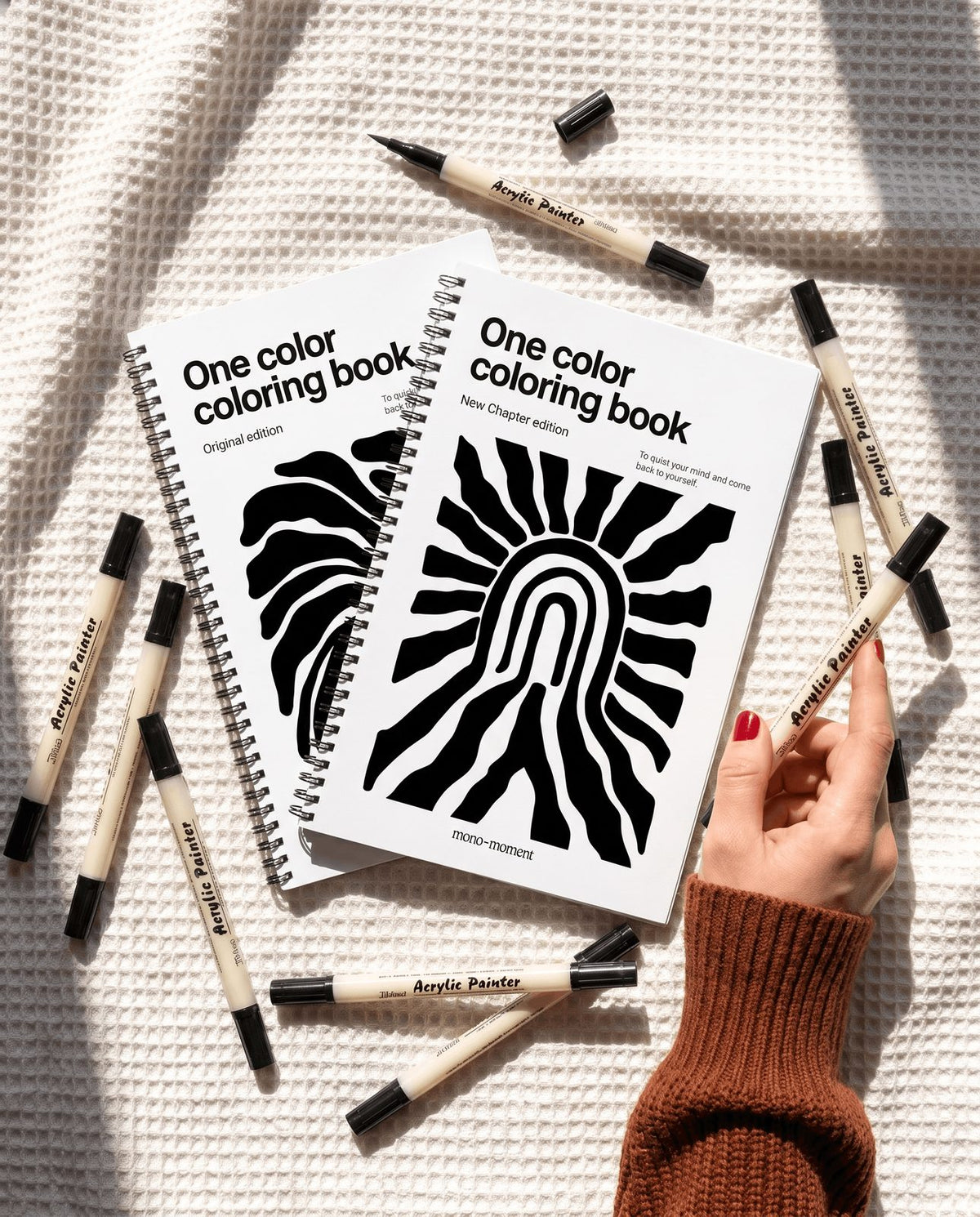
What you make: A page of bold abstract shapes filled with one solid color. (Black is best — it forgives mistakes the way pencil never will.)
Why there's no beginner penalty: There are no thin lines, no small details, no representational subjects to "get right." The shapes are designed to be filled. There's no skill to acquire — your first stroke looks the same as your hundredth.
Why it's genuinely creative: You decide the rhythm, the direction, where you finish, what stays empty. Two people coloring the same page produce noticeably different results.
Day-one outcome: A finished filled page that looks intentional, not amateur.
What you need: Mono Moment's One Color Coloring Book is built for this — large abstract shapes, 160gsm cream paper, one black brush pen included. $24.90 ships free worldwide.
2. Pressed flowers

What you make: Flowers preserved between sheets of paper, pressed under heavy books for 1-2 weeks, eventually arranged on cards or framed.
Why there's no beginner penalty: You don't have to draw the flower. You have to find one, lay it flat, and wait. Nature already made the beautiful object — you're just preserving it.
Why it's genuinely creative: Composition, choice of flower, framing, what you do with the pressed pieces afterward (cards, a frame, a journal page).
Day-one outcome: A flower in a book. (The reward comes in week 2 when you check on it.)
What you need: Flowers (a walk in any park or your own garden), heavy books, parchment paper. Total cost: $0 if you already have books.
3. Friendship bracelets / simple knotwork
What you make: A bracelet from embroidery thread, in one of three or four basic patterns (chevron, candy stripe, diagonal).
Why there's no beginner penalty: The patterns are mechanical — once you know the knot, you repeat it. There's no "off" version of a friendship bracelet. Wonky ones look intentional.
Why it's genuinely creative: Color combinations. Pattern choice. Sizing.
Day-one outcome: A small bracelet you can give to a friend or wear yourself.
What you need: $5-10 worth of embroidery thread, a clipboard or piece of tape to hold one end. YouTube has 10-minute tutorials for the three basic patterns.
4. Photography (with one rule)
What you make: A set of photos. Not portraits, not landscapes — just whatever's around you.
Why there's no beginner penalty: Modern phone cameras are forgiving. The "rule" that fixes everything: only photograph things that aren't moving. Buildings. Plants. Coffee. Shadows. Food. Skip people, skip pets, skip moving cars. Static subjects look fine on day one.
Why it's genuinely creative: Composition, light, what you choose to point the lens at.
Day-one outcome: 10-20 photos that don't make you wince.
What you need: A phone. (Don't buy a camera — that's a different hobby called "learning a camera.")
5. Collage
What you make: Cut images from magazines or printed photos, arrange them, glue them down on a page.
Why there's no beginner penalty: You're not creating the images — you're arranging them. The bar for "good arrangement" is forgivingly low.
Why it's genuinely creative: What you choose to combine. Color, theme, mood. The act of cutting itself is meditative.
Day-one outcome: A finished page that has a mood.
What you need: Old magazines (free at any library or thrift store), scissors, a glue stick, a notebook or a sheet of cardstock.
6. Plant arranging (not flower arranging — different skill)
What you make: A small composition of cuttings, leaves, or branches in a vase or jar.
Why there's no beginner penalty: You're not arranging florist-cut flowers (that's a real skill). You're putting one or two interesting branches in a jar of water. The Japanese practice of ikebana — at its most beginner-accessible — is closer to "two branches and a stone" than the bouquet you're imagining.
Why it's genuinely creative: Choice of cuttings, vessel, height, where you put it in your home.
Day-one outcome: A small arrangement on your kitchen counter that looks intentional.
What you need: A walk outside (free cuttings — local parks or your own yard), a small vase or jar, water.
7. Repetitive crafts: latch hook, cross-stitch, paint by numbers
What you make: A finished textile or canvas, made by following a pattern or chart.
Why there's no beginner penalty: The pattern tells you exactly what to do. There's no "creativity decision" you can get wrong — you're rendering someone else's design.
Why it's genuinely creative: Choice of project, color modifications you make along the way, framing of the finished piece.
Day-one outcome: A small completed section. (The full piece can take 10-30 hours.)
What you need: A kit ($15-40 depending on size). The kit comes with everything.
Honest note: This one has a slight beginner discomfort — the first 30 minutes you're awkward with the tools. But the pattern guarantees a non-embarrassing outcome by hour 2.
What these all share
Re-read the list. Notice what's not there:
- No drawing.
- No painting (except paint-by-numbers, which is following a pattern).
- No music.
- No knitting (the "I dropped a stitch" problem).
- No "writing" as a hobby.
- No bullet journaling (which feels easy but is actually a planning system + creative practice + pressure to be "aesthetic").
What the 7 above share:
- No representational subject. Nothing has to "look like a face" or "look like a tree." Abstract or pattern-based outputs are forgiving.
- The materials guide the result. Nature pressed your flower. The pattern guided your cross-stitch. The book-shape guided your coloring. You're a collaborator, not the sole author.
- Day-one output is presentable. Nothing on this list produces an embarrassing first attempt.
- Failure-tolerant. Going outside a line, picking the "wrong" color, wonky knots — none of these break the result.
If you've quit creative hobbies before, the issue was almost certainly that you picked one with high beginner penalty. There's nothing wrong with you.
The 5-minute test for whether to start
Pick one of the 7 above. Ask yourself, honestly:
- Can I get the materials by tomorrow without buying anything online? (Most of the list: yes — you have a book, a phone, scissors, a vase. The Coloring Book and the friendship-bracelet thread are the only ones you'd buy.)
- Can I do 5 minutes of it tonight? Not 30 — 5.
- Will doing it badly ruin anything?
If 1 and 2 are yes and 3 is no, that's your hobby for this week. Don't pick three. Don't research the "best" version. Just start.
If you want to start with #1, the One Color Coloring Book ships in 24 hours, comes with the pen, and you can be objectively "good" at it tonight.
The whole point of these hobbies is the absence of pressure. Don't put pressure on the choice.
Sources & further reading
- Kaimal, G., Ray, K., & Muniz, J. (2016) Reduction of Cortisol Levels and Participants' Responses Following Art Making, Art Therapy, 33(2), 74-80 — measured a 75% drop in cortisol after 45 min of art-making, regardless of skill level.
- Kuo, F. E. (2001) Coping with poverty: Impacts of environment and attention in the inner city, Environment and Behavior, 33(1), 5-34.
- Conner, T. S., DeYoung, C. G., & Silvia, P. J. (2018) Everyday creative activity as a path to flourishing, The Journal of Positive Psychology, 13(2), 181-189.
- Forgeard, M. J. C., & Eichner, K. V. (2014) Creativity as a target and tool for positive interventions, in The Wiley-Blackwell Handbook of Positive Psychological Interventions.

The One Color Coloring Book
A single-pen, decision-free coloring book on 160 gsm cream paper — engineered for the wind-down ritual described above.
 Pair it with the 3 Dual Tip Brush Pens — $5 instead of $9.95 in the Book + Pens bundle.