Tests every pen, paper and design she recommends — most evenings around 10:30pm.
Published October 7, 2026 · 7 min read
In this article · 7 sections
In short. The best markers for adult coloring books are the ones your paper can hold: water-based brush markers for most books, alcohol markers only on single-sided pages. Test on a back page first.
I'm Caroline, and I make coloring books for a living, so I've spent more evenings than I'd like to admit with a marker in one hand and a ruined page in the other. Most guides on this subject are lists of brands. I think that's the wrong starting point. The same marker can be perfect in one book and a disaster in another, and the difference is nearly always the paper.
So this guide works the other way round. First the paper you have, then the type of marker that suits it, then how to check in two minutes before you spoil a design you like.
Start with your paper, not with the marker
Paper weight is measured in grams per square meter, written gsm. The number tells you how much ink a page can take before it shows on the other side.
- Under about 100gsm. This is what most glued paperback coloring books use. It takes pencil well and markers poorly. Any marker will show through if you press or go over the same area twice.
- Around 120 to 140gsm. Better. Water-based markers are usually fine with a light hand. Alcohol markers still go through.
- Around 160gsm and above. This is where markers start to feel comfortable. A water-based marker can lay down solid color without ghosting on the back.
Two other things matter as much as the weight. The first is whether the pages are printed on one side or both. On a single-sided book, a little show-through costs you nothing. On a double-sided book it costs you the drawing on the back. The second is the binding. A spiral lets the page lie flat, which keeps your hand steady and stops ink pooling in the fold.
If your book doesn't state a weight, assume it's thin. I've written a longer guide to coloring books with thick paper if you want to go deeper on gsm.
The four types of markers, and what each is good for

Nearly every marker sold for adult coloring falls into one of four families. Knowing which family you're holding tells you most of what you need.
| Type | Ink | Bleed-through risk | Best for | Watch out for |
|---|---|---|---|---|
| Alcohol markers | Dye dissolved in alcohol | High on almost any paper | Smooth blends, large even areas, single-sided pages | Goes through the page, strong smell, refills and sets add up |
| Water-based brush markers | Dye or pigment in water | Low to medium | Everyday coloring, filling shapes, most books | Streaks if you overlap wet strokes, can pill thin paper |
| Water-based bullet or fine markers | Dye in water | Low | Medium and small areas, children's style sets | Slow on large shapes |
| Fineliners | Water-based or pigment ink | Very low | Details, outlines, tiny sections | Far too slow for filling, tips wear on rough paper |
Alcohol markers
Alcohol markers, such as the ones Copic made its name with, use dye carried in alcohol. The alcohol evaporates fast and the ink sinks into the fibers, which is why two colors melt into each other so well. It is also why the ink travels through the sheet. That isn't a fault of a particular brand. It's how the ink works.
Use them if blending is what you enjoy, and if your book is single-sided or you're happy to sacrifice the reverse. Always slide a spare sheet of paper behind the page.
Water-based brush markers
This is the family I'd point most people to. A flexible brush tip covers a large shape in a few strokes and can still reach into a corner if you lift the pressure. Water-based ink sits closer to the surface of the paper, so it shows through far less.
The trade-off is streaking. If you go back over an area while it's still wet, you get darker bands. The fix is simple: work in one direction, finish one shape before starting the next, and don't scrub.
Bullet and fine tip markers
The classic school marker has grown up. Sets with firm round tips are inexpensive, come in dozens of colors and behave predictably. They're slower than a brush on big areas and better than a brush on medium ones. A good choice for a first set.
Fineliners
Fineliners have a thin plastic or fiber tip and a very controlled flow. They're for the smallest sections of intricate designs and for tidying an edge. Filling a large shape with one is a test of patience I wouldn't wish on anyone.
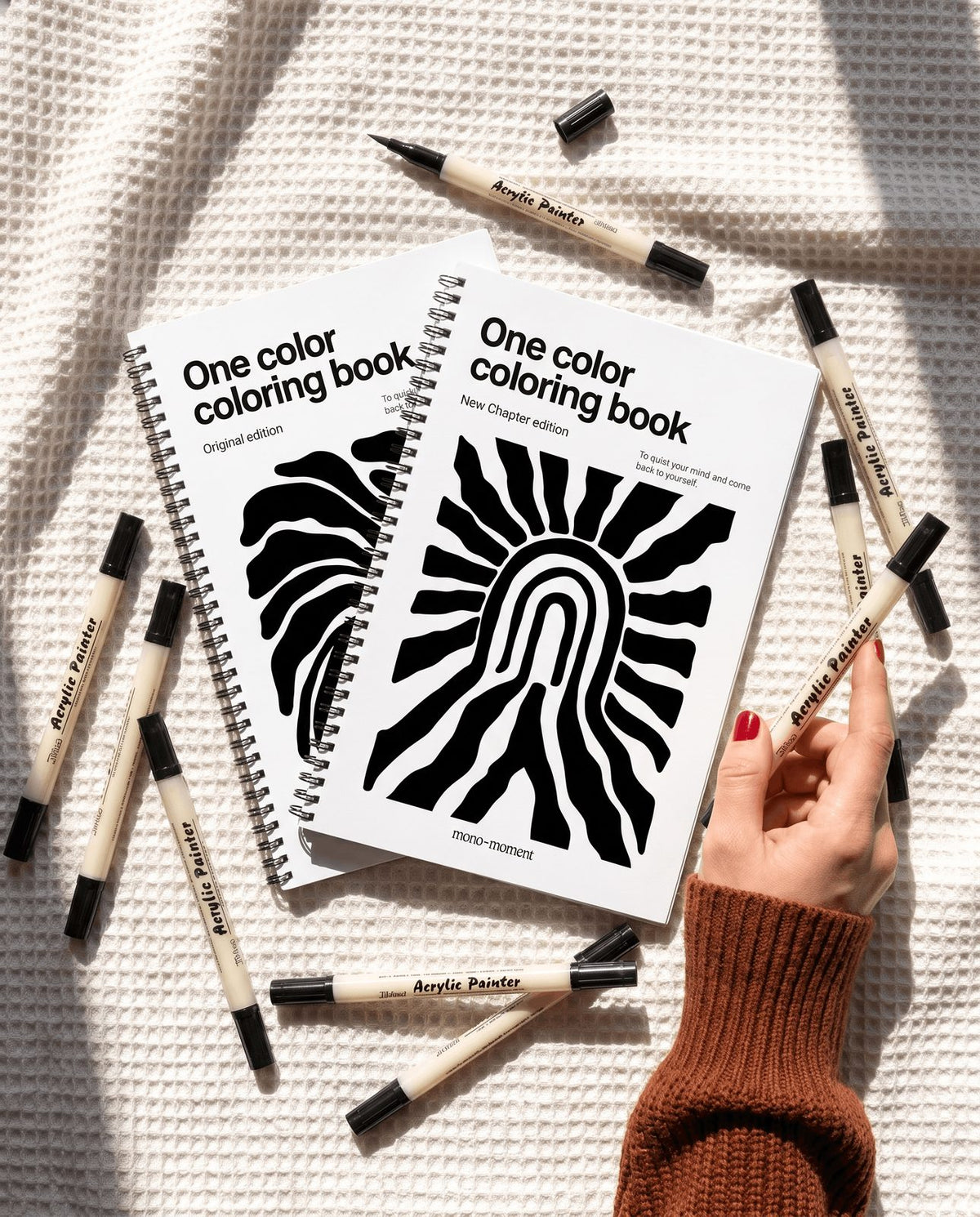
Our own pens come in sets of 3, 6 and 12: here is the set of 6 dual tip brush pens.
Which marker for which kind of coloring book
Here's how I'd match them, book by book.
Intricate mandalas and detailed patterns. Fineliners for the small cells, a fine or bullet tip for the rest. A brush tip is too wide for most of the page.
Bold and easy books with large shapes. Water-based brush markers. The shapes are big enough that a brush tip saves real time, and simple enough that streaks are easy to avoid.
Single-sided books on thick paper. This is where alcohol markers earn their place, with a blotter sheet behind the page.
Double-sided books. Water-based only, and test first. The drawing on the back is worth more than a smoother blend.
One color coloring books. One black marker with a broad tip. The whole format is built on filling marked areas in a single color, so the question of which shade to pick never comes up. This is the kind of book we make. The One Color Coloring Book is printed on 160gsm paper with a spiral binding, and we sell dual tip brush pens in black in our coloring pens collection, with a brush tip for filling and a fine tip for edges. One pen really is the whole kit.

The two-minute test before you start a page

I do this with every new book and every new marker. It has saved me more pages than any buying guide.
- Find a page you don't care about. The title page, a copyright page or the last sheet.
- Draw a square about the size of a postage stamp and fill it normally. One pass, the way you'd really color.
- Draw a second square and fill it twice. This is your worst case: the place where you'll go back over a patch.
- Wait a full minute. Ink keeps spreading after you lift the tip.
- Turn the page over and hold it to the light. A faint shadow is ghosting, and you can usually live with it. A clear mark of color is bleed-through, and you can't.
If the single pass is clean and the double pass ghosts, you can use that marker with a light hand. If the single pass already shows, change the marker or put a blotter sheet behind every page.
Five mistakes I see most often
Buying the biggest set first. A set of 120 feels like value. In practice most people use the same fifteen colors, and the other hundred and five are a decision to make every evening. The Cleveland Clinic describes how a long run of small choices wears down the quality of the ones that follow. Coloring is supposed to be the opposite of that.
Blaming the marker for the paper. If a respected marker bleeds through, the page is thin. Changing brand rarely fixes it. Changing ink type or adding a blotter sheet does.
Pressing hard. Pressure pushes more ink into one spot and crushes the tip. Let the marker do the work.
Storing dual tip markers upright. Keep them flat so both tips stay fed with ink.
Leaving caps half on. Water-based ink dries at the tip within hours. Listen for the click.
What I'd buy if I were starting today
If you asked me as a friend and not as someone with a shop, this is what I'd say.
- You have a regular paperback coloring book. A modest set of water-based markers with fine or bullet tips, twelve to twenty-four colors, and a few sheets of printer paper to use as blotters.
- You have a thick, single-sided book and love blending. A small set of alcohol markers in one color family you like, plus a colorless blender. Add more later if you find you use them.
- You want coloring to be the easy part of your day. A book with large shapes and one or two water-based brush markers. Fewer tools, fewer choices, a finished page by the time the tea is cold.
- You have a one color coloring book. A single black dual tip brush pen. A second one as a spare, because the first will run dry at the worst moment.
Whatever you choose, the test above takes two minutes and costs nothing. Do it before you fall in love with a design.
A calmer way to think about it
Research summarized by the Cleveland Clinic suggests that coloring helps because it gives the mind one simple, repetitive task to rest on. The marker is only there to serve that. The best markers for adult coloring books are the ones that let you stop thinking about markers: ink that stays on its side of the page, a tip that suits the size of the shapes, and few enough colors that you can pick one up without a debate.
If you'd like to go further, I've compared the best pens for adult coloring books in a separate guide, and looked closely at water-based markers vs alcohol markers for anyone still deciding between the two.

The One Color Coloring Book
50+ bold designs, one single color, zero decisions — on 160 gsm paper with a lay-flat spiral, engineered for the wind-down ritual described above.
 Pair it with the 3 Dual Tip Brush Pens — $5 instead of $9.95 in the Book + Pens bundle.
Sources & further reading
Frequently asked questions
What are the best markers for adult coloring books?
Which markers don't bleed through coloring book pages?
Are alcohol markers good for adult coloring books?
How many markers do I need to start?
What is the difference between a brush tip and a bullet tip?
Know someone who needs a quieter evening? Pin it · Share on Facebook ·
↑