About the author
Published April 26, 2026 · Last reviewed May 9, 2026 · 7 min read

In this article · 7 sections
TL;DR. Every time you reach for a coloring book and a tin of 24 pencils, you start the activity by making 24 little choices: which color, which area, what to pair it with. That is decision overhead. Removing it — by working with one pen on a black-and-white page — makes the whole experience faster to settle into and harder to bounce out of. This is not minimalism for its own sake. It is the cognitive science of how the calming effect of coloring actually happens.
When people first see a single-color coloring book they have one of two reactions. Some recognize it instantly — oh, of course, I've been wanting this for years. Others squint a little — but isn't that the whole point of a coloring book, the colors?
It turns out the second reaction is the one worth taking seriously, because it points to an interesting question: what exactly is the calming part of coloring? Most people would answer the colors. The research, and a fair amount of personal experience, suggests something different. The calming part is the attention pattern, not the palette. And in a lot of cases the colors are working against the calm rather than for it.
This article explains why, what cognitive science says about decision overhead in creative activities, and what changes when you remove color decisions from the equation entirely.
The hidden cost of a 24-color tin
Picture sitting down to color in the evening with a multi-color book and a fresh tin of pencils. Before you make a single mark, you have already made several decisions:
- Which page to color
- Which region of the page to start with
- Which color to use for that region
- Which colors to reserve for which other regions to avoid clashes
- Whether to commit (these are pencils, not erasable) or go light first
This is choice architecture and it is not free. The Decision Lab summarizes decision fatigue cleanly: as we make more decisions across a day, the quality and ease of subsequent decisions degrade. The classic illustration is the famous parole-judge study (which has been argued over methodologically, but the broader phenomenon — choice overload exhausting cognitive resources — is well established in everyday life).
A typical adult arrives at coloring time having made hundreds of small decisions about work, food, schedules, messages, what to ignore, what to respond to. Pulling out a 24-pencil tin says to that exhausted decision-making system: here is one more open-ended task for you. The activity that was supposed to be a break begins by extracting more of exactly the resource you came in to restore.
There is nothing wrong with multi-color coloring. It can be wonderful, and on a Saturday morning when you are fresh and unhurried it is a genuine pleasure. But as a daily evening or break-time wind-down activity, it is asking your brain to switch on the part you wanted to switch off.
What single-color coloring actually does differently

Removing color choice does three small things. They sound trivial in isolation, and they are surprisingly large in combination.
It eliminates the entry decision
Most coloring routines die not from boredom but from the friction of starting. With a multi-color setup, "should I color tonight?" is also "do I have the energy to make twenty small choices?" The honest answer is often no, and the book stays closed. With a single pen on a single-color page, the entry decision is just open the book and start. The activation energy is close to zero.
It moves attention from selection to motion
When the next color is preselected (because there is only one), the visual system stops scanning for "what would look good here?" and the motor system takes over. You start doing faster. This is the same shift that runners describe when a familiar route lets them stop navigating and start moving. It is the shortest path to flow state, which the Positive Psychology guide to mindful coloring describes as the engaged-but-quiet attention coloring is best at producing.
It rewards subtlety
A monochrome page does not let you compensate with bold color contrast. You have line weight, density, hatching direction. That is it. After three or four pages most people start noticing things they were skipping past in color books — the shape of a leaf, the rhythm of a repeated motif, the way a slow stroke looks different from a fast one. The reduced palette pushes attention into texture, which is exactly the kind of low-stakes sensory focus that calms a busy mind.
A small thought experiment
If you are still skeptical, try this: pick a familiar coloring book and color one page using only a black pen. Time yourself loosely. Notice what changes.
Most people report two things. First, the page takes less time than they expected. Second, they feel less braced afterwards — that subtle "I did a thing" energy is replaced with something quieter. Some people compare it to a long shower, where you do not remember the individual minutes but you feel different at the end.
This is not a research finding. It is the consistent informal feedback we have heard from customers and from the people we ask to test books before we publish them. Take it as a hypothesis worth one page of your time.
Why we built the One Color Coloring Book

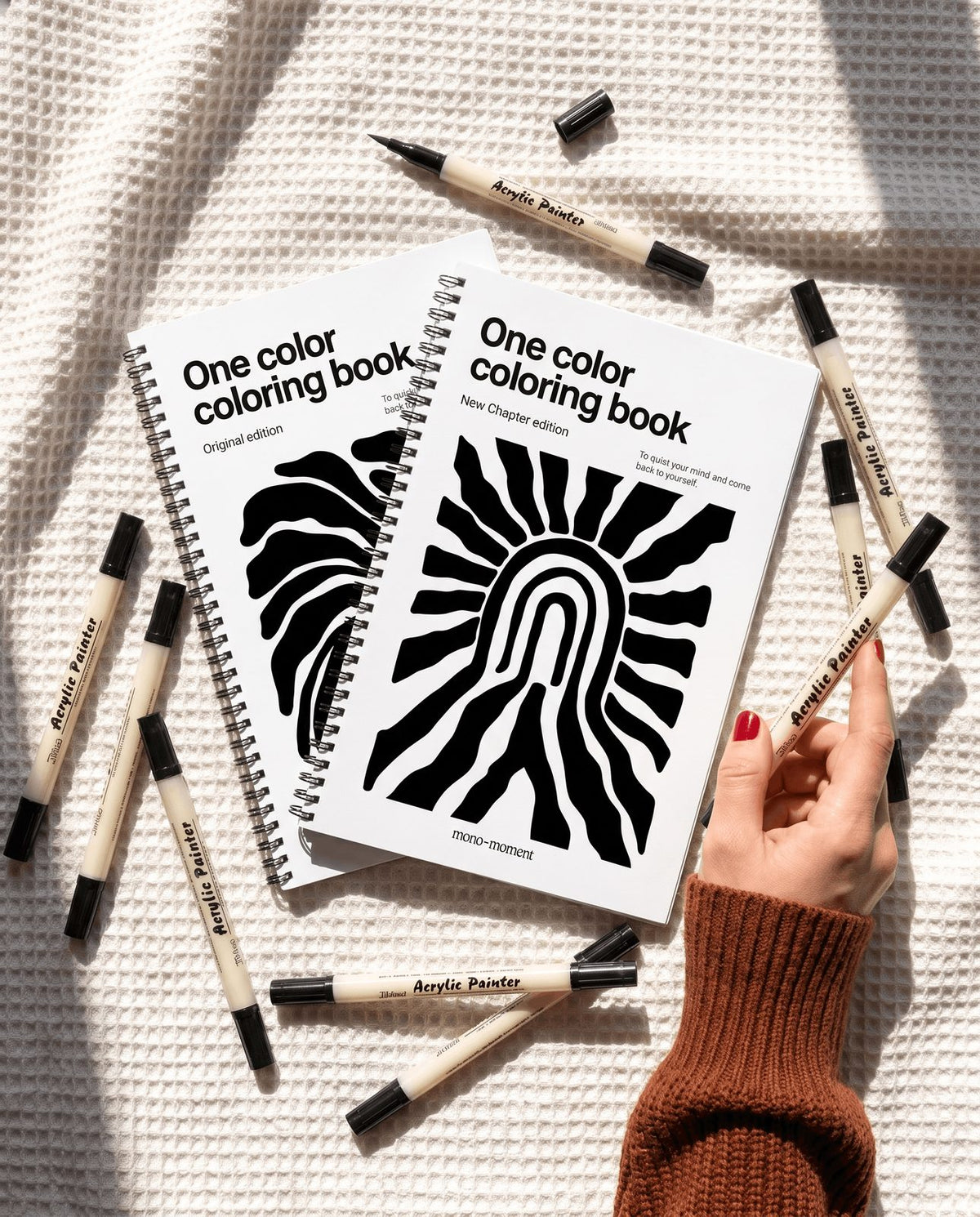
I will keep this short and honest. We make a coloring book that is designed from the first sketch for this single use case. Every page is built to be completed with one pen — usually black, sometimes whatever you have in your bag. The line work is intentionally lean: enough detail to give your hand somewhere to go, not so much that you spend the whole page deciding which corner to start in. The paper is 160 gsm, which handles gel pens, brush pens and most fineliners without bleed-through.
You do not need to buy our book to try this. A black gel pen and any line-art coloring page will give you the experience. We made the One Color Coloring Book because we wanted the same experience without the friction of finding the right page in a book that is mostly designed for color choice. If you have already tried single-color coloring and want a book purpose-built for it, that is what we are for.
How this fits into a broader mindfulness practice
A common worry: isn't this just a gimmick? Real mindfulness practice is meditation. That is one position, and there is a long tradition behind it. There is also a longer tradition — older than modern meditation as we know it — of contemplative repetitive crafts. Knitting, weaving, calligraphy, beadwork, hand-copying texts, tea preparation. None of these are gimmicks. All of them produce the same quiet, focused state that meditators chase.
Coloring fits this lineage cleanly. It is a contemplative repetitive craft. The single-color version simplifies it further so the contemplative aspect can come forward. If you have a meditation practice already, monochrome coloring is a nice complementary tool — useful especially on days when sitting still feels impossible. If you do not, it is a low-friction entry point. You do not have to call it meditation if that word does not fit. You can just call it the thing I do for fifteen minutes after dinner.
When single-color is not the right tool
Honesty matters more than a clean recommendation. There are times when monochrome is not what you want.
- You are coloring with young children who want enthusiastic color and visible variety. Keep the multi-color books on hand.
- You are using coloring for active creative play, not for calming down. The exploration of color is the point. Use the full palette.
- You enjoy the planning phase. For some people, choosing a palette is itself the relaxing part. If that is you, you do not need to fix what is not broken.
The single-color approach is a tool for a specific job: lowering the activation energy and decision overhead of a calming activity, especially during a busy week. Use it when that is the job you have. Use other tools when it is not.
Try the smallest possible version tonight
If you want to test this in the next twenty-four hours:
- Find any coloring page (printed, in a book, free download — does not matter)
- Find one black pen. Pencil works too.
- Sit down somewhere with reasonable light and color for ten minutes. Time it.
- Notice how you feel after, compared to ten minutes of phone scrolling.
That is the whole protocol. If the experience is meaningful, you will know within a week. If it is not, you have lost ten minutes — which is a smaller cost than most things we try in pursuit of calm.
If it works and you want a book designed for exactly this approach, the single-pen coloring book is built specifically around it: one page at a time, one pen, no decisions to slow you down. We also have a deeper guide to simple coloring books for adults if you want to compare options before choosing one.
The point is not the book. The point is the quiet. The book is just a way to make the quiet easier to find.

The One Color Coloring Book
A single-pen, decision-free coloring book on 160 gsm cream paper — engineered for the wind-down ritual described above.
 Pair it with the 3 Dual Tip Brush Pens — $5 instead of $9.95 in the Book + Pens bundle.