In this article · 9 sections
- What each one is, in one sentence
- What paint by numbers actually asks of your brain
- What decision-free single-color coloring asks instead
- The honest scoreboard
- Who should pick paint by numbers
- Who should pick decision-free coloring
- The deeper question: what are you actually trying to relieve?
- A small thought experiment before you decide
- Sources & further reading
If you've spent any time in the adult-mindfulness aisle of a craft store, you've probably encountered both: a paint-by-numbers canvas promising "the calm of finished art," and a single-color coloring book promising "five quiet minutes for the overthinking mind." They look like cousins. They're not.
We sell the latter, so I'll be transparent: this is a comparison written by someone who chose a side. But it's an honest comparison — paint by numbers does some things very well, and there are people who should buy it instead of our book.
This piece is for the person who's already tried one and quietly given up, or the person standing in the aisle wondering which one will actually help.
What each one is, in one sentence
Paint by numbers is a printed canvas divided into small numbered regions; you receive a kit of small numbered paint pots and you fill each region with the matching paint, eventually revealing a representational image (a landscape, a portrait, a city skyline).
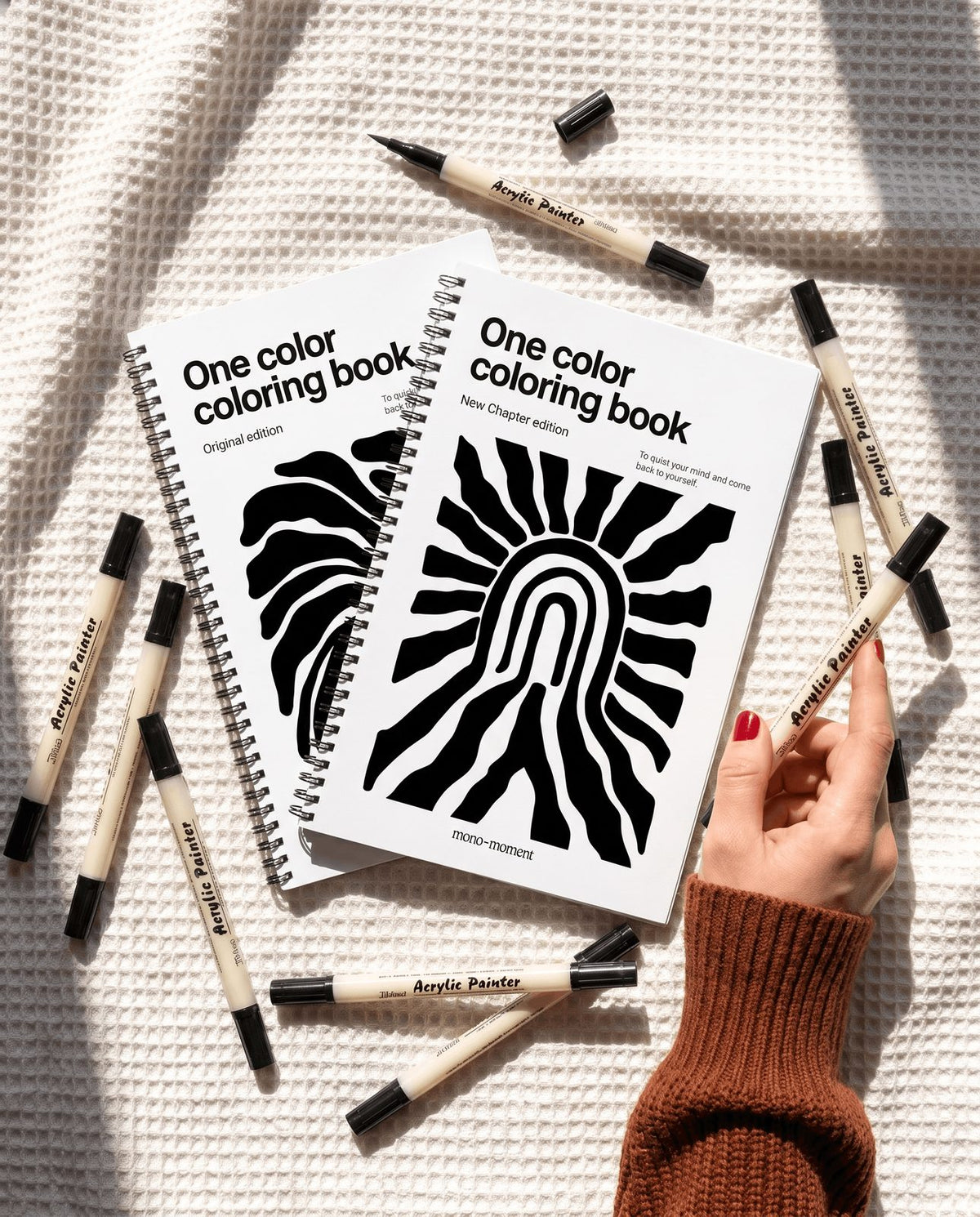
Decision-free coloring (the kind we make at Mono Moment) is a spiral-bound book of large, abstract shapes that you fill with a single black brush pen. There are no numbers, no color matching, and no representational outcome — just one shape per page and the slow rhythm of filling it in.
Both arrive in similar packaging. The cognitive demand of using each one is wildly different.
What paint by numbers actually asks of your brain

The marketing for paint by numbers leans on a phrase like "no skill required." That's true for the technical part — you don't have to draw. But the mental work is non-trivial:
- Color matching. Each numbered region maps to one of (typically) 24 to 48 paint colors. You read the number, find the matching pot, dip the right brush, return to the canvas, and place the right color. Per region. For hundreds of regions. By stroke 200 your brain is doing low-stakes pattern-recognition work that feels relaxing because it's not stressful — but it's not empty either.
- Precision. The numbered regions are small (some are 3-4mm wide). Filling them without bleeding into the adjacent region requires a steady hand, a fine brush, and visual focus. People with shaky hands, tremors, or fine-motor fatigue (which is common after a long workday) find this taxing.
- Time pressure that's invisible but real. A paint-by-numbers canvas is rarely "done in one sitting." Most kits represent 8 to 30 hours of work. The unfinished canvas in your living room becomes a small mental obligation. Some people love this; for others it sits on a side table for six months and starts to feel like another unfinished thing.
These aren't reasons to avoid paint by numbers. They're reasons to be honest about what it actually is: a long-form, low-stakes, representational craft project. It scratches the same itch as a jigsaw puzzle.
What decision-free single-color coloring asks instead
Compare that to the cognitive load of a single-color page in the One Color Coloring Book:
- One color. There is one black brush pen in the room. There is no decision to make about hue, shade, saturation, or "what looks good with what." The choice that drains most adults at the end of a workday — which one? — is removed.
- No precision. The shapes on the page are large, organic, and abstract. The "inside the lines" pressure is dialed down by design — there are no thin lines, no tiny details, no "you ruined it by going outside."
- No representational outcome. When you finish a page, you've made a filled abstract shape. There is no portrait, no landscape, no "is the face right." The page is done when you decide it's done.
The total cognitive demand is closer to: pick up pen, look at page, fill the shape. Repeat. When neuroscientists describe "structured flow" — the state where attention is engaged enough to crowd out rumination but not so engaged that it generates new tension — this is roughly what they mean.
(For a deeper look at the science behind why removing decisions calms an exhausted brain, our decision-free coloring guide covers the research.)
The honest scoreboard

This is the part where I'll try to be fair to paint by numbers.
| What you want | Paint by numbers | Decision-free single-color |
|---|---|---|
| A finished representational image to frame | ✅ Strong | ❌ Not the format |
| A 5-15 minute daily ritual | ❌ Sessions are usually longer | ✅ Designed for it |
| Almost zero cognitive load | ❌ Color matching + precision | ✅ One pen, no choices |
| Works as a wind-down ritual before sleep | ❌ Bright light + focus | ✅ Cream paper + soft light |
| Travels well | ⚠️ Bulky, paint pots | ✅ Spiral book + one pen |
| Helps with overthinking specifically | ⚠️ Indirect | ✅ Designed for it |
| Engages perfectionists who like a "right" answer | ✅ The numbers are the answer | ❌ Intentionally no answer |
| Costs less than $30 | ⚠️ Bigger kits run higher | ✅ Single book $24.90 |
If you read down that table and stopped at "finished representational image to frame," paint by numbers is the right call. Don't let me talk you out of a finished landscape on your wall.
If you stopped at "5-15 minute daily ritual" or "wind-down before sleep" or "helps with overthinking," you're in the territory where decision-free coloring is genuinely a better tool.
Who should pick paint by numbers
I want to make this list as useful as possible, because we shouldn't pretend our format is universal.
- People who feel calm by completing a long, structured project (the same brain that loves jigsaw puzzles).
- People who genuinely enjoy color matching and have no decision fatigue around it.
- People who want a finished, frameable result — a gift, a piece for their wall, a painting "done by them."
- People with consistent 1-2 hour blocks and no preference for short rituals.
- Beginners who explicitly want representational images (cats, landscapes, famous paintings) and would feel "let down" by abstract shapes.
If most of those describe you, buy a paint-by-numbers kit. We'd rather you have the right tool than the wrong one with our logo on it.
Who should pick decision-free coloring
- People whose brain has already made hundreds of micro-decisions by the time they sit down (most knowledge workers, most parents, most people in their 30s and 40s).
- People who've tried mandala books and abandoned them after a few pages.
- People who want a 5-15 minute window, not a 10-hour project.
- People who want this to be a sleep ritual specifically.
- People who already know they don't care about a representational outcome — they want the practice itself, not a thing to frame.
- Highly sensitive people, overstimulated parents, post-burnout adults, anyone whose nervous system is already running hot.
(If point 5 was a no for you — you do want something to keep — paint by numbers might still be the better fit.)
The deeper question: what are you actually trying to relieve?
The reason these two products feel similar but produce different effects is that they target different problems.
Paint by numbers targets boredom and the desire to make something. It's an antidote to the empty Sunday afternoon, the long evening alone, the period when you want a project. The brain is happy because it has a clear, low-stakes task to chip away at.
Single-color decision-free coloring targets decision fatigue and the inability to switch off. It's an antidote to the post-work spiral, the 9pm doomscroll, the bedtime brain that won't quiet. The brain is happy because, for once, it's been given absolutely nothing to decide.
If you mostly need a project, paint by numbers wins. If you mostly need to stop, decision-free coloring wins.
A small thought experiment before you decide
Picture yourself in your most overstimulated state — maybe it's 8pm on a Wednesday, you've been "on" since 7am, and your brain is sour and tired. Now imagine, in that exact state:
- Sitting down with 32 tiny pots of paint, a numbered canvas with 600 regions, and a fine brush.
- Sitting down with one black pen, one bold abstract shape, and 5 minutes.
The first is a project. The second is a release. Both have value. They're not the same thing.
If, on a normal Wednesday, the second sounds more like what you actually need, that's your answer.
Our One Color Coloring Book is built for exactly that Wednesday.
Sources & further reading
- Csikszentmihalyi, M. Flow: The Psychology of Optimal Experience (1990) — for the structured-flow framework. Wikipedia overview.
- Vohs, K. D. et al. (2008) Making Choices Impairs Subsequent Self-Control, Journal of Personality and Social Psychology, 94(5), 883-898 — foundational decision-fatigue research.
- Kaimal, G., Ray, K., & Muniz, J. (2016) Reduction of Cortisol Levels and Participants' Responses Following Art Making, Art Therapy, 33(2), 74-80 — measured a 75% drop in cortisol after 45 minutes of art-making.
- Drexel University (2016) Press release on the Kaimal cortisol study.

The One Color Coloring Book
A single-pen, decision-free coloring book on 160 gsm cream paper — engineered for the wind-down ritual described above.
 Pair it with the 3 Dual Tip Brush Pens — $5 instead of $9.95 in the Book + Pens bundle.