About the author
Published June 25, 2026 · Last reviewed October 6, 2026 · 10 min read

In this article · 7 sections
- What "regulating your nervous system" actually means
- The accelerator and the brake: sympathetic vs parasympathetic
- The vagus nerve, carefully
- What dysregulation actually feels like
- How to regulate your nervous system: the core techniques
- Building a daily nervous system reset (the single-channel idea)
- When to get help
TL;DR. To regulate your nervous system, help your body shift out of fight-or-flight and back into rest-and-digest. The most reliable levers are a longer exhale than inhale (breathe in for 4, out for 6–8), brief cold exposure, gentle movement, grounding your attention in the present, and a single quiet low-decision task. A short session calms the body in minutes; consistent practice makes your whole system easier to settle over time.
Some days your body just will not settle. Your heart is a little too fast, your shoulders are up by your ears, your mind keeps skittering, and nothing has actually gone wrong. You are not in danger. You are dysregulated — your nervous system is stuck in the "on" position and has forgotten how to come back down.
I spent a long time treating that state as a personality problem. I am just a tense person, I figured; I just run hot. It was a relief, honestly, to learn that "regulating your nervous system" is a real, learnable skill with real physiology behind it — not a vibe, not a wellness slogan, but a set of specific levers you can pull to move your body from alert back to calm.
This is a practical guide to those levers. I will explain what regulation actually means, what is happening in the two branches of your autonomic nervous system, the role of the vagus nerve (carefully — there is a lot of overclaiming online), what dysregulation feels like, and then the concrete techniques that work, in roughly the order I reach for them. Where I make a physiological claim, I have cited a reputable source so you can check it yourself.
Regulating your nervous system means restoring flexibility between the sympathetic accelerator and the parasympathetic brake, not staying calm all the time. Calm cannot be forced, but the body can be sent signals of safety. The fastest lever is a longer exhale: breathe in for about four counts and out for six to eight, for a minute or two.
What "regulating your nervous system" actually means
Your autonomic nervous system runs the background processes you do not consciously control — heart rate, breathing, digestion, the stress response. It has two main branches that work like a seesaw.
The sympathetic branch is the accelerator: the fight-or-flight system that ramps you up to meet a challenge. The parasympathetic branch is the brake: the rest-and-digest system that brings you back down. In a healthy day you tip gently between them — a little activation to handle something stressful, then a return to calm afterward.
Regulation is not living permanently in the calm state. That is neither possible nor desirable; you need sympathetic activation to wake up, focus, exercise, and handle real problems. Regulation is flexibility — the ability to ramp up when you genuinely need to, then return to baseline when the demand passes. A dysregulated system has lost that flexibility. The accelerator gets stuck on, the brake gets weak, and small things produce big reactions.
So when we talk about how to regulate your nervous system, we are really talking about two things: short-term resets that break a stress state in the moment, and longer-term practice that makes the whole system more flexible over time. Both matter. The techniques below cover both.
The accelerator and the brake: sympathetic vs parasympathetic

It is worth understanding the machinery, because the techniques make more sense once you do.
When your brain registers a demand or a threat — real or perceived — the sympathetic branch fires. As the American Psychological Association explains in its overview of stress effects on the body, this triggers the release of adrenaline and cortisol, which speed up your heart, quicken your breathing, tense your muscles, and sharpen your alertness. This is exactly what you want if you need to react fast. It is exhausting and miserable when it switches on for a crowded inbox or a difficult conversation and then will not switch off.
Recovery is the parasympathetic branch's job. The APA notes that once a stressor passes, the body is meant to return to baseline — heart rate and breathing slow, muscles loosen. The problem in modern life is that activation rarely fully passes. One demand stacks on the next, the recovery cycle never completes, and the system drifts toward chronic sympathetic dominance. This is why dysregulation is cumulative rather than sudden, and it is closely tied to staying in a high-cortisol state; if that is your pattern, it is worth reading specifically about how to lower cortisol levels fast.
The good news hidden in this design: the seesaw works both ways. You cannot consciously command your heart to slow down, but you can deliberately do the things that activate the parasympathetic brake — and the body follows. That is the entire basis of nervous system regulation. You do not force calm; you send the signals that let calm happen.
The vagus nerve, carefully
You cannot read about nervous system regulation online without running into the vagus nerve, and a lot of what is written about it is overstated. Here is the careful version.
The vagus nerve is the longest cranial nerve and the main highway of the parasympathetic system, connecting the brain to the heart, lungs, and gut. The Cleveland Clinic describes the vagus nerve as a key part of the parasympathetic "rest-and-digest" system, helping control heart rate, digestion, and the calming of the body after stress. Activities that gently engage it — slow exhalation, humming, gargling, cold-water exposure on the face — are thought to support parasympathetic activity, which is why so many calming techniques cluster around the breath and the face.
What I want to be honest about: you will see confident claims online that specific "vagus nerve resets" or "polyvagal exercises" produce dramatic, guaranteed effects, often referencing polyvagal theory. Polyvagal theory is an influential framework, but parts of it remain debated and not fully established in the research, so I am not going to present it as settled science. You do not need to buy any particular theory for the practical techniques to work. The underlying physiology — that a longer exhale and reduced input shift you toward the parasympathetic state — is well supported on its own. Treat the vagus nerve as a useful map of why these techniques help, not as a magic button.
What dysregulation actually feels like

Most people do not notice dysregulation as "my nervous system is stuck on." They notice the symptoms and assume something is wrong with them specifically. It shows up across the body, emotions, and mind at once.
In the body: a fast or pounding heart at rest, shallow chest breathing, tension in the shoulders, neck, or jaw, a jittery or wired feeling, disrupted sleep, digestive upset, and a tiredness that rest does not seem to fix.
In the emotions: quick irritability, a short fuse, feeling overwhelmed by ordinary demands, tearfulness for no clear reason, or a flat, shut-down numbness when the system has been over-activated too long.
In the mind: racing thoughts, trouble concentrating, difficulty making small decisions, and that "buffering," can't-quite-land feeling. Much of this overlaps with sensory and cognitive overload — if it resonates, it is worth understanding what does overstimulated mean, because being chronically overstimulated is one of the most common roads into a dysregulated state.
None of these signs are diagnostic on their own, and many have other causes. But if you regularly hit a cluster of them — especially at the same time of day — there is a good chance your nervous system is leaning hard toward the accelerator and needs deliberate help getting back to the brake.
How to regulate your nervous system: the core techniques
Here are the levers, in roughly the order I reach for them. None require equipment, an app, or a class. The principle underneath all of them is the same: send your body the signals of safety and let the parasympathetic brake take over.
1. Lengthen the exhale. This is the fastest and most reliable lever you have. Breathe in for about four counts and out for about six to eight. The extended out-breath directly nudges the parasympathetic system on, slowing the heart within a minute or two. A 2023 randomized controlled trial in Cell Reports Medicine found that just five minutes a day of structured breathwork — particularly "cyclic sighing," which emphasizes a long exhale — improved mood and lowered resting respiratory rate more than mindfulness meditation over a month, evidence that slow, exhale-focused breathing measurably shifts physiological arousal. If you remember only one technique from this article, make it this one.
2. Use cold, briefly. Splashing cold water on your face, holding a cold pack to your cheeks and the sides of your neck, or ending a shower with thirty seconds of cool water triggers a calming reflex via the face and the vagus nerve. It is a fast circuit-breaker for a spike of panic or anger — not a daily ritual so much as an emergency reset.
3. Move, gently. A short walk, some slow stretching, shaking out your hands and arms, or rolling your shoulders helps discharge the physical charge of a stress response. Movement tells a body braced for fight-or-flight that the "action" has happened, so it can stand down. Gentle is the key word; an intense workout can be its own stressor when you are already maxed out.
4. Ground your attention in the present. Dysregulation pulls your mind into the future (worry) or the past (rumination). Grounding drags it back to now: name five things you can see, four you can hear, three you can touch; press your feet into the floor and feel the contact; hold something textured. The NIH's complementary health center notes that grounding and other relaxation techniques help bring about the body's "relaxation response" — slower breathing, lower heart rate, lower blood pressure — which is the literal opposite of the dysregulated state.
5. Reduce input, then add one quiet channel. This is the step people skip, and it is often the one that matters most. You cannot regulate a system you keep feeding. Dim the lights, lower the noise, put the phone in another room. Then give your scattered attention one slow, single-channel task to land on — washing dishes by hand, folding laundry, a quiet hobby, or single-color coloring. Removing decisions and competing inputs is itself a regulating signal.
That last point is the bridge to the rest of my evenings, so let me be specific about it.
Building a daily nervous system reset (the single-channel idea)

The techniques above are reactive — they break a stress state once it has already spiked. But the deeper win is making your whole system more flexible, and that comes from practice, not crisis management. The way you do that is by building a small, repeatable daily reset that your nervous system learns to recognize.
The most important property of a daily reset is that it should require no decisions. This sounds like a minor detail and it is actually the whole thing. Decision-making draws on the same regulatory budget as sensory input — every choice is a small demand. So a wind-down ritual full of choices ("what should I do tonight, what should I watch, which option, which color") quietly keeps the accelerator running even while you are trying to relax. A genuinely regulating ritual removes choice entirely.
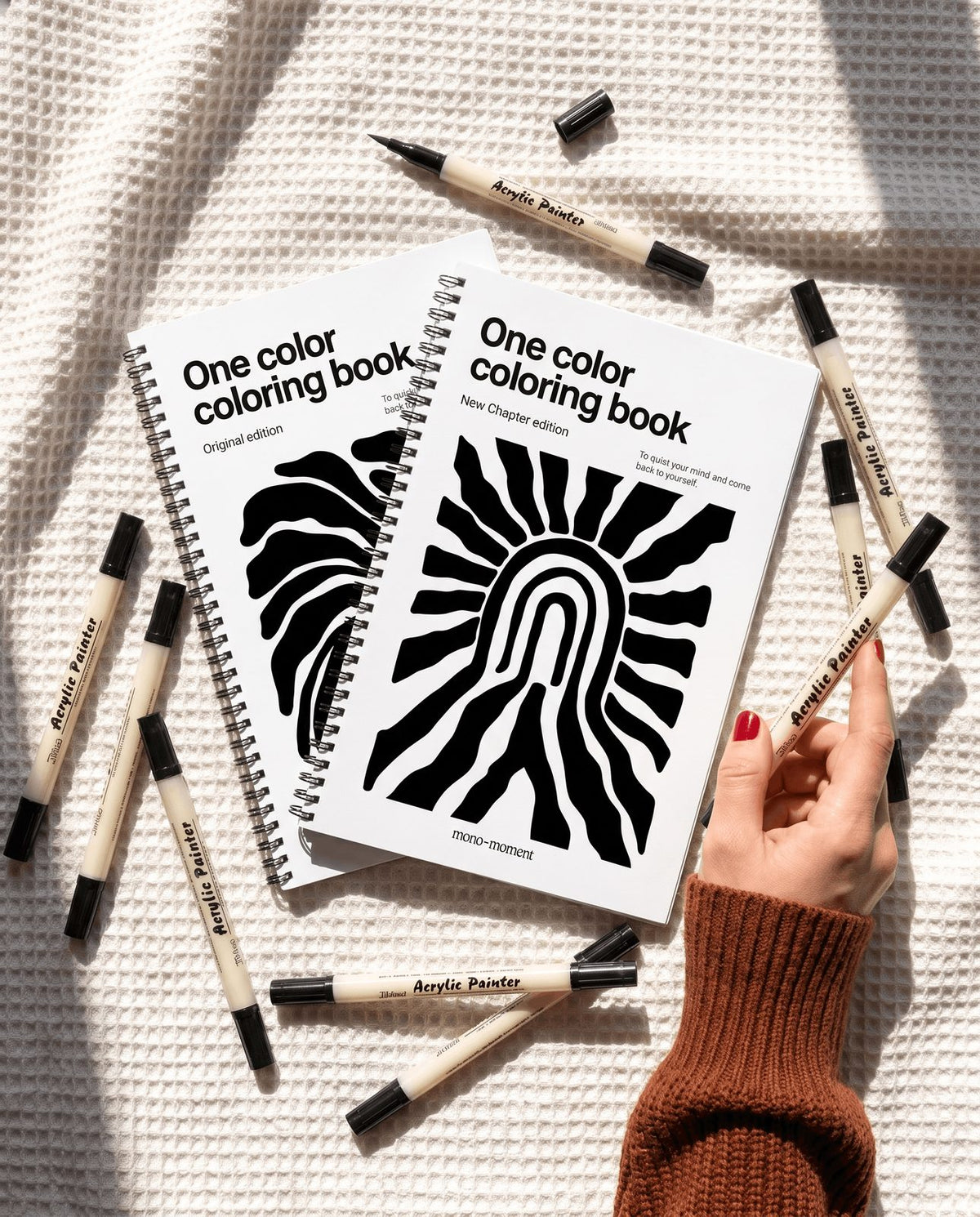
For me, that has been a one color coloring book. It is a single-pen, single-color book where the design is already drawn and all I do is fill the shapes. There is no palette to choose, no picture to plan, nothing to get wrong. After a day of hundreds of micro-decisions, that absence of choice is the entire point — it is rest for the part of me that is tired, not just for my body. The slow repetitive motion, the narrow focus, the quiet posture, and the zero decision load stack the parasympathetic conditions together in one simple practice. If you want a fuller menu built on the same principle, my round-up of parasympathetic nervous system activities lists more options; this article is the why and how behind them.
A reliable daily reset looks like this: a fixed cue (same time, same spot), reduced input (lamp instead of overhead, phone away), one of the breathing patterns above to start, and then ten to twenty minutes of a single quiet task. Do it consistently and something useful happens — your nervous system learns the off-ramp, and over weeks it gets faster at taking it. Mine is almost aggressively boring: lamp on, phone in the other room, chamomile tea, ten minutes filling shapes in the same single-pen coloring book. The boredom is the feature. Regulation is built from repetition, not novelty.
When to get help
Self-regulation techniques are powerful and, for everyday stress and overwhelm, they are often enough. But they are not a substitute for care when something more is going on.
If your dysregulation is severe, constant, or getting worse — if you are having panic attacks, your sleep has collapsed, you feel persistently numb or hopeless, or the symptoms are interfering with daily life — please talk to a doctor or a qualified mental health professional. The same is true if you have a history of trauma; trauma-related dysregulation often needs the support of a trained therapist rather than self-help alone, and that is a sign of doing this well, not failing at it.
Used in the right place, though, the core idea is genuinely freeing: a nervous system that feels stuck on is not broken, and it is not your personality. It is a system that has lost some flexibility and can relearn it — one long exhale, one quiet ritual, one return to baseline at a time.

The One Color Coloring Book
A single-pen, decision-free coloring book on 160 gsm cream paper — engineered for the wind-down ritual described above.
 Pair it with the 3 Dual Tip Brush Pens — $5 instead of $9.95 in the Book + Pens bundle.