About the author
Published June 25, 2026 · Last reviewed October 6, 2026 · 10 min read

In this article · 6 sections
TL;DR. Being overstimulated means your nervous system has taken in more input — noise, light, screens, decisions — than it can process at once, tipping into a fight-or-flight state. The signs: irritability, a racing or foggy mind, a pounding heart, an urge to escape. The fix is less input — dim the lights, mute the noise, slow your exhale, and give your brain one quiet, low-decision task.
You know the feeling even if you have never had a word for it. The kids are talking, the TV is on, your phone buzzes, the kitchen light is too bright, and somewhere in the middle of it all something in you just trips. You snap at someone who did not deserve it. You want everyone to stop talking. You would give almost anything for ten minutes of silence and a dark room.
That is overstimulation. And it is one of the most common — and most misunderstood — experiences of modern adult life.
I started paying close attention to my own overstimulation about two years ago, when I realized that the 6 p.m. version of me was a different person than the 10 a.m. version: shorter-tempered, foggier, weirdly fragile. Nothing was wrong. I was just full. My nervous system had hit its ceiling for the day, and I had no idea that was a real, physical thing with a name.
This is the explainer I wish I had read back then. What "overstimulated" actually means, what is happening in your nervous system when it tips, the signs to watch for, the everyday triggers most people never connect to it, and — the part that matters most — how to bring an overstimulated system back down.
Overstimulated means the nervous system has received more input than it can comfortably process at one time. That input can be sensory (sound, light, touch, screens) or cognitive (decisions, notifications, conversations). Once the load exceeds the brain's filtering capacity, the body switches into a fight-or-flight stress response, which shows up as irritability, brain fog, a racing heart and an urge to leave.
What "overstimulated" actually means
Overstimulated means your nervous system has received more input than it can comfortably process at one time.
That input can be sensory — sound, light, smell, touch, movement, screens — or it can be cognitive: decisions, notifications, conversations, problem-solving, mental tabs left open. Your brain is constantly filtering all of it, deciding what matters and what to ignore. That filtering has a budget. When the incoming load exceeds the budget, the system stops coping smoothly and flips into a stress response instead.
The Cleveland Clinic describes sensory overload as what happens when input from your senses "feels overwhelming" and triggers a physiological reaction — the sympathetic nervous system switching on a fight-or-flight response. In other words, your body reacts to a noisy, bright, busy room the same way it would react to genuine danger, because to an overloaded nervous system, "too much" is a kind of danger.
The key thing to understand is that overstimulation is not weakness, drama, or being "too sensitive" in the dismissive sense. It is a normal physiological limit being reached. Everyone has the limit. Some people just reach it faster than others — and almost everyone reaches it more easily than they did before the average day became this loud.
What's happening in your nervous system

Your autonomic nervous system has two branches that work like a seesaw.
The sympathetic branch is the accelerator — the fight-or-flight system. The parasympathetic branch is the brake — the "rest-and-digest" system that calms you back down. In a well-regulated day, you tip gently back and forth between them: a little activation to handle something stressful, then a return to calm.
Overstimulation is what happens when the accelerator gets stuck on. As the American Psychological Association explains in its overview of stress effects on the body, the sympathetic nervous system triggers the release of adrenaline and cortisol, mobilizing your body for action — faster heart rate, quicker breathing, tense muscles, heightened alertness. That is exactly what you want if you need to sprint away from something. It is exhausting and miserable when the "something" is just a normal Tuesday with too much going on.
The APA also notes that recovery from stress is supposed to be handled by the parasympathetic system — but when activation is near-constant, that restoration cycle never fully completes. This is why overstimulation is cumulative. A single loud meeting will not undo you. A loud meeting on top of a poor night's sleep, on top of three weeks of low-grade overload with no real recovery, will. By evening, your seesaw is jammed in the "on" position and the smallest extra input feels unbearable.
That is also why the solution is not to push through. Pushing through adds input. The solution is to deliberately hand the controls to the parasympathetic brake — which we will get to.
The signs and symptoms of overstimulation
Overstimulation shows up in the body, the emotions, and the mind at the same time. Most people notice the emotional signs first and never connect them to the physical ones.
Emotional and behavioral signs:
- Sudden irritability or anger over something small
- Feeling "touched out" — not wanting to be talked to, hugged, or asked anything
- A strong urge to leave the room, the conversation, or the building
- Feeling overwhelmed and tearful for no clear reason
- Snapping at the people closest to you, then feeling guilty
Cognitive signs:
- A racing mind, or the opposite — a foggy, blank, "buffering" mind
- Trouble making even small decisions (what to eat, what to watch)
- Losing your train of thought mid-sentence
- Difficulty concentrating or reading a paragraph without rereading it
Physical signs:
- A pounding or racing heart
- Shallow, fast breathing
- Tension in the shoulders, neck, or jaw
- Feeling hot, flushed, or jittery
- A headache or a clenched, wound-up feeling behind the eyes
The Cleveland Clinic lists very similar markers — stress, anxiety, confusion, irritability and racing thoughts on the mental side; dizziness, a flushed face, trembling, sweating and chest tightness on the physical side. If you regularly hit several of these at the same time of day, you are most likely not "in a bad mood." You are overstimulated.
Everyday triggers most people miss

When people picture sensory overload, they picture extremes: a packed concert, Times Square, a screaming toddler in a tiled restaurant. Those absolutely qualify. But the overstimulation that quietly wrecks most adults' evenings is built from much smaller, more constant inputs that never feel dramatic on their own.
Screens and notifications. Every ping is a micro-demand on your attention. A day of Slack, email, group chats, and half-watched video is a day of thousands of tiny interruptions, each one a small hit of sympathetic activation.
Background noise. Open-plan offices, the TV left on, traffic, a dishwasher, overlapping conversations. Your brain processes all of it whether you consciously hear it or not.
Decision fatigue. This is the one people most often miss. Every choice you make — what to wear, what to reply, which option to pick, what to make for dinner — spends a little of the same regulatory budget. By evening, after hundreds of small decisions, your capacity to handle any more input is depleted. Decision load and sensory load draw from the same well, which is exactly why a low-decision wind-down works so well as a reset.
Social load. Conversation is high-bandwidth input: words, tone, faces, subtext, your own responses. Even pleasant social time spends the budget, which is why introverts (and most parents) hit the wall after a long stretch of it.
Light, especially at night. Bright overhead and blue-heavy screen light late in the day keep the alert system switched on when it should be powering down.
None of these is a problem in isolation. The problem is the stack. Five "minor" inputs running at once, all day, with no real gaps, is how an ordinary day quietly fills the tank — and why understanding cognitive overload symptoms matters as much as understanding sensory ones. If this pattern sounds permanent rather than occasional for you, it is worth reading about calming activities for highly sensitive people, because a more sensitive nervous system reaches this ceiling faster by design.
How to calm an overstimulated nervous system
The instinct when overstimulated is to do more — push through the task, finish the conversation, power down the to-do list. That is the exact wrong move. You cannot calm an overloaded system by adding load. You calm it by subtracting input and then giving the parasympathetic brake something gentle to grab onto.
Here is the sequence I use, in order.
1. Cut the input first. Before anything else, reduce what is coming in. Dim or turn off overhead lights. Mute or leave the noise. Put the phone in another room — not face-down on the table, in another room. Step somewhere quieter, even if it is the bathroom or the car for two minutes. You are lowering the tide before you try to do anything clever.
2. Slow your exhale. The fastest physical lever you have is your breath, specifically a long exhale. Breathe in for about four counts, out for about six to eight. The extended out-breath directly nudges the parasympathetic system on. The NIH's complementary health center notes that breathing exercises and other relaxation techniques help bring about the body's "relaxation response" — slower breathing, lower heart rate, lower blood pressure — which is the literal opposite of the overstimulated state.
3. Give your brain one single-channel task. An overstimulated brain is being pulled in ten directions. The relief of a single, undemanding, repetitive task is that it gives all that scattered attention one quiet place to rest. A short walk works. So does washing dishes by hand, folding laundry, or — my own default — single-color coloring, where there are no decisions to make and nothing to get wrong. The point is one channel, low stakes, no choices.
4. Warmth and dim light. A warm drink, a blanket, lamps instead of overheads. These are not just comforting clichés; warmth and low light are genuine calming signals to the nervous system.
For a clinician's walk-through of bringing an overstimulated system down in the moment, this short explainer is worth the few minutes:
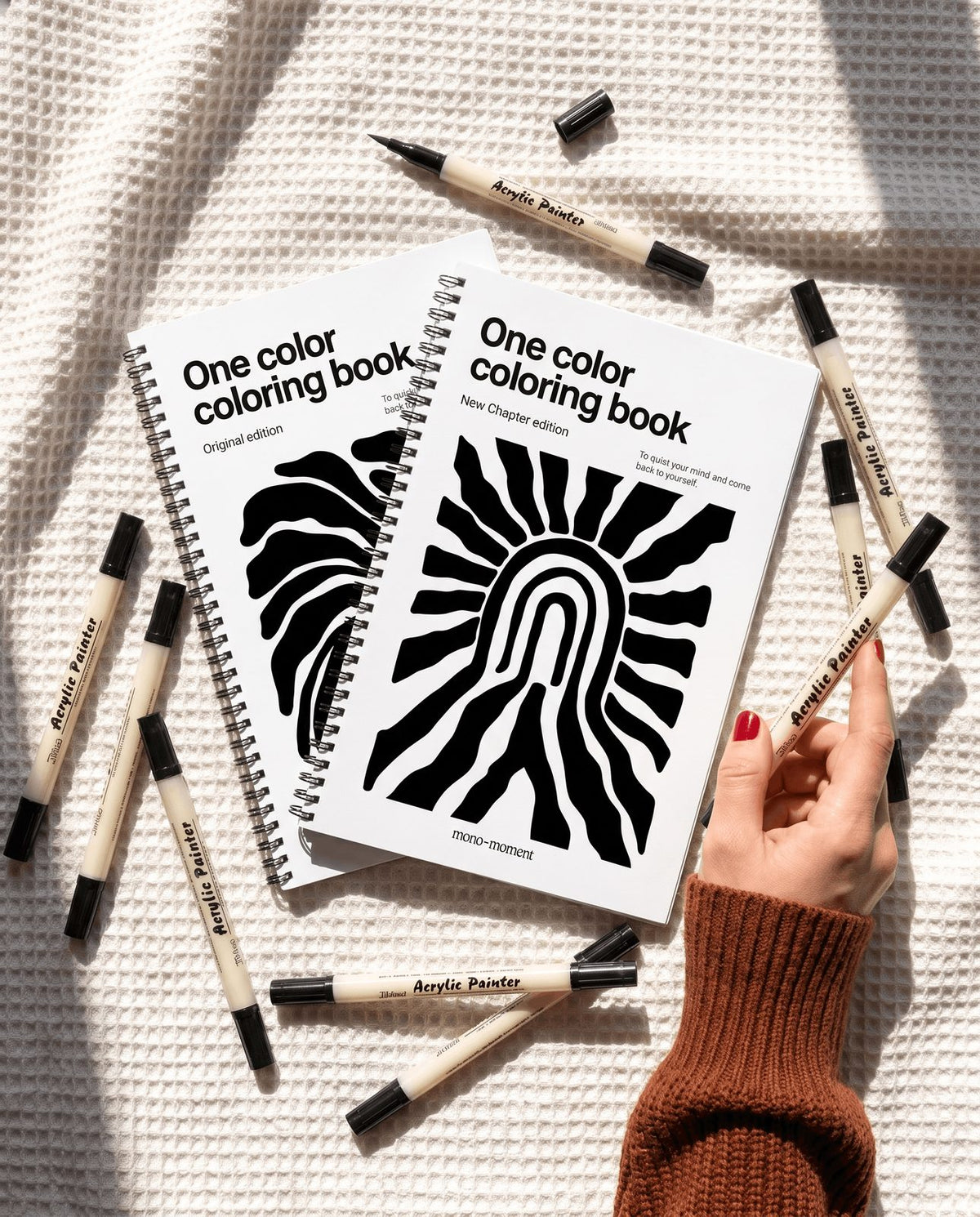
I am deliberate about the "single-channel task" step because it is the one that actually pulls me out, not just down. For me that has been a one color coloring book: a single-pen, single-color book where the design is already made and all I do is fill the shapes. There is no palette to choose, no picture to plan, nothing to ruin. After a day of decisions, that absence of choice is the entire point: it is rest for the part of me that is tired, not just for my body. If you want a longer menu of options, these low-stimulation activities for adults and parasympathetic nervous system activities are built on the same principle.
There is even some evidence for the coloring approach specifically. A randomized controlled study published in Evidence-Based Complementary and Alternative Medicine found that 20 minutes of structured mandala coloring significantly reduced anxiety in older adults compared with a reading control group — pointing to what many of us already know by feel: that a quiet, structured, low-decision visual task settles an overactivated mind.
When overstimulation is chronic (the HSP and high-load angle)

For some people, overstimulation is not an occasional evening problem. It is a near-daily ceiling that arrives early and stays.
If you are a highly sensitive person (HSP), your nervous system is simply built to take in and process more detail — more sound, more emotional nuance, more subtle sensory information — than average. That sensitivity has real upsides (depth, empathy, attention to detail), but it means you reach your input ceiling faster and need more deliberate recovery to come back down. The Cleveland Clinic also notes that people with anxiety, ADHD, autism, PTSD, or a history of chronic stress are more prone to sensory overload, because their filtering and threshold systems are already working harder.
If that is you, the goal is not to eliminate stimulation — that is neither possible nor desirable. The goal is input budgeting: treating your daily capacity for stimulation like a finite resource and protecting recovery the way you would protect sleep. In practice that looks like building genuine low-stimulation gaps into the day rather than only collapsing into them at night, saying no to a second loud thing in one evening, and keeping a reliable, boring, repeatable wind-down ritual that you do not have to think about.
That last part matters most for chronically overstimulated people: the ritual has to require no decisions, because decisions are part of the load. Mine is the same every night — lamp on, phone in the other room, chamomile tea, ten minutes filling shapes in the same single-pen coloring book. It is almost aggressively unexciting, and that is exactly why it works. If you build something similar — a fixed cue, a single quiet task, no choices — your nervous system learns the off-ramp, and over time it gets faster at taking it.
You are not too sensitive, too much, or broken. You are a person with a normal nervous system limit, living in an environment engineered to exceed it. Understanding what overstimulated means is the first real step toward managing it — and most of the management comes down to one quiet idea: when you are full, the answer is less, not more.

The One Color Coloring Book
A single-pen, decision-free coloring book on 160 gsm cream paper — engineered for the wind-down ritual described above.
 Pair it with the 3 Dual Tip Brush Pens — $5 instead of $9.95 in the Book + Pens bundle.
Sources & further reading
- Cleveland Clinic — How To Manage (and Even Overcome) Sensory Overload
- American Psychological Association — Stress effects on the body
- NIH / NCCIH — Relaxation Techniques: What You Need To Know
- Chung et al. (2020), Evidence-Based Complementary & Alternative Medicine — Coloring activities for anxiety reduction (RCT)