About the author
Published April 26, 2026 · Last reviewed May 9, 2026 · 7 min read

In this article · 4 sections
TL;DR. Overstimulated adults do not need more rest in the productivity sense — they need less input. The activities below are ranked by how little they ask of your nervous system. From staring at the wall (genuinely, the floor of the list) to single-pen coloring, they share one quality: they reduce the amount of new information your brain has to process. Most people feel a shift within 20 to 30 minutes.
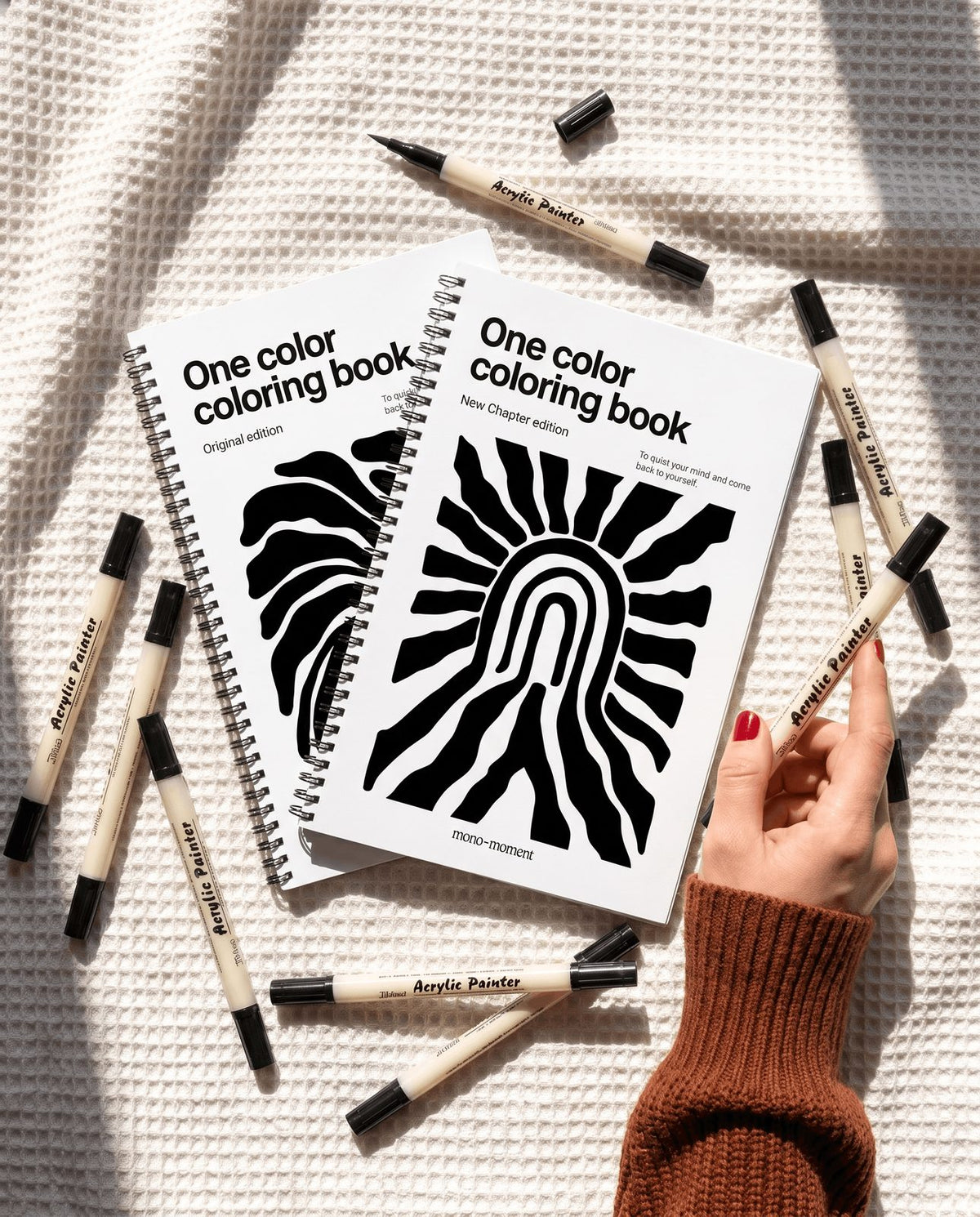
If single-focus activities appeal to you, a one color coloring book is the lowest-stimulation form of coloring: one pen, bold shapes, nothing to choose.
There is a specific kind of tiredness that comes from too much input rather than too much output. You did not run a marathon. You did not lift heavy. You sat at a desk all day, made a hundred small decisions, processed seventy emails, half-listened to two meetings, took your phone everywhere, and arrived at the evening unable to do anything at all. Your body is fine. Your nervous system is overloaded.
The reflex move when this happens — for almost everyone — is to scroll, watch something, or pour a drink. None of those are less input. They are different input. The nervous system stays buzzing.
What actually helps is reducing the rate at which new signals enter your brain. The activities below are sorted by exactly that: how little they require of you. Whether you are an introvert who runs out of bandwidth early, an HSP, an ADHD adult mid-shutdown, or just an office worker at the end of a hard week, the same logic applies. Lower the input. Let the system settle.
Why "doing nothing" rarely works for overstimulated adults
You might expect "lie down and stare at the ceiling" to be the perfect low-stim activity. For some people, sometimes, it is. For most adults — especially those with anxious or busy minds — it is not. Within five minutes of trying, the mind starts looping. Tomorrow's emails. That conversation. The phone in the next room.
The reason: an idle, unfocused mind is the inverse of a flow state. There is no anchor. The nervous system, deprived of an external signal, generates its own — usually rumination. So "rest" turns into more cognitive work, not less.
What works better is an activity that is simple enough to require no cognitive load, structured enough to give the mind a place to rest its attention. A line to follow. A row to knit. A path to walk. The body and the senses are gently occupied; the mind is given a quiet shape to settle around.
This is the principle behind every activity below.
The 12 lowest-stimulation activities, roughly ordered

1. A walk without headphones
Outside, alone, no podcast, no music, no phone in your hand. Most adults have not done this in months. The result the first time can be uncomfortable — your mind wants its usual input. Within fifteen minutes, the nervous system starts down-regulating. You hear your footsteps, distant traffic, wind, your own breathing. It is genuinely the cheapest reset there is.
2. Watering plants slowly
Specifically slowly. Not as a chore. One plant, look at it, water it, look at it. Repeat. Plants are the lowest-pressure social interaction we have. They never need anything from you. Tending to them at a low pace is meditative without trying to be.
3. Hand-washing a few dishes
Warm water, slow movement, sensory but rhythmic. Not a sink full — just three or four things by hand. The same principle: gentle sensory input, a clear simple goal, no decisions.
4. Folding laundry
Surprising entry on the list, but it works. Repetitive, tactile, complete-able in a defined window. Many adults report it being one of the few household tasks they do not resent. Fold without a podcast in the background and it gets even better.
5. Knitting or crocheting basic stitches
The classic low-stim adult hobby. Repetitive motion, immediate visual feedback, almost no decisions once the pattern is set. The barrier is the learning curve — the first few weeks are not low-stim because your brain is still figuring out the technique. Past that, it is one of the best on the list.
6. Solo cooking, no recipe
Familiar dish. Slow pace. No timer pressure. No phone in the kitchen. The act of chopping, stirring, smelling — the senses get used in a way that feels productive without being demanding. Easier than knitting, harder than walking. Good middle of the list.
7. Reading a paper book
Specifically a paper book, not a Kindle. Not a phone. Lower contrast, no notifications, no clickable links. Fiction works better than nonfiction for nervous-system reset — the brain stops trying to "extract value" and just follows the story. If you cannot focus on a novel, that is itself a sign you are very overstimulated. Try a short story.
8. Stretching very slowly on the floor
No yoga app, no count, no rep. Just slow, intentional movement. Lie on the floor, move whatever feels stuck, breathe. The floor itself does something — it tells the body it is safe to stop holding tension.
9. Single-pen coloring
This is what I mostly do. It hits the lowest-stim sweet spot for me: the structure of a line to follow, the absence of color decisions, the tactile quality of pen on cream paper. You can do it for fifteen minutes or two hours. It is portable. It does not need anything plugged in.
I use the decision-free coloring approach specifically because choosing a color is the same kind of micro-decision my overstimulated brain wants no part of at the end of the day. The single-pen design takes that out of the equation entirely. The book makes the choices; I just follow the line. (This piece is published by us — we make the One Color Coloring Book — but the broader point holds whether you use ours or any other low-decision book.)
10. Hand-copying poetry or a passage you like
Pick a poem or a paragraph from a book you respect. Copy it by hand into a notebook. Slowly. The cognitive load is near-zero — you are not generating, just transcribing — but the focus required is enough to anchor the mind.
11. Watching a fire, candle, or moving water
The original low-stim activity. Humans have done it for hundreds of thousands of years. A fireplace, a candle on the table, a small fountain, a sink running. Visual input that is alive but predictable. The brain wave research on this is consistent — moving water and flame both shift the EEG toward alpha-state patterns.
12. Sitting with tea, no phone, near a window
Strip everything else away and you have this: a hot drink, a window, no input. Not "meditation" — you are not trying to do anything. Just a quiet ten or twenty minutes. Hardest entry on the list for most adults because there is nothing to occupy the hands. If this works for you, you have already done some of the harder work elsewhere.
"Low dopamine activities" and low stimulation: the difference
You may have seen "low dopamine mornings" or low dopamine activities trending. The idea overlaps with this list but is not identical: low-dopamine routines avoid the big artificial spikes (phone, sugar, rapid-fire content) so ordinary life feels rewarding again. Low-stimulation activities go one step further — they lower the total sensory and decision load itself. The activities below do both at once: no screen, no noise, no choices, one slow analog task.
How to actually use this list
You do not need to do all of them. You probably already have one or two that work for you. The point of the list is to give you options when your default is broken — when you are too tired to read, too restless to walk, too overstimulated to sit.
A practical pattern that works for many adults:
- Weekday evenings: one repeatable, low-effort anchor. Coloring, knitting, paper book, slow tea. Pick one. Do it most nights.
- Saturday afternoon: a longer version of the same. Two hours instead of twenty minutes.
- Mid-week shutdown: when a Tuesday feels like a Friday. A walk without headphones. Or sit with tea by the window for ten minutes before doing anything else.
The pattern matters more than the specific activity. The nervous system learns: when this thing happens, the day is winding down. When you do that consistently, you start producing the wind-down state on cue, the way some people fall asleep faster after a few weeks of a real bedtime routine.
Why this matters more than usual right now

In 2026, the average adult takes in more discrete signals per day than at any point in human history. Notifications, ads, micro-content, group chats, dopamine loops engineered to keep you in front of one more screen. The nervous system was not built for this volume.
The cumulative effect — the buzzing tiredness, the inability to settle, the sleep that does not feel restorative even when it is long enough — is what most adults are quietly carrying right now. It is not a failure of your willpower. It is the predictable result of an environment that is constantly asking for your attention.
Low-stimulation activities are not a luxury or a "self-care" badge. They are the maintenance your nervous system needs to continue functioning. Twenty or thirty minutes a day. Whatever activity from the list you will actually keep doing.
For deeper reading on what to do when this kind of overstimulation has tipped into chronic anxious overthinking, the article on calming an overactive mind covers the cognitive side. For ADHD-specific notes on sensory overload, coloring for ADHD adults is a more focused piece.
Whatever you pick, the move is the same: less input. Slower pace. One thing at a time. The system settles when you let it.

The One Color Coloring Book
A single-pen, decision-free coloring book on 160 gsm cream paper — engineered for the wind-down ritual described above.
 Pair it with the 3 Dual Tip Brush Pens — $5 instead of $9.95 in the Book + Pens bundle.