About the author
Published January 21, 2026 · Last reviewed April 26, 2026 · 15 min read
In this article · 6 sections
Anxiety relief coloring pages are one of the simplest, yet most effective, tools I've found for taming a chaotic mind. It’s all about using structured, repetitive motions to quiet the noise, reduce stress, and find a bit of mindfulness. Think of it less as a nostalgic hobby and more as a practical, scientifically supported way to find a pocket of peace in a hectic day.
How Coloring Eases an Anxious Mind

Ever wondered why filling in a simple pattern with a pen can feel so deeply calming? The magic is in the way this small act engages your brain. When you're stuck in a loop of anxious thoughts, your amygdala—your brain’s "alarm system"—is working overtime. Coloring gives it a simple, predictable job to do, which is often just enough to quiet that internal alarm.
This gentle focus pulls your attention away from worrying about the future or replaying the past. It grounds you in the here and now. The rhythmic motion of your hand moving across the paper becomes almost meditative, helping to slow your heart rate and release physical tension. It's a kind of active mindfulness that doesn't demand you sit perfectly still; instead, it gives your restless energy a quiet, productive outlet.
The Science of a Quieter Brain
This calming effect isn’t just a feeling; it’s backed by a growing body of research. The adult coloring book market has exploded for a reason, growing into a global industry valued at USD 2.5 billion and projected to more than double by 2033. This boom is fueled by its recognized therapeutic benefits. Studies show that structured creative activities like coloring can trigger the brain's relaxation response and measurably lower anxiety levels. You can dig into the market's growth and the science behind it in this report from Verified Market Reports.
So, what’s happening on a psychological level? A few key things:
- Reduced Amygdala Activity: By engaging in a focused task, you’re actively soothing the part of your brain that manages fear and stress.
- Mindfulness and Presence: Coloring requires your full attention, which makes it incredibly difficult to get lost in anxious thought-spirals.
- Predictability and Structure: The clear lines and simple goal give you a sense of control and order, which can be immensely comforting when your mind feels chaotic.
Why Monochrome Deepens the Calm
While any kind of coloring can help, the philosophy behind Mono Moment takes this idea a step further. We deliberately remove a hidden source of stress: the pressure of choosing colors. Deciding which shades to use, wondering if they’ll clash, or trying to blend them perfectly can accidentally trigger perfectionism and decision fatigue—the very things you’re trying to escape.
When you switch to monochrome designs, the experience shifts. It’s no longer about creating a perfect masterpiece; it’s about the pure, simple process. It becomes a decision-free activity that lets you sink into a deeper state of meditative flow.
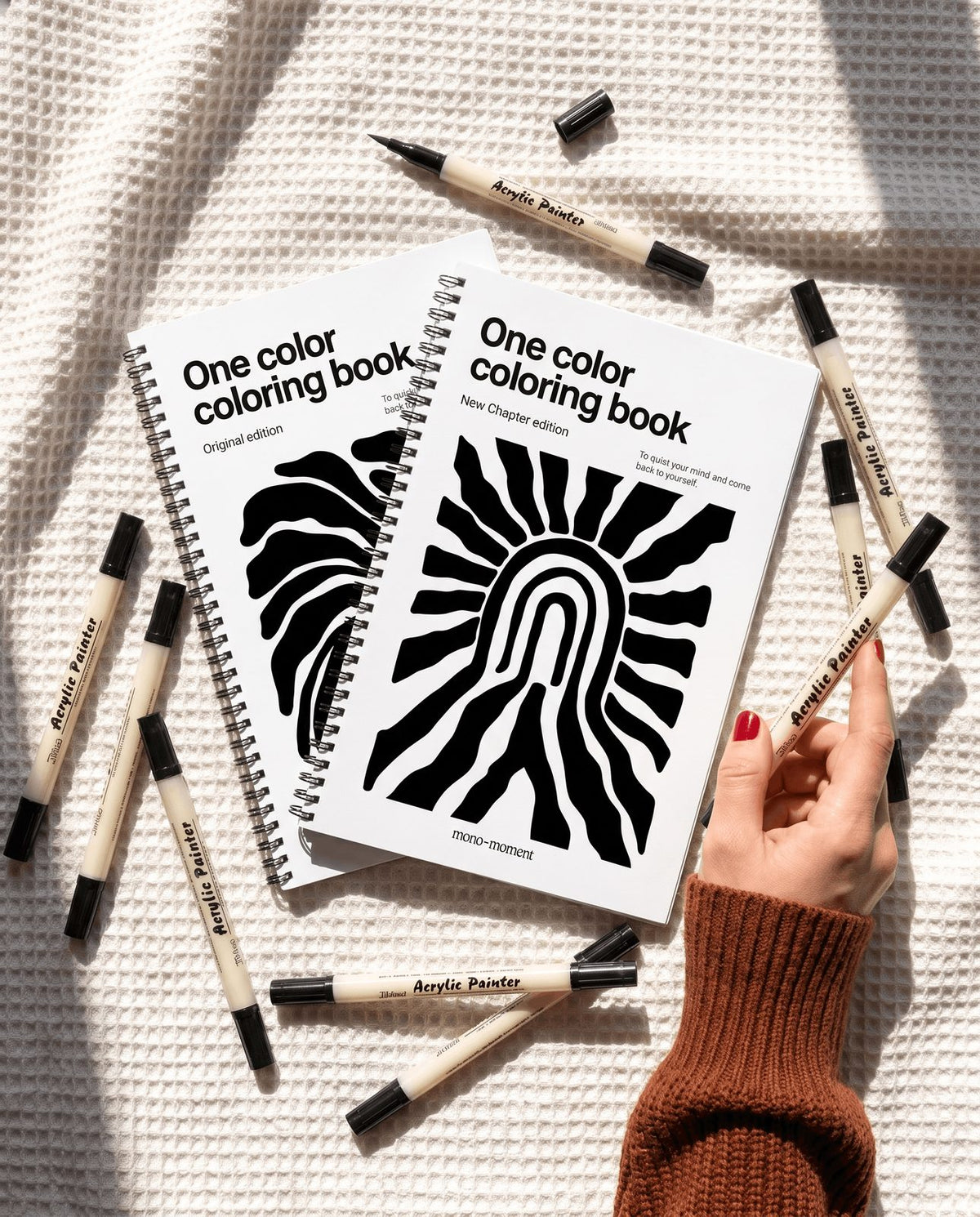
This approach is tailor-made for overthinkers. The Mono Moment One Color Coloring Book, our flagship product, gives your brain the structure it craves without the overwhelming element of choice. You can just pick up a pen and immediately start to unwind, making it a reliable tool for anyone who needs to quiet their mind. For more strategies on this, you can also explore our guide on how to calm an anxious mind.
Creating Your Personal Coloring Ritual
Let's move beyond just grabbing some anxiety relief coloring pages and transform this simple activity into a powerful ritual. It’s about carving out a small, almost sacred, space in your day dedicated to quiet and calm. This doesn't mean you need to block off hours; it’s all about being intentional with your environment, your timing, and especially your tools.
The right setting can make all the difference. You don't need a special room—a quiet corner of your couch, a comfy chair by a window, or even just five minutes at your desk can work wonders. The point is to create a signal for your brain that says, "Okay, this time is different." Maybe you dim the lights, put on some soft instrumental music, or just silence your phone.
When you color is just as important as where. Are you a morning person who could use a few moments of peace before the day’s chaos kicks in? Or do you find yourself carrying the day's stress to bed? If so, an evening wind-down session might be your sweet spot. Play around with it and see what feels right. The real magic happens with consistency, creating a predictable pocket of peace your mind can start to crave.
Choosing Tools That Foster Flow
Honestly, nothing shatters a moment of zen faster than frustrating supplies. Picture this: you’ve settled in, you're finding your rhythm, and then your marker bleeds straight through the paper, ruining the design on the other side. It’s a common and incredibly discouraging hiccup.
This is exactly why the Mono Moment One Color Coloring Book was designed with premium, artist-grade 160gsm paper. This isn't your standard printer paper; it's thick and durable, specifically chosen to handle different tools without bleeding through. You can confidently use markers, gel pens, or even vibrant brush pens, knowing your creative space is protected.
A true relaxation ritual should feel seamless. Your tools should almost disappear, letting you focus entirely on the meditative motion of coloring, not on whether your pen is destroying the next page.
The right pens also play a huge role in achieving that effortless flow state. Tools that scratch the paper, skip, or need a lot of pressure create friction—both literally and mentally. You want pens that glide smoothly, making the physical act of coloring feel like a soothing sensory experience in itself.
This is why it's a great idea to pair your book with tools designed to work well with it. A high-quality set of brush pens, like the ones offered by Mono Moment, gives you that smooth, satisfying glide. When your pen and paper work together this well, all those little frustrations melt away, letting you sink fully into the calming process.
Your Blueprint for a 15-Minute Mindful Session
I get it. The idea that you don't have enough time for self-care is one of the biggest hurdles we face. But a powerful mental reset doesn't require a full hour. With just 15 minutes and a little intention, you can carve out a pocket of peace that calms your nervous system and brings your mind back to center.
A bit of structure can turn a short break into something truly restorative. It’s all about creating a small, repeatable ritual.
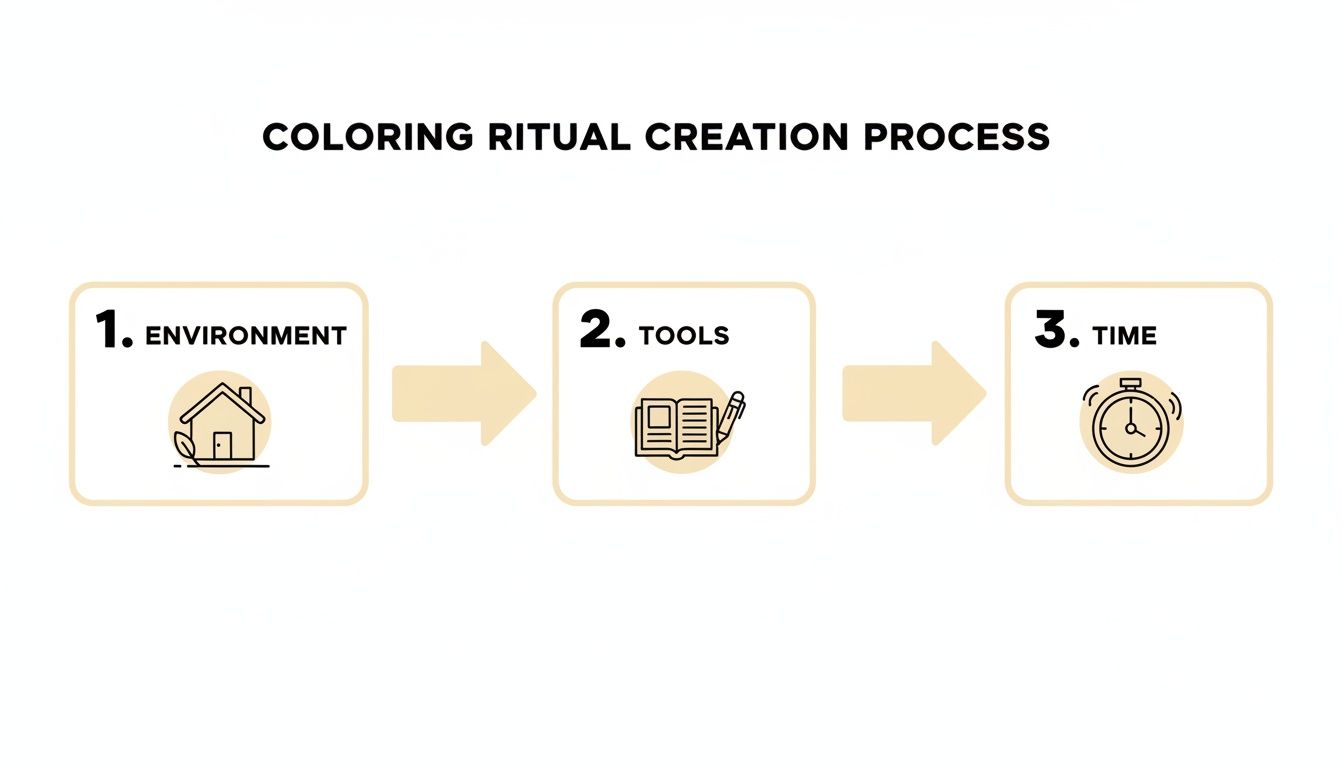
Think of it this way: a successful session begins before the pen ever touches the paper. A little thoughtful preparation is what unlocks the real magic.
The Settle Phase (2 Minutes)
Before you even think about coloring, take two minutes. Just two. This is your transition time.
Sit down, get comfortable, and take three deep, slow breaths. Inhale through your nose, exhale through your mouth. Just notice how your body feels in this moment, without any judgment.
Now, pick your design. The illustrations in the Mono Moment One Color Coloring Book are perfect for this because they're designed to be completed in one sitting. You get the satisfaction of finishing something, which avoids that feeling of starting yet another overwhelming project.
The Flow Phase (10 Minutes)
Alright, it's time to color. For the next ten minutes, give yourself permission to do nothing else. Forget the to-do list. Forget the emails. Your only job is to focus on the page in front of you.
This isn't about creating a masterpiece. It's about finding that state of flow, where the noise in your head quiets down and you become completely absorbed in the present.
To get there, tune into your senses. Here are a few prompts I use to keep my own mind from wandering:
- Listen for the soft whisper of the pen on the page.
- Feel the texture of the paper under the side of your hand.
- Watch the ink as it floods a white space, transforming it.
- Let your eyes trace the lines of the design before you fill them in.
These small, sensory details are incredibly powerful anchors for a restless mind. If you find this kind of practice helpful, you might also like these 10 quick mindfulness activities for adults.
The goal of the flow state is not to achieve perfection but to experience presence. It's about letting the simple, repetitive motion of coloring guide you away from mental clutter and into a state of calm focus.
The Reflection Phase (3 Minutes)
When your ten minutes are up, resist the urge to immediately jump up and get back to it. That jarring transition can undo all your good work.
Instead, gently put your pen down. Take the last three minutes to just... be. Look at what you created. Notice the contrast of the ink on the paper.
More importantly, check in with yourself. How do you feel now compared to 15 minutes ago? Is your breathing a little slower? Your shoulders a little lower? Does your mind feel even slightly clearer? This brief closing act helps your brain register the positive shift you just created, making it a habit you'll actually want to come back to.
Not every day allows for a long, luxurious break. The key is knowing how to adapt your ritual to the time you have. Sometimes all you need is a quick 15-minute reset, while other times you might crave a deeper, 30-minute session to fully unwind.
Here’s a look at how you can structure both.
Your 15-Minute vs. 30-Minute Coloring Session
| Phase | 15-Minute Session (Quick Reset) | 30-Minute Session (Deep Relaxation) |
|---|---|---|
| Settle (Prep) | 2 minutes: Sit, take 3 deep breaths, quickly choose a simple design. | 5 minutes: Set up your space, maybe light a candle or play soft music. Settle in with 5-10 deep breaths and choose a design without rushing. |
| Flow (Coloring) | 10 minutes: Focus entirely on the sensory experience—sound, touch, sight. Aim for presence over progress. | 20 minutes: Allow yourself to become fully immersed. Explore different shading techniques or color patterns. Let your mind quiet down completely. |
| Reflect (Closing) | 3 minutes: Put your pen down. Observe your work and notice the immediate shift in your mood and breathing. | 5 minutes: Take time to admire your finished (or nearly finished) piece. Write down one word describing how you feel now. Gently transition back to your day. |
Whether you have a spare quarter-hour between meetings or a half-hour before bed, there’s a structure that can help you find your calm. The most important thing is simply to show up for yourself.
Choosing Designs That Soothe Instead of Stress
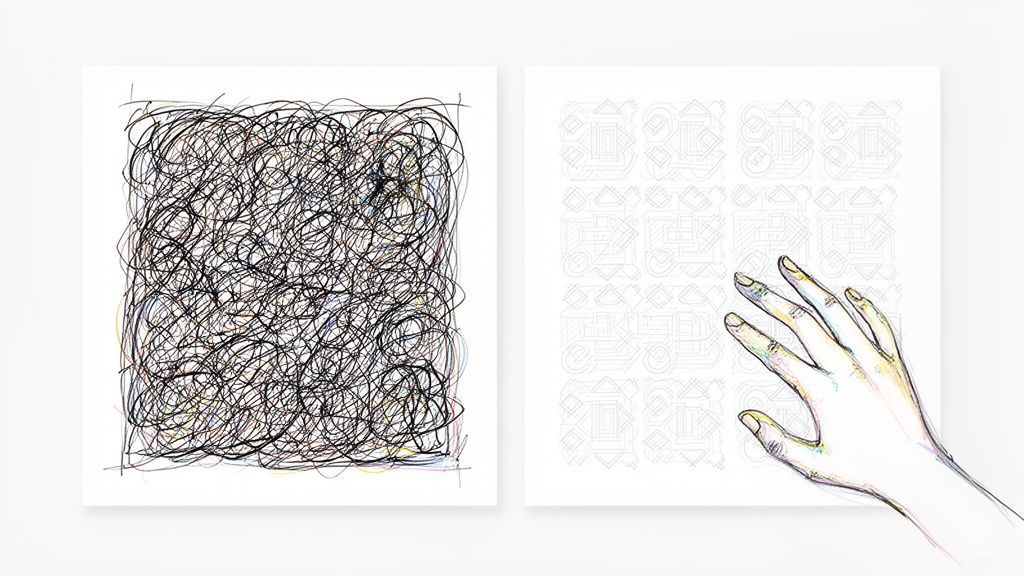
Ever picked up a coloring page promising to melt your stress away, only to find yourself feeling even more anxious? It happens all the time. You sit down to unwind, but the page is a dizzying web of microscopic details. Suddenly, your relaxing hobby feels like a high-stakes art project you’re destined to fail.
The reality is, not all anxiety relief coloring pages are built the same. An incredibly intricate design can accidentally feed the exact feelings you’re trying to escape—pressure, perfectionism, and the fear of making a mistake. Instead of quieting your mind, it demands an intense, surgical focus that can easily spike your frustration when you color outside a tiny line.
This is why your choice of design is everything. For genuine mental calm, you want patterns that are structured enough to keep you engaged but simple enough to let your mind drift. The sweet spot is a design that guides your hand without demanding unwavering concentration, letting you slip into that gentle, meditative flow state you’re looking for. It also helps to know how the different books stack up, and our guide to the best coloring books for adults compares every style in one place.
The Quiet Magic of Decision-Free Coloring
One of the biggest hidden stressors in coloring is what psychologists call the paradox of choice. You’ve got a whole rainbow of pens laid out, and every empty shape on the page forces a new decision. Which color goes here? Do these two shades clash? What if I pick the wrong one and ruin it?
For a mind already prone to overthinking, this constant stream of choices is flat-out exhausting. It’s the very opposite of the mental break you need. This is the exact problem the Mono Moment One Color Coloring Book was created to solve.
By designing pages for a single color, we completely remove the paradox of choice. All those nagging questions about color palettes and coordination just evaporate. This decision-free approach instantly lowers the stakes and tells that inner critic to take a hike.
Your focus naturally shifts from the final product to the process itself. You can get lost in the simple, satisfying feeling of filling a space with ink. The rhythmic motion becomes the meditation.
This radical simplification is what makes it so powerful for anxiety. It clears out the mental clutter, letting your brain truly rest without the subtle pressure to create a masterpiece.
How to Spot Designs That Actually Work
The wellness world has caught on to the power of coloring, and as a result, we're seeing more specialized designs emerge. This isn't just a trend; it's a response to what people and mental health professionals are finding works best: the right kind of structure is crucial. You can see how this is shaping the broader market on TechSci Research.
So, what should you look for? Here’s what I’ve found makes a real difference:
- Repetitive Patterns: Geometric shapes, mandalas, and other repeating patterns are incredibly meditative. Their predictability is soothing to an anxious brain.
- Clear Boundaries: Pages with bold, crisp lines are far more relaxing than those with faint, sketchy ones. They offer a reassuring sense of order.
- Minimalist Art: Sometimes, less really is more. If this idea resonates with you, our article on minimalist coloring pages is a great place to explore further.
- A Finishable Scope: Pick a design you can reasonably complete in one 15-30 minute session. The feeling of accomplishment is a huge mood booster, whereas another half-finished project can just feel like more clutter.
The Mono Moment coloring book was built on these exact principles. Every single illustration is crafted to be engaging but not overwhelming, structured but not rigid. It’s the perfect framework to help you reclaim a few quiet moments for yourself, one simple pen stroke at a time.
Navigating Common Mental Roadblocks
So you’ve carved out the time, found a design that speaks to you, and your favorite pens are at the ready. But instead of that wave of calm you were hoping for, your brain is suddenly louder than ever. If this happens, don’t get discouraged. This is completely normal and it doesn't mean coloring isn't "working." It just means you’ve hit a couple of very common mental hurdles.
Let's be real: our brains don't just flip an "off" switch on demand. When you’re used to running a thousand miles a minute, your mind brings its old habits—like perfectionism and self-judgment—right to the table. Spotting these patterns is the first step to gently showing them the door.
Letting Go of Perfection and the Fear of "Messing Up"
The biggest obstacle I see people face is the fear of making a mistake. It’s that little nagging voice in the back of your head saying, "What if I go outside the lines? What if I pick the wrong color?" All of a sudden, this simple, relaxing activity feels like a high-stakes test you're about to fail.
This is exactly why the Mono Moment philosophy is so powerful. Our One Color Coloring Book was created specifically to tear down this wall of anxiety. By taking color choice completely out of the equation, we remove a massive source of decision fatigue. There simply is no “wrong” choice to make.
The goal isn't to produce a masterpiece; it's to lose yourself in the process. You're giving your mind a rare chance to play without the pressure to perform, and that's where true anxiety relief begins.
This shift in perspective is everything. Try to see every stroke of the pen not as a permanent mark, but as a fleeting moment of mindfulness. If your hand slips, who cares? This page is your private space to be perfectly imperfect. Think of it as practice for letting go.
What to Do When Your Mind Won't Settle Down
The other classic challenge is a mind that just won't stop racing. You're physically coloring, but mentally, you’re still sorting through your inbox, replaying a conversation from yesterday, or building a to-do list. The trick isn't to fight these thoughts off, but to gently guide your focus back to what's right in front of you using your senses.
Here are a few simple “sensory anchors” to pull you back to the present moment:
- Listen to the Sound: Tune in to the soft, rhythmic scratch of the pen gliding across the thick 160gsm paper found in our books. Try to make that the only sound you hear.
- Feel the Touch: Focus on the sensation of the pen resting in your hand. Notice the smooth texture of the paper under your palm as you steady the page.
- Watch the Movement: Let your eyes follow the ink as it flows from the tip of the pen, filling in the white space. Trace the intricate lines of the design with your gaze.
Every time you notice your mind has drifted, just acknowledge the thought without judgment ("Ah, there's my to-do list again") and then gently pull your attention back to one of these physical anchors. It’s a quiet, patient practice that trains your brain to stay present, one simple line at a time.
Common Questions About Coloring for Anxiety
Got questions? You're not alone. When people first start using coloring as a tool for anxiety, a few common concerns pop up. Let's walk through them so you can begin with confidence.
How Often Should I Color to Feel a Difference?
Think consistency over marathon sessions. You'll get far more out of a 15-minute session a few times a week than you will from a single, two-hour coloring binge once a month. It’s like a small act of mental hygiene—a quick, repeatable ritual that helps keep the static down.
This is exactly why the designs in the Mono Moment One Color Coloring Book are made to be finished in one sitting. It helps you build a rewarding habit without that nagging feeling of an unfinished project hanging over your head.
What if I Don't Feel Calm Right Away?
That is perfectly okay, and honestly, pretty normal. Just like meditation or any other mindfulness practice, the effects build up over time. Some days, you might feel a wave of calm wash over you almost instantly. Other days, it might just be a welcome distraction that gives your brain a much-needed break.
The secret is to release any expectations. You're not trying to force yourself to relax. You're simply giving your mind something quiet and structured to do. With time, your brain will start to connect this simple act with a feeling of genuine peace.
The real magic of a coloring practice isn't found in one "perfect" session. It's in building a reliable, go-to tool for self-soothing, one page at a time.
Is a Monochrome Palette Really Better for Anxiety?
For a lot of us, especially those with busy minds prone to overthinking, the answer is a huge "yes." Think about it: traditional coloring books can accidentally create decision fatigue. Which color should I use here? Do these shades go together? How do I get the blending just right? It can quickly become a minefield for perfectionism.
Monochrome coloring, which is the heart of the Mono Moment approach, gets rid of all that mental clutter. It lets you sink into the simple, meditative motion of putting pen to paper. By stripping away the creative pressure, you get a much more direct path to that quiet, mindful state.
Ready to see what decision-free relaxation feels like? The Mono Moment One Color Coloring Book was designed specifically to soothe an overthinking mind. With premium, no-bleed paper and designs you can actually finish, it’s the perfect way to start your anxiety relief ritual. Explore the collection at mono-moment.com.

The One Color Coloring Book
A single-pen, decision-free coloring book on 160 gsm cream paper — engineered for the wind-down ritual described above.
 Pair it with the 3 Dual Tip Brush Pens — $5 instead of $9.95 in the Book + Pens bundle.