About the author
Published April 26, 2026 · Last reviewed May 9, 2026 · 8 min read

In this article · 7 sections
- What flow state actually is
- The four conditions that produce flow
- Why most "productivity" advice fails to produce flow
- The cheapest flow triggers (no apps, no equipment)
- Why low-decision creative activities work best
- A 15-minute protocol you can try tonight
- Common reasons flow doesn't happen for you
TL;DR. Flow state — the absorbed, time-vanishing focus mode — is not a productivity hack. It is a specific brain state with four entry conditions defined by Csikszentmihalyi: a clear goal, fast feedback, skill-challenge match, and uninterrupted attention. The fastest way in for most adults is not meditation. It is a low-decision creative activity at the edge of your skill — coloring, sketching, knitting, an instrument. You will be there in 10 to 20 minutes if you set up the conditions properly.
There is a specific kind of focus that most adults have stopped accessing. The kind where you sit down to do something, look up, and an hour has gone. No phone-scrolling break. No mental drift. No "let me just check one thing." Just thirty or sixty or ninety minutes that disappeared cleanly into the work.
The psychologist Mihaly Csikszentmihalyi spent decades naming and studying that state. He called it flow. He found it produced more reported well-being than almost any other mental state — including rest. He also found that most adults experience it less than they used to, because modern work and modern phones have systematically dismantled its preconditions.
This piece is the practical version of that research. What flow actually is. Why most "focus" advice does not produce it. And the cheapest, most reliable way to enter flow that I have found over almost two years of testing — including a low-decision creative practice that needs nothing but a pen and ten minutes.
What flow state actually is
Flow is a brain state, not a productivity tactic.
The defining marker, according to Csikszentmihalyi's interviews with thousands of musicians, athletes, surgeons, chess players, and craftspeople, is the disappearance of self-conscious time. Hours go by and you do not notice. You stop monitoring whether you are doing well. You stop monitoring whether you are tired. The activity and the doer collapse into the same thing.
Three other markers travel with it:
- Effortless concentration — attention is held by the task itself, not by willpower
- Loss of self-evaluation — the inner critic temporarily quiets
- Sense of intrinsic reward — the activity feels worthwhile in itself, not as a means to something else
You can be very busy without being in flow. You can be very productive without being in flow. Flow is a quality of attention, not a quantity of output.
The four conditions that produce flow

Csikszentmihalyi's research found that flow does not happen randomly. It happens when four things are true at once:
- A clear goal. Not "be creative." Not "feel better." Something narrow: finish the line, complete this page, play this passage, fold this stitch. The brain needs a target.
- Immediate feedback. You can tell, in the moment, whether what you are doing is working. The pen line is straight or it is not. The note is in tune or it is not. You do not have to wait for someone else to evaluate.
- A skill-challenge match. The task is hard enough that you have to pay attention, but not so hard that you constantly fail. About 4 to 5 percent above your current skill ceiling — challenging but reachable.
- Minimal interruption. Notifications, ambient conversation, intermittent demands on your attention all break flow. Continuous focus is the medium flow lives in.
Look at almost any common adult activity through this lens and you can see why some produce flow and others never do. Watching TV: weak goal, no feedback, no skill challenge → no flow. Browsing social media: same. Email: weak goal, intermittent feedback, constant interruption → almost never flow. A complex board game with friends, on the other hand, hits all four — which is why hours disappear.
Why most "productivity" advice fails to produce flow
Most modern productivity advice is about doing more in less time. Flow is about how you experience the time itself.
The classic suggestions — "block your calendar," "wake up earlier," "use the Pomodoro technique" — can help with output, but they do not directly trigger flow. You can be perfectly disciplined, plow through a calendar block, and never enter flow once. You finished the work. Your nervous system is exhausted in the bad way, not the good way.
The reason: those tactics manage the quantity of focused time. They do not engineer the four conditions. If your work has unclear goals, slow feedback, and gets interrupted every fifteen minutes, no amount of time-blocking will produce flow inside of it. You can produce output. You will not produce flow.
This is why creative side practices — even a small one, even thirty minutes — matter so much. They are sometimes the only place an adult experiences flow at all. And without flow, the deeper kind of recovery and reset that the brain seems to need does not happen.
The cheapest flow triggers (no apps, no equipment)

The fastest, least-equipment-heavy way I have found to enter flow consistently is a low-decision structured creative activity — drawing, coloring, lettering, knitting, hand-copying, sketching basic forms. Each meets the four conditions almost trivially:
- Clear goal: finish this line, fill this shape, complete this row.
- Immediate feedback: the pen mark is on the page. You see it.
- Skill challenge: harder than scrolling, easier than mastering. Suitable for almost any starting skill.
- Minimal interruption: if you put the phone in another room, the activity itself does not generate notifications.
Of these, coloring is probably the lowest-friction entry. You do not need to figure out what to draw. You do not need to make it look like anything in particular. You just follow the line.
I started decision-free coloring — a single-pen, single-color version of adult coloring books — for a very practical reason: I needed a flow trigger that did not require any creative confidence on my part. The book makes the design decisions; I make the line.
What I did not expect is how reliably it produces flow. Not every time. But more than anything else I have tried, including meditation apps, evening yoga, and several years of journaling.
Why low-decision creative activities work best
The reason coloring (and similar activities) reliably produce flow is the same reason most people fail at meditation: the brain enters flow when given a defined task, not when told to be still.
Sit on a cushion and try to "clear your mind" and the cognitive load is enormous. You are constantly catching wandering thoughts, comparing yourself to how you should be doing, restarting. The activity has no clear goal, no feedback, and no skill challenge. By Csikszentmihalyi's framework, it is almost the worst environment for flow.
Pick up a pen and start filling a botanical pattern with simple lines, and the four conditions are met automatically. Your attention is held by the line you are drawing right now. The work tells you, instantly, whether you are doing it. You stop monitoring how you are doing because you can see how you are doing.
This is not anti-meditation. Plenty of people do enter flow through meditation, after years of practice. It is a respect for what most adult brains are actually capable of in the first few weeks: more flow with a pen and a pattern than with sustained attention to nothing.
A 15-minute protocol you can try tonight
This is the version I use most nights, refined over almost two years. It works for almost anyone who does not consider themselves "creative":
- Pick the activity in advance. Coloring, sketching simple shapes, knitting, hand-copying a passage of a book you like. Decide before you sit down. Do not decide at the moment.
- Set up the environment. Phone in another room — not face-down on the table. Warm lamp light if it is evening. A surface clear enough to work on. Tea, water, whatever you want within arm's reach.
- Set a 20-minute timer. Long enough to get past the on-ramp, short enough that you do not negotiate with yourself about starting. The first 5 to 10 minutes will feel slightly fidgety. That is normal.
- Start at the line, not the plan. Do not stare at the blank page deciding what to do. Pick up the pen, find a place to start, draw the first line. The intention emerges from the doing, not the other way around.
- Stop when the timer ends. Or do not. If you are deep in flow, ignore the timer. The marker that you are done is when you check the clock and notice it has been longer than expected.
Most people, by the third or fourth night, find the on-ramp shortens. The brain is learning the cue.
Common reasons flow doesn't happen for you
If you have tried something like the above and not gotten anywhere, three things usually fix it.
The activity is too easy. Pure rote work — typing, washing dishes — does not have enough skill challenge for most adults' minds to commit. You need an activity that requires some attention. Coloring with a brush pen is harder than coloring with a roller; the brush requires line control.
The activity is too hard. Trying to draw a realistic portrait when you have not drawn since you were ten will produce frustration, not flow. Start far below your imagined ceiling. The point is the doing, not the product.
You are checking your phone. Even one notification breaks flow and forces you to climb the on-ramp again. This is non-negotiable. The phone goes in another room. Not on silent. Not face down. In another room.
If those three are right, flow comes. Not always on the first night, but reliably within the first week. And once the brain remembers the on-ramp, it gets faster every time.
The wider point: flow is not something you have to discover or unlock. It is your brain in its natural state of absorbed focus, which most adult environments now systematically prevent. The cure is not more discipline. It is twenty minutes a day spent inside the four conditions Csikszentmihalyi described — using whatever low-decision activity is easiest for you to keep doing.
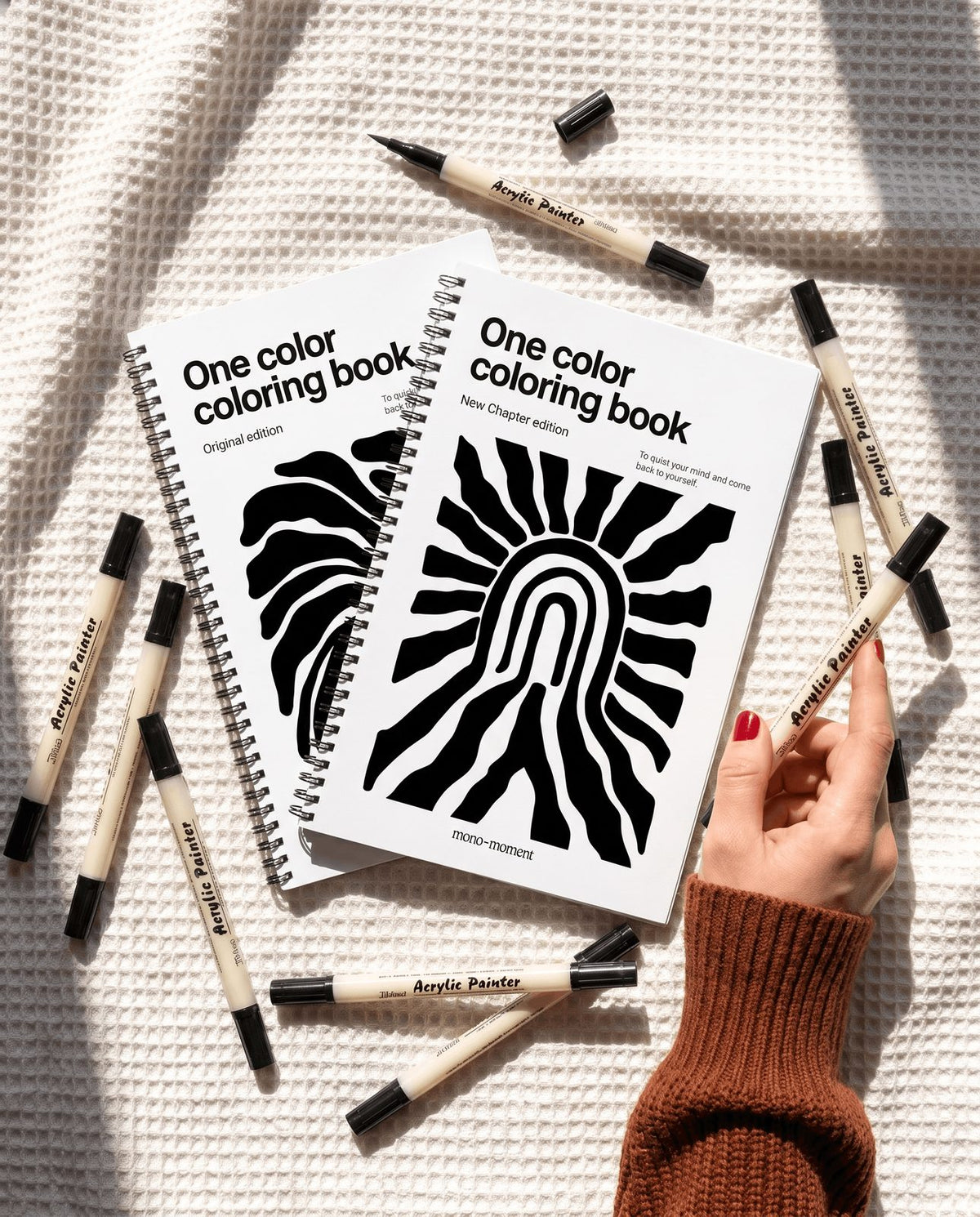
For me, that activity has been the One Color Coloring Book since the spring of last year. For you it might be sketching, knitting, lettering, woodworking, or learning a slow instrument. The activity matters less than the conditions. The conditions matter less than picking something you will actually keep doing.

The One Color Coloring Book
A single-pen, decision-free coloring book on 160 gsm cream paper — engineered for the wind-down ritual described above.
 Pair it with the 3 Dual Tip Brush Pens — $5 instead of $9.95 in the Book + Pens bundle.