Tests every pen, paper and design she recommends — most evenings around 10:30pm.
Published October 1, 2026 · 10 min read
In this article · 7 sections
TL;DR. The best cat coloring book for adults depends on why you color. For a long, absorbing project, choose an intricate or mandala-style cat book. For quick, cheerful pages, choose a cute bold-and-easy book. For a likeness of a real breed, choose realistic portraits. For switching off at the end of the day, choose a one-color book: bold cats, one pen, no palette to pick. Whichever type you buy, check three things first: paper weight (160gsm holds brush pens without bleed-through), binding (spiral lies flat, glued does not), and how many decisions each page asks of you.
Type "cat coloring book" into any search bar and the results make no distinctions. Books drawn for six-year-olds sit beside books where every whisker is its own section, and round kawaii kittens sit beside Maine Coons shaded like graphite studies. Adding "for adults" narrows it less than you'd hope, because on a cover those two words can mean "harder" or "calmer," and those are opposite things.
I color most evenings, usually for twenty minutes or so after dinner, and I've learned that the subject on the cover tells you very little about how a book will feel in your hands. A cat is a cat. What changes the experience is the line work, the paper, the binding, and how much the page asks you to decide.
So this is a buyer's guide, not a ranking. I'll go through what to check, compare the four main types of cat coloring books as fairly as I can, and then explain the one-color approach we use at Mono Moment, including who it does not suit. (If you spell it cat colouring book for adults, everything here applies to you too.)
What "for adults" should mean on a cat coloring book
Start with a question that has nothing to do with cats: what do you want those twenty minutes to do for you?
There are two honest answers. Some people color for the result: a finished page they're proud of, with a palette they chose and shading they worked at. Others color for the state: a quiet, absorbed stretch where the day stops replaying. Both are good reasons. They call for different books, and a lot of disappointment comes from buying a results book when what you wanted was a rest.
Two features sort a book into one camp or the other.
Line style. Intricate books use fine lines and small sections: fur textures, patterned collars, backgrounds full of leaves. They reward precision and a sharp pencil, and one page can last several sittings. Bold books use thick outlines and large shapes. They forgive a wobbly hand, they work with brush pens, and they're easier on tired eyes under lamp light. If you've read my guide to bold and easy coloring pages, you'll know which side I lean toward in the evening.
Decision load. This is the one nobody prints on the back cover. Every full-color page asks a string of small questions: which palette, what color for this cat, does the cushion clash with the wall. For some people that's the fun. For others it's the reason the book goes back in the drawer. Cleveland Clinic describes decision fatigue as the mental tiredness that builds as choices pile up over a day, and by evening most of us have made plenty. A book can add to that pile or leave it alone.
The four main types of cat coloring books, compared

Nearly every cat coloring book for adults falls into one of four families. None is better than the others in the abstract. They're tools for different moods.
| Type | Line style | Decisions required | Best tools | Best for |
|---|---|---|---|---|
| Intricate or mandala-style cats | Fine lines, tiny patterned sections | Many: a palette, plus a color choice for each small section | Fineliners, sharp colored pencils | Long projects, people who enjoy precision |
| Cute or kawaii bold-and-easy cats | Thick outlines, large rounded shapes | Some: a palette to pick, but few sections | Markers, brush pens, crayons | Quick cheerful pages, beginners, gifts |
| Realistic breed portraits | Fine line or grayscale with fur detail | Many, plus shading and blending technique | Colored pencils | A likeness of a real cat, pencil lovers |
| One-color books | Bold shapes built for a single fill color | Almost none: choose one pen and begin | One brush pen or marker | Winding down, tired evenings, overthinkers |
Intricate and mandala-style cats. The cat is a silhouette filled with pattern: paisley, florals, zentangle-style doodles, sometimes a full mandala behind it. These books are absorbing in the way a jigsaw is absorbing, and a finished page looks impressive. The honest downside is stamina. Small sections need good light and a steady hand, and a half-finished page can sit on the shelf for a long time.
Cute and kawaii bold-and-easy cats. Round faces, chunky outlines, cats asleep in teacups or on bookshelves. This style has made adult coloring feel approachable again, and it deserves its popularity. If you want an easy cat coloring book, this is the obvious place to look: pages finish in a sitting and nearly any tool works. Two things to check: paper weight varies a lot from one book to the next, and on thinner stock markers show through. The art direction also runs sweet, which some people find charming and others find too young for the coffee table.
Realistic breed portraits. Maine Coons, Siamese, British Shorthairs, tabbies drawn with real anatomy. Often the page is grayscale or carries fine fur lines, so your color sits on top of shading that's already there. With colored pencils and patience, the results can be beautiful. The trade-off is that this type depends on technique more than any other. Layering, blending and following the direction of the fur are skills, and without them the page can fall short of what you pictured.
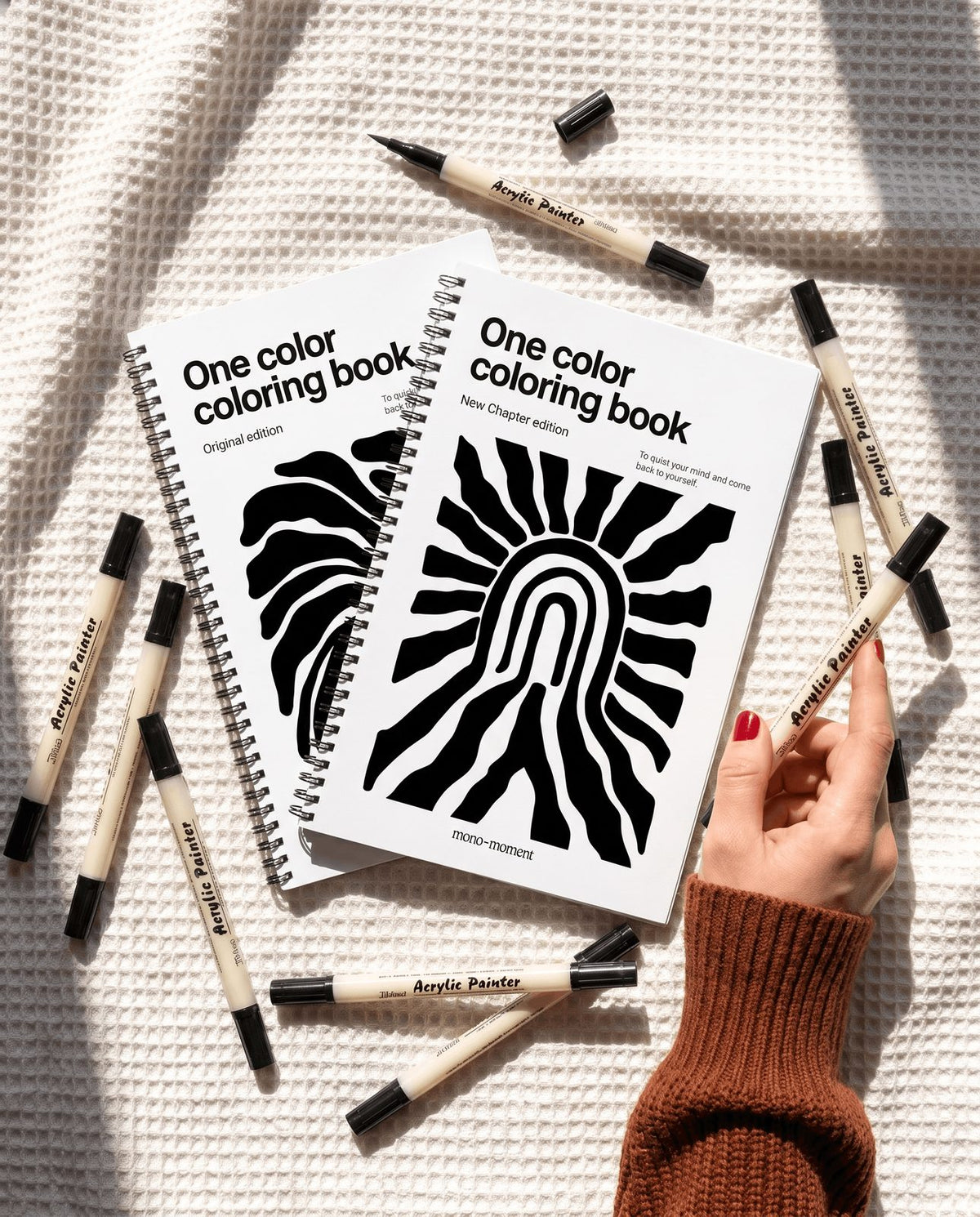
One-color books. The least familiar family, and the one I work on. The illustrations are bold and graphic, and each is designed to be completed with one color. You don't build a palette. You pick up one pen and fill. The result is closer to a print than a painting, which some people love and some find too plain.
Paper, pages and binding: the specs worth checking
The art gets you to buy the book. These details decide whether you finish it.
Paper weight (gsm). Gsm means grams per square meter, and it's the best single predictor of bleed-through, the ink that soaks through and marks the next page. Thin paper is fine for colored pencils. Water-based markers and brush pens need more body, and 160gsm is the weight at which I stopped slipping a blotter sheet behind the page. Alcohol-based markers are the exception: they're far wetter, and I'd test them on a back page of any book before trusting them. My test for a new book is simple. One slow stroke of the wettest pen I own on the last page, then turn it over.
Paper surface. Tooth is the texture you feel when you run a finger across the sheet. Pencils like some tooth because it grips pigment. Brush pens prefer a smoother surface, where the tip glides and a large fill stays even.
Single-sided or double-sided. Single-sided pages mean a bleed can never spoil the drawing behind, and you can remove a page to frame or give away. Double-sided printing isn't a flaw in itself, but it only works when the paper is heavy enough that nothing shows through. If a listing doesn't say which it is, look for a photo of the back of a page.
Binding. Glued bindings look neat on a shelf, but the book wants to close, and the inner edge of each drawing curves into the gutter. You end up holding it open with one hand. A spiral binding lies flat and folds back on itself, which matters if you color on a sofa with the book on your knees, like I do. The fair criticism of spirals is that the wire can sit under your hand near the inner edge. Folding the book back solves most of that.
Number of designs. More is not automatically better. A high page count on thin paper is a different product from fewer pages on heavy stock, so compare the paper before you compare the numbers. Fifty designs at three evenings a week is roughly four months of cat coloring pages for adults who keep to a routine.
How a one-color cat coloring book works

The idea is simple enough that it sounds like a gimmick until you try it. Take away the palette. Every page is drawn so that one color finishes it: bold cats, clear shapes, strong contrast between what you fill and what you leave as paper.
What that removes is the planning. There's no stage where you lay out twelve pencils and audition them. You sit down, uncap one pen, and the first stroke is already the activity. For me that's the difference between coloring on a Tuesday night and thinking about coloring on a Tuesday night. If you'd like to test that before buying anything, one of our free printable coloring pages is a cat watching a goldfish bowl, drawn the same way.
There's some evidence for why a simple task like this feels restful. In a randomized controlled study, Koo, Chen and Yeh (2020) found that a 20-minute session of structured coloring reduced anxiety. That study didn't test cat books or single-color books, and I won't pretend it did. It supports the broader point that a simple, structured coloring task can settle an anxious mind in a short sitting. I go deeper into that in my guide to choosing a coloring book for relaxation.
The book I'd point a cat person to is our own, so weigh my opinion accordingly. The One Color Coloring Book – Cats Special Edition has 50 bold cat illustrations, each designed to be filled with one color and one pen. It's printed on thick 160gsm paper with no bleed-through, and the metal spiral binding lies flat. It costs $24.90.
Who it suits
- People who color to wind down and find a full palette more tiring than soothing.
- Beginners who don't trust their color sense yet. One color can't clash with itself.
- Anyone who has abandoned an intricate book halfway through a page.
- Cat lovers who like a bold, graphic look more than a realistic one.
Who it doesn't suit
- If blending, shading and choosing colors are your favorite part, you'll miss them. This is a different pleasure, and it won't replace a full-color book.
- If you want a realistic likeness of your own cat, with the right markings and eye color, a breed-portrait book and a set of pencils will serve you better.
- If you want one page to fill a whole weekend, bold designs finish too quickly for that.
Plenty of people keep two kinds of book for two kinds of evening.
If they're a dog person
Households are divided on this, and I'm not going to referee. There's a matching One Color Coloring Book – Dogs Special Edition with 50 bold dog illustrations and the same specs: one color, thick 160gsm paper, metal spiral binding. Everything in this guide carries over if you're shopping for a dog coloring book for adults: the same four types, and the same questions about paper and binding. Both sit next to the Original and New Chapter editions in our one color coloring books collection.
The pen matters as much as the book

A one-color page is mostly large fills, so the pen does more of the work than it would in a detailed book. I look for three things: a brush tip broad enough to cover a big shape evenly, a fine tip for edges and corners, and ink that stays where I put it.
What I use most nights is a black dual-tip brush pen. The brush end covers the big areas in long strokes, and I flip to the fine end to tidy the edge where a tail curls or an ear comes to a point. Our 3 Dual Tip Brush Pens are built that way, with a fine tip and a brush tip in black ink. Black is where I'd start, because it gives the strongest contrast and a finished page reads like a print.
You don't need our pens to use the book, though. Any pen in a color you like will do once you've tested it on a back page. My own routine is not sophisticated: tea, the lamp by the sofa, phone in another room, one page or half of one, then bed.
How to choose your cat coloring book
If you're still deciding, go back to the first question.
- You want a long, detailed project. Buy an intricate or mandala-style cat book, and use fineliners or sharp pencils.
- You want quick, cheerful pages. Buy a cute bold-and-easy book, and check the paper before you bring out the markers.
- You want a cat that looks like a specific breed. Buy realistic portraits and a good set of colored pencils.
- You want to stop thinking for twenty minutes. Buy a one-color book and one pen.
If you're choosing a coloring book for cat lovers as a present, the same four questions work. My guide on whether a coloring book makes a good gift goes into that in more detail, and for ideas beyond books I keep a list of gifts for cat lovers sorted by what the gift actually does.
Whichever type you choose, check the paper weight, look for a photo of the book lying open, and be realistic about how many pages you'll finish. And if your answer was the fourth one, the One Color Coloring Book – Cats Special Edition is the one I'd put on the table tonight, with one pen beside it.

The One Color Coloring Book – Cats Special Edition
50 bold cat designs, one single color, zero decisions — on 160 gsm paper with a lay-flat spiral.
Get the book, $24.90 → Pair it with the 3 Dual Tip Brush Pens.
Sources & further reading
Frequently asked questions
What is the best cat coloring book for adults?
What paper weight should a cat coloring book have?
What is a one-color cat coloring book?
Are cat coloring books good for relaxation?
What pens work best for a cat coloring book?
Know someone who needs a quieter evening? Pin it · Share on Facebook ·
↑