Tests every pen, paper and design she recommends — most evenings around 10:30pm.
Updated August 28, 2026 · 5 min read
In this article · 9 sections
- What actually makes the Bobbie Goods style work
- 1. Coco Wyo — for cozy scenes instead of characters
- 2. Two Ribbons — for disciplined, true large-print ease
- 3. The One Color Coloring Book — for zero decisions and premium materials
- 4. Coloring Book Cafe — for cheap variety across every theme
- 5. Grayscale easy books — for depth without skill
- 6. Large-print books — for late-night eyes
- 7. Printable pages — for testing styles for pennies
- How to choose, honestly
TL;DR. If Bobbie Goods is your comfort zone, pick your next book by what you love about it. For cozy scenes instead of characters: Coco Wyo. For disciplined large-print ease: Two Ribbons. For zero decisions and premium paper: a one-color book on 160gsm stock. For variety on a budget: the big catalog publishers. For instant depth with beginner effort: grayscale. All of them keep the trait that matters — pages that ask very little of you at 9pm.
There's a reason Bobbie Goods took over everyone's feed: the books feel kind. Soft little characters making soup, reading in armchairs, watering plants — drawn with thick, forgiving lines that make you feel welcome instead of tested. After a decade of adult coloring meaning "the most intricate mandala wins," that kindness was radical.
But sooner or later you finish the book — or you catch yourself wanting the same gentleness in a different flavor. That's the question I get constantly: "I love my Bobbie Goods, what else is like it?"
The honest answer depends on which part you love. The cuteness? The ease? The cozy ritual it gave your evenings? Here are seven directions, honestly compared — including where each one falls short.
What actually makes the Bobbie Goods style work
Before the list, name the ingredients. The appeal isn't just aesthetic — it's cognitive. Thick outlines and generous shapes remove precision work. Familiar, domestic subject matter removes interpretation work. And that low mental load is precisely what the research says makes coloring calming: a simple, structured, low-stakes activity your attention can rest on. The Cleveland Clinic's psychologists put it plainly — it's hard to get wrong, and that's the point.
Every book below preserves that core. They differ on the same four axes I use in every comparison: design simplicity, paper quality, binding, and decision load.
1. Coco Wyo — for cozy scenes instead of characters

The other giant of the bold-and-easy wave. Where Bobbie Goods gives you someone (a character living a gentle life), Coco Wyo gives you somewhere — reading nooks, kitchens, rainy windows. Same forgiving line weight, different emotional flavor: less storybook, more interior-magazine-you-can-color. If you've finished the character worlds and want settings instead, this is the natural next shelf. I've compared their whole ecosystem in my guide to coloring books like Coco Wyo.
Where it falls short: standard paperback paper — brush pens need a blotter sheet — and some scenes run busier than the covers suggest.
2. Two Ribbons — for disciplined, true large-print ease
The quiet consistent one. Two Ribbons stays strict about simplicity: genuinely large sections, minimal clutter, no surprise fiddly pages halfway through the book. If some Bobbie Goods pages felt more detailed than you signed up for, this is the correction.
Where it falls short: less personality. You're trading charm for reliability.
3. The One Color Coloring Book — for zero decisions and premium materials

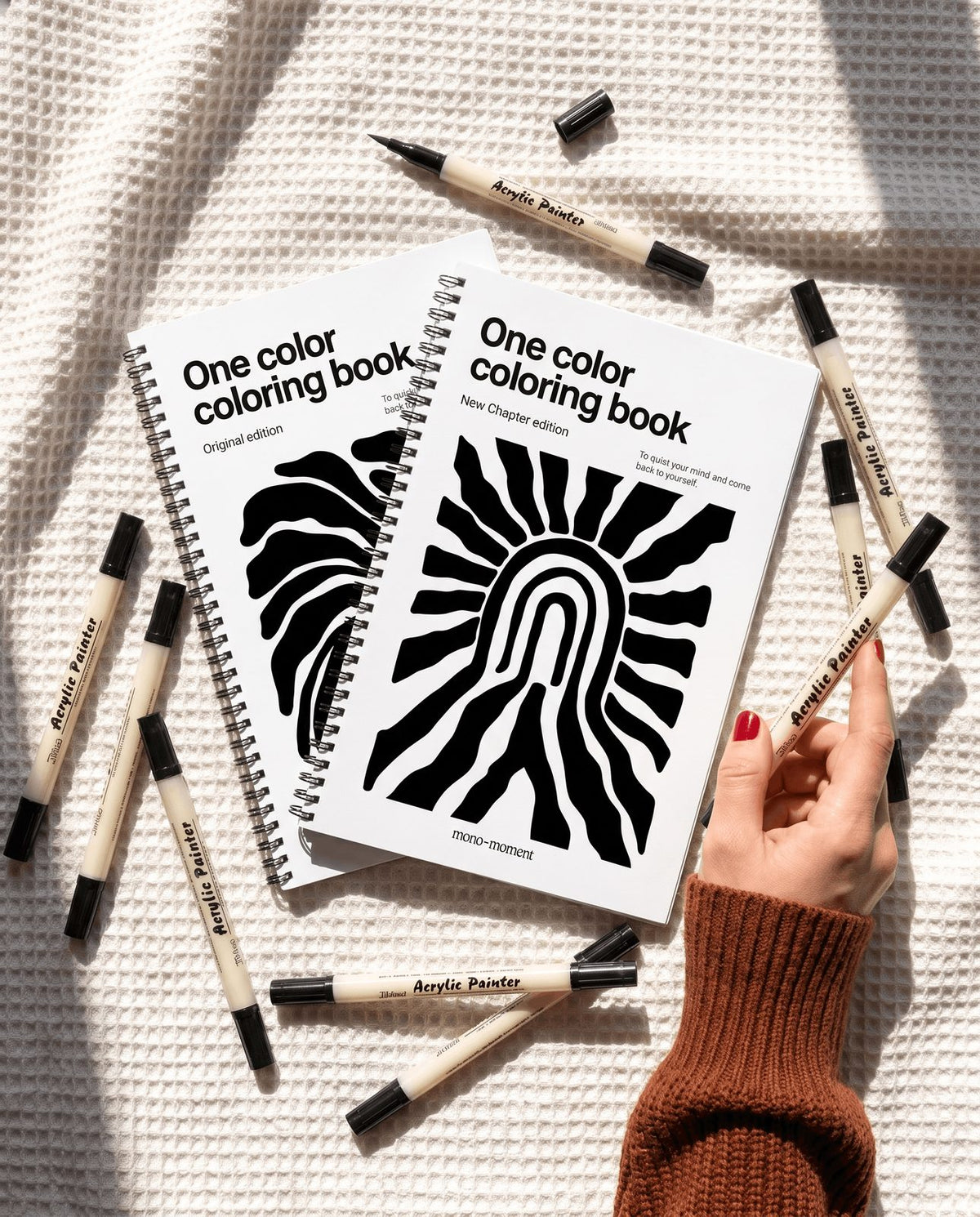
This one is ours, so full transparency about what it is and who it's for. The One Color Coloring Book keeps the bold, friendly line work — and removes the entire palette layer. Every page is a set of bold black designs meant to be filled with one single color: whatever pen you feel like tonight. No color theory, no "does this clash," no 40-pencil case on the table.
It's also built around the material complaints I kept hitting as a reviewer: 160gsm paper (about twice paperback weight) that takes brush pens with no bleed-through, printed on both sides because the paper allows it, with a metal spiral so it lies flat on your knees under a blanket.
Where it falls short: if collecting colorful finished spreads is your joy, one color per page isn't that mood — it's the book for the evenings when one less decision is the whole point. And it's a premium object at a premium price next to an Amazon paperback.
4. Coloring Book Cafe — for cheap variety across every theme
A big catalog publisher with hundreds of titles: farmhouse kitchens, gardens, holidays, animals. When you want to explore subjects without committing, catalogs are how.
Where it falls short: page-to-page consistency. Difficulty and style vary, so preview before buying if "easy" is the requirement.
5. Grayscale easy books — for depth without skill
A clever side path: soft gray shading is pre-printed under simple line art, so one flat layer of your color instantly looks dimensional. Highest reward-per-effort in the hobby — beginner motions, intermediate results.
Where it falls short: the pre-shaded look divides people, and cheap grayscale printing goes muddy under markers.
6. Large-print books — for late-night eyes
Books labeled large print — usually marketed to seniors — are secretly among the most faithful "easy" books made: oversized sections, high-contrast lines, zero squinting. I recommend them to readers of every age who color at the end of the day, when eyes are the first thing to give up.
Where it falls short: functional rather than beautiful art direction.
7. Printable pages — for testing styles for pennies
Independent artists sell bold-and-easy printable packs everywhere, and free samples abound (we give away a set of our own designs too). Printing at home is the cheapest way to learn what style actually suits you — and to re-color a favorite page twice.
Where it falls short: thin home paper, nothing lies flat in a binder, and the nightstand-book ritual — half of what makes the habit stick, as I argued in my guide to cozy coloring books for adults — never quite forms around loose sheets.
How to choose, honestly
Match the book to the evening you're actually having. If you color for delight — characters, worlds, finished spreads to photograph — stay with the illustrated universes: Bobbie Goods, Coco Wyo, the catalogs, thinner paper and all. If you color to stop thinking — the wind-down, the ritual, the quiet — then simplicity and materials outrank charm, and that's the exact gap the one color coloring book fills: one pen, bold shapes, paper that takes anything, a spiral that stays open on your lap.
The research is reassuring either way: the calming effect of art-making shows up regardless of skill, and it doesn't take long. Whichever book keeps you filling shapes for twenty minutes instead of scrolling — that's the right alternative.

The One Color Coloring Book
65+ bold designs, one single color, zero decisions — on 160 gsm paper with a lay-flat spiral, engineered for the wind-down ritual described above.
 Pair it with the 3 Dual Tip Brush Pens — $5 instead of $9.95 in the Book + Pens bundle.
Sources & further reading
Frequently asked questions
What is Bobbie Goods known for?
What coloring books are similar to Bobbie Goods?
Are cute character coloring books good for relaxation?
What should I look for in a Bobbie Goods alternative?
Is one-color coloring a good alternative to full-color books?
Know someone who needs a quieter evening? Pin it · Share on Facebook ·
↑