Tests every pen, paper and design she recommends — most evenings around 10:30pm.
Published October 18, 2026 · 5 min read
In this article · 8 sections
- What "large print" actually means for a coloring book
- Five signs of a truly large print coloring book
- Who large print coloring books are for
- Paper and binding matter more than you'd think
- Light, pens and a few small aids
- What we make, and where it fits
- A simple routine for comfortable coloring
- In short
In short. A large print coloring book for adults has thick, dark outlines, big shapes and only a few dozen areas per page, on paper heavy enough for a marker and a binding that lies flat. "Large print" has no standard, so judge the sample page, not the label. Add a bright lamp and a pen that colors without pressure, and coloring becomes easy on the eyes again.
I'm Caroline. A surprising number of the messages I get are about eyes. "I loved coloring, but I can't see the little sections anymore." "My eyes are done by the evening after a day of screens." "My mother has macular degeneration and misses her hobby."
They are almost always looking for the same thing: a large print coloring book that is genuinely easy to see. Here's what that means, how to spot one, and how to set up an evening so your eyes can rest while your hands work.
What "large print" actually means for a coloring book
With books, large print means bigger text. With coloring books, it means bigger drawings: bold outlines and large shapes, so the design is easy to see and easy to stay inside.
There is no official standard. One publisher's "large print" is another's "medium detail." That's why the label alone tells you very little, and why a sample page tells you almost everything.
Five signs of a truly large print coloring book

1. Thick, dark outlines. You should see the lines clearly from arm's length. Grey or hairline outlines disappear in low light.
2. Big shapes. As a rough test, most areas should be bigger than your fingertip. A shape you can fill in a few strokes is a pleasure. A shape you need to squint at is not.
3. Few areas per page. A few dozen, not several hundred. Fewer areas also means a page you can finish in one sitting.
4. High contrast. Black lines on white paper are easier to read than soft colors or textured backgrounds. Busy patterned backgrounds add visual noise.
5. Clear subjects. Familiar shapes, like a cup, a cat, a house or a tree, are easier to make sense of than abstract patterns when your eyes are tired.
| What you see on the sample page | Large print? |
|---|---|
| Thick black outlines, shapes bigger than a fingertip | Yes |
| Medium lines, a hundred or so areas | Somewhere in between |
| Hairline outlines, hundreds of tiny cells | No, whatever the cover says |
Who large print coloring books are for
Tired eyes. After a day of screens, fine detail is the last thing your eyes want. A bold page gives them something easy to rest on.
Low vision. The National Eye Institute describes low vision as vision loss that glasses, contact lenses or surgery can't fully correct, making everyday tasks harder. High contrast and bold shapes help many people keep enjoying close-up hobbies. A low vision specialist can advise on the right lighting and magnifiers for your own eyes.
Older adults. Eyesight changes with age, and so do hands. I've written a separate guide to coloring books for seniors, with more on grip, comfort and gifting.
Beginners. A large print page is simply easier to finish, and a finished first page is what makes people come back.
Anyone who wants to relax. The Cleveland Clinic describes coloring as relaxing because it gives the mind one simple task. That works best when the task really is simple.
Paper and binding matter more than you'd think

Paper weight. Large shapes mean a lot of ink in one place. On thin paper that shows through to the back and spoils the next page. Look for a weight in gsm: around 160gsm takes markers comfortably.
Binding. A spiral binding lets the book lie completely flat, so you don't have to hold it open with one hand. That matters if your grip isn't what it was, or if you color with a magnifier in the other hand.
Page size. A bigger page makes every shape bigger. A smaller one is lighter on the lap. Choose for where you'll color.
Light, pens and a few small aids
Light first. Good, even light helps more than almost anything else. Use a bright lamp aimed at the page from the side of the hand you don't color with, so your hand doesn't cast a shadow. Daylight bulbs are easier on the eyes than warm, dim ones.
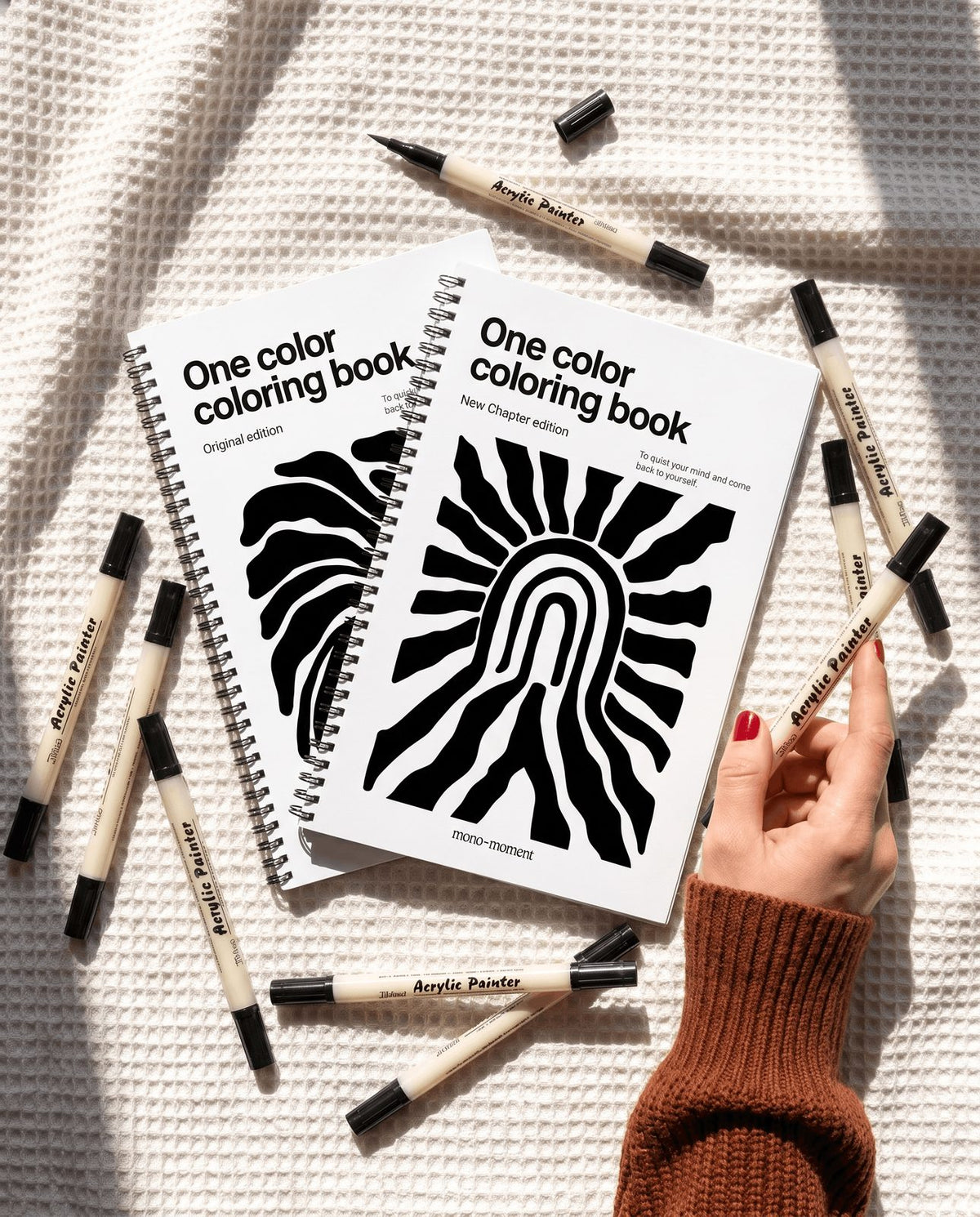
A pen that colors without pressure. Markers and brush pens put down strong color with a light touch, which pencils don't. A broad brush tip fills a big shape in a few strokes. I've compared the options in my guide to the best pens for adult coloring books, and our own coloring pens for adults are dual tip brush pens with water-based black ink.
Dark ink. Black or a very dark color against white paper is the easiest contrast to see. Pale yellows and light pinks are the hardest.
A stand or a slope. Tilting the book toward you brings the page closer to your eyes without bending your neck.
A magnifier, if you use one. A lamp with a built-in magnifier leaves both hands free.
Short sessions. Twenty minutes, then a break. The National Institute on Aging encourages staying engaged in activities you enjoy as you age; the point is to keep it enjoyable.
What we make, and where it fits
I'll be honest about our own book, because it fits this subject well without being made only for it.
The One Color Coloring Book is built on bold black shapes with thick outlines, printed on 160gsm paper and spiral bound so it lies flat. The areas to fill are marked, and you fill them all with one pen, so there are no colors to choose and no small sections to match. Black on white gives the strongest contrast there is.
Its limits: it isn't labeled or tested as a low vision product, and some pages have smaller details alongside the big shapes, so look at the sample pages first. If you'd like more color, a bold and easy book with a limited palette might suit you better. There are five editions in our one color coloring books collection, including Cats, Dogs and Woodland, if a familiar subject helps.
A simple routine for comfortable coloring
- Set the light before you sit down. Lamp on, aimed at the page.
- Choose a page with big shapes for your first session of the day.
- Start with the largest area. It's the most satisfying and the least tiring.
- Stop after twenty minutes, or as soon as your eyes feel it.
- Keep the book open on the table. A spiral book left open is an invitation to come back.
In short
A good large print coloring book is about what's on the page, not on the cover: thick dark lines, big shapes, few areas, high contrast. Pair it with heavy paper, a lay-flat binding, a bright lamp and a pen that glides. Then coloring is restful again, for your mind and your eyes.

The One Color Coloring Book
65+ bold designs, one single color, zero decisions — on 160 gsm paper with a lay-flat spiral, engineered for the wind-down ritual described above.
 Pair it with the 3 Dual Tip Brush Pens — $5 instead of $9.95 in the Book + Pens bundle.
Sources & further reading
Frequently asked questions
What is a large print coloring book for adults?
Who are large print coloring books for?
How do I know if a coloring book is really large print?
What pens are best for large print coloring books?
Can people with low vision enjoy coloring?
Know someone who needs a quieter evening? Pin it · Share on Facebook ·
↑