In this article · 13 sections
- 1. Single-color coloring (the lowest cognitive load on this list)
- 2. Walking a fixed loop
- 3. Listening to one specific album, all the way through
- 4. Watering and tending plants
- 5. Reading fiction (the easier the writing, the better)
- 6. Jigsaw puzzles (with one major caveat)
- 7. Cooking one repeatable comfort meal (not new recipes)
- 8. Organizing one small drawer (not a whole room)
- 9. Bird-watching from a window
- 10. Stretching (without a YouTube class)
- What these all share (and what's missing from most "relaxing hobby" lists)
- How to actually start one this week
- Sources & further reading
Most "relaxing hobbies for adults" lists are stressful in disguise.
They tell you to take up knitting (which requires you to count stitches and frog when you mess up), watercolor (which requires you to plan layers and accept that your first 100 paintings will be ugly), sourdough (which requires a schedule and a starter and an oven thermometer), or jigsaw puzzles (which is great until you lose a piece and your nervous system flares).
These are real hobbies. They have real benefits. But they're not relaxing in the sense most adults need — they're engaging, which is different.
This list is for the person who's already exhausted by 7pm and cannot, will not, take on another thing that asks something of them. The hobbies below are ranked by lowest cognitive demand first. None require talent. None require specialized equipment beyond what fits in a drawer.
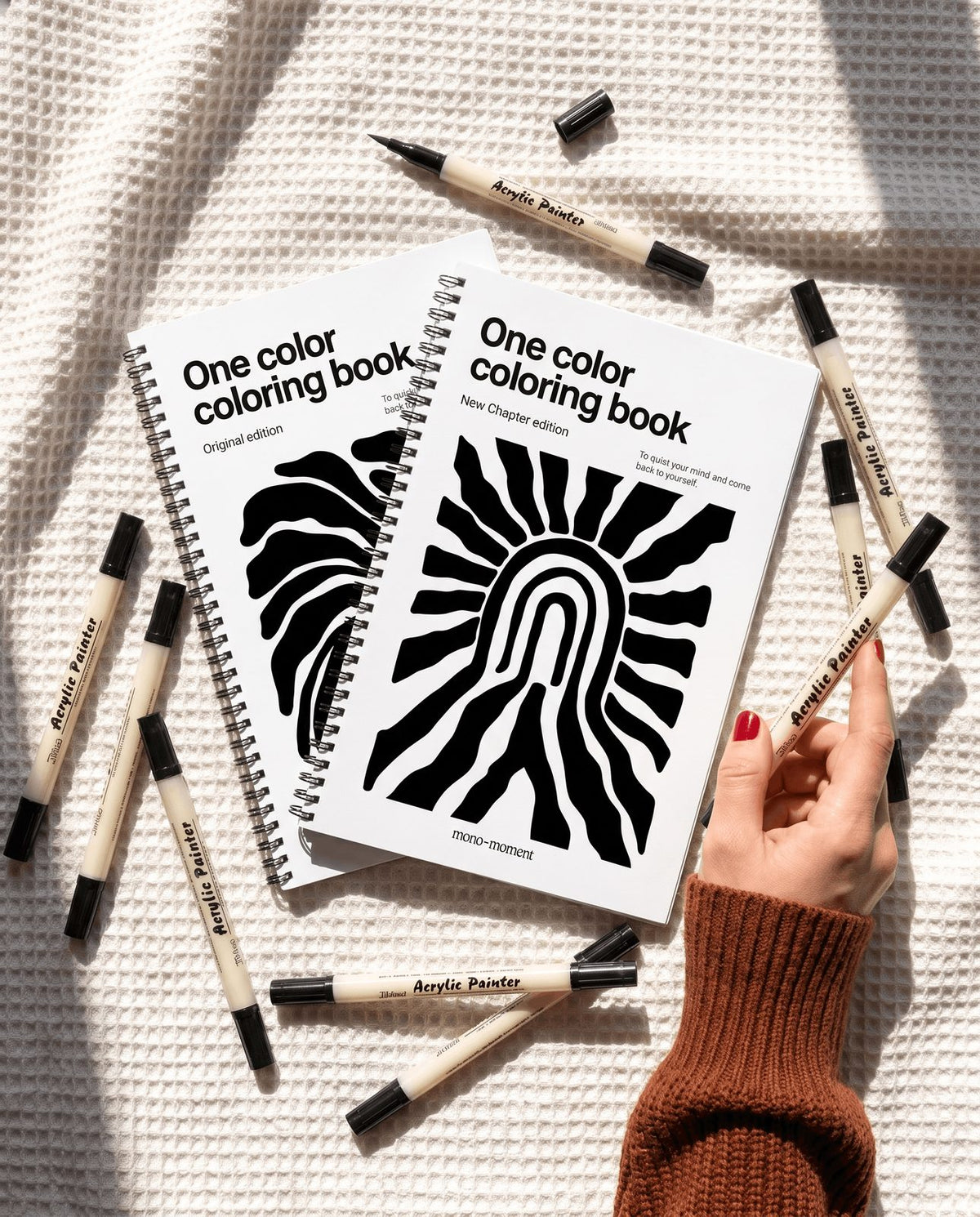
1. Single-color coloring (the lowest cognitive load on this list)
What it is: A spiral-bound book of large abstract shapes, one black pen, no decisions about which color goes where.
Why it works: Your brain has likely made between 200 and 35,000 decisions by the time you sit down. (The "35,000" figure is famously hard to source, but the underlying point — that your decision capacity is depleted — is well-established in research on ego depletion.) Single-color coloring removes the choice that traditional coloring books still demand: which shade goes where. One pen. One shape. Five quiet minutes.
Honest notes: There's no representational outcome. You won't make a portrait of your dog. If your brain wants something to "show off" at the end, this isn't the hobby.
Time required: 5-15 minutes per session.
What you need: Mono Moment's One Color Coloring Book is purpose-built for this — 50+ pages, one black brush pen included, 160gsm paper that handles ink without bleed-through.
2. Walking a fixed loop

What it is: Walking the same neighborhood loop, the same trail, the same lap of the park. Same one. Repeatedly.
Why it works: When the route is familiar, your prefrontal cortex stops doing navigation work and your default mode network kicks in. This is when the "shower thought" effect happens — quiet ideas arrive on their own. It's also one of the most studied stress-reducing activities in modern wellness research.
Honest notes: Has to be the same loop. Variety defeats the purpose. The point is the lack of decisions about where to go.
Time required: 15-45 minutes.
What you need: Shoes. Optional: a podcast or silence (try silence first).
3. Listening to one specific album, all the way through
What it is: Pick an album you've heard before. Sit. Listen to the entire thing. No phone.
Why it works: Pre-streaming, this was the default way music was consumed. Now we shuffle, we skip, we make 40 micro-decisions per listen. Choosing one album and committing to all 45 minutes removes those decisions. Familiar music engages reward circuits without demanding novel attention. It's a pattern your brain knows.
Honest notes: Has to be an album, not a playlist. The album as a sequence is part of the calm — the "this is what's next" guarantee.
Time required: 35-60 minutes.
What you need: An album. Headphones if you want to disappear.
4. Watering and tending plants

What it is: Going around your home or a single windowsill and giving each plant water, rotating, snipping a yellow leaf.
Why it works: It's slow, it's tactile, it's mildly responsive (the plant responds over weeks, which is just feedback enough to feel rewarding), and there's no "right answer." The plant is already alive. You're just maintaining.
Honest notes: Don't take this on if you don't already have plants — adding "buy plants" to your to-do list defeats the entire purpose.
Time required: 5-20 minutes.
What you need: Plants. A small watering can.
5. Reading fiction (the easier the writing, the better)
What it is: A novel. Light, well-written prose. Not a productivity book.
Why it works: Narrative absorption is one of the strongest known interrupters of rumination. The University of Sussex famously found a 68% reduction in stress markers after just six minutes of reading. The trick is the prose has to be easy — heavy literary fiction is engaging but cognitively expensive.
Honest notes: If you're a slow reader, audiobooks count. If you're a "should-be-reading-non-fiction" person, this is your permission slip — fiction is what works for stress; non-fiction often makes it worse.
Time required: 15-60 minutes.
What you need: A book. Preferably one you've already started so there's no "what to read" decision.
6. Jigsaw puzzles (with one major caveat)
What it is: A 500-1000 piece jigsaw, set up on a dedicated surface so you can return to it across days.
Why it works: Repetitive, rhythmic, visual. Engages just enough of the brain to stop rumination but not so much that it generates new tension. Long-form completion is satisfying.
Honest notes: Only works if you have a dedicated surface. If you have to clear and re-set the puzzle each time, the friction will kill the habit. Also: if losing a piece will cause a meltdown, this isn't your hobby. Be honest with yourself.
Time required: Open-ended, 10-min sessions over weeks.
What you need: A puzzle, a flat surface, an honest self-assessment about pieces.
7. Cooking one repeatable comfort meal (not new recipes)
What it is: You have one or two meals you can make from memory. You cook one of them, slowly, on a Sunday evening.
Why it works: The novelty of "trying a new recipe" makes cooking stressful. Cooking the same thing you've made twenty times is meditative — your hands know what to do, you can listen to music, you can let your brain wander.
Honest notes: This only works if you genuinely have a meal you can do without consulting a recipe. If you don't, this isn't your hobby yet.
Time required: 30-90 minutes.
What you need: A meal you know by heart. Ingredients in the house.
8. Organizing one small drawer (not a whole room)
What it is: You pick one drawer. The bathroom one. The junk one. You take everything out, sort, put back.
Why it works: It's a closed system. Unlike "decluttering the house" (which is psychologically infinite), one drawer has a clear endpoint. The before-and-after dopamine hit is real.
Honest notes: This breaks the moment you go beyond one drawer. Resist the urge to "do the whole room while I'm at it." That's a different activity called "weekend lost to organizing."
Time required: 15-30 minutes.
What you need: A drawer. A trash bag.
9. Bird-watching from a window
What it is: Sit by a window. Watch what shows up.
Why it works: Passive observation of a natural system you don't control is one of the lowest-cognitive-load forms of attention humans have. It's also been studied for stress reduction in prison and hospital settings.
Honest notes: You need a window with at least some sky and ideally some greenery or a bird feeder. If your window faces a brick wall, this isn't the hobby for you.
Time required: 10-30 minutes.
What you need: A window. Optional: a bird feeder, a small notebook.
10. Stretching (without a YouTube class)
What it is: Five to ten minutes of slow stretching. No video. No counting. Just slow.
Why it works: Combines proprioceptive feedback (you feel the body) with breath. The reason it ends up at the bottom of this list is that most people, when told to "stretch," reach for a 30-minute YouTube class with someone counting reps — which has its place, but isn't this. This is just slow listening to your body.
Honest notes: If you're someone who turns "stretching" into a 45-minute ordeal with a foam roller and four resistance bands, that's a workout. This is a stretch.
Time required: 5-15 minutes.
What you need: A floor. Maybe a yoga mat if you have one, but not required.
What these all share (and what's missing from most "relaxing hobby" lists)
Re-read the list. Notice what's not there:
- No instruments (months of "I'm bad at this" before you can enjoy it).
- No new recipes (decisions every step).
- No watercolor or "art journaling" (cognitive expensive at the start).
- No language apps (gamified to demand return engagement).
- No "find a hobby that gives you a side income" — that's a job.
What the 10 above share:
- Low decision count per minute. Most ask you to make zero or one or two decisions in a 15-minute window.
- Repeatable. You can do them again tomorrow with no reset.
- Failure-tolerant. "Doing it badly" doesn't ruin the session.
- Genuine outcome is the practice, not a finished product (with the exception of cooking and jigsaw, where you do get an output).
If your goal is to find a hobby that genuinely calms you, prioritize those four traits above the word "creative." Calming and creative are not the same thing. Sometimes they overlap. Often they don't.
How to actually start one this week
The hardest part of finding a relaxing hobby isn't picking it — it's not abandoning it three days in. Two rules:
- Start with 5 minutes, not 30. You're not building a "practice." You're building a 5-minute habit. The 30-minute version comes naturally if the 5-minute version sticks.
- Reduce friction to zero. The book/pen/shoes/album has to be within arm's reach of where you'll do the hobby. If it requires a 4-step setup, you'll skip on bad days. Bad days are when you most need it.
If you want to try #1 (single-color coloring), the One Color Coloring Book ships in 24 hours and lives well on a bedside table or kitchen counter. The pen comes with it.
The other nine on this list cost nothing.
Sources & further reading
- Lewis, D. (2009) Sussex University reading study — 68% stress reduction after six minutes of reading.
- Vohs, K. D. et al. (2008) Making Choices Impairs Subsequent Self-Control, Journal of Personality and Social Psychology — for decision fatigue.
- Kaimal, G., Ray, K., & Muniz, J. (2016) Reduction of Cortisol Levels and Participants' Responses Following Art Making, Art Therapy — measured 75% cortisol drop.
- Kaplan, S. (1995) The Restorative Effects of Nature: Toward an Integrative Framework, Journal of Environmental Psychology — for fixed-loop walking + bird-watching.
- Conner, T. S. et al. (2018) Everyday creative activity as a path to flourishing, Journal of Positive Psychology — simple creative acts increase next-day positive affect.

The One Color Coloring Book
A single-pen, decision-free coloring book on 160 gsm cream paper — engineered for the wind-down ritual described above.
 Pair it with the 3 Dual Tip Brush Pens — $5 instead of $9.95 in the Book + Pens bundle.