Tests every pen, paper and design she recommends — most evenings around 10:30pm.
Published October 7, 2026 · 5 min read
In this article · 8 sections
In short. The best coloring books for seniors have thick outlines, large shapes, paper heavy enough for a marker and a binding that lies flat. Check a sample page: "large print" has no standard.
I'm Caroline. A good share of the people who write to me about our books are in their sixties, seventies and eighties, or are buying for a mother or a father. Their questions are practical and almost always the same: can she see the lines, can he hold the pen, will the book stay open on his knees.
Those are the right questions. This guide answers them, for yourself or for someone you love.
What changes with age, and what a good book does about it
Nothing here is a rule. Plenty of eighty-year-olds color mandalas with a fine pen. But a few things become more common, and a well-chosen book quietly allows for them.
Eyes. Fine lines and low contrast get harder to follow, especially in evening light. Bold black outlines on white paper are the easiest thing to see.
Hands. Grip weakens, joints stiffen, and some hands tremble. Staying inside a small cell with a thin pencil is tiring. A large shape and a pen that colors without pressure are kinder.
Energy. A page that takes four hours can feel like a task. A page that can be finished in one sitting gives a small, real satisfaction.
Confidence. Many people haven't drawn since school and are afraid of doing it badly. The fewer choices a page asks for, the easier it is to begin.
Seven things to look for

1. Thick outlines
Look at a sample page, not the cover. The lines should be clearly visible from arm's length.
2. Large shapes, and not too many
A comfortable page has a few dozen areas at most. If most of them are smaller than a fingernail, the book is detailed, whatever the cover says. This style is often sold as bold and easy coloring books, and I've written a full guide to choosing one.
3. "Large print" that really is
There's no standard for the phrase. Some books use it for genuinely big shapes. Others only mean the page is large. Trust the sample pages.
4. Paper that holds ink
Markers are the easiest tool for tired hands, and markers need decent paper. Look for a weight stated in gsm. Around 160gsm takes water-based markers comfortably. On thin paper, slip a spare sheet behind the page.
5. A binding that lies flat
This one is easy to overlook and makes a great difference. A spiral lets the book stay open by itself and fold back to a single page, so it sits on a lap or a tray without being held. I've explained the details in my guide to spiral bound coloring books for adults.
6. Adult subjects
Flowers, birds, cats, dogs, gardens, kitchens, seasons. A simple page is not a childish page. A book of cartoon characters given to a grown woman says something you don't mean.
7. Few decisions
Choosing colors is a pleasure for some people and a worry for others. If it's a worry, limit the set to five or six pens, or look at a book designed for one color only.
| What to check | Comfortable | Tiring |
|---|---|---|
| Outlines | Thick and black | Thin or grey |
| Shapes | Large, a few dozen per page | Hundreds of tiny cells |
| Paper | Weight stated, around 160gsm | No weight given |
| Binding | Spiral, lies flat | Thick glued spine |
| Subjects | Familiar, adult | Children's characters |
| Colors needed | A handful, or one | Dozens to look right |

The right pens for older hands
Choose markers or brush pens over pencils. A pencil needs pressure and many passes. A marker colors at a touch.
Prefer water-based ink. It has little smell and is far less likely to go through the page than alcohol ink.
Look for a thicker barrel. It's easier to hold loosely. For a slim pen, a foam pencil grip costs very little and helps a lot.
Pick a broad tip for filling. A brush or chisel tip covers a large shape in a few strokes.
Keep the set small. Six pens in a cup are easier to live with than sixty in a tin.
One color books: a good fit for many seniors

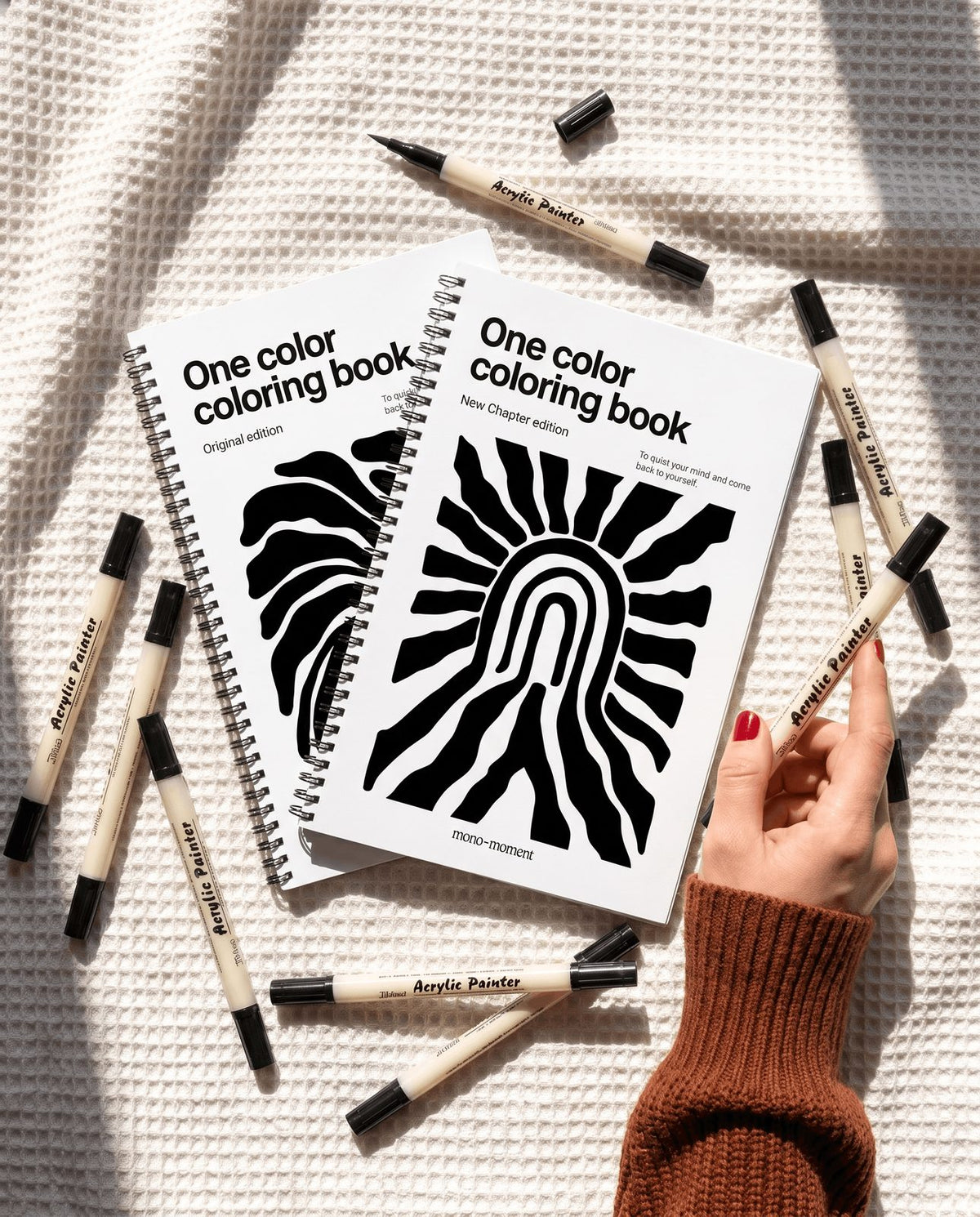
A one color coloring book takes the bold and easy idea one step further. The areas to fill are marked on the page, and you fill all of them with the same pen, usually black. There's no palette to choose and nothing to match. The picture appears through contrast.
This is the kind of book we make. The One Color Coloring Book is spiral bound on 160gsm paper, and there are editions devoted to cats and to dogs for animal lovers.
It isn't right for everyone. Someone who loves choosing colors will miss them, and filling large areas in black uses a fair amount of ink, so a spare pen is worth having. But for a person who says "I wouldn't know where to start", having only one thing to do is often what gets the first page finished.
What the research says, without overstating it
A randomized controlled study of older adults living in the community found that those who took part in coloring activities reported lower anxiety than a control group. That is one study, and coloring is not a medical treatment.
The National Institute on Aging makes a broader and safer point: taking part in activities you enjoy is associated with well-being as you age. That's the honest reason to color. It's pleasant, it's calm, and at the end there is something to show for the time.
Tips for families and caregivers
- Offer, don't prescribe. "I thought you might like this" lands better than "this will be good for you."
- Set it up once. Book open, pen uncapped, good light, a cup of tea. Starting is the hard part.
- Sit and color too. A second book on the same table turns it into company.
- Keep sessions short. Twenty minutes is plenty. Stopping while it's still pleasant brings people back.
- Don't correct. Outside the lines is fine. So is leaving a page half done.
- Date the pages. A small date in the corner makes a record of quiet afternoons.
If the person is living with memory loss, follow their lead and their care team's advice. Choose the simplest pages, and treat the time together as the point.
If you're choosing a gift
A coloring book makes a thoughtful present when it's chosen for comfort: bold designs, a binding that stays open, and a pen in the parcel so they can begin the same day. I've gathered more ideas in my guide to gifts for grandma.
In short
Look for thick lines, big shapes, real paper and a book that lies flat. Add a pen that glides. Then leave the choice of page, and the pace, to the person holding it.

The One Color Coloring Book
65+ bold designs, one single color, zero decisions — on 160 gsm paper with a lay-flat spiral, engineered for the wind-down ritual described above.
 Pair it with the 3 Dual Tip Brush Pens — $5 instead of $9.95 in the Book + Pens bundle.
Sources & further reading
Frequently asked questions
What is the best kind of coloring book for seniors?
What does large print mean for a coloring book?
Are coloring books good for older adults?
What pens are easiest for seniors to hold?
Is a coloring book a good gift for a grandparent?
Know someone who needs a quieter evening? Pin it · Share on Facebook ·
↑