In this article · 11 sections
- Why 20 minutes is the right number
- 1. Single-color coloring (5-15 minutes, the lowest-overhead reset on the list)
- 2. The fixed-loop walk (15-20 minutes)
- 3. Eat lunch somewhere your laptop can't see you
- 4. The 4-7-8 breath (3-5 minutes, can be done at your desk)
- 5. Listen to one familiar album
- 6. The "look out the window for 10 minutes" practice
- 7. The 1-drawer organize
- 8. Stretching at your desk (5-10 minutes)
- How to make this stick
- Sources & further reading
By 1pm, your brain has made somewhere between 200 and a few thousand micro-decisions, sat through one or two meetings, written maybe a dozen emails or messages, and is running on a fraction of the cognitive capacity you started the day with. This is decision fatigue colliding with a natural circadian dip — and unless you intervene, the afternoon is already cooked.
The lunch break is the only natural reset window most knowledge workers get. Most of us waste it scrolling Slack or eating at our desks while continuing to work.
This guide is for the person who's noticed that "by 2pm I'm useless" and wants to do something about it without buying an app or installing a meditation cushion under their desk. Eight practices. None require leaving the building (though some are better outside). None require equipment beyond what fits in a desk drawer.
Why 20 minutes is the right number
Some research perspective before the list. Micro-break studies (Trougakos & Hideg, 2009; Kim et al., 2017) consistently find that short breaks of 10-20 minutes meaningfully reduce afternoon fatigue and restore attention — but only if the break is genuine, meaning the person actually disengages from work tasks during it. Eating lunch while answering Slack is not a break.
The break also has to involve some kind of attentional shift — physical movement, visual change, or attention to something genuinely non-work. Just sitting at your desk staring out the window counts. Sitting at your desk on Twitter does not (it's the same screen, same input mode).
20 minutes is roughly the sweet spot: long enough to drop the work-state physiologically, short enough to fit a real lunch break, and long enough to do one of the practices below well.
1. Single-color coloring (5-15 minutes, the lowest-overhead reset on the list)

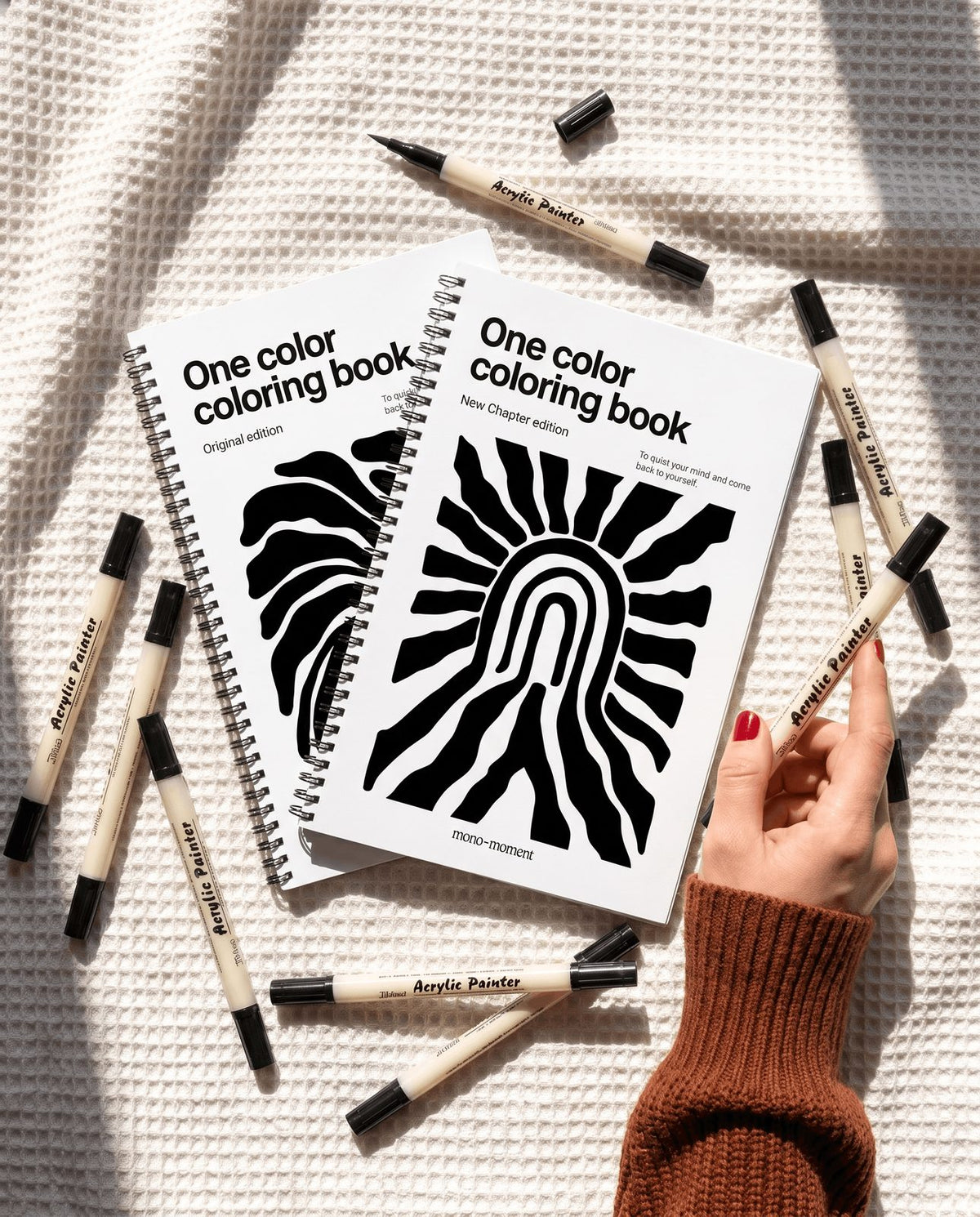
What it looks like: A small spiral-bound coloring book in your desk drawer. One black brush pen. You open it, fill one bold abstract shape, close it.
Why it works as a lunch reset: It's the opposite of every other input you've had since 9am. No notifications, no decisions about which color goes where, no judgment about whether you did it well. Just rhythmic, low-cognitive-load motion that interrupts rumination. By the time the page is filled, the work-state has dropped and the afternoon brain feels noticeably different.
We make this kind of book on purpose for this kind of break. The One Color Coloring Book is small enough to live in a desk drawer; one pen, no setup, no clean-up.
Time required: 5-15 minutes. (Most users find a single page takes about 8-10 minutes once they get into a rhythm.)
Honest note: This won't work if your desk is in a busy open-plan office where you'll feel weird coloring. In that case, find a meeting room, eat your lunch in a café for 20 minutes, or save this one for working-from-home days.
2. The fixed-loop walk (15-20 minutes)
What it looks like: Same path every day. Around the block, the same neighborhood loop, the same lap of the park. No phone, or phone in pocket on do-not-disturb. Same path on purpose — variety defeats the reset.
Why it works: Familiar route lets your prefrontal cortex stop doing navigation work, which is when the default-mode network kicks in. This is the brain state where shower thoughts happen — the small ideas you've been sitting on quietly resolve themselves. It's also one of the most studied stress-reducers in occupational health research.
Time required: 15-20 minutes round trip. Walk pace, not exercise pace.
Honest note: Has to be roughly the same loop. If you're navigating new streets each day, your brain's still working.
3. Eat lunch somewhere your laptop can't see you

What it looks like: You leave your desk. You go to a café, a park bench, a kitchen table that's not your work setup, the office's other floor — anywhere your laptop is physically out of sight. You eat your lunch slowly. You don't open Slack on your phone.
Why it works: Most "lunch" attempts fail because the laptop is still in peripheral vision. Your brain stays in work-mode. Physical visual separation from the work surface flips the state more effectively than any willpower-based "I'll just not check email" attempt.
Time required: 20 minutes.
Honest note: This is the cheapest practice on the list. It's also the one most people skip because it sounds too simple. Try it for a week before deciding it doesn't count.
4. The 4-7-8 breath (3-5 minutes, can be done at your desk)
What it looks like: Inhale through the nose for 4 counts. Hold for 7 counts. Exhale through the mouth for 8 counts. Repeat 4-6 cycles.
Why it works: Activates the parasympathetic nervous system through the vagus nerve. The lengthened exhale is what does most of the work. (For more on parasympathetic activation, see our parasympathetic nervous system activities guide.)
Time required: 3-5 minutes.
Honest note: Don't do this immediately after eating — the breath-holding can feel uncomfortable on a full stomach. Either do it before lunch or wait 20 minutes after.
5. Listen to one familiar album
What it looks like: Pick an album you've listened to 20+ times. Headphones. Sit somewhere not your desk. Listen.
Why it works: Familiar music engages reward circuits without demanding novel attention. The fact that it's an album (not a playlist) means there are no skip decisions — your brain knows what's coming and can stop monitoring.
Time required: 20-45 minutes (one side of a record, or about half a streaming album).
Honest note: Has to be familiar. New album = your brain is doing assessment work. You want pattern recognition only.
6. The "look out the window for 10 minutes" practice
What it looks like: Find a window. Look out of it. For 10 minutes. No phone.
Why it works: Visual change is one of the strongest known interrupters of work-state attention. Sky, weather, trees, even traffic — anything beyond your screen. Hospital research has shown measurable cortisol drops in patients with views of greenery vs. brick walls. The same effect, smaller magnitude, applies to office workers.
Time required: 10 minutes.
Honest note: This one feels deeply weird the first time you do it. "I'm just... looking?" Yes. That's the practice. It's also the practice your great-grandmother accidentally did every day while she stirred soup.
7. The 1-drawer organize
What it looks like: Pick one drawer at your desk or in your bag. Empty it. Sort. Put back.
Why it works: Closed-system tasks (one drawer, not a whole room) deliver a contained dopamine hit with a clean endpoint. The before-and-after is satisfying, the work is mechanical, and your brain can wander while your hands sort.
Time required: 10-20 minutes.
Honest note: Strict rule — one drawer. Not "while I'm at it, the cabinet too." That breaks the practice and you've now accidentally taken on a project at lunch.
8. Stretching at your desk (5-10 minutes)
What it looks like: Five to ten minutes of slow movement. Neck rolls. Shoulder rolls. Standing forward fold. A doorway pec stretch. Slow.
Why it works: After a morning of typing and meeting-sitting, your shoulders are at your ears, your hip flexors are short, and your neck is leading your posture. Five minutes of slow opening releases physical tension that compounds mental tension. The point is not the workout — it's the body-listening.
Time required: 5-10 minutes.
Honest note: This isn't a workout. Don't turn it into one. If you put on a 30-minute YouTube class, you've started a different activity. The point is brief, slow, and self-directed.
How to make this stick
The biggest reason "lunch break stress relief" advice fails is that the practice requires planning the night before to actually happen. Three small commitments make the difference:
1. Put one prop in your bag the night before. The book. The headphones. The walking shoes. Whichever practice you're trying. If it's already in your bag, the friction at noon is zero.
2. Schedule it on your calendar. A 12:30-12:50pm "lunch reset" block makes the difference between "I'll get to it" and actually doing it. Treat it like a meeting with yourself that the rest of the day depends on.
3. Pick one practice for the week, not all eight. You're not designing a perfect lunch routine. You're picking one practice this week and seeing if it sticks. If it does, keep it. If not, swap to another one next week. Most people find their default within 3-4 weeks.
The afternoon you save isn't going to feel dramatic. You'll just notice, around 4pm, that you're still actually here — that the slack-jawed, can't-write-an-email feeling didn't show up the way it usually does.
That's the whole goal.
If you want to try practice #1, the One Color Coloring Book is small enough to live in a desk drawer, ships in 24 hours, and comes with the pen.
Sources & further reading
- Trougakos, J. P., & Hideg, I. (2009) Momentary Work Recovery: The Role of Within-Day Work Breaks, Research in Occupational Stress and Well-being — foundational micro-break work.
- Kim, S., Park, Y., & Niu, Q. (2017) Micro-break activities at work to recover from daily work demands, Journal of Organizational Behavior, 38(1), 28-44.
- Kaplan, S. (1995) The Restorative Effects of Nature: Toward an Integrative Framework, Journal of Environmental Psychology.
- Vohs, K. D. et al. (2008) Making Choices Impairs Subsequent Self-Control, Journal of Personality and Social Psychology — decision fatigue.
- Cleveland Clinic. 4-7-8 Breathing: How It Works and Benefits — for the parasympathetic activation behind the breath practice.

The One Color Coloring Book
A single-pen, decision-free coloring book on 160 gsm cream paper — engineered for the wind-down ritual described above.
 Pair it with the 3 Dual Tip Brush Pens — $5 instead of $9.95 in the Book + Pens bundle.