Tests every pen, paper and design she recommends — most evenings around 10:30pm.
Published October 7, 2026 · 5 min read
In this article · 8 sections
In short. A spiral bound coloring book lies flat and folds back on itself, which matters most on a sofa or in bed. Check the paper weight too: a spiral does not stop ink showing through.
I'm Caroline, and I make coloring books. The first decision I made about ours had nothing to do with the drawings. It was the binding. I'd spent too many evenings pinning a paperback open with my left forearm while trying to color with my right hand, and I didn't want anyone else to do the same.
The binding is the least glamorous part of a coloring book and the part you notice every single minute you use it. Here's what a spiral really changes, what it doesn't, and how to choose one.
What a spiral binding changes
The book lies flat. Both pages sit level with the table. There's no hump in the middle and no page slowly rising while you work.
You can color to the inner edge. In a glued paperback, the two centimeters nearest the spine curve away from you. Designs that run into the fold are almost impossible to finish neatly. With a spiral, the whole page is usable.
The book folds back on itself. Turn the cover and the finished pages right round to the back, and you're left with one single page in front of you. That halves the space the book needs. It fits on a lap tray, the arm of a sofa or an airplane table.
Both hands are free. One hand colors. The other holds your tea. Nothing needs pinning down.
The spine doesn't break. A paperback pressed flat again and again cracks along the glue and starts shedding pages. A wire doesn't wear out that way.
The Cleveland Clinic describes coloring as relaxing partly because it gives your attention one simple thing to rest on. A book that fights back gives you a second thing: keeping it open. Removing that small irritation is the whole point of a spiral.
What a spiral doesn't fix

It's worth being honest about this, because a spiral is often sold as a sign of quality in general. It isn't.
It doesn't stop bleed-through. That's the paper's job. A spiral book printed on thin paper will still show marker ink on the back. Look for the weight in gsm. Around 160gsm is comfortable for water-based markers and brush pens. I've written more about this in my guide to coloring books with thick paper.
It doesn't make pages removable by itself. You can pull a page off a wire, but the punched holes stay on the sheet. If you want clean pages to frame, you need perforation.
The wire can get in the way. On the left-hand page, a right-handed colorist's hand rests near the wire. Folding the book back solves most of it. So does turning the book a quarter turn.
It adds a little bulk. Spiral books don't sit flush on a shelf, and a wire can bend if the book is crushed in a bag.
Spiral or glued spine: how they compare
| Spiral bound | Glued spine (paperback) | |
|---|---|---|
| Lies flat | Yes | Only if you press or break the spine |
| Folds back to one page | Yes | No |
| Usable inner edge | Yes | The fold swallows part of the design |
| Coloring on a lap | Easy | Needs a hand to hold it open |
| Removing pages | Possible, cleaner with perforation | Possible if perforated, otherwise cut |
| Shelf and bag | Slightly bulkier, wire can bend | Flat and tidy |
| Price | Usually higher | Usually lower |
Neither is wrong. They suit different habits.

What to check before you buy a spiral bound coloring book

1. Paper weight, in numbers. "Thick" and "premium" aren't measurements. If no gsm figure is given, assume ordinary paper and plan to put a spare sheet behind each page.
2. Single or double-sided. Single-sided pages are safer for wet pens and can be removed without losing a drawing. Double-sided gives you more designs for the same thickness and relies on heavier paper. I've compared the two in my guide to single-sided coloring books.
3. Perforation. Only matters if you want to take pages out. If you do, it matters a lot.
4. The wire. A metal wire holds its shape better than a thin plastic coil. Check in the photos that the loops are closed and evenly spaced.
5. Where the wire sits. Most books are bound on the left. A few are bound at the top, like a notepad, which left-handed colorists often prefer.
6. The cover. A stiff cover front and back gives you a firm surface when you color away from a table.
7. The size. A large page is easier on the eyes. A smaller one travels better. Decide where you'll mostly use it.
Who should choose a spiral
- You color on the sofa, in bed or in a chair. This is the clearest case. A spiral was made for laps.
- You use markers or brush pens. A flat page means even strokes and no ink pooling in the fold.
- Your hands tire or ache. Not having to hold the book open is real relief over twenty minutes.
- You're left-handed. Fold the book back or turn it, and the wire is out of the way.
- You travel. One page facing you fits on any small surface.
When a glued spine is perfectly fine
If you always color at a desk, if you take pages out before you start, or if you're trying coloring for the first time and want to spend as little as possible, a paperback will do the job. Many beautiful books only exist as paperbacks. Use a large clip to hold the pages down, and slip a sheet of paper behind the page you're working on.
Our own book, and its limits
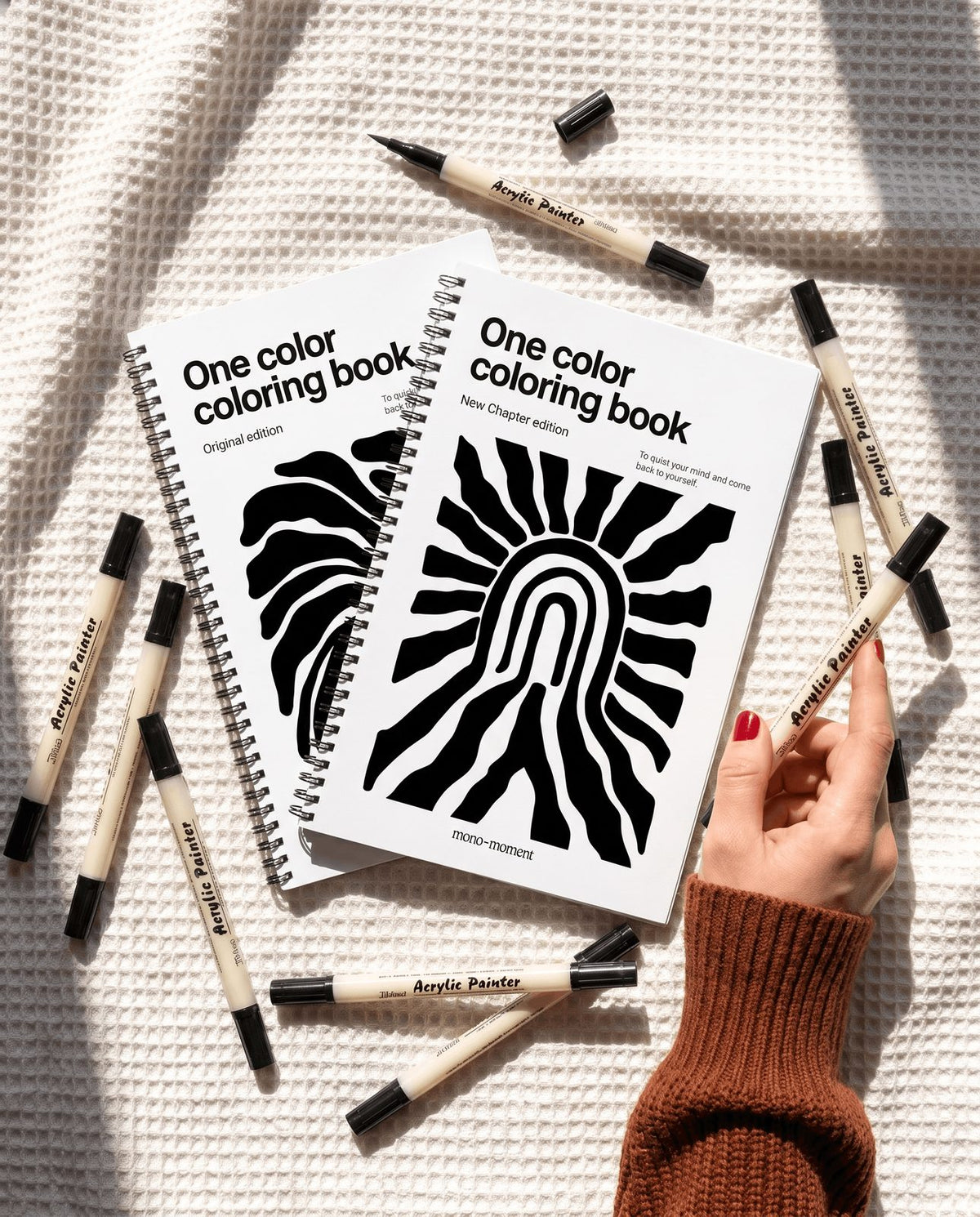
The book we make at Mono Moment is spiral bound for all the reasons above. The One Color Coloring Book is printed on 160gsm paper and designed to be filled in with a single pen, so the flat page matters even more: large areas of solid ink need steady, even strokes. The Cats and Dogs editions use the same binding and paper.
One honest limit. Our pages are printed on both sides, so you get more designs, but you can't remove one without losing the drawing on its back. If framing finished pages is your priority, a single-sided, perforated book will suit you better. I've set out the alternatives fairly in my comparison of the best one color coloring books.
In short
Choose the binding for where you color, not for how the book looks on a shelf. On a lap, a spiral is worth the small extra cost. At a desk, either works. In both cases, check the paper weight in numbers, because the binding can only make a good page easier to reach. It can't make a thin page hold ink.

The One Color Coloring Book
65+ bold designs, one single color, zero decisions — on 160 gsm paper with a lay-flat spiral, engineered for the wind-down ritual described above.
 Pair it with the 3 Dual Tip Brush Pens — $5 instead of $9.95 in the Book + Pens bundle.
Sources & further reading
Frequently asked questions
Are spiral bound coloring books better?
Do spiral bound coloring books lay flat?
Can I remove pages from a spiral bound coloring book?
Is a spiral binding good for left-handed people?
What paper weight should a spiral bound coloring book have?
Know someone who needs a quieter evening? Pin it · Share on Facebook ·
↑