Tests every pen, paper and design she recommends — most evenings around 10:30pm.
Published October 7, 2026 · 5 min read
In this article · 9 sections
In short. Mandala coloring books suit patient colorists who enjoy detail and choosing colors. If they feel like too much, try larger sections, fewer colors, or a simpler style of book.
I'm Caroline. I make coloring books, and I'll say this plainly at the start: ours aren't mandalas. But mandalas are where many of us began, me included, and they deserve a fair guide. They are lovely. They're also the reason a lot of people decide coloring "isn't for them", when the truth is that they simply chose the hardest kind of page first.
Here's who mandalas suit, how to choose a good one, and what to try if they leave you more tense than when you sat down.
What a mandala coloring book is
Mandala means circle in Sanskrit. In coloring books, a mandala is a round design built outward from a center point, with shapes that repeat around it: petals, arcs, triangles, rings.
Two things define the experience.
- Symmetry. Whatever you do in one section, you'll probably repeat in the others. That repetition is what many people find calming.
- Detail. Most mandalas are made of many small sections. A single design can have several hundred.
The designs in coloring books are decorative. They borrow a form with deep spiritual roots in several traditions, and it's worth knowing that, even if you're only here for a quiet evening.
What the research says

The study most often quoted is by Nancy Curry and Tim Kasser, published in 2005 in the journal Art Therapy. Students who colored a mandala for twenty minutes showed a greater drop in anxiety than those who colored freely on a blank page. A plaid pattern did about as well as the mandala.
That last detail matters. The researchers suggested the benefit came from the structure and complexity of the design, which holds attention, and not from the circular shape as such. A structured page gives you something to follow. A blank page gives you something to worry about.
The Cleveland Clinic makes a similar point about coloring in general: it draws attention away from your own thoughts and onto a simple task. It's a pleasant way to rest, not a medical treatment.
Who mandalas suit
- People who enjoy detail. If small, precise work absorbs you, a mandala is a pleasure.
- People who like choosing colors. Planning a palette and watching it repeat around the circle is half the fun.
- Patient colorists. A detailed mandala is several sessions of work.
- People with good light and fine pens. The sections are small.
When mandalas feel like too much

If you've opened a mandala book, looked at the page and closed it again, you have plenty of company. The usual reasons:
Too many decisions. Every section needs a color, and the symmetry means one choice commits you to twelve more. The Cleveland Clinic describes decision fatigue as the way a long run of choices wears down the ones that follow. After a day full of decisions, a page that asks for three hundred more isn't restful.
Sections that are too small. Tiny cells need a fine tip, steady hands and good eyesight. In evening light, that's a strain.
Pages that never get finished. A design that takes six hours across a week often gets abandoned halfway. An unfinished page nags.
Fear of spoiling it. One wrong color in a symmetrical design feels like it ruins the whole thing. It doesn't, but the feeling is real.
None of this means coloring isn't for you. It means this page isn't.
How to choose a mandala coloring book
Check the detail level first. Look at sample pages. If you're new, choose mandalas with thick lines and large sections. They're sometimes sold as easy, simple or large print mandalas.
Look for the paper weight. Fine markers on thin paper show through. A weight stated in gsm is a good sign. Around 160gsm takes markers comfortably.
Prefer single-sided pages if you use markers. You won't lose a design to ink coming through.
Think about the binding. A spiral lets a round design lie flat, which helps when you're turning the book to follow the circle.
Pick a size you can see. A large page makes small sections bigger.
For the full checklist across every style, see my guide on how to choose an adult coloring book.
Five ways to make a mandala easier
- Choose three colors and stop. Put the rest of the set away before you start.
- Work from the center outward. One ring at a time. It breaks the page into small finishes.
- Color in pairs. Do one section, then its opposite. The symmetry builds itself.
- Leave some sections white. White is a color. A mandala with breathing room often looks better.
- Set a timer for twenty minutes. Stop when it rings. The page will be there tomorrow.

Simpler alternatives to mandalas
If you want the calm without the complexity, three kinds of book are worth knowing.
| Style | What it is | Decisions per page | Best for |
|---|---|---|---|
| Easy mandalas | Circular designs with large sections | Fewer | Staying with mandalas, more gently |
| Bold and easy | Thick lines, large everyday shapes | A few dozen | Beginners and tired evenings |
| Color by number | Colors are assigned for you | Almost none | People who dislike choosing |
| One color | Marked areas, filled with a single pen | None | People who want to switch off |
Bold and easy books keep the pleasure of choosing colors and remove most of the detail. I've written a guide to bold and easy coloring books if that sounds right.
One color books go further. The areas to fill are marked on the page, and you fill them all with one pen, usually black. The picture appears through contrast. I explain the idea in my piece on what monochrome coloring is.
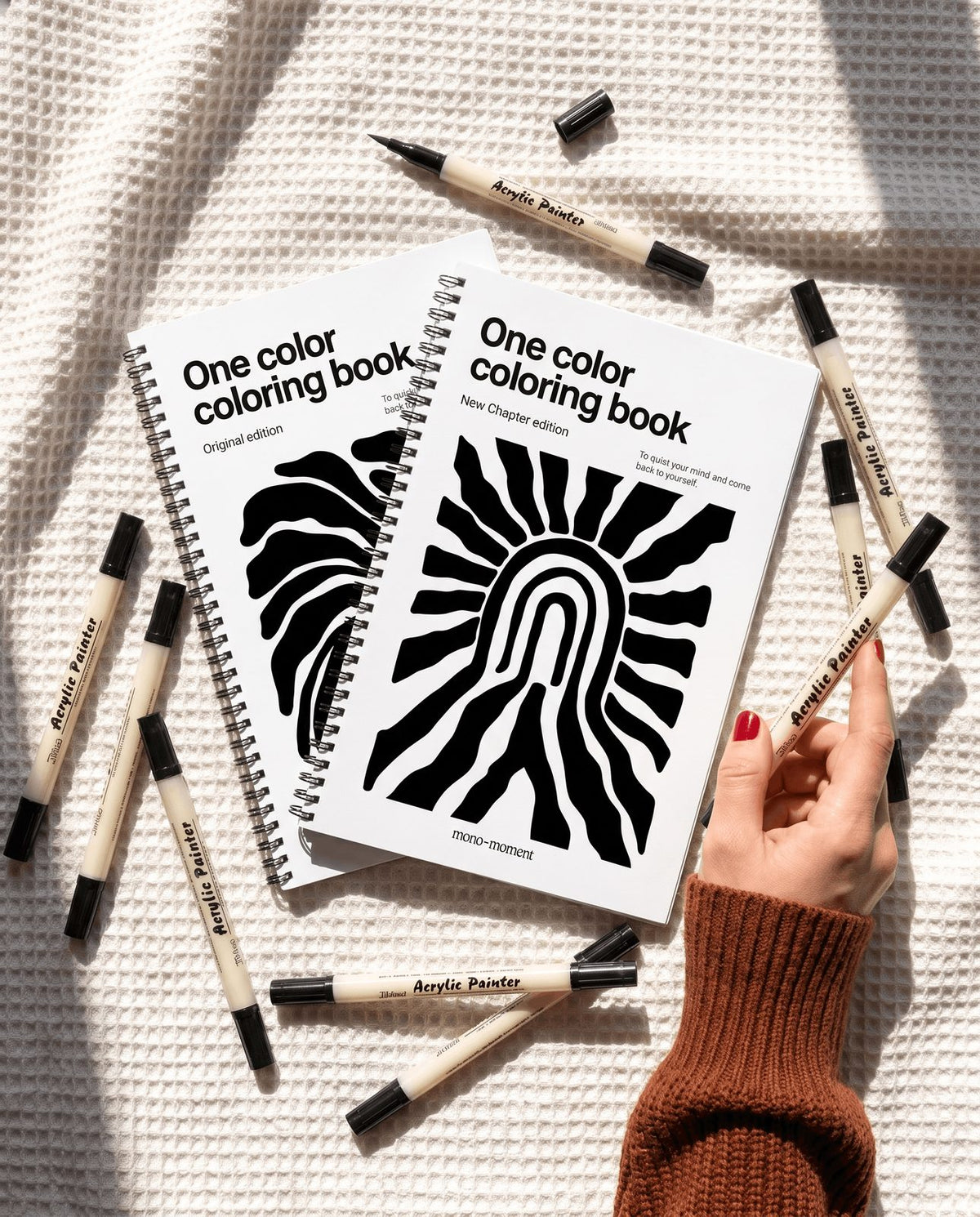
This is what we make at Mono Moment. The One Color Coloring Book is spiral bound on 160gsm paper. It isn't a better book than a mandala book. It's a different evening. If you love color, you'll miss it. If you're tired of deciding, you may find it's the first book you finish.
Mandalas and simpler books can live together
Plenty of people keep both. A mandala for a slow Sunday when you have the light and the patience. A bold or one color page for a weeknight when you have twenty minutes and nothing left to give.
The Curry and Kasser study points the same way: what helps is a structure to follow. The circle is one structure. A page of large marked shapes is another. Choose the one that matches the evening you're having.
In short
Mandala coloring books are beautiful and, for many people, calming. Choose one by its level of detail and its paper, start with larger sections, and limit your colors. And if mandalas leave you tense, try a simpler page before you give up on coloring. The right book is the one you look forward to opening.

The One Color Coloring Book
65+ bold designs, one single color, zero decisions — on 160 gsm paper with a lay-flat spiral, engineered for the wind-down ritual described above.
 Pair it with the 3 Dual Tip Brush Pens — $5 instead of $9.95 in the Book + Pens bundle.
Sources & further reading
Frequently asked questions
What is a mandala coloring book?
Are mandala coloring books relaxing?
Are mandala coloring books good for beginners?
What do you use to color a mandala?
What can I color instead of mandalas?
Know someone who needs a quieter evening? Pin it · Share on Facebook ·
↑