Tests every pen, paper and design she recommends — most evenings around 10:30pm.
Updated August 28, 2026 · 5 min read
In this article · 6 sections
If you have searched for "monochromatic coloring" you have probably met two very different worlds. One is art-class theory: color wheels, tints, tones and shades of a single hue. The other is the one this guide is about — monochromatic coloring books, the quietly booming format where you fill bold black designs with one single color and your brain finally gets to switch off.
I have colored both ways for years, and this is the honest guide to the second kind: what monochromatic coloring actually means, why the one-color constraint is precisely what makes it calming, and what to look for before you buy a monochromatic coloring book.
What "monochromatic" actually means (art theory vs. real life)
In classical art vocabulary, a monochromatic color scheme is one hue plus everything you can make from it: lighter tints, darker shades, muted tones. Painters use it because it guarantees harmony — nothing clashes when everything descends from the same color.
Monochromatic coloring books borrow the same guarantee and strip away the theory. The artwork is printed as bold black line art. You pick one color — one pen, one pencil, one marker — and fill the marked shapes. That is the entire method. If you want the deeper background on the practice, our explainer on what monochrome coloring is covers the definition and its history; this guide focuses on the books themselves and how to choose one.
The result surprises people. A page completed in a single color does not look unfinished — it looks intentional, closer to a screen-printed poster than a children's coloring page. The black artwork does the visual heavy lifting; your one color makes it yours.
Why one color beats a full palette for stress relief

Here is the part most coloring books get backwards. The industry sells variety — 48 pencils, gradient tutorials, elaborate palettes — but variety is exactly what an exhausted brain does not want.
Adults make an estimated 35,000 decisions a day, and research on decision fatigue shows the quality of our choices degrades as the day wears on — the famous PNAS study of judicial rulings found favorable decisions dropped from about 65% to nearly zero within each session before a break. By 9pm, "which of these 48 blues goes on this petal" is not relaxation. It is unpaid work.
Monochromatic coloring removes that entire layer:
- No palette management. One pen is chosen once, before you start.
- No planning. The design already decides what gets filled — you just fill it.
- No wrong answers. A single color cannot clash with itself.
The research supports the structure. Curry & Kasser's classic study found that coloring structured designs reduced anxiety significantly more than free-form drawing, a result replicated by van der Vennet & Serice in 2012. And Drexel University's work on art-making showed cortisol dropped for around 75% of participants regardless of skill level. Structured, low-decision, skill-free: that is a monochromatic coloring book described in three words.
What makes a good monochromatic coloring book
I have tested enough books to know the format only works when it is designed for one color from the start. Four things separate the good ones:
1. Bold, closed shapes — not open line art. In a book built for a single color, every area you are meant to fill should be a clearly closed zone. Open, sketchy artwork forces you to decide where color starts and stops, which reintroduces the decisions you were escaping. The best books mark the fill zones so there is genuinely nothing to figure out.
2. Paper that can take a marker. One color means saturated coverage — large areas of solid ink. On the thin 90–120gsm paper of standard coloring books, that guarantees bleed-through and ruined reverse pages. Look for 160gsm or heavier. It is the single spec that most predicts whether you will love or abandon the book.
3. Single-sided or lie-flat printing. Spiral binding that lies completely flat matters more here than in any other format, because flat, even strokes are the whole aesthetic. Fighting a curled page with a brush pen is miserable.
4. Designs that finish in one sitting. The quiet magic of this format is completing a page in an evening. Enormous intricate spreads break that loop. Large shapes, 20–40 minutes per page, is the sweet spot.
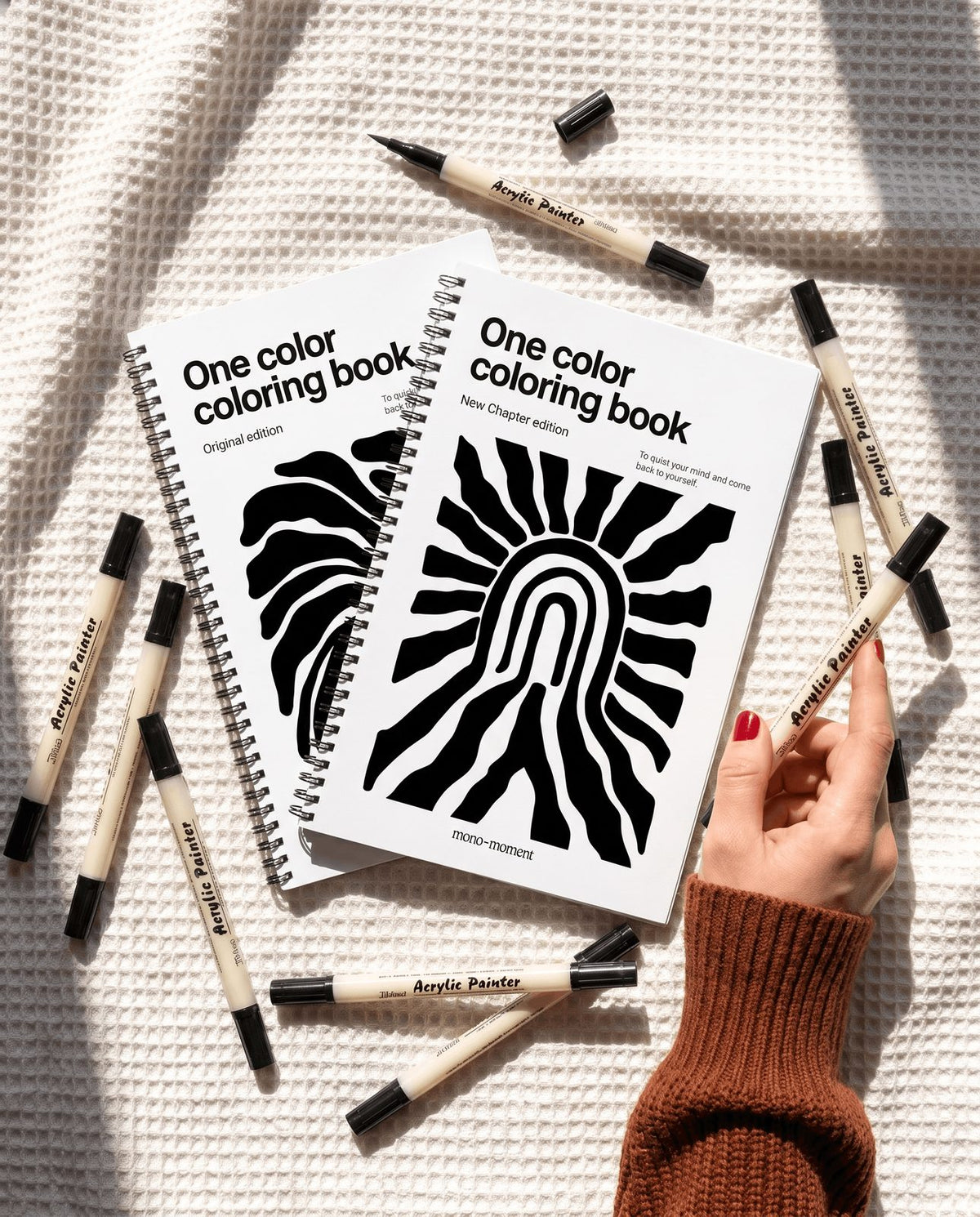
Our own monochromatic coloring book was engineered around exactly these four rules — 65+ bold closed designs, 160gsm no-bleed paper, lie-flat spiral — because we could not find a book that respected all four at once.
One color, or shades of one color? Both are correct

Purists will tell you true monochromatic art uses tints and shades of a hue. Colorists who just want to decompress use one flat color. Both are legitimate, and the format supports both:
- Flat one-color is the calmest entry point: a single brush pen, even strokes, zero theory. This is where I tell every beginner to start, and it is what the marked-zone designs are made for.
- Tonal monochromatic adds one lighter tint of the same color — a grey wash behind charcoal, a soft sage behind deep green. It adds depth without reopening the palette problem, because the second tone literally cannot clash with the first.
If you experiment with tones, pen choice matters more; our guide to the best pens and markers for adult coloring covers which brush pens layer cleanly on thick paper.
Monochromatic vs. black and white vs. grayscale
Three terms get tangled together, so here is the clean separation. Black and white describes the printed artwork itself — black line art on white paper, the canvas almost every coloring book starts from (black and white coloring books for adults covers that style in depth). Grayscale books print shaded photographs you color over — beautiful, but demanding. Monochromatic describes how you complete the page: one color, your choice, flat or tonal.
So a monochromatic coloring book is usually a bold black-and-white book designed to be finished in one color. The terms are cousins, not competitors.
How to start tonight

The whole appeal of this format is that starting takes five minutes:
- Pick one pen. Any color you already love. Black is the modern classic; muted tones (sage, terracotta, dusty blue) photograph beautifully.
- Open anywhere. A good monochromatic book has no required order.
- Fill the marked shapes, edges first. Outline each zone, then fill with slow, even strokes. Let the strokes show a little — that texture is part of the look.
- Stop when the page is done. One page, one evening, one finished thing. That completion loop, not the artwork, is what you will come back for.
No skill, no setup, no palette. That is the entire practice — and it is precisely why it works.

The One Color Coloring Book
65+ bold designs, one single color, zero decisions — on 160 gsm paper with a lay-flat spiral, engineered for the wind-down ritual described above.
 Pair it with the 3 Dual Tip Brush Pens — $5 instead of $9.95 in the Book + Pens bundle.
Sources & further reading
- Curry & Kasser (2005), Art Therapy — Can Coloring Mandalas Reduce Anxiety?
- van der Vennet & Serice (2012), Art Therapy — Can Coloring Mandalas Reduce Anxiety? A Replication Study
- Drexel University — Making Art Reduces Stress Hormones Regardless of Skill (Kaimal, 2016)
- Danziger et al. (2011), PNAS — Extraneous factors in judicial decisions (decision fatigue)
Frequently asked questions
What is a monochromatic coloring book?
Is monochromatic coloring the same as monochrome coloring?
Why would I color with only one color?
Do I need special pens for a monochromatic coloring book?
Can I use shades of one color, like real monochromatic art?
Know someone who needs a quieter evening? Pin it · Share on Facebook ·
↑