Tests every pen, paper and design she recommends — most evenings around 10:30pm.
Published October 6, 2026 · 11 min read
In this article · 7 sections
TL;DR. Color by number for adults is a coloring page split into cells, each tagged with a number that tells you which color goes there. People find it calming because the color decisions are already made. There are four broad types: classic numbered pages, mystery or pixel pages, large print pages, and a one-color relative that swaps numbers for small marks. Choose by cell size, number legibility, palette size and paper weight. Its weak points are tiny cells, pencil sorting and squinting, and the simplest alternative is to fill marked shapes with a single pen.
Most people meet color by number as children and assume they have outgrown it. Then, somewhere in their thirties or fifties, they pick up an adult version in a bookshop or print one at home, and discover that an activity where somebody else has already chosen the colors is a very pleasant way to spend an evening.
I color most days, and I've worked through a fair number of adult color by number books and printables alongside the one-color pages we make. This guide covers what the format is, the types you'll come across, how to choose a book, and which pencils, pens and paper behave well. It also covers where the format gets tiring, because it does, and what I'd reach for when that happens.
What color by number for adults is, and why it calms
An adult color by number page is a line drawing divided into cells. Each cell carries a number, a letter or a symbol, and a key at the edge of the page or the front of the book tells you which color belongs to it. You work through the page cell by cell until the picture is complete.
The adult versions differ from the children's ones in three ways. The cells are smaller and there are far more of them. The palette is bigger, often two or three dozen colors where a child's page has six. And the subjects are more ambitious: landscapes, florals, animals, stained-glass patterns, reproductions of famous paintings.
Paint by number is the same idea on canvas with acrylic paint. I wrote a separate piece on paint by numbers compared with decision-free coloring, so here I'll only say that the paper version asks for less: no drying time, no brushes to wash, and nothing you have to leave out on a table for a fortnight.
Why having the colors chosen for you feels restful
In an open coloring book, every shape asks a question. Which green? Does it sit well next to that pink? Should the background be darker? None of these is a hard question. There are just a lot of them, and they arrive at the end of a day that was already full of questions.
The Cleveland Clinic describes decision fatigue as the state in which making many decisions through the day leaves you mentally, physically and emotionally worn down, and one of its suggestions for avoiding it is to remove choices from the routine parts of life. That article is about daily life in general, not about coloring. I think the principle carries over, though. A numbered page has removed the choices in advance, so what is left is the part most of us wanted in the first place: a hand moving, a shape filling, a picture slowly arriving.
What the research does and doesn't say
I haven't found a controlled study of adult color by number as such, so I won't claim one. The nearest good evidence I know is a 2020 randomized controlled study by Koo, Chen and Yeh. They assigned 120 adults aged 55 to 75 to 20 minutes of mandala coloring, plaid-pattern coloring, free-form drawing or reading, after a short exercise designed to raise anxiety. Only the mandala coloring group ended with significantly lower anxiety than the reading group.
The limits matter here. It was a single 20-minute session. The participants were older adults attending community centers in Taiwan. The pattern was a mandala, not a numbered page, and the plaid pattern didn't show the same effect, so not every kind of coloring is equal. What I take from it is modest: structured coloring can be a settling way to spend twenty minutes. It is not a treatment for anxiety, and nobody should buy a coloring book expecting one.
The four types of adult color by number

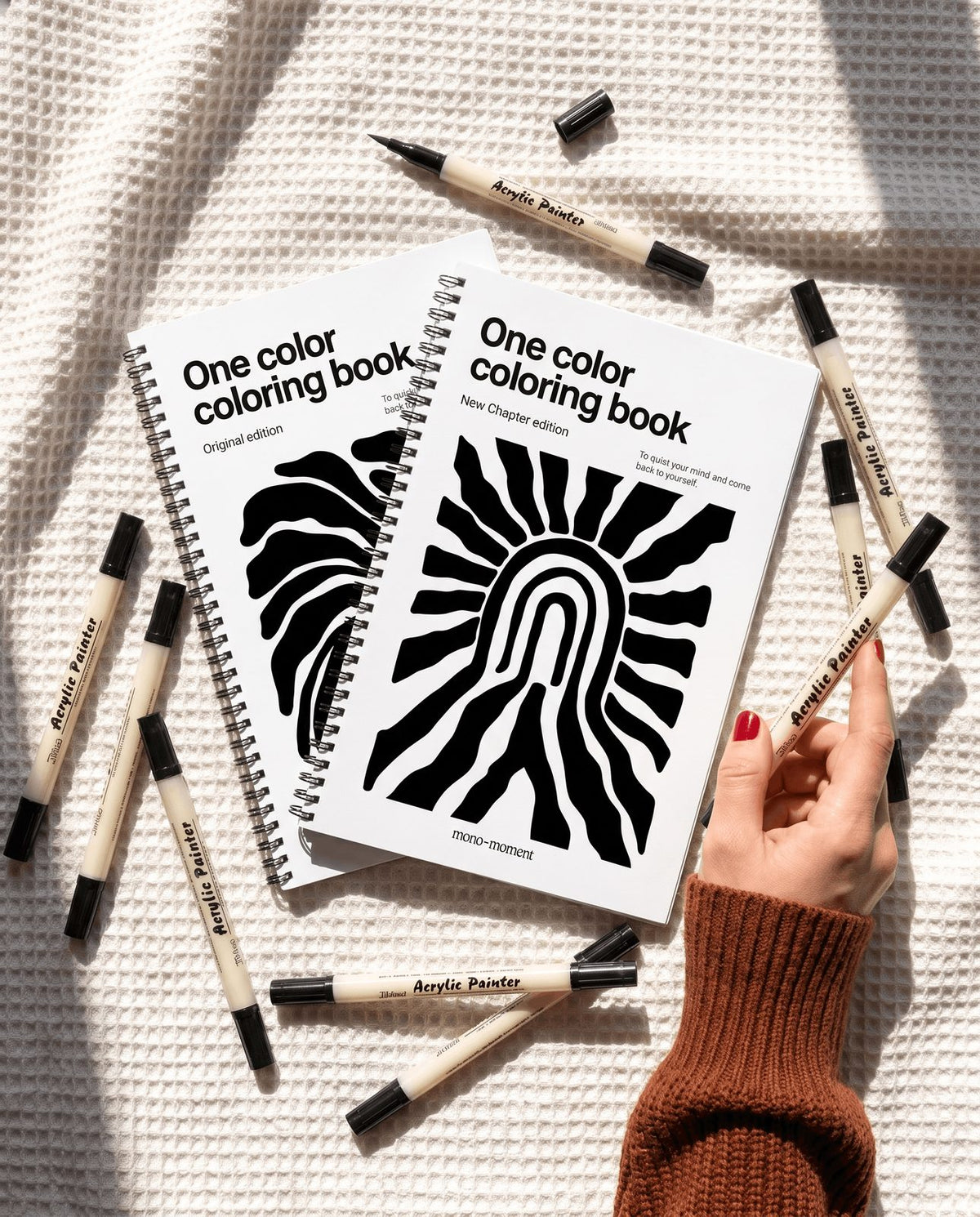
The pages pictured above belong to the fourth type on this list, the one without numbers. I'll take the three numbered types first, since they are what most people mean by the term.
Classic numbered multi-color pages
This is the standard format, and it is what most color by number books for adults contain. You get a detailed drawing, a numbered key and a palette of anywhere from a dozen to several dozen colors. The finished page looks like a proper illustration, with shading built in by the way light and dark tones are assigned to neighboring cells.
It suits you if you enjoy a long project and like seeing a realistic image come together. It asks the most of your eyes and your pencil tin.
Mystery and pixel pages
Mystery pages hide the picture. The cells are abstract shards or a grid of squares, and you don't know what you're making until a good part of the page is filled. Pixel versions use squared paper, so every cell is the same size and the result looks like cross-stitch or early video game art.
The surprise is the appeal. The trade-off is that you can't use common sense to catch a mistake. On a classic page you'd notice a blue cell in the middle of a leaf. On a mystery page you find out twenty minutes later.
Large print and easy pages
Large print books are built for comfort: bigger cells, bigger numbers, thicker outlines and a smaller palette, often eight to twelve colors. If you've searched for easy color by number for adults, this is the category to look in. It is the best starting point for beginners, for anyone whose eyes tire in the evening, and for hands that don't enjoy fine work.
A page takes one sitting where a classic page takes several. The pictures are simpler, which some people find less satisfying and others find a relief. The same logic sits behind bold and easy coloring pages in general: fewer, larger shapes are kinder to tired eyes.
The one-color "marked shapes" relative
This one isn't a color by number in the strict sense, and I'd rather be exact about that. There are no numbers and no key. The page is a line drawing in which some shapes carry a small mark, usually a dot, and the method is one sentence long: fill every marked shape with the same pen and leave the rest white.
It keeps the thing people like about color by number, which is that the page tells you what to do. It drops the matching. The finished page is a bold two-tone graphic, closer to a linocut or a paper cut than to a shaded illustration. People sometimes search for it as monochrome color by number, which is a fair description of how it feels to do, if not of how it works.
If you'd like to try the method before buying anything, our free one-color printable pages use it, and one page downloads without an email address.
Where color by number falls short
I like the format, and I still put it down more often than I expected to. These are the reasons.
Many small cells. A detailed page can hold several hundred cells, some only a few millimeters across. Filling them neatly takes a sharp point and a steady hand. After a long day, that kind of precision can feel like more work.
Sorting pencils. A 36-color key means 36 pencils to find, line up, and keep in order. Every cell involves a small lookup: read the number, check the key, find the pencil, put the last one back. The decision about which color is gone, but it has been replaced by a filing task. If your set doesn't match the key exactly, you also end up choosing substitutes, which brings back the decisions you were hoping to avoid.
Squinting at tiny numbers. Numbers are printed small and pale so they disappear under the color. That is good for the finished page and hard on the eyes while you work, especially under warm evening light. A number on a dark-toned cell can also show through light pencil.
None of this makes color by number a poor choice. It means the format rewards patience, good light and an organized pencil case, and it is worth knowing that before you buy a 60-page book of intricate florals.
One-color coloring: the simplest relative

When numbered pages start to feel like admin, the marked-shapes method is what I move to. Set the two side by side and the difference is plain. In color by number you read a number, find its color and fill the cell. In one-color coloring you see a mark and fill the shape. There is one pen on the table, nothing to match and nothing to sort.
This is the kind of book we make, so weigh my view accordingly. The One Color Coloring Book is not a color by number book. It has no numbers and no palette. It has 65 bold designs with small marks showing which shapes to fill, printed on 160gsm paper, with a metal spiral that lets the book lie flat. We sell 3 dual-tip brush pens to go with it: the brush end covers a large shape in a few strokes and the fine end follows the edges. The Cats and Dogs Special Editions, which appear in the photos on this page, sit with the original in our one color coloring books.
It has limits of its own. A one-color page will never give you the shaded, many-colored picture that a classic color by number does. If choosing and blending colors is the part you enjoy, you would miss it. And because the shapes are large, a page is finished sooner, which is a drawback if you wanted a project to last the week.
My own habit is to keep both. A numbered page is for a slow Sunday afternoon with daylight and the whole pencil tin on the table. A one-color page is for a weekday evening when I have twenty minutes and no wish to organize anything.
How to choose a color by number book for adults
If you're buying a numbered book, these are the things I'd check, roughly in this order. Most can be judged from the sample pages a retailer shows online.
- Cell size. Look at the smallest cells on a sample page, not the largest. If they look like grains of rice on your screen, they'll be smaller in your hand.
- Number legibility. Numbers should be readable at arm's length without being so dark that they show through yellow or pale pink.
- Palette size. Count the colors in the key. Under 15 is relaxed, 15 to 30 is a project, and more than that needs a large pencil set and some patience.
- How the key is given. A key that names generic colors (light blue, dark green) works with any set. A key tied to one brand's pencil codes is tidy if you own that set and frustrating if you don't.
- Where the key is printed. On the same page or a facing page is ideal. A key only at the front of the book means flipping back and forth all evening.
- Paper weight and printing. Look for the gsm in the description. Thin paper is fine for pencil. For any kind of marker, you want heavy paper and designs printed on one side only, so that bleed-through or ghosting doesn't spoil the next picture.
- Binding. A spiral or a lay-flat binding keeps cells near the spine reachable. With a glued spine, perforated pages you can tear out are the next best thing.
- Subject. Choose pictures you'd be glad to look at for three evenings, since that is how long you'll spend with each one.
For a color by number printable for adults, the same checks apply, with one addition: you control the paper. Ordinary office paper is thin and has very little tooth, so pencil goes on pale and markers soak through. Printing on a heavier, uncoated stock that your printer can feed makes a noticeable difference. If you use an inkjet printer, test a marker on a corner first, since water-based ink can lift and smear some inkjet lines.
Pencils, pens and paper that suit small cells
Colored pencils are the default for good reason. A sharp point reaches into the smallest cell, the color can be built up in layers, and pencil never bleeds through. They need paper with a little tooth, meaning a slight surface texture that grips the pigment. On very smooth paper the color stays thin however hard you press. Keep a sharpener beside you, because numbered pages eat points.
Fine-tip water-based markers and fineliners give flat, bright color with little effort and work well on smoother paper. They may ghost on thin pages, where the color is faintly visible from the other side, and they can't be shaded the way a pencil can.
Alcohol markers produce the most even color and they go through nearly everything. Use them only on heavy, single-sided pages, and put a blotter sheet behind the page you're working on.
Brush pens are excellent for large areas and too broad for most numbered cells. They come into their own on large print pages and on one-color pages, where the shapes are big enough to enjoy the stroke.
Gel pens are handy for the very smallest cells and for highlights. They take a moment to dry, so work from the top of the page down, or from left to right if you're right-handed, to avoid smudging.
Two small habits help with any of these. Before you begin, lay out the colors in key order and make a swatch strip on a scrap of the same paper, labeled with the numbers, so you can see how each color really looks. And fill one color at a time across the whole page. It cuts the pencil-swapping to almost nothing. I go into more detail on tips, inks and paper in my guide to the best pens for adult coloring books.
Where I'd start
If you're new to adult color by number, begin with a large print book or a single printable and a set of 12 pencils. See whether you enjoy the rhythm before investing in a 72-color tin and a book of intricate landscapes. Work in good light, do one color at a time, and stop when your eyes ask you to.
If you already know that the matching and sorting wear you out, skip the numbers altogether. Print one of the free one-color pages mentioned above and fill the marked shapes with whatever pen you have. If that turns out to be the part you wanted all along, the one color coloring book is the bound version of the same idea: bold shapes, one pen and thick paper that lies flat.
Both are good ways to spend a quiet half hour. Which one suits you depends mostly on how much organizing you want to do before you start coloring.

The One Color Coloring Book
65+ bold designs, one single color, zero decisions — on 160 gsm paper with a lay-flat spiral, engineered for the wind-down ritual described above.
 Pair it with the 3 Dual Tip Brush Pens — $5 instead of $9.95 in the Book + Pens bundle.
Sources & further reading
Frequently asked questions
What is color by number for adults?
Is color by number relaxing for adults?
What is the difference between paint by number and color by number?
What are the best pencils or pens for adult color by number?
Is there a color by number that uses only one color?
Know someone who needs a quieter evening? Pin it · Share on Facebook ·
↑