Tests every pen, paper and design she recommends — most evenings around 10:30pm.
Published September 2, 2026 · 4 min read
In this article · 6 sections
Once you've realized you're overstimulated — not lazy, not broken, just past your input ceiling — the next question is practical: what actually helps? The search data says thousands of people a month look for noise cancelling headphones for overstimulation specifically, and that instinct is right. But headphones are one tool for one channel, and the market is full of "calming" products that quietly add input instead of removing it.
I've spent two years testing what genuinely lowers the noise in my own overstimulated evenings. This is the honest shortlist: what each tool fixes, what it doesn't, and the test that separates real overstimulation tools from clutter.
The one rule: subtract, don't add
Overstimulation is a supply problem — more input than your nervous system can process. So a real overstimulation tool does one of two things: it closes an input channel (sound, light, screens) or it narrows your attention to one quiet thing so your brain can stop scanning.
That single rule disqualifies most of what gets marketed for calm. An app with streaks and notifications adds input. A craft kit with forty options adds decisions. If you're unsure which state you're even in, start with our guide to overstimulated vs overwhelmed — because too-much-to-carry needs a different fix than too-much-coming-in, and no purchase solves the first one.
Noise cancelling headphones: the best first purchase

Sound deserves to be attacked first because it's the channel you control least. You can close your eyes; you can't close your ears. Open-plan offices, appliances, other people's audio — it all stacks against your ceiling all day.
Active noise cancellation closes that channel on demand, and you don't need the $400 flagship to get the effect. What matters for overstimulation specifically:
- Comfort over hours, not minutes. You'll wear them longest on the worst days. Clamping pressure matters more than the last decibel of cancellation.
- No sound is a feature. You don't have to play anything. ANC with silence is often calmer than ANC with music — one less input.
- Earbuds travel, over-ears soothe. Many highly sensitive people find the physical enclosure of over-ears adds a settling, pressure-like effect that earbuds don't.
The honest limit: headphones mute the world, but they do nothing about a mind that keeps scanning. That's what the second category is for.
One low-input task: give your attention somewhere to land
Here's what surprised me most in practice. Removing input isn't always enough — a quiet room with a racing brain is still a racing brain. The attention system wants an object, and if you don't give it one, it goes looking for the phone.
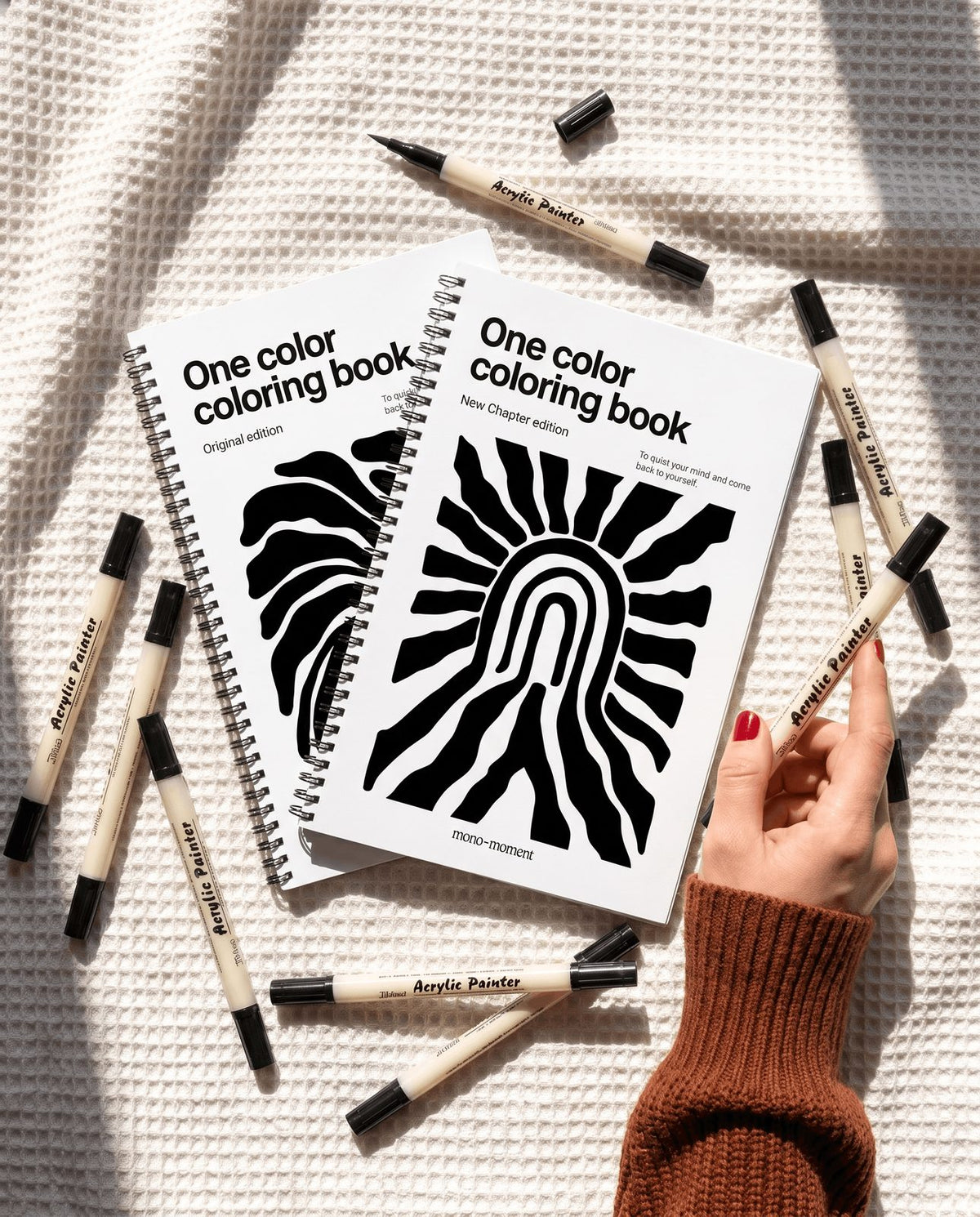
The tool that works is a task with almost no inputs: one implement, no choices, no skill demands, clear edges. That's precisely the design brief behind the one color coloring book — one pen, bold closed shapes, small marked zones telling you exactly what to fill. No palette to manage, nothing to plan, impossible to do wrong. Research on structured art-making backs the mechanism: in Drexel University's cortisol study, 45 minutes of art lowered stress hormones for about 75% of participants, regardless of skill.
Twenty minutes of filling shapes does for my attention what the headphones do for my ears: one channel, low volume, no decisions. The two tools stack — headphones on, page open, and the evening finally has a floor under it.
The supporting cast: light, pressure, and the phone

Three more levers, in order of cost:
The free one: lights down, phone in another room. Overhead light is input; the phone is an input slot machine. One warm lamp and physical distance from the phone remove more stimulation than most purchases. Do this before buying anything.
Weighted blankets: real, but situational. Deep pressure is steady, predictable input that can crowd out chaotic input — genuinely useful for the wired-but-tired feeling at night. But it's a bed tool. It won't help at 3pm in an office.
Sunset lamps, candles, warm bulbs: mood-real, effect-mild. Softer light is a legitimately lower input than blue-white light. Just don't expect a lamp alone to fix a flooded evening.
What to skip
The test for any "calming" purchase: does it reduce inputs and decisions, or add them? By that test, skip:
- Meditation apps you'll use on your phone — the device is the problem; adding a subscription to it rarely ends well. If meditation works for you, it needs no purchase at all.
- Multi-option craft kits — forty colors and twelve steps is decision fatigue in a gift box. It's the opposite of a low-stimulation activity.
- Anything with notifications, streaks, or progress mechanics — gamified calm is input wearing a costume.
None of these are bad products. They're just not overstimulation tools, and buying them for that job leads to the drawer of abandoned self-care purchases we all own.
Building your kit: match the tool to the state
Keep it to one tool per channel, and deploy them in order: close the loudest channel, dim the visual one, then give your attention its single quiet task. If the problem turns out to be load rather than input — a to-do list, not a noise level — put the credit card away entirely and use the steps in what to do when you're overstimulated to sort which fix your evening actually needs.
The whole kit — headphones, a lamp you already own, one pen and one book — costs less than a single month of most wellness subscriptions. Subtraction is cheap. That's the point.

The One Color Coloring Book
65+ bold designs, one single color, zero decisions — on 160 gsm paper with a lay-flat spiral, engineered for the wind-down ritual described above.
 Pair it with the 3 Dual Tip Brush Pens — $5 instead of $9.95 in the Book + Pens bundle.
Sources & further reading
Frequently asked questions
Do noise cancelling headphones help with overstimulation?
What is the best tool for overstimulation?
Are weighted blankets good for overstimulation?
What should I avoid buying for overstimulation?
Why does one-color coloring help an overstimulated brain?
Know someone who needs a quieter evening? Pin it · Share on Facebook ·
↑