Tests every pen, paper and design she recommends — most evenings around 10:30pm.
Published September 6, 2026 · 5 min read
In this article · 6 sections
TL;DR. Fidget toys help adults with anxiety in one specific way: they give restless hands something to do during a spike. They don't quiet the mind. The ones that work are silent, discreet and slow (a spinner ring, a worry stone, putty); the ones that don't are noisy, stimulating or compulsive. For the evening, when you need your head to actually come down, a structured low-input task like one-pen coloring does what a fidget can't: it gives your attention a single track and holds it there for twenty minutes.
I own a drawer of fidget toys. A spinner ring I still wear, a worry stone I've rubbed smooth, a click cube that lasted a week before a colleague politely asked me to stop. So this isn't a takedown. It's the honest sorting I wish someone had done for me before I bought half of Amazon: which fidgets genuinely help an anxious adult, which ones quietly make things worse, and what to reach for when a fidget isn't enough.
What a fidget actually does (and doesn't do)
Anxiety has two layers. There's the body layer, the restless energy that wants to bounce a knee or pick at a cuticle, and there's the mind layer, the loop of thoughts that keeps refreshing itself. A fidget toy speaks to the first layer. Repetitive motion gives the nervous energy an outlet, and for some people that small discharge is enough to stay seated through a meeting or a flight.
What a fidget doesn't do is interrupt the loop. Your fingers spin a ring while your brain keeps drafting the same worried email. That's why the relief tends to feel real but shallow: the hands are calmer, the head isn't. I mention this first because most disappointment with fidget toys comes from asking them to do a job they were never built for.
The fidget toys that work for anxious adults

After a lot of trial and error, the ones I'd actually recommend share three qualities: they're silent, they're discreet, and the motion is slow. Speed matters more than people think. A fast, frantic fidget mirrors anxiety; a slow one counters it.
- Spinner ring. The one I still use. It looks like jewelry, makes no sound, and the rotation is smooth enough to slow down deliberately. Ideal for meetings, queues, and phone calls.
- Worry stone. A flat smooth stone with a thumb groove. Old-fashioned, weirdly effective, and completely invisible in a pocket.
- Putty or thinking clay. Kneading is a bigger, slower motion than clicking, and it tires the hands out in a satisfying way. Keep it in a desk drawer rather than out on the desk.
- Silicone fidget band or textured strap. Quiet, cheap, and easy to loop around a finger under a table.
- A smooth pen you can roll. Half the adults who "don't fidget" already do this. It counts.
Notice what's not on this list: nothing with lights, nothing that pops, nothing designed for a nine-year-old's hands. Those aren't calming tools, they're stimulation tools, and stimulation is usually the last thing an anxious adult needs more of.
The ones that make anxiety worse
Three categories, from experience:
Noisy fidgets. Click cubes, poppers, anything that snaps. The sound draws attention in a shared space, and the social awareness of being "the person clicking" adds a second layer of stress. Mine lasted a week.
Overstimulating fidgets. Flashing spinners, multi-function cubes with six different textures and switches. If you're already overstimulated, these are more input on a full plate. I wrote about this trap in overstimulation tools that actually help: the test for any calming object is whether it subtracts input or adds it.
Compulsive fidgeting. This one's subtler. If you fidget faster as anxiety rises, the fidget can become a cue, a signal to your body that says "we're anxious now," which keeps the loop running. The fix isn't to stop fidgeting; it's to switch to something slower and structured, which brings me to the alternative.
When a fidget isn't enough: give your attention a track

Here's what changed things for me. A fidget occupies the hands but leaves the attention free to wander back into the loop. What I needed at the end of the day was the opposite: something that occupied the attention too, without demanding effort.
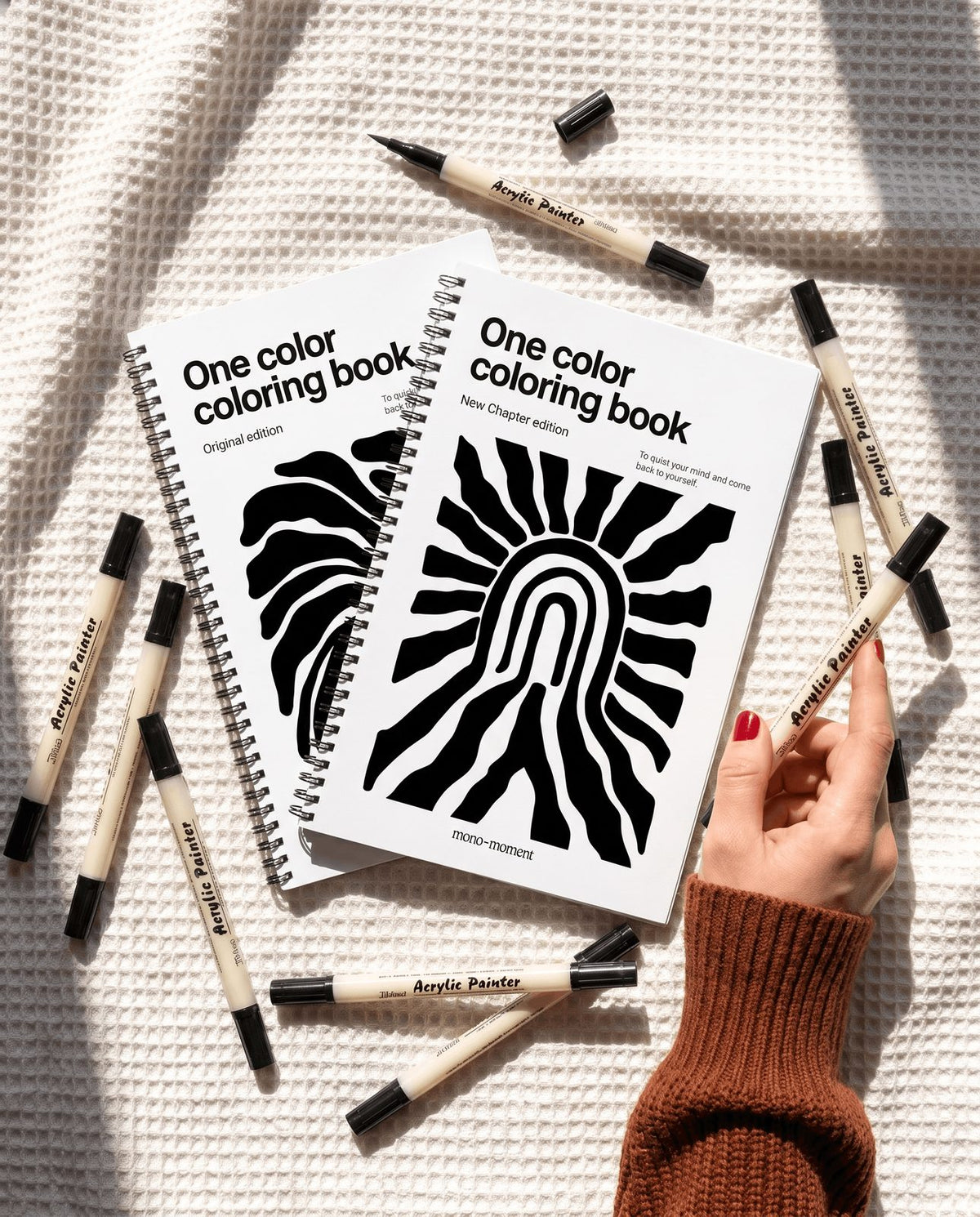
The answer turned out to be structured coloring with a single pen. Not intricate mandalas, which ask for skill and color decisions and end up feeling like homework, but big, bold, closed shapes with small marked zones telling you exactly what to fill. That's the design of the One Color Coloring Book: one pen, no palette, nothing to plan. Your hands get the slow repetitive motion a fidget gives, and your attention gets a narrow, quiet channel to sit in.
The research backs the mechanism. A randomized controlled trial on coloring found that structured coloring for around 20 minutes reduced anxiety measurably, more than free-form drawing. Structure is the point: the fewer decisions the activity asks for, the easier it is for an anxious brain to settle into it. Cleveland Clinic's description of decision fatigue explains the other half: every choice you don't have to make is attention you get back.
Twenty minutes of filling shapes does for my mind what the spinner ring does for my fingers. The two aren't in competition; they're for different moments. Ring during the day, page in the evening.
How to build a fidget kit that actually calms
If I were starting over, I'd build it in three tiers instead of buying a bag of random toys:
- Pocket tier (daytime, in public): one spinner ring or worry stone. Silent, invisible, always with you.
- Desk tier (work, focus): putty in a drawer, or a textured band. Something for the hands during long calls.
- Evening tier (actually coming down): a structured low-input task. One-color coloring, a basic knitting stitch, a jigsaw. This is the tier most people skip, and it's the one that does the real work. If evenings are when your brain is loudest, grounding techniques for anxiety pair well with it.
One more note for the ADHD readers, because fidgets and ADHD overlap heavily: the same logic applies, but the evening tier matters even more. I go into it in coloring for adults with ADHD, including why "less" consistently beats "busy."
What I'd buy first

If your budget is one item, make it a spinner ring: it's the fidget with the highest days-used-per-dollar in my experience. If you can stretch to two, add the evening tier, because that's where anxiety actually decides whether tomorrow starts calm or loud. The one color coloring book with a single black pen is what I reach for; 65 pages, one a night, and a drawer of fidget toys I open a lot less than I used to.

The One Color Coloring Book
65+ bold designs, one single color, zero decisions — on 160 gsm paper with a lay-flat spiral, engineered for the wind-down ritual described above.
 Pair it with the 3 Dual Tip Brush Pens — $5 instead of $9.95 in the Book + Pens bundle.
Sources & further reading
Frequently asked questions
Do fidget toys actually help adults with anxiety?
What is the best fidget toy for anxiety at work?
Are there fidget alternatives that calm the mind, not just the hands?
Can fidget toys make anxiety worse?
What should I look for when choosing a fidget toy as an adult?
Know someone who needs a quieter evening? Pin it · Share on Facebook ·
↑